


Modern marketing is no longer limited to a single platform or communication channel. Customers interact with businesses through websites, social media, email, messaging apps, search engines, and offline touchpoints before making a purchase. Managing these interactions manually is difficult, which is why omnichannel marketing AI has become an essential part of modern marketing strategies. Businesses are now using Automated Email Marketing, AI-powered decision-making, and intelligent automation to deliver consistent customer experiences across every touchpoint while improving operational efficiency.
As customer expectations continue to rise, organizations are investing in AI customer experience tools that connect multiple marketing channels into one ecosystem. Along with Conversion Rate Optimization, AI helps marketers personalize communication, analyze customer behavior, predict future actions, and automate campaigns without sacrificing quality. This shift enables companies to deliver the right message to the right customer at the right time while reducing manual work.
What Is Omnichannel Marketing Automation?
Omnichannel marketing automation is the process of managing customer interactions across multiple digital and offline channels using artificial intelligence and automation technologies.
Unlike basic automation, AI continuously learns from customer behavior, campaign performance, and engagement patterns to optimize every interaction.
These systems connect:
- Email marketing
- Search engines
- Social media
- SMS
- Websites
- Mobile apps
- CRM platforms
- Customer support systems
- Offline interactions
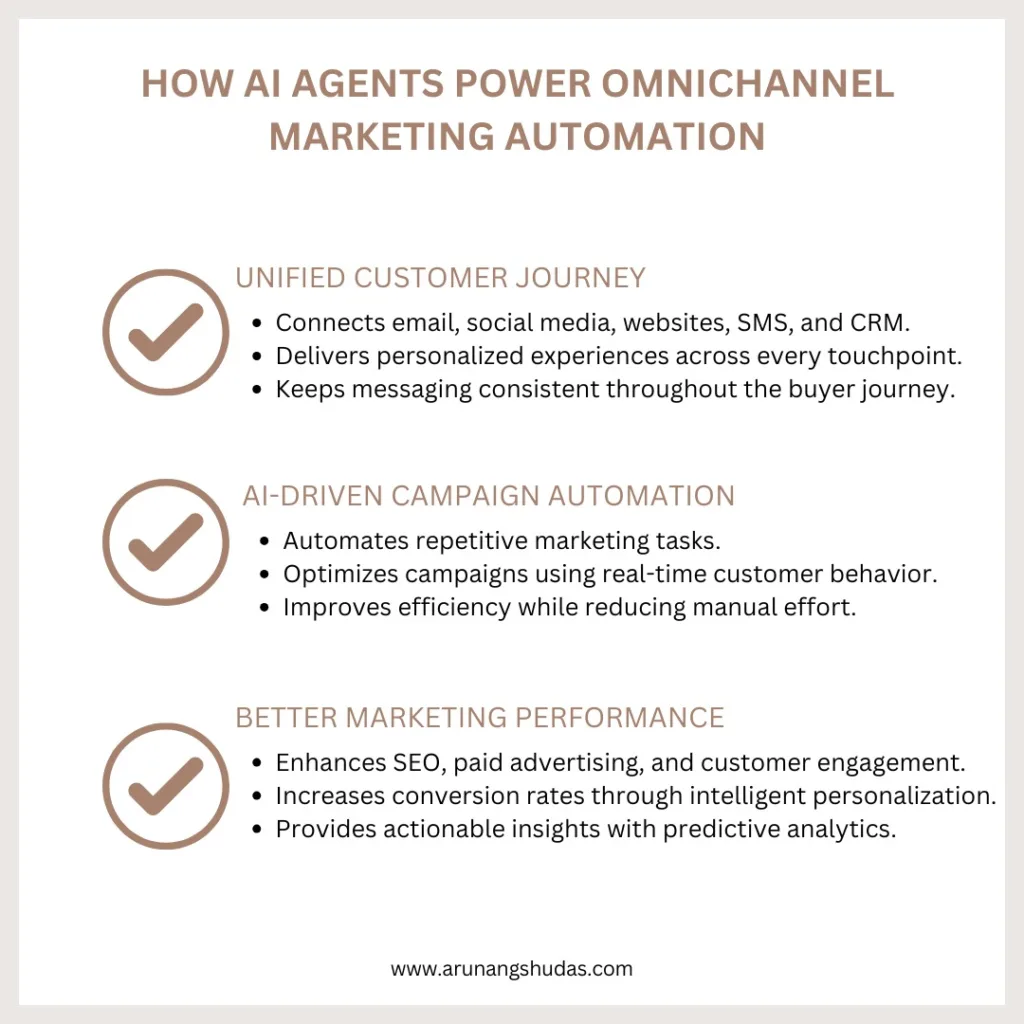
Instead of treating every channel separately, AI creates a unified customer journey.
Why AI Agents Are Changing Marketing Automation
Traditional automation follows fixed workflows and predefined rules.
AI agents go beyond simple automation by making intelligent decisions based on customer data, campaign results, and behavioral insights.
For example, instead of sending the same email to every subscriber, an AI agent can:
- Predict the best sending time
- Recommend personalized products
- Select the ideal communication channel
- Modify campaign messaging
- Pause irrelevant campaigns
- Trigger follow-up actions automatically
This intelligent decision-making significantly improves customer engagement.
Traditional Automation vs AI Agents
| Feature | Traditional Automation | AI Agents |
| Workflow | Rule-based | Self-learning |
| Personalization | Limited | Real-time personalization |
| Decision Making | Manual setup | Autonomous optimization |
| Customer Insights | Historical | Predictive |
| Campaign Updates | Manual | Continuous optimization |
| Cross-Channel Coordination | Limited | Intelligent synchronization |
How AI Agents Create Unified Marketing Workflows
One of the biggest advantages of AI is building unified marketing workflows that eliminate disconnected campaigns.
Instead of managing every channel independently, AI connects all customer interactions into one intelligent system.
These workflows can automatically:
- Send welcome emails
- Update CRM records
- Trigger SMS reminders
- Launch remarketing campaigns
- Notify sales teams
- Personalize website content
- Schedule social media posts
Everything works together without manual intervention.
AI-Driven Campaign Orchestration
Modern businesses are replacing isolated campaigns with AI-driven campaign orchestration.
AI agents coordinate multiple marketing activities simultaneously while monitoring customer responses in real time.
This includes:
- Email campaigns
- SMS marketing
- Push notifications
- Paid advertisements
- Website personalization
- Customer support messaging
Every customer receives a seamless experience regardless of the platform they choose.
Cross-Channel Automation Improves Customer Experience
Customers rarely purchase after a single interaction.
They may:
- See a Facebook advertisement.
- Visit the website.
- Read a blog.
- Subscribe to a newsletter.
- Click a Google advertisement.
- Download a guide.
- Receive a personalized email.
- Complete a purchase.
This entire process becomes smoother with cross-channel automation, where AI keeps messaging consistent across every platform.
Customer Journey Optimization Using AI
Every customer follows a unique buying journey.
AI continuously analyzes:
- Browsing history
- Purchase behavior
- Email engagement
- Social interactions
- Device preferences
- Geographic location
- Previous support conversations
Using these insights, businesses achieve better Customer Journey Optimization by delivering highly personalized experiences.
AI Across the Customer Journey
| Customer Stage | AI Action | Business Benefit |
| Awareness | Personalized advertisements | Higher reach |
| Consideration | Dynamic website content | Better engagement |
| Evaluation | Product recommendations | Increased trust |
| Purchase | Automated follow-ups | Higher conversions |
| Retention | Personalized loyalty campaigns | Improved retention |
| Advocacy | Referral campaigns | More brand ambassadors |
AI Agents for SEO
Search visibility remains one of the most important growth channels.
Modern AI Agents for SEO help marketers automate repetitive optimization tasks while improving search performance.
AI agents assist with:
- Keyword research
- Competitor analysis
- Internal linking
- Meta optimization
- Technical SEO audits
- Content optimization
- SERP monitoring
- Search trend prediction
Rather than replacing SEO professionals, AI helps them work faster and make smarter decisions.
Digital Marketing Workflows Become Smarter
Managing multiple campaigns manually often creates delays and inconsistencies.
AI improves Digital Marketing Workflows by automating repetitive tasks while connecting every marketing channel.
Examples include:
- Lead scoring
- CRM updates
- Campaign scheduling
- Audience segmentation
- Social media publishing
- Reporting dashboards
- Analytics generation
- Performance alerts
Marketing teams spend less time on manual work and more time on strategic planning.
Automate Content Marketing at Scale
Content production remains one of the largest marketing investments.
Businesses now Automate Content Marketing at Scale by using AI for:
- Topic research
- Content briefs
- SEO optimization
- Blog outlines
- Social media captions
- Email copy
- Product descriptions
- Content repurposing
This enables consistent publishing without overwhelming marketing teams.
Improving Paid Advertising Campaign Performance
Advertising platforms generate massive amounts of performance data every day.
AI analyzes this information to improve Paid Advertising Campaign Performance by:
- Adjusting bids automatically
- Identifying high-performing audiences
- Pausing low-performing ads
- Optimizing creatives
- Forecasting ROI
- Allocating budgets intelligently
Campaign optimization becomes continuous instead of periodic.
AI-Powered Brand Monitoring
Businesses need to know what customers say across multiple platforms.
AI enables real-time Brand Monitoring by tracking:
- Social media mentions
- Customer reviews
- News articles
- Forums
- Blogs
- Video comments
AI also identifies sentiment trends, helping companies respond quickly to both positive and negative feedback.
Intelligent Communication Platforms
Modern intelligent communication platforms connect every customer interaction in one ecosystem.
These platforms integrate:
- Live chat
- SMS
- Social media
- Voice assistants
- CRM software
- Customer support tools
Customers receive consistent communication regardless of where they interact.
AI Customer Experience Tools
Businesses increasingly rely on AI customer experience tools to improve satisfaction throughout the customer lifecycle.
Common capabilities include:
- Personalized recommendations
- Smart chatbots
- Voice assistants
- Predictive support
- Customer sentiment analysis
- Automated onboarding
- Loyalty personalization
These tools help organizations build stronger customer relationships.
Campaign Synchronization Across Channels
Marketing campaigns often fail because channels operate independently.
With campaign synchronization, AI ensures:
- Consistent messaging
- Shared customer data
- Coordinated promotions
- Real-time updates
- Unified reporting
- Better attribution
This creates a seamless customer experience from awareness to retention.
Benefits of Omnichannel AI Automation
| Benefit | Impact |
| Personalized Experiences | Higher customer satisfaction |
| Automated Campaigns | Reduced manual work |
| Predictive Analytics | Smarter decisions |
| Unified Customer Data | Better personalization |
| Faster Optimization | Improved ROI |
| Better Attribution | Accurate performance insights |
Enterprise Engagement AI
Large organizations handle millions of customer interactions every month.
Enterprise engagement AI enables businesses to:
- Scale customer communication
- Improve personalization
- Automate service requests
- Support multiple languages
- Analyze customer behavior
- Deliver consistent experiences globally
Large enterprises benefit from improved efficiency without increasing operational costs.
AI Supports B2B Marketing Strategies
AI is transforming B2B Marketing Strategies by helping companies identify high-value prospects and nurture leads more effectively.
AI assists B2B marketers with:
- Account-based marketing
- Lead qualification
- Sales forecasting
- Personalized outreach
- CRM automation
- Buyer intent analysis
This shortens sales cycles while improving lead quality.
AI Agents Across Marketing Channels
| Marketing Channel | AI Capability | Expected Outcome |
| Personalization | Higher open rates | |
| Social Media | Content optimization | Better engagement |
| SEO | Keyword optimization | Increased organic traffic |
| Paid Ads | Bid optimization | Lower acquisition cost |
| CRM | Lead scoring | Better conversions |
| Customer Support | AI chatbots | Faster resolutions |
Enhancing Customer Engagement Systems
Modern customer engagement systems continuously monitor customer behavior across every interaction.
AI helps these systems:
- Predict churn
- Recommend next-best actions
- Personalize communication
- Trigger automated campaigns
- Improve retention
- Increase customer lifetime value
The result is stronger long-term customer relationships.
Influencer Marketing Campaigns Become More Intelligent
AI is also transforming Influencer Marketing Campaigns by helping brands identify the right creators, analyze audience authenticity, measure engagement quality, and predict campaign success. Instead of relying solely on follower counts, AI evaluates relevance, audience demographics, content performance, and brand alignment to maximize influencer partnerships.
Marketing Journey Automation
Modern marketing journey automation allows businesses to personalize every stage of the buying process.
AI automatically reacts to customer behavior by:
- Sending personalized offers
- Triggering follow-up emails
- Recommending products
- Launching remarketing campaigns
- Updating CRM records
- Notifying sales teams
Every customer receives relevant communication based on real-time behavior.
Key AI Technologies Used in Marketing
| Technology | Primary Use |
| Machine Learning | Predictive analytics |
| Natural Language Processing | Chatbots and content |
| Predictive AI | Customer behavior forecasting |
| Recommendation Engines | Product suggestions |
| Computer Vision | Visual content analysis |
| Generative AI | Content creation |
Best Practices for Implementing AI Agents
Successful implementation requires:
- Define clear business goals.
- Integrate customer data across platforms.
- Maintain high-quality data.
- Monitor AI recommendations regularly.
- Combine AI insights with human expertise.
- Continuously optimize workflows.
- Ensure privacy and compliance.
- Measure performance using meaningful KPIs.
Conclusion
AI agents are redefining omnichannel marketing by connecting every customer interaction into one intelligent ecosystem. From Digital Marketing Workflows and AI Agents for SEO to Customer Journey Optimization, Paid Advertising Campaign Performance, Brand Monitoring, B2B Marketing Strategies, and marketing journey automation, AI enables businesses to operate faster, personalize communication at scale, and improve campaign effectiveness. Organizations that adopt omnichannel marketing AI, AI-driven campaign orchestration, campaign synchronization, and enterprise engagement AI are better positioned to deliver consistent customer experiences while maximizing marketing ROI.
Frequently Asked Questions (FAQs)
1. What are AI agents in omnichannel marketing?
AI agents are intelligent systems that automate marketing decisions, personalize customer interactions, analyze behavior, and coordinate campaigns across multiple channels without relying solely on predefined rules.
2. How is AI different from traditional marketing automation?
Traditional Automation follows fixed workflows and predefined triggers, while AI agents learn from data, adapt to customer behavior, optimize campaigns in real time, and make predictive decisions.
3. Can AI improve customer engagement across multiple channels?
Yes. AI enhances customer engagement by personalizing messages, synchronizing campaigns, optimizing timing, and maintaining consistent communication across email, social media, websites, SMS, and other channels.
4. How do AI agents help with SEO and content marketing?
AI agents support keyword research, technical SEO audits, content optimization, competitor analysis, internal linking, and help businesses Automate Content Marketing at Scale while maintaining quality and relevance.
5. Which businesses benefit the most from omnichannel marketing AI?
E-commerce brands, SaaS companies, B2B organizations, retail businesses, healthcare providers, financial institutions, and enterprises managing multiple customer touchpoints can all benefit from omnichannel marketing AI and intelligent automation.
