


Communication in Microservices architecture offers unparalleled scalability, flexibility, and development agility, but it brings unique challenges when it comes to communication between services. Optimizing service-to-service communication is crucial to ensure efficiency, reliability, and scalability in microservices-based systems.
Introduction to Microservices Communication
Microservices are small, independently deployable services that work together to form a complete system. One of the key challenges in microservices architecture is ensuring efficient communication between these services. The right optimization strategy depends on factors like latency, data consistency, system resilience, and more. In general, service-to-service communication can happen via:
- Synchronous Communication: Typically using HTTP/REST or gRPC.
- Asynchronous Communication: Using messaging protocols like AMQP, Kafka, or RabbitMQ.
Choosing the Right Communication Protocol
The first step in optimizing microservices communication is selecting the appropriate protocol. This choice impacts the scalability, resilience, and efficiency of the system.
- REST (Representational State Transfer): REST is a well-established protocol that is simple and widely adopted, but it may suffer from increased latency and lacks strict typing.
- gRPC: gRPC is an efficient, modern RPC framework that uses HTTP/2. It offers low latency, high performance, and built-in support for streaming, making it a great choice for performance-critical scenarios.
- GraphQL: Useful for dynamic data retrieval, GraphQL allows clients to specify precisely the data they need, reducing over-fetching or under-fetching issues often seen in REST.
When to Use Synchronous vs. Asynchronous Communication
- Synchronous Communication: Suitable when immediate responses are needed, like retrieving data for a user request.
- Asynchronous Communication: Ideal for scenarios where eventual consistency is acceptable or where decoupling services helps reduce system load, such as event-driven data propagation.
Reducing Latency with Effective Load Balancing
In a distributed system, managing load efficiently across services is crucial for minimizing latency.
- Client-Side Load Balancing: Using tools like Ribbon, clients can choose which instance to communicate with, distributing the load and reducing response times.
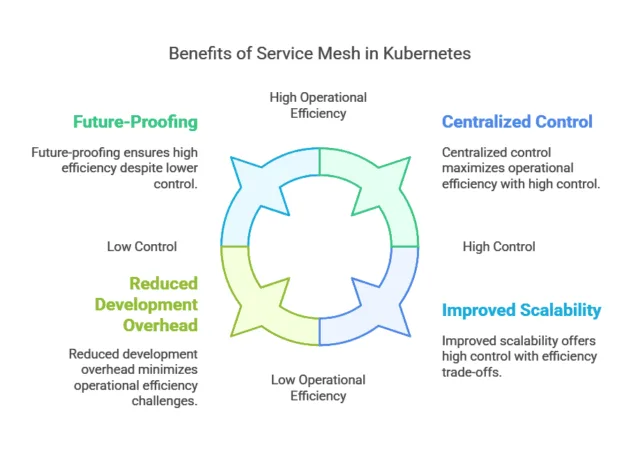
- Service Mesh and Sidecar Pattern: Service meshes (e.g., Istio or Linkerd) leverage a sidecar proxy for managing service discovery and load balancing. This helps abstract communication details away from the application code and provides dynamic routing, retries, and failover.
Read more blog : What is Zero Trust architecture and why are companies adopting it?
Implementing Circuit Breakers for Resilience
Network calls between services can fail due to high load, network issues, or service downtime. Implementing a circuit breaker pattern helps:
- Prevent cascading failures by stopping calls to an unhealthy service.
- Detecting and temporarily “breaking” communication when a certain threshold of failure is reached.
Tools like Hystrix and Resilience4j are popular for implementing circuit breakers.
Service Discovery for Dynamic Environments
Microservices often scale dynamically, and instances may frequently join or leave the cluster. Service discovery mechanisms are critical to keeping communication effective:
- Client-Side Discovery: Clients directly query the service registry (e.g., Eureka) to get the location of services.
- Server-Side Discovery: A load balancer or API gateway handles the lookup, which simplifies clients.
Efficient Data Sharing: Use of Caching
Communication between microservices can often involve repeated requests for the same data. Caching helps in:
- Reducing the number of calls to other services or databases.
- Tools like Redis or Memcached can be used to cache frequently requested data, thus reducing the need for redundant inter-service communication.
Optimizing Payload Size and Serialization
Large payloads and inefficient serialization can significantly impact the performance of service-to-service communication.
- Minimize Payload Size: Avoid including unnecessary data in API responses. GraphQL can be particularly helpful here since it allows precise control over what data is fetched.
- Use Efficient Serialization Formats: Instead of JSON, consider using Protocol Buffers (Protobuf), which is more compact and faster to serialize and deserialize.
Rate Limiting and Throttling
Excessive service requests can overwhelm a service, causing degradation across the system. Implementing rate limiting and throttling mechanisms helps protect services from getting overwhelmed:
- Token Bucket or Leaky Bucket Algorithms can help control the flow of requests.
- Many service meshes and API gateways provide built-in support for rate limiting.
Using Message Brokers for Asynchronous Communication
To decouple microservices, message brokers like Kafka, RabbitMQ, or Amazon SQS are commonly used. They allow:
- Event-Driven Architecture: Services communicate by publishing and consuming events, ensuring loose coupling.
- Replayability: Message brokers can store messages for replay, which is helpful during recovery from failures.
Tracing and Observability
Optimizing microservices communication requires understanding how data flows between services. Implementing distributed tracing helps monitor and visualize service interactions, which is key for diagnosing performance bottlenecks.
- Distributed Tracing Tools: Use tools like Jaeger, Zipkin, or OpenTelemetry to trace requests across services. Observability enables you to detect and resolve bottlenecks, latency issues, and points of failure.
| Architecture Strategy | Core Technology / Protocol | Communication Pattern | Key Benefit | Trade-Off / Challenge |
| High-Performance Internal RPC | gRPC (HTTP/2, Protobuf) | Synchronous (Request-Response, Streaming) | Ultra-low latency, strongly typed contracts, compact binary payloads | Limited native browser support; requires contract sync |
| Public & Edge API Ingress | REST (OpenAPI) / GraphQL | Synchronous (Request-Response) | Universal client compatibility; precise field selection (GraphQL) | Higher payload overhead (JSON); risk of over/under-fetching |
| Decoupled Event Streaming | Apache Kafka / RabbitMQ | Asynchronous (Publish-Subscribe) | Elastic load buffering, high throughput, service decoupling | Eventual consistency; operational cluster complexity |
| Distributed Transaction Management | Saga Pattern (Orchestration / Choreography) | Mixed (Async Events / Sync RPC) | Preserves data consistency across isolated databases without 2PC locking | Complex failure handling; requires custom compensating actions |
| Traffic Resilience & Security | Service Mesh (Istio, Linkerd) | Sidecar Proxy Layer | Transparent mTLS encryption, automated retries, dynamic routing | Added memory/CPU resource overhead per service pod |
| End-to-End System Observability | OpenTelemetry / Jaeger | Distributed Context Propagation | Fast identification of cross-service latency bottlenecks and errors | Instrumentation overhead; requires consistent trace header forwarding |
Ensuring Data Consistency with Saga Pattern
Distributed systems inherently face challenges around data consistency. Using a Saga Pattern helps maintain data integrity across services in long-running transactions by breaking them into smaller, coordinated steps with compensating actions in case of failure.
- Choreography-Based Saga: Each service listens for events and reacts accordingly. This is suitable for smaller workflows with limited services.
- Orchestration-Based Saga: A central orchestrator manages the flow of transactions. This is ideal for complex workflows involving many services.
Implementing API Gateway for Centralized Control
An API Gateway can centralize and optimize service-to-service communication by:
- Handling cross-cutting concerns like authentication, rate limiting, logging, and retry policies.
- Reducing chattiness between client and microservices by aggregating multiple services’ data into a single response, thereby improving efficiency.
Popular tools include Kong, NGINX, and AWS API Gateway.
Handling Network Failures Gracefully
Networks are inherently unreliable, and microservices must handle these failures gracefully to prevent service degradation.
- Retry Pattern: Automatically retry requests in case of transient network errors.
- Backoff Strategy: Implement exponential backoff to prevent overwhelming services during failures.
- Timeouts: Define appropriate timeouts for all inter-service communication to prevent hanging requests.
Security Best Practices for Service Communication
Security is paramount when services communicate across potentially untrusted networks.
- Mutual TLS (mTLS): Use mTLS to encrypt communication and authenticate both client and server.
- OAuth and OpenID Connect: Use OAuth tokens to secure APIs, ensuring only authorized services can communicate with each other.
Read more blog : 5 Secure Web Hosting Services Every Website Owner Should Consider
Real-World Examples and Case Studies
Optimizing service-to-service communication is critical for some of the most well-known software platforms.
- Netflix: Netflix uses tools like Hystrix for resilience and has built its own service discovery with Eureka.
- Uber: Uber relies heavily on gRPC for its low-latency needs, enabling efficient communication across its many microservices.
Conclusion
Optimizing service-to-service communication in microservices architecture requires a careful balance of various strategies, from choosing the right protocol, load balancing, ensuring resilience, adopting caching mechanisms, and securing interactions. By leveraging modern tools like service meshes, distributed tracing, and advanced serialization techniques, developers can build efficient, scalable, and resilient microservices-based systems.
Read more blog : Difference Between Network Security, Cybersecurity, and Information Security
Key Takeaways
- Choose the right communication protocol depending on the use case.
- Reduce latency with effective load balancing and caching.
- Implement circuit breakers, rate limiting, and retries for resilience.
- Use distributed tracing tools for observability.
- Optimize data transfer with efficient serialization and minimize payload size.
Further Reading
- Caching Strategies for High-Performance Backends
- How to Implement Microservices for Maximum Scalability
- Scaling Databases for High Traffic Applications
This guide aims to provide a thorough understanding of the practices required to optimize service-to-service communication in microservices. Adopting these strategies will help build a high-performance, reliable, and scalable system.
Frequently Ask Questions:
1. When should I choose gRPC over REST for microservices communication?
Answer: Use gRPC for high-throughput, latency-critical internal service-to-service communication. It runs over HTTP/2, uses binary serialization (Protocol Buffers), supports bidirectional streaming, and provides strict API contracts. Stick with REST for public-facing APIs, external third-party integrations, and systems requiring browser-native compatibility.
2. What is the difference between Orchestration and Choreography in the Saga pattern?
Answer: In Choreography, services publish domain events and react independently without a central coordinator, making it lightweight for simple workflows. In Orchestration, a dedicated central service (the orchestrator) explicitly directs each participating service on which transaction or compensating action to execute, making it easier to track and debug complex multi-step workflows.
3. How does a Service Mesh improve service-to-service communication?
Answer: A Service Mesh (such as Istio or Linkerd) deploys lightweight sidecar proxies alongside each service to offload networking logic from application code. It automatically manages cross-cutting concerns like mutual TLS (mTLS) encryption, dynamic traffic routing, load balancing, health checks, retries, and distributed tracing injection.
5. How do you prevent the “Retry Storm” problem during network outages?
Answer: Naive retries can overwhelm a recovering service. Prevent retry storms by combining:
Exponential Backoff: Progressively increasing the delay between subsequent retries.
Jitter: Adding randomized variance to retry intervals to avoid synchronized spikes from multiple callers.
Circuit Breakers & Budgets: Capping maximum retry attempts (e.g., max 3 retries or 10% total request volume) before failing fast.
