


Large Language Models (LLMs) are the backbone of modern AI applications, enabling everything from intuitive chatbots to advanced enterprise research tools. However, not all LLMs are built the same way. Different underlying architectures serve fundamentally different purposes, each bringing a unique set of strengths and limitations to the table.
If you are wondering which type of AI model is best suited for your next project, let’s break down the six core architectures dominating the industry today.
1. Autoregressive Models (AR) – Masters of Text Generation
Autoregressive models generate text sequentially—one token (word or word fragment) at a time—by predicting the next most likely word based on the text that came before it.
- Example Models: OpenAI’s GPT-4 / GPT-5 series, Meta’s Llama series.
- Best For:
- Conversational AI: Building highly engaging chatbots and virtual assistants.
- Creative Writing: Drafting stories, poetry, blog outlines, or marketing copy.
- Code Generation: Automating software development and debugging (e.g., GitHub Copilot).
- Limitations: They are prone to hallucinations (generating factually incorrect info with high confidence) and require massive computational power.
2. Autoencoding Models (AE) – Masters of Language Understanding
Unlike models built to write, autoencoding models are built to comprehend. They read entire sentences simultaneously and use Masked Language Modeling (MLM)—hiding certain words in a sentence and training the model to predict them—to map out deep linguistic context.
- Example Models: BERT, RoBERTa, ALBERT.
- Best For:
- Search & Ranking: Powering modern search engines (like Google Search) to match user intent.
- Sentiment Analysis: Monitoring social media and customer reviews for positive or negative intent.
- Named Entity Recognition (NER): Extracting vital data (names, dates, conditions) from legal, medical, or financial documents.
- Limitations: They are inherently poor at generating free-flowing text or holding multi-turn conversations.
3. Seq2Seq Models – Masters of Translation & Summarization
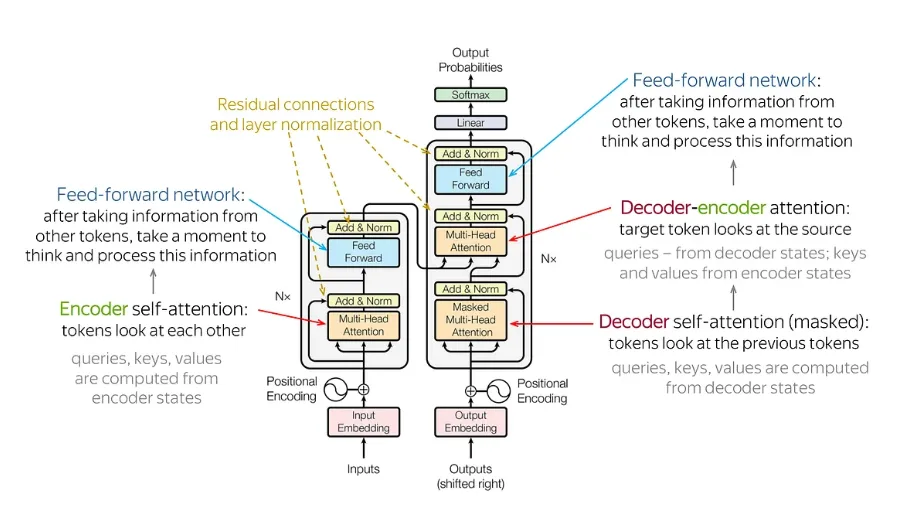
Sequence-to-Sequence (Seq2Seq) models feature an encoder-decoder architecture specifically engineered to ingest a sequence of text and transform it into a completely new sequence.
- Example Models: T5, BART, MarianMT.
- Best For:
- Language Translation: High-accuracy translation tools (e.g., Google Translate, DeepL).
- Text Summarization: Condensing lengthy legal documents, academic papers, or news digests.
- Structured Q&A: Automated customer support workflows that require concise mappings.
- Limitations: They frequently require fine-tuning on domain-specific data to capture industry jargon or cultural nuances correctly.
4. Diffusion-Based Language Models – The Experimental Innovators
While diffusion techniques are famous for powering image generators like Stable Diffusion, applying them to text is a cutting-edge frontier. These models start with a “noisy,” randomized string of text and gradually refine it into a highly controlled, structured response.
- Example Models: Experimental text-diffusion researchers (Note: Stability AI’s StableLM actually uses a standard autoregressive setup, but pure text diffusion remains a hot research area at places like OpenAI).
- Best For:
- Highly Controlled Output: Generating text that must adhere to exact structural formats or lengths.
- Multi-Modal Alignment: Serving as a bridge that tightly couples text generation with AI image, video, or audio synthesis.
- Limitations: They are highly complex and computationally expensive to run, making them less common in standard text apps.
5. Knowledge-Based Models – The Fact-Checkers
Knowledge-based systems rely on a framework known as Retrieval-Augmented Generation (RAG). Instead of pulling answers solely from a static pool of pre-trained data, these models actively search external databases, local documents, or live APIs in real time before generating a response.
- Example Models: DeepMind’s RETRO, customized enterprise RAG pipelines.
- Best For:
- Fact-Grounded Systems: Enterprise research assistants, legal search tools, and medical advisors.
- Internal Knowledge Bases: Corporate HR or IT chatbots that need to reference changing internal handbooks.
- Minimizing Hallucinations: Drastically dropping error rates by forcing the AI to prove its sources.
- Limitations: They depend heavily on the quality of your underlying database and introduce slight latency (delay) during the search step.
6. Hybrid & Reasoning Models – The Best of Both Worlds
The gold standard for production applications involves hybrid architectures. These systems combine massive autoregressive capabilities with real-time retrieval networks and dedicated “thinking” reinforcement learning loops to maximize both creative execution and factual precision.
- Example Models: OpenAI’s GPT-5.5, Google’s Gemini 3.1 Pro, DeepSeek-R1.
- Best For:
- Advanced AI Agents: Executing multi-step, autonomous tasks like browsing the web and writing code.
- Next-Gen Search: Powering semantic engines that synthesize verified web sources into a clean answer.
- All-in-One Enterprise Tools: Handling everything from heavy mathematical coding to soft creative writing in a single interface.
- Limitations: High operational costs and multi-layered processing chains that require careful engineering to maintain fast response speeds.
Architectural Comparison Matrix
| Architecture | Primary Strength | Key Use Case | Core Limitation |
| Autoregressive (AR) | Fluent text generation | Chatbots, Creative writing, Coding | Prone to hallucinations |
| Autoencoding (AE) | Deep sentence comprehension | Sentiment analysis, Search ranking, NER | Cannot generate free text |
| Seq2Seq | Sequence-to-sequence mapping | Language translation, Text summarization | Requires specific fine-tuning |
| Diffusion-Based | Controlled structural formatting | Multi-modal alignment, Rigid outputs | Heavy computing costs |
| Knowledge-Based | Real-time factual accuracy | Enterprise wikis, Medical/Legal search | Higher latency, Data dependent |
| Hybrid & Reasoning | Multi-step logic and execution | Autonomous AI agents, Complex problem-solving | Expensive operational infrastructure |
Which Architecture Should You Choose?
- Choose a Hybrid/Reasoning Model if you require a state-of-the-art assistant to handle complex, multi-step logic.
- Choose an Autoregressive Model if you need a creative copywriter, fluent conversationalist, or coding partner.
- Choose an Autoencoder Model if you are classifying data, extracting entities, or building search features.
- Choose a Seq2Seq Model if your core focus is language translation or document summarization.
- Choose a Knowledge-Based (RAG) Setup if accuracy is non-negotiable and you need to query live or proprietary data.
You may also like:
1) How AI is Transforming the Software Development Industry
2) 8 Key Concepts in Neural Networks Explained
3) Top 5 Essential Deep Learning Tools You Might Not Know
4) 10 Common Mistakes in AI Model Development
5) 6 Types of Neural Networks You Should Know
6) The Science Behind Fine-Tuning AI Models: How Machines Learn to Adapt
7) 7 Essential Tips for Fine-Tuning AI Models
8) Top 10 Generative AI Tools for Content Creators in 2025
9) 10 Best Practices for Fine-Tuning AI Models
Read more blogs from Here
Share your experiences in the comments, and let’s discuss how to tackle them!
Follow me on Linkedin
Frequently Ask Question :
What is the main difference between BERT (Autoencoding) and GPT (Autoregressive)?
BERT reads a sentence bi-directionally (looking at words to both the left and right simultaneously), making it incredible at understanding context and intent. GPT reads uni-directionally (left-to-right) to predict the next word, making it highly optimized for generating text rather than just analyzing it.
Can an Autoregressive model (like ChatGPT) be turned into a Knowledge-Based model?
Yes, and this is how most modern enterprise systems work. By implementing a Retrieval-Augmented Generation (RAG) pipeline, you can use a model like GPT to handle the conversation, while forcing it to construct its answers using documents pulled from a secure, verified external database.
Why do Autoregressive models hallucinate?
Because they are fundamentally designed to predict the statistically most likely next word, not to check for truth. Without an external database grounding them (like in a RAG system), they prioritize keeping the text grammatically and stylistically fluent over making it factually correct.
Are Seq2Seq models still relevant if Hybrid models exist?
Absolutely. While hybrid models are incredibly smart, they are also massive and expensive to deploy. For specialized, high-volume tasks like translating millions of lines of text or summarizing daily news feeds, smaller Seq2Seq models (like T5) are highly efficient, cheaper, and faster.
