


Modern enterprise applications rely on Java because of its scalability, security, and platform independence. As organisations build cloud-native applications, microservices, and distributed systems, employers expect candidates to have more than just basic programming knowledge. Preparing for Advanced Java Interview Questions for Experienced Developers helps professionals understand what recruiters and technical interviewers are looking for in senior-level roles.
Whether you are preparing for software engineering interview questions, java interview questions for developers, or senior developer interview questions, mastering advanced Java concepts is essential. Companies often evaluate candidates on multithreading, JVM internals, collections, memory management, Spring Boot, microservices, and system design rather than basic syntax. This guide covers the most common advanced Java interview questions with detailed answers to help experienced developers succeed.
If you are also preparing for basic technical interview questions, associate software engineer interview questions, or interviews for leadership positions, understanding advanced Java concepts will give you an advantage over other candidates. Besides Java-specific topics, interviewers may also include core java questions asked in interview, architecture discussions, API design, database optimisation, and coding challenges to assess your overall problem-solving ability.
Why Companies Ask Advanced Java Interview Questions
Unlike entry-level interviews, experienced developer interviews focus on practical implementation rather than definitions.
Interviewers typically evaluate:
- Problem-solving ability
- Code optimisation
- Memory management
- Thread safety
- API development
- Distributed architecture
- Performance tuning
- Database interaction
- Design patterns
- Clean coding practices
Senior developers are also expected to explain why they choose one solution over another.
Junior vs Experienced Java Interview Focus
| Junior Developer | Experienced Developer |
| Java Syntax | JVM Architecture |
| Loops & Arrays | Multithreading |
| OOP Basics | Concurrency |
| Simple Programs | Design Patterns |
| Collections | Performance Optimisation |
| Exception Handling | Microservices |
1. What Happens Inside the JVM When a Java Program Starts?
Answer
When a Java application starts:
- JVM loads the class.
- Bytecode is verified.
- Classes are linked.
- Memory areas are allocated.
- Objects are created.
- JIT Compiler compiles frequently executed code.
- Garbage Collector continuously manages memory.
Why Interviewers Ask
They want to evaluate your understanding of JVM internals rather than simply writing Java code.
2. Explain Heap Memory and Stack Memory.
Answer
Heap Memory stores:
- Objects
- Instance variables
Stack Memory stores:
- Method calls
- Local variables
- References
Comparison Table
| Heap Memory | Stack Memory |
| Shared by Threads | Private to Each Thread |
| Stores Objects | Stores Local Variables |
| Managed by GC | Automatically Cleared |
| Larger Memory | Smaller Memory |
3. What is Garbage Collection?
Garbage Collection automatically removes unused objects from heap memory, making Java applications more memory-efficient and reliable. Understanding how GC works is important not only for Java interviews but also for coding interview questions with solutions, where candidates are often asked to optimize memory usage and explain JVM behaviour.
Popular Garbage Collectors Include:
- Serial GC
- Parallel GC
- G1 GC
- ZGC
- Shenandoah GC
Interviewers May Ask:
- How does Garbage Collection work?
- When does Garbage Collection run?
- Can Garbage Collection be forced?
Correct Answer:
No. Calling System.gc() does not force Garbage Collection. It only sends a request to the JVM, which decides whether and when to perform Garbage Collection based on its memory management strategy.
4. Explain Java Memory Model (JMM)
Java Memory Model defines how threads interact with shared memory.
Key concepts:
- Visibility
- Ordering
- Atomicity
- Synchronization
Without JMM, different threads may read outdated values from memory.
Java Memory Areas
| Memory Area | Purpose |
| Heap | Objects |
| Stack | Method Execution |
| Method Area | Class Metadata |
| PC Register | Current Instruction |
| Native Method Stack | Native Methods |
5. What is the Difference Between Synchronised and Lock?
Synchronised
- Built into Java
- Automatically released
- Simpler
Lock Interface
- More flexible
- Supports timeout
- Supports fairness
- Better control
Use Lock when advanced thread coordination is required.
6. Explain Volatile Keywords
The volatile keyword ensures that every thread reads the latest value of a variable.
Example:
Without volatile:
Thread A changes a variable.
Thread B may still read the old value.
With volatile:
All threads immediately see the updated value.
7. Difference Between HashMap and ConcurrentHashMap
HashMap
- Not thread-safe
- Faster in single-threaded applications
ConcurrentHashMap
- Thread-safe
- Suitable for concurrent environments
- Better performance than synchronised HashMap
8. Explain Immutable Objects.
Immutable objects cannot be modified after creation.
Example:
String
Benefits:
- Thread safety
- Better caching
- Improved security
- Easier debugging
9. What are Design Patterns Used in Java?
Common patterns include:
- Singleton
- Factory
- Builder
- Prototype
- Observer
- Strategy
- Decorator
- Adapter
Experienced developers should know where each pattern is applicable instead of only memorising definitions.
10. Explain Dependency Injection
Dependency Injection removes tight coupling between classes.
Instead of creating objects manually:
EmployeeService service = new EmployeeService();Frameworks like Spring inject dependencies automatically.
Benefits:
- Easier testing
- Loose coupling
- Better scalability
- Cleaner architecture
Common Advanced Java Topics Asked in Interviews
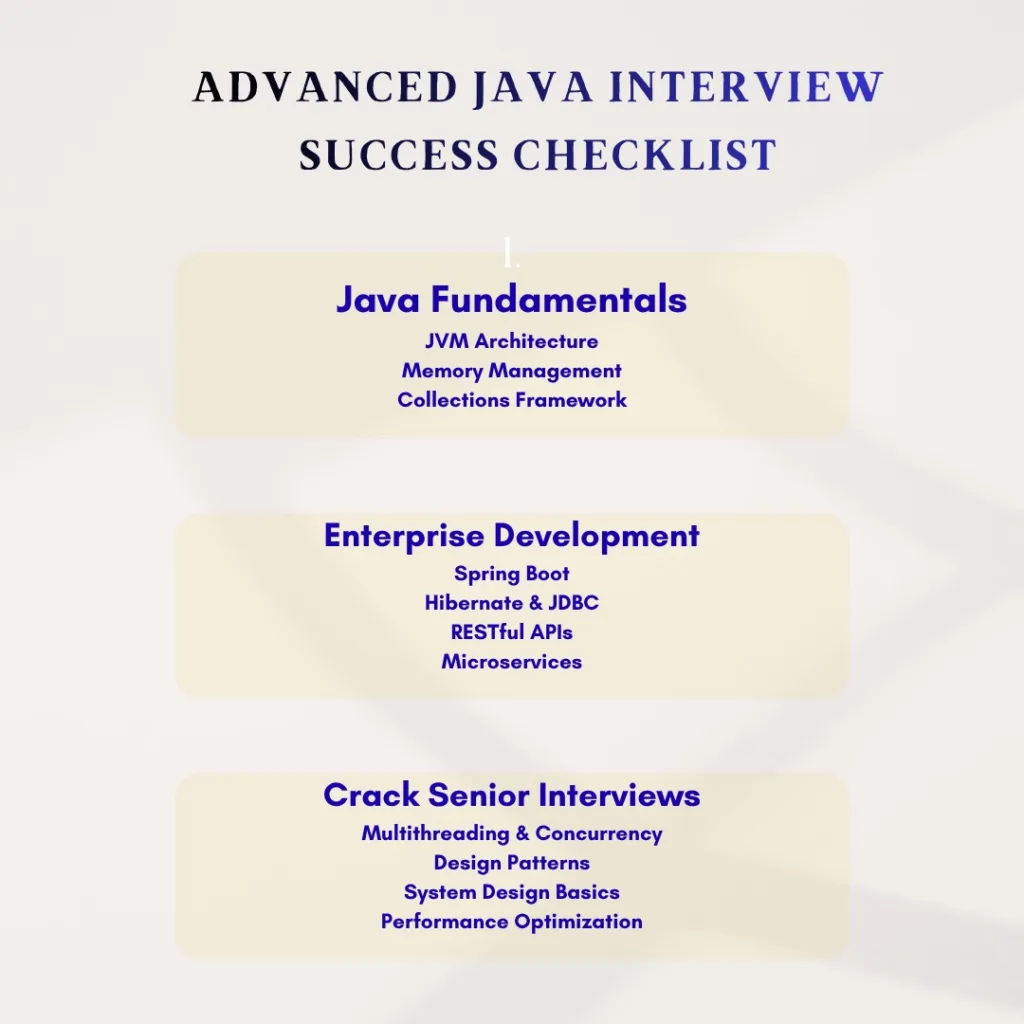
Interviewers frequently cover additional subjects beyond Java fundamentals, including microservices, REST APIs, database optimisation, caching, messaging systems, Docker, Kubernetes, and cloud deployment. Candidates preparing for interview questions for senior java developer or java senior developer interview questions should also review these technologies because they are widely used in enterprise applications.
Many companies combine Java rounds with broader software engineering discussions. You may also encounter restful api interview questions, backend questions for interview, and top system design interview questions to assess your ability to build scalable applications. Understanding API versioning, authentication, load balancing, and distributed systems can significantly improve your interview performance.
This guide is also useful for candidates searching for interview questions for java developer, senior java developer interview questions, senior developer java interview questions, java developer interview questions, and interview questions for full stack java developer. Additionally, professionals preparing for java full stack developer interview questions can benefit from mastering these advanced Java concepts before moving on to Spring Boot and microservices.
11. What is the Difference Between Spring and Spring Boot?
Answer
Spring is a comprehensive framework for building Java applications, while Spring Boot is an extension of Spring that simplifies application development by providing auto-configuration, embedded servers, and production-ready features.
Spring vs Spring Boot
| Spring | Spring Boot |
| Requires manual configuration | Auto-configuration available |
| External server required | Embedded Tomcat/Jetty |
| More XML configuration | Minimal configuration |
| Longer setup time | Faster project setup |
| Suitable for enterprise frameworks | Ideal for microservices |
Why Interviewers Ask
Experienced developers are expected to know when to use Spring Boot over the traditional Spring Framework and how it improves developer productivity.
12. Explain Microservices Architecture
Answer
Microservices architecture divides a large application into multiple independent services. Each service performs a specific business function and communicates with other services using REST APIs or messaging systems.
Advantages
- Independent deployment
- Better scalability
- Easier maintenance
- Fault isolation
- Faster development
Challenges
- Distributed transactions
- Service discovery
- Monitoring
- Security
- Network latency
Interviewers often ask follow-up questions on API Gateway, Eureka Server, Config Server, Circuit Breaker, and distributed logging.
13. What are Java Streams?
Answer
The Stream API, introduced in Java 8, allows developers to process collections efficiently using functional programming concepts.
Common Stream operations include:
filter()

map()

sorted()

reduce()

collect()

distinct()
Benefits
- Cleaner code
- Improved readability
- Parallel processing support
- Less boilerplate code
14. What is CompletableFuture?
Answer
CompletableFuture enables asynchronous programming in Java.
Instead of blocking the main thread while waiting for a task to finish, CompletableFuture allows multiple tasks to execute concurrently.
Common Methods
supplyAsync()

thenApply()

thenAccept()

thenCombine()

exceptionally()
Interview Tip
Senior developers should understand when asynchronous execution improves application performance and when synchronous processing is more appropriate.
15. Explain JDBC Connection Pooling
Answer
Creating a new database connection for every request is expensive.
Connection pooling maintains a pool of reusable database connections, reducing response time and improving application performance.
Popular connection pools include:
- HikariCP
- Apache DBCP
- C3P0
Benefits
- Faster execution
- Reduced database overhead
- Better scalability
- Lower resource consumption
16. What is Hibernate?
Answer
Hibernate is an Object Relational Mapping (ORM) framework that maps Java objects to database tables.
Instead of writing SQL queries repeatedly, developers interact with Java objects.
Advantages
- Reduced boilerplate code
- Automatic table mapping
- Caching support
- Lazy loading
- Database independence
Interviewers may also ask about:
- First-level cache
- Second-level cache
- Lazy vs Eager fetching
- Entity lifecycle
17. What is Kafka and Why is it Used?
Answer
Apache Kafka is a distributed event-streaming platform used for handling large volumes of real-time data.
Common Use Cases
- Log processing
- Notification systems
- Payment systems
- Real-time analytics
- Event-driven architecture
Components
- Producer
- Consumer
- Topic
- Broker
- Partition
Senior Java developers are frequently asked how Kafka integrates with Spring Boot applications.
18. How Do You Improve Java Application Performance?
Answer
Performance optimization is one of the most important responsibilities of an experienced Java developer.
Common optimisation techniques include:
- Using appropriate collections
- Minimising object creation
- Connection pooling
- Efficient SQL queries
- JVM tuning
- Caching frequently accessed data
- Using multithreading wisely
- Profiling applications with tools such as VisualVM and JProfiler
Interviewers expect candidates to explain why a particular optimisation improves performance instead of simply listing techniques.
19. Explain REST API Best Practices.
RESTful APIs are widely used in enterprise Java applications. Experienced developers should understand how to design secure, scalable, and maintainable APIs. Many recruiters include restful api interview questions during Java backend interviews to evaluate a candidate’s knowledge of API design, security, versioning, and best practices for building enterprise-grade applications.
Best Practices
- Use proper HTTP methods (GET, POST, PUT, PATCH, DELETE)
- Return meaningful HTTP status codes
- Validate input data before processing requests
- Secure APIs using OAuth or JWT authentication
- Implement API versioning for backward compatibility
- Use pagination for large datasets to improve performance
- Handle exceptions consistently with standard error responses
- Document APIs using Swagger/OpenAPI for better developer experience
Common HTTP Methods
| Method | Purpose |
| GET | Retrieve data |
| POST | Create resource |
| PUT | Update resource |
| PATCH | Partial update |
| DELETE | Remove resource |
20. Explain Java Design Principles (SOLID).
Answer
SOLID principles help developers write maintainable and scalable applications.
SOLID Principles
- S – Single Responsibility Principle
- O – Open/Closed Principle
- L – Liskov Substitution Principle
- I – Interface Segregation Principle
- D – Dependency Inversion Principle
Following SOLID principles results in cleaner architecture, easier testing, and better code reusability.
Additional Topics Experienced Java Developers Should Prepare
Today’s technical interviews rarely focus only on Java. Recruiters often evaluate a candidate’s overall software engineering knowledge. Alongside java interview questions for developers, candidates may encounter coding interview questions with solutions, interview questions for data structures and algorithms, and backend questions for interview to assess problem-solving skills, algorithmic thinking, and application architecture.
Developers applying for enterprise roles should also prepare interview questions for full stack java developer, java full stack developer interview questions, and full stack interview questions because many organisations expect Java developers to understand frontend frameworks, databases, cloud services, and DevOps practices. Having a working knowledge of HTML, CSS, JavaScript, REST APIs, and modern deployment pipelines can make a significant difference during technical discussions.
Interview preparation should not be limited to Java alone. Companies may include seo interview question, seo marketing interview questions, wordpress interview questions, wp interview questions, interview questions on html css, front developer interview questions, interview questions on machine learning, and ai engineer interview questions depending on the job role or the organisation’s technology stack. Being aware of these related topics demonstrates versatility and adaptability.
Tips to Crack Senior Java Developer Interviews
- Revise JVM architecture thoroughly.
- Practise multithreading and concurrency problems.
- Build REST APIs using Spring Boot.
- Understand database indexing and query optimisation.
- Review common design patterns and SOLID principles.
- Practise coding problems on arrays, strings, trees, graphs, and dynamic programming.
- Prepare real-world project explanations with measurable outcomes.
- Be ready to discuss system design and scalability decisions.
- Improve communication skills for technical discussions.
- Stay updated with the latest Java versions and enterprise development trends.
Conclusion
Preparing for Advanced Java Interview Questions for Experienced Developers requires more than memorising answers. Employers look for candidates who can apply Java concepts to solve real-world problems, design scalable systems, optimise application performance, and write clean, maintainable code. By mastering JVM internals, multithreading, Spring Boot, REST APIs, Hibernate, Kafka, and system design while regularly practising coding challenges, you can confidently tackle technical interviews for mid-level and senior Java positions. Consistent preparation, practical experience, and a strong understanding of software engineering principles will significantly improve your chances of landing your next Java developer role.
Frequently Asked Questions (FAQs)
1. What topics are most important for experienced Java developer interviews?
Focus on JVM internals, multithreading, collections, Spring Boot, Hibernate, REST APIs, microservices, design patterns, system design, and performance optimisation.
2. How many years of experience are required for senior Java developer interviews?
Most companies consider professionals with five or more years of experience for senior roles, although expectations vary depending on the organisation and project complexity.
3. Are coding rounds mandatory for experienced Java developers?
Yes. Even senior candidates are usually assessed through coding challenges, data structures, algorithms, and practical problem-solving exercises alongside architecture discussions.
4. Which framework is most commonly used in Java interviews?
Spring Boot is currently the most frequently discussed framework because of its widespread use in enterprise applications, microservices, and cloud-native development.
5. How should I prepare for Advanced Java interviews?
Build hands-on projects, revise core Java concepts, practise coding regularly, study JVM internals, understand Spring Boot and microservices, review system design concepts, and prepare to explain real-world project decisions confidently.
