


Landing a software engineering role requires more than technical knowledge—it demands strong problem-solving skills, coding proficiency, and confidence in handling real-world challenges. Whether you are preparing for your first developer role or aiming for a senior position, practicing the right coding interview questions can significantly improve your chances of success.
Many companies evaluate candidates through technical assessments that include technical interview questions rounds, algorithm challenges, and system design discussions. By mastering the most frequently asked questions, candidates can approach with greater confidence and efficiency.
Why Practicing Coding Interview Questions Matters
Interviewers use coding assessments to evaluate logical thinking, problem-solving abilities, and programming expertise. The most successful candidates regularly practice coding interview questions with solutions to understand not only the answers but also the reasoning behind them.
In addition to coding challenges, employers often ask technical interview questions related to data structures, algorithms, object-oriented programming, and software design principles. Consistent practice helps candidates develop optimized solutions under time constraints.
Common Coding Interview Topics
The following areas form the foundation of most software engineering interviews:
| Topic | Importance | Common Applications |
| Arrays & Strings | High | Data manipulation and searching |
| Linked Lists | High | Dynamic memory management |
| Stacks & Queues | High | Browser history, scheduling systems |
| Trees & Graphs | Very High | Database indexing and network routing |
| Sorting & Searching | Very High | Performance optimization |
| Dynamic Programming | Advanced | Optimization problems |
| Recursion | High | Tree traversals and backtracking |
| Hash Tables | High | Fast lookups and caching |
Many software developer interview questions are built around these fundamental concepts, making them essential areas to practice.
Beginner-Level Coding Questions
1. What Is an Array?
An array is a data structure that stores elements of the same data type in contiguous memory locations. Arrays allow quick access to elements using indexes and are among the most common coding questions asked in interview processes.
Example
Input:
[10, 20, 30, 40]
Accessing the third element:
array[2] = 30
2. What Is a Linked List?
A linked list is a collection of nodes where each node contains data and a pointer to the next node.
Types include:
- Singly Linked List
- Doubly Linked List
- Circular Linked List
Linked list concepts frequently appear in coding questions asked for freshers because they test understanding of memory management and pointers.
3. Explain Stack and Queue
Stack (LIFO)
Last In, First Out structure.
Example:
Push: 1,2,3
Pop: 3
Queue (FIFO)
First In, First Out structure.
Example:
Enqueue: 1,2,3
Dequeue: 1
These concepts commonly appear in interview questions code assessments.
4. What Are the Main Principles of OOP?
Object-Oriented Programming is based on:
- Encapsulation
- Inheritance
- Polymorphism
- Abstraction
Many software engineering questions focus on how these principles improve scalability and maintainability.
5. What Is a Binary Search Tree?
A Binary Search Tree (BST) stores data in a hierarchical structure where:
- Left subtree values are smaller
- Right subtree values are greater
BSTs are frequently discussed in data structures and algorithms interview questions because they support efficient searching and insertion operations.
Intermediate Coding Interview Questions With Solutions
1. Reverse an Array
Question
Reverse an array without using extra space.
Solution
function reverseArray(arr){
    let left = 0;
    let right = arr.length - 1;
    while(left < right){
        [arr[left], arr[right]] = [arr[right], arr[left]];
        left++;
        right--;
    }
    return arr;
}
Time Complexity
O(n)2. Find the Kth Largest Element
Question
Find the Kth largest element in an array.
Solution
function findKthLargest(arr, k){
    arr.sort((a,b)=>b-a);
    return arr[k-1];
}
Example
| Input | K | Output |
| [3,2,1,5,6,4] | 2 | 5 |
| [7,4,9,1] | 1 | 9 |
| [10,20,15] | 3 | 10 |
These are among the most popular coding interview questions asked by leading technology companies.
3. Move All Zeroes to the End
Question
Move all zeros while maintaining the order of non-zero elements.
Solution
function moveZeroes(nums){
    let index = 0;
    for(let i=0;i<nums.length;i++){
        if(nums[i] !== 0){
            nums[index++] = nums[i];
        }
    }
    while(index < nums.length){
        nums[index++] = 0;
    }
    return nums;
}
Example
Input:
[0,1,0,3,12]
Output:
[1,3,12,0,0]
4. Detect a Cycle in a Linked List
Question
How can you determine whether a linked list contains a cycle?
Solution
Use Floyd’s Cycle Detection Algorithm.
function hasCycle(head){
    let slow = head;
    let fast = head;
    while(fast && fast.next){
        slow = slow.next;
        fast = fast.next.next;

        if(slow === fast){
            return true;
        }
    }

    return false;
}
This is a favorite among interviewers because it evaluates algorithmic thinking and optimization skills.
Advanced Programming Interview Questions
1. Explain Heap Sort
Heap Sort is a comparison-based sorting algorithm that uses a binary heap data structure.
Key Steps
- Build a max heap.
- Swap root with last element.
- Reduce heap size.
- Heapify again.
- Repeat until sorted.
Heap Sort offers
Time Complexity: O(n log n)
Space Complexity: O(1)
This topic frequently appears in sr software engineer interview questions because it demonstrates a deeper understanding of algorithm design.
2. How Do You Detect a Cycle in a Graph?
For Undirected Graphs
Use DFS and track parent nodes.
For Directed Graphs
Use DFS with a recursion stack.
Interviewers often include such problems in coding questions for interview rounds to assess graph traversal knowledge.
3. Search in a Sorted Matrix
Approach
Start from the top-right corner:
- Move left if the current value is greater than target.
- Move down if the current value is smaller than target.
Complexity
O(m + n)This is one of the most common coding interview questions asked in product-based companies.
4. What Is Multithreading?
Multithreading enables multiple threads to execute concurrently within a process.
Benefits
- Improved performance
- Better resource utilization
- Enhanced responsiveness
Multithreading concepts are frequently discussed during software developer interview questions and senior engineering.
5. What Are Regular Expressions?
Regular Expressions (Regex) are patterns used for searching and manipulating text.
Example
Phone Number Validation:
^\d{10}$
Regex questions commonly appear in technical questions for backend and full-stack development roles.
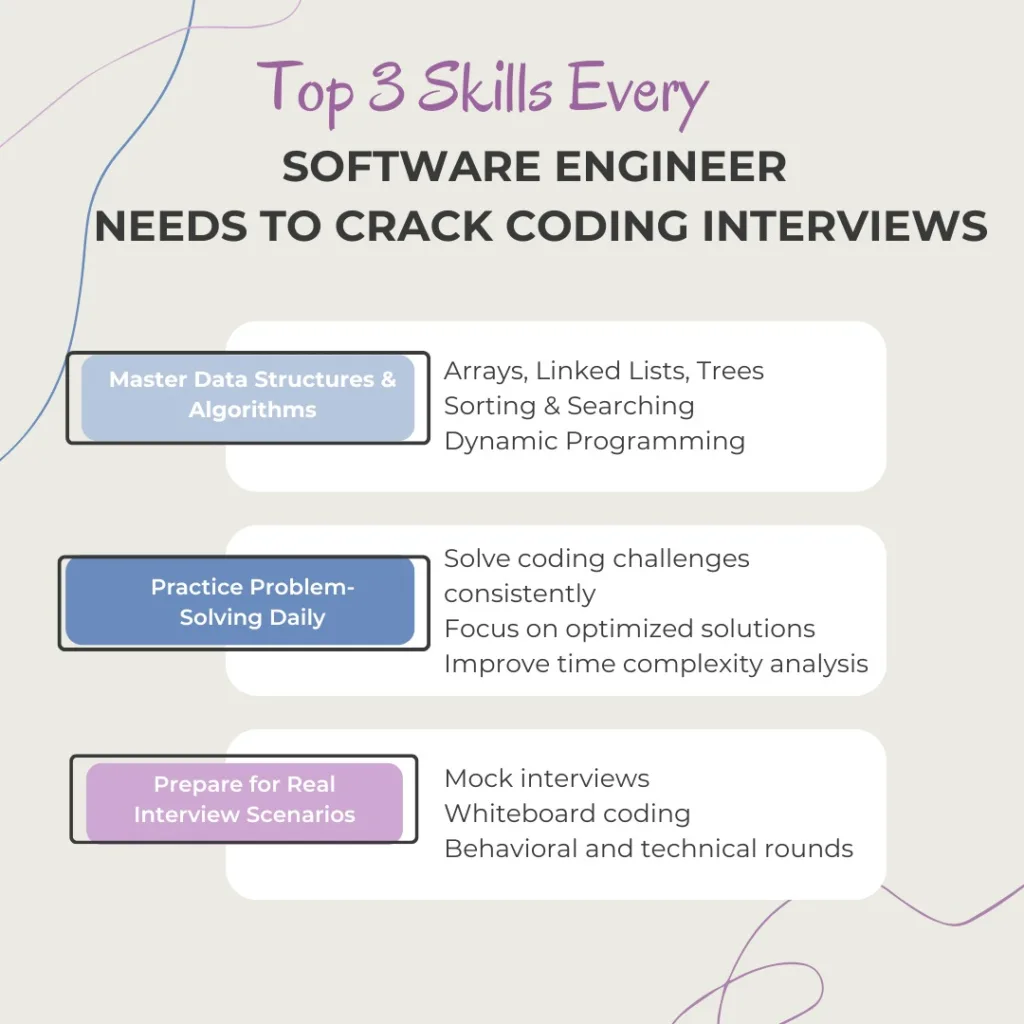
Interview Preparation Tips for Software Engineers
Practice Daily
Solve at least two coding problems every day to strengthen problem-solving skills.
Focus on Fundamentals
Master arrays, linked lists, trees, graphs, recursion, and dynamic programming before moving to advanced topics.
Review Solutions
Studying coding questions with solutions helps you understand optimized approaches and common interview patterns.
Learn Time Complexity
Interviewers expect candidates to explain the efficiency of their solutions using Big O notation.
Participate in Mock Interviews
Mock interviews help improve communication skills and prepare you for real-world scenarios.
Final Thoughts
Success in software engineering depends on consistent practice, strong fundamentals, and a structured preparation strategy. Whether you are preparing for entry-level roles or tackling a software engineer interview questions, mastering these coding questions will help you build confidence and improve your problem-solving abilities.
Focus on the most popular coding interview questions, regularly solve coding questions asked, and strengthen your knowledge of data structures and algorithms interview questions. With dedicated preparation, you’ll be better equipped to handle challenging assessments and secure your next software engineering opportunity.
FAQs
1. What are the most common coding interview questions asked by companies?
The most common coding interview questions focus on arrays, linked lists, stacks, queues, trees, graphs, sorting algorithms, searching techniques, and dynamic programming. Use these questions to assess problem-solving and coding skills.
2. How can I prepare for coding interview questions effectively?
Start by learning data structures and algorithms, solving coding challenges regularly, reviewing coding questions with solutions, and participating in mock interviews. Consistent practice is the key to improving performance.
3. Are coding questions asked in interview for freshers different from experienced candidates?
Yes. Coding questions asked in for freshers typically focus on programming fundamentals, basic algorithms, and data structures. Experienced professionals may also face system design, optimization, and architecture-related questions.
4. Why are data structures and algorithms important in software engineering interviews?
Data structures and algorithms help candidates write efficient and scalable code. Many companies include data structures and algorithms questions because they reveal a candidate’s ability to solve complex problems efficiently.
5. What are some popular coding interview questions for software engineers?
Popular coding interview questions include reversing an array, detecting cycles in linked lists, finding the Kth largest element, implementing binary search, checking for palindromes, solving graph traversal problems, and optimizing sorting algorithms. These questions frequently appear in technical rounds for software engineering roles.
