


Automate Content Marketing at Scale is becoming a strategic priority for modern businesses that need to compete in crowded markets. Unlike Traditional Automation, which typically follows fixed rules and predefined triggers, AI-powered systems can analyze large volumes of market data, identify patterns, and recommend actions. By connecting Digital Marketing Workflows with intelligent analysis, organizations can continuously monitor competitors, understand changing customer preferences, and turn market signals into actionable marketing decisions.
AI agents can transform how businesses approach competitive intelligence AI, market benchmarking automation, and AI market research. Instead of manually collecting information from competitor websites, advertising channels, social media, search results, and industry reports, intelligent agents can gather and organize relevant data automatically. This creates a faster foundation for strategic marketing insights and helps marketing teams make decisions based on current market conditions rather than outdated assumptions.
What Are AI Agents for Competitive Marketing Intelligence?
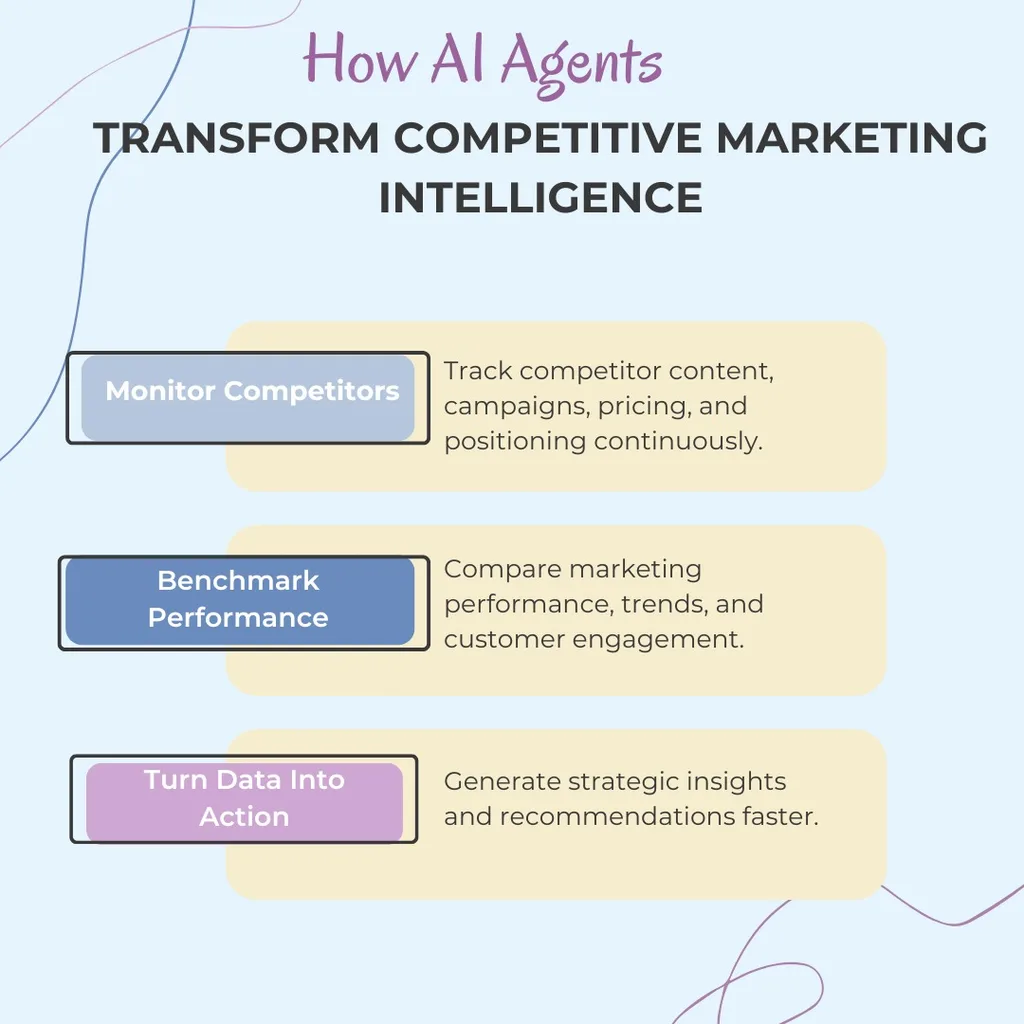
AI agents for competitive marketing intelligence are intelligent software systems designed to continuously collect, analyze, interpret, and act on competitive and market information. They can monitor competitor activities, identify emerging opportunities, compare marketing performance, and provide recommendations to marketing teams.
Unlike conventional competitor analysis tools, AI agents can go beyond presenting dashboards. They can identify unusual changes, summarize important developments, compare multiple competitors, and highlight areas that deserve immediate attention.
For enterprises, these capabilities can complement existing enterprise analytics systems and marketing intelligence platforms, creating a more connected approach to competitive research and decision-making.
How AI Agents Improve Competitive Intelligence
Modern businesses generate enormous amounts of marketing data every day. Competitor websites change, advertising campaigns evolve, customer reviews accumulate, social conversations shift, and new industry trends emerge. Manually monitoring these signals can be slow and inconsistent.
AI agents can automate this process by continuously examining relevant sources and identifying meaningful changes.
For example, an AI-driven system can:
- Monitor competitor product launches and promotions.
- Compare competitor messaging and positioning.
- Track changes in website content and SEO strategies.
- Analyze customer reviews and sentiment.
- Identify emerging market opportunities.
- Monitor advertising activity and campaign changes.
- Detect shifts in customer interests.
- Generate automated competitive reports.
- Recommend areas where a brand can differentiate itself.
This makes AI-driven competitor tracking particularly valuable for organizations that need continuous visibility into their competitive landscape.
Market Benchmarking Automation for Better Decisions
Market benchmarking automation enables businesses to compare their marketing performance against competitors, industry standards, and historical performance. AI agents can consolidate data from multiple channels and identify performance gaps.
Instead of simply asking, “How are we performing?”, marketers can ask more strategic questions:
- Where are competitors outperforming us?
- Which channels are generating stronger engagement?
- What messaging appears to resonate with customers?
- Which customer segments are competitors targeting?
- Where are there gaps in the market?
- Which emerging trends could influence demand?
These insights help marketing teams prioritize investments and develop more effective campaigns.
Competitive Intelligence Comparison
| Area | Traditional Approach | AI-Agent Approach |
| Competitor monitoring | Manual research | Continuous automated monitoring |
| Data collection | Spreadsheet-based | Automated multi-source collection |
| Market research | Periodic reports | Continuous AI market research |
| Competitor comparison | Static benchmarks | Dynamic benchmarking |
| Reporting | Manual presentations | Automated summaries and alerts |
| Insights | Human interpretation | AI-assisted pattern detection |
| Decision-making | Reactive | More proactive |
AI Market Research and Industry Trend Monitoring
AI agents can process information from a wide range of market sources, making industry trend monitoring faster and more scalable. They can analyze search behavior, customer conversations, competitor activity, product announcements, reviews, and other market signals.
This capability can help companies identify Consumer Trends Earlier, allowing marketers to respond before changes become mainstream.
For example, if an AI agent detects increasing consumer interest in a specific product feature, pricing model, or category, the marketing team can investigate the opportunity before competitors fully capitalize on it.
AI agents can also categorize trends according to:
- Customer demand
- Competitor activity
- Search behavior
- Product innovation
- Pricing changes
- Consumer sentiment
- Content trends
- Industry developments
Brand Positioning AI and Strategic Marketing Insights
Strong positioning requires understanding not only what a company says about itself but also how competitors communicate and how customers perceive the market.
Brand positioning AI can analyze competitor messaging, value propositions, product claims, content themes, and customer responses to identify positioning opportunities.
AI systems can help marketers answer questions such as:
- What differentiates our brand?
- Which competitor messages are becoming common?
- Which customer needs remain underserved?
- What language do customers use when describing their problems?
- Where can our brand establish stronger differentiation?
These capabilities support strategic marketing insights that can influence brand messaging, campaign planning, content strategy, and product marketing.
AI Agents Across Modern Marketing
Competitive intelligence becomes even more valuable when connected to broader marketing activities. AI agents can support Chatbots in Modern Marketing, enabling customer-facing systems to use current market knowledge when answering questions.
They can also support Content Repurposing by identifying high-performing competitor topics and transforming internal content into formats suited to different channels.
Other applications include:
- Marketing Automation for repetitive campaign processes.
- Conversion Rate Optimization through competitor and customer behavior analysis.
- Influencer Marketing Campaigns by identifying relevant creators and monitoring competitor partnerships.
- Lead Nurturing through better segmentation and behavioral insights.
- B2B Marketing Strategies using account, industry, and competitor intelligence.
- Brand Monitoring across digital channels.
- Paid Advertising Campaign Performance benchmarking against market activity.
- Customer Journey Optimization by identifying friction points and comparing customer experiences.
AI-Powered Marketing Intelligence Applications
| Marketing Function | AI Agent Capability | Potential Benefit |
| Competitor research | Continuous competitor monitoring | Faster market awareness |
| Content strategy | Topic and messaging analysis | Better content opportunities |
| Advertising | Competitor campaign monitoring | Stronger media decisions |
| Brand management | Sentiment and positioning analysis | Improved brand differentiation |
| Lead generation | Audience and account intelligence | Better targeting |
| CRO | Competitor and customer behavior analysis | Improved conversion opportunities |
| Customer experience | Journey analysis | Better customer interactions |
| Trend research | Automated signal detection | Earlier opportunity identification |
From Competitor Analysis Tools to Autonomous Intelligence
Traditional competitor analysis tools generally require users to search for information, create reports, and interpret results. AI agents can reduce this manual workload by continuously processing information and surfacing only the insights that matter.
For example, an AI agent could generate an alert such as:
“Three major competitors have increased investment in short-form educational content during the past month, while customer engagement around this topic has also increased.”
A marketer can then investigate the trend and decide whether it aligns with the company’s strategy.
This changes competitive intelligence from a periodic research task into an ongoing intelligence capability.
Integrating Marketing Intelligence Platforms
Organizations can integrate AI agents with existing marketing intelligence platforms and enterprise technology stacks. This can create a central intelligence layer that connects competitive information with marketing performance.
A mature architecture might connect:
- Competitive data sources
- Customer and CRM data
- Advertising platforms
- Website analytics
- Social media intelligence
- Search and content data
- Enterprise analytics systems
- AI reasoning and recommendation layers
The result is a more unified view of market performance.
Competitive Benchmarking Metrics
| Benchmark Category | Example Metrics | Intelligence Use |
| Content | Publishing frequency, engagement, topic coverage | Identify content gaps |
| SEO | Keyword visibility, content coverage | Discover search opportunities |
| Advertising | Ad activity, creative themes, channel presence | Compare campaign strategies |
| Brand | Sentiment, mentions, share of voice | Measure positioning |
| Customer | Reviews, complaints, preferences | Identify customer needs |
| Conversion | Landing-page experience, CTAs, offers | Support Conversion Rate Optimization |
| Social | Engagement, creator activity, audience response | Improve social strategy |
Building a Competitive Intelligence AI Workflow
A practical competitive intelligence AI workflow can be organized into five stages.
1. Collect
AI agents gather relevant information from approved internal and external sources.
2. Analyze
The system categorizes data and identifies patterns, anomalies, changes, and relationships.
3. Benchmark
Performance is compared against competitors, industry standards, and historical results.
4. Interpret
AI generates summaries and strategic marketing insights explaining what the changes may mean.
5. Act
Insights can trigger workflows, alerts, content recommendations, research tasks, or campaign reviews.
This approach enables market benchmarking automation while reducing repetitive manual research.
Competitive Intelligence and the Future of Marketing
The future of marketing intelligence is moving from static dashboards toward systems that can observe, reason, recommend, and continuously learn from new information.
AI agents can help marketing teams move beyond simply collecting data. Their greater value lies in connecting different signals and explaining why those signals matter.
For example, a change in competitor pricing combined with increased customer interest and declining engagement on a company’s existing campaign may indicate a strategic opportunity. An AI agent can bring these signals together and prompt the marketing team to investigate.
Organizations that combine AI agents with strong data governance, human oversight, and clear strategic objectives can build a more responsive competitive marketing capability.
AI Agent Capability Maturity
| Stage | Capability | Marketing Outcome |
| Level 1 | Data collection | Centralized information |
| Level 2 | Automated monitoring | Faster awareness |
| Level 3 | Benchmarking | Performance comparison |
| Level 4 | AI interpretation | Actionable insights |
| Level 5 | Agentic recommendations | Proactive decision support |
| Level 6 | Workflow integration | Automated intelligence-to-action |
Frequently Asked Questions
1. What are AI agents for competitive marketing intelligence?
AI agents are intelligent systems that continuously collect, analyze, and interpret market and competitor information. They can monitor competitors, identify trends, benchmark performance, and generate recommendations for marketing teams.
2. How does AI improve competitor analysis?
AI can process large amounts of competitive data much faster than manual research. It can identify changes in competitor messaging, content, advertising, pricing, customer sentiment, and market activity, helping marketers respond more quickly.
3. Can AI agents replace traditional market research?
AI agents can automate significant parts of research, including data collection, categorization, monitoring, and initial analysis. However, human expertise remains important for validating findings, understanding business context, and making strategic decisions.
4. How can companies use AI for market benchmarking?
Companies can use AI to compare their marketing performance with competitors and industry benchmarks across areas such as content, advertising, SEO, brand visibility, engagement, and customer experience. This can reveal performance gaps and opportunities.
5. How do AI agents support marketing automation?
AI agents can connect intelligence with Marketing Automation, allowing market signals to inform campaign planning, lead nurturing, content workflows, advertising analysis, and customer journey improvements. This creates a more adaptive marketing operation where intelligence can continuously influence execution.
