

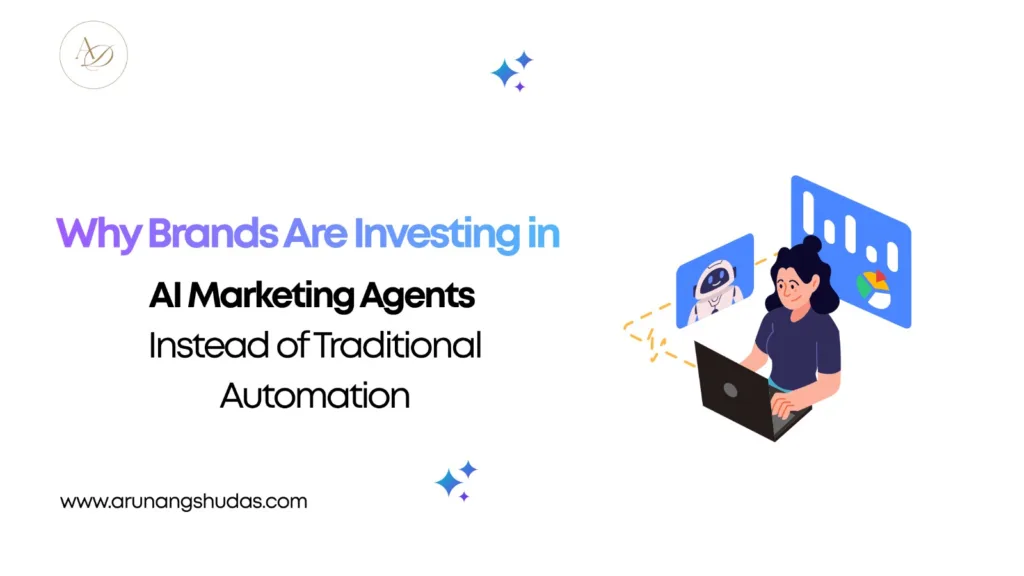
In today’s rapidly evolving marketing landscape, brands are rethinking how they manage campaigns, customer interactions, and business growth. Traditional automation tools once revolutionized marketing by simplifying repetitive tasks, but modern businesses now require more intelligent solutions capable of making decisions, adapting to customer behavior, and optimizing performance in real time. This shift has fueled the rise of AI marketing agents, which are transforming Digital Marketing Workflows across industries.
Unlike conventional automation software that follows predefined rules, AI-powered systems can learn from data, identify opportunities, and execute actions autonomously. As customer expectations continue to rise and competition intensifies, businesses are increasingly turning to advanced AI solutions to achieve scalable growth and operational efficiency.
Understanding the Difference Between Traditional Automation and AI Marketing Agents
Traditional automation focuses on executing repetitive tasks based on fixed workflows. These systems are useful for scheduling emails, posting social media content, or triggering notifications based on specific events.
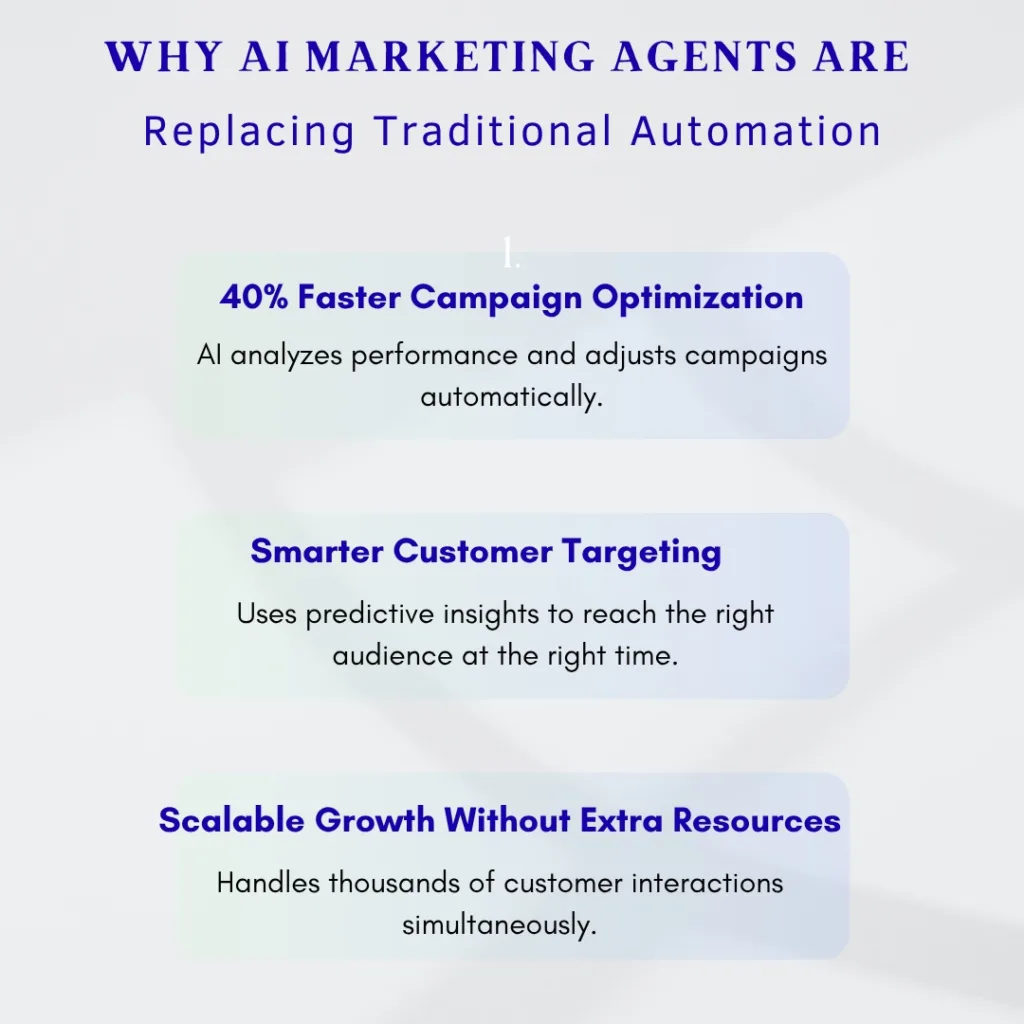
However, AI marketing agents go beyond task execution. They analyze customer data, predict outcomes, make recommendations, and continuously optimize campaigns without requiring constant human intervention.
Key Differences
| Feature | Traditional Automation | AI Marketing Agents |
| Decision Making | Rule-Based | Data-Driven |
| Learning Ability | None | Continuous Learning |
| Adaptability | Limited | High |
| Customer Personalization | Basic | Advanced |
| Campaign Optimization | Manual | Autonomous |
| Real-Time Responses | Limited | Intelligent |
This evolution is encouraging organizations to replace rigid workflows with more dynamic and responsive intelligent marketing systems.
Why Traditional Automation Is Reaching Its Limits
Marketing teams today manage multiple channels, audiences, campaigns, and customer journeys simultaneously. Traditional automation struggles to keep pace because it depends heavily on manual setup and ongoing adjustments.
Common limitations include:
- Static workflows
- Limited personalization
- Inability to interpret customer intent
- Manual campaign optimization
- Delayed response to market changes
- Siloed data utilization
As customer journeys become increasingly complex, businesses need solutions that can think, learn, and act independently.
The Rise of Intelligent Marketing Systems
Modern intelligent marketing systems combine machine learning, predictive analytics, natural language processing, and autonomous decision-making capabilities.
These systems help marketers:
- Analyze large volumes of customer data
- Identify behavioral patterns
- Predict future actions
- Optimize marketing budgets
- Improve customer experiences
- Scale campaigns efficiently
Rather than simply automating tasks, AI systems actively contribute to strategic marketing outcomes.
How AI Campaign Workflows Improve Marketing Performance
One of the biggest reasons brands are adopting AI solutions is the effectiveness of AI campaign workflows.
Traditional workflows require marketers to:
- Build campaign logic manually.
- Monitor performance continuously.
- Adjust targeting criteria.
- Optimize creative assets.
- Allocate budgets manually.
AI-driven workflows can perform many of these tasks automatically.
Benefits of AI Campaign Workflows
| Marketing Activity | Traditional Process | AI-Powered Process |
| Audience Segmentation | Manual | Automated |
| Campaign Testing | Time-Consuming | Continuous |
| Budget Allocation | Human Managed | AI Optimized |
| Performance Analysis | Periodic | Real-Time |
| Customer Journey Mapping | Static | Dynamic |
These improvements help organizations reduce operational overhead while increasing campaign effectiveness.
Autonomous Customer Engagement Is Changing Customer Experiences
Customers expect brands to respond instantly and deliver personalized experiences at every touchpoint.
This demand has accelerated the adoption of autonomous customer engagement technologies.
AI agents can:
- Deliver personalized recommendations
- Respond to inquiries instantly
- Predict customer needs
- Trigger contextual communications
- Improve customer retention strategies
Unlike traditional automation, AI agents can understand context and adapt interactions based on customer behavior, making engagement more relevant and impactful.
Enterprise AI Marketing Is Becoming a Competitive Advantage
Large organizations are investing heavily in enterprise AI marketing because it enables them to manage complex operations at scale.
Enterprise-level marketing teams often oversee:
- Multiple brands
- Global campaigns
- Diverse customer segments
- Large advertising budgets
- Cross-channel communication
AI agents provide centralized intelligence that helps organizations coordinate these activities more effectively.
Enterprise Benefits
| Business Objective | Impact of Enterprise AI Marketing |
| Revenue Growth | Improved targeting and conversion |
| Operational Efficiency | Reduced manual workload |
| Customer Retention | Better personalization |
| Marketing ROI | Smarter budget allocation |
| Scalability | Faster campaign expansion |
As organizations continue their digital transformation initiatives, AI becomes a critical strategic asset.
AI Growth Tools Are Driving Smarter Decision-Making
Modern AI growth tools help businesses uncover opportunities that traditional software often misses.
These tools can:
- Predict customer lifetime value
- Identify high-converting audience segments
- Recommend content strategies
- Optimize ad spending
- Forecast campaign outcomes
Instead of relying solely on historical reports, marketers gain forward-looking insights that improve decision-making and accelerate growth.
Digital Transformation Marketing Requires More Intelligence
The era of digital transformation marketing is about more than adopting new technologies. It involves creating agile, data-driven organizations capable of adapting quickly to market changes.
AI marketing agents support digital transformation by:
- Connecting fragmented data sources
- Automating complex decision-making
- Enhancing customer experiences
- Improving organizational efficiency
- Enabling predictive marketing strategies
Businesses that embrace AI often gain a significant advantage over competitors still dependent on traditional automation methods.
The Growing Demand for Scalable Marketing AI
As businesses expand, marketing complexity increases dramatically.
This is where scalable marketing AI becomes essential.
AI agents can handle:
- Millions of customer interactions
- Large-scale campaign optimization
- Multi-channel personalization
- Real-time performance monitoring
- Automated reporting
Unlike traditional systems that require additional resources as operations grow, AI-powered solutions can scale more efficiently.
How AI Agents Drive Business Functions
| AI Capability | Primary Function | Business Benefit |
| AI Operations Marketing | Automates campaign execution and resource allocation | Improves efficiency and reduces manual workload |
| AI Agents for SEO | Identifies keyword opportunities and technical issues | Enhances search visibility and organic traffic |
| Memory for Agents | Retains historical interactions and context | Delivers personalized and consistent experiences |
| Transforming Financial Research Workflows | Analyzes large datasets and market trends | Accelerates decision-making and forecasting accuracy |
The Role of AI Agents for SEO
Search engine optimization is becoming increasingly complex due to changing algorithms, evolving search intent, and growing content competition.
AI Agents for SEO can assist teams by:
- Identifying keyword opportunities
- Monitoring ranking fluctuations
- Optimizing content recommendations
- Analyzing competitor strategies
- Automating technical SEO audits
These capabilities help organizations improve search visibility while reducing manual effort.
Why Memory for Agents Matters
One of the most powerful advancements in AI technology is Memory for Agents.
Traditional automation tools operate without context retention. AI agents equipped with memory can:
- Remember customer interactions
- Learn from previous campaigns
- Improve future recommendations
- Deliver consistent customer experiences
- Enhance personalization efforts
This persistent understanding allows AI systems to become more effective over time.
Beyond Marketing: Transforming Financial Research Workflows
The capabilities of AI agents extend far beyond marketing departments.
Organizations are increasingly using AI for Transforming Financial Research Workflows, enabling analysts to:
- Process large datasets quickly
- Generate actionable insights
- Identify market trends
- Improve forecasting accuracy
- Reduce research time significantly
This broader adoption demonstrates the versatility and long-term value of AI-driven systems.
Challenges Brands Must Consider
While AI marketing agents offer significant benefits, successful implementation requires thoughtful planning.
Key considerations include:
- Data quality and governance
- Integration with existing systems
- Team training and adoption
- Compliance and privacy requirements
- Ethical AI usage
- Ongoing performance monitoring
Organizations that address these challenges proactively are more likely to achieve successful outcomes.
The Future of Marketing Belongs to Intelligent Systems
The shift from traditional automation to AI-driven marketing is not simply a technology upgrade—it represents a fundamental transformation in how brands operate.
As customer expectations continue to evolve, businesses need systems capable of learning, adapting, and making decisions independently. AI marketing agents provide these capabilities, helping organizations improve efficiency, enhance personalization, and drive sustainable growth.
Brands investing in AI today are positioning themselves for a future where intelligent decision-making, autonomous execution, and scalable operations become standard components of marketing success.
FAQs
1. What are AI marketing agents?
AI marketing agents are intelligent software systems that can analyze data, make decisions, optimize campaigns, and execute marketing tasks autonomously with minimal human intervention.
2. How do AI marketing agents differ from traditional automation?
Traditional automation follows predefined rules, while AI marketing agents learn from data, adapt to changing conditions, and continuously improve campaign performance.
3. Why are businesses investing in intelligent marketing systems?
Businesses use intelligent marketing systems to improve personalization, increase efficiency, optimize marketing spend, and deliver better customer experiences.
4. Can AI marketing agents help with SEO?
Yes. AI Agents for SEO can assist with keyword research, content optimization, technical audits, ranking analysis, and competitive intelligence.
5. Are AI marketing agents suitable for small businesses?
Absolutely. Many AI growth tools and scalable marketing AI platforms are designed to support businesses of all sizes, enabling small companies to compete more effectively in digital markets.
