


AI systems are no longer mere question-answer systems. These days, the agents strategize, make calls, recollect previous experiences, and evolve. One of the most important abilities of this evolution is memory. Even the most potent model is like a person with amnesia without memory; bright in the here and now but unable to learn by experience.
When we discuss What Is an AI Agent, we actually discuss a system capable of perceiving, making decisions, taking action, and making it better. It is memory that puts all that together. It will enable the agents to go beyond individual prompts and be truly autonomous.
What Is Memory for AI Agents?
Memory of Agents is defined as the processes due to which an AI agent is able to store, recall, and utilize information through time. This is all the way up to short-time context in a session to long-term knowledge that is accumulated in weeks or months.
The short-term memory can be residing within the context window of the model. It is quick and weak–when the session is over it is lost. On the contrary, long-term memory is lasting. Here the memory systems of AI agents such as the vector stores, key-value stores and graph databases are involved.
The major distinction in the context and persistent memory is that of endurance. Context assists the agent in thinking at the moment. The memory enables the agent to have improved thoughts tomorrow.
Why Memory Matters in Agentic AI Systems
Memory converts agents into passive agents by making them active partners. Agents with long-term memory enhance the decision-making process since the agent will have the ability to consult the outcome. When an agent recollects that a certain strategy did not work in the past, he can make changes rather than commit errors again.
Personalization also works in this way. A software that is aware of the user preferences does not seem like software but rather a friendly helper. Without memory AI Agents Replace Workflows Just Surficially. They meaningfully replace them with the help of memory.
Stateless LLMs think brilliantly separately, but they do not think with continuity. The gap is filled by the use of memory that bases intelligence on experience.
Types of Memory for AI Agents
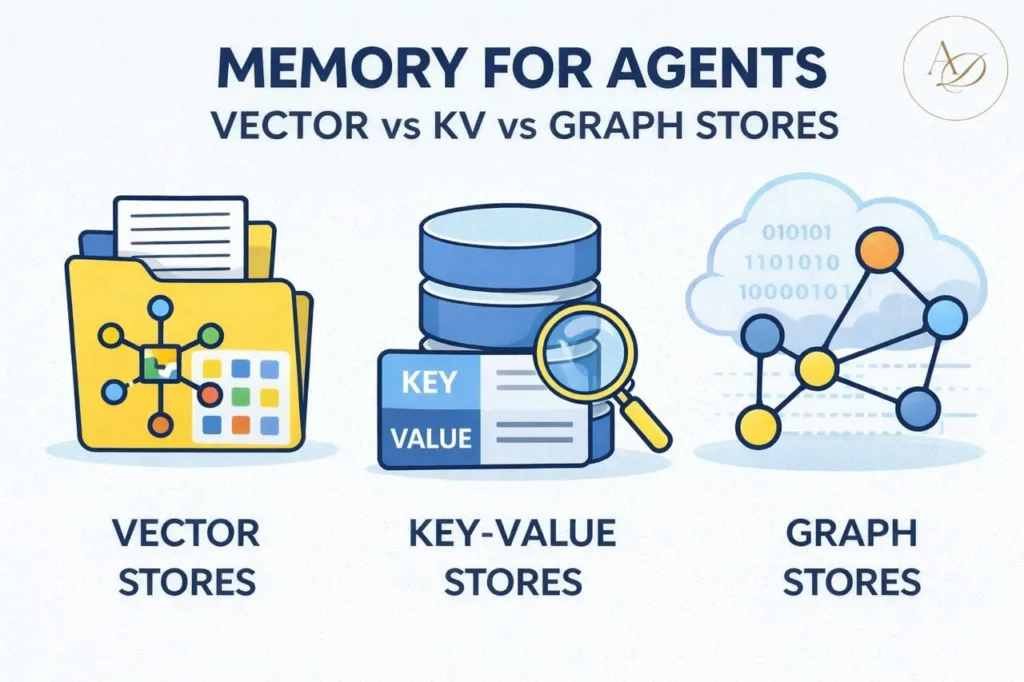
It does not have a single type of memory that is the solution to everything. Rather, the contemporary agent systems are based on various memory stores based on the task. Agents can use the primary memory options which are the vector memory, key-value memory and the graph memory.
Both systems are good at a style of recall. The vector memory is associative and fuzzy. KV memory is exact and fast. Graph memory is orderly and organized. The transfers of one to the other characterize the performance of your agent when under pressure.
Vector Stores as Memory for Agents
The idea behind the use of vector stores is to encode text, images, or events as numbers, specifically as embeddings or numerical representations of meaning. These embeddings enable agents to do a semantic search, where in order to find information it is not required to be exactly matched, just similar.
This makes vector stores useful in storing unstructured experience of agents such as a conversation or a document. They excel in vibe-based recall like when remembering a prior conversation despite the change of words.
Nonetheless, there are limitations associated with the usage of the vector stores. They may be black box like and at times retrieval of similarity is giving them something matching but not accurate.
Use Cases of Vector Memory in AI Agents
In conversational agents, natural recall can be performed by vector memory. The agent is able to recall previous conversations and cite them effortlessly. In heavy systems of knowledge, the databases of vectors are used as the external brain of the system that complements the knowledge of the model.
Vector memory is also powerful for contextual decision support. For example, when you Train an AI Agent for customer support, vector memory helps it recall similar past issues and solutions without rigid rules.
Key-Value (KV) Stores as Memory for Agents
The simplest and the fastest type of agent memory is key-value memory. Information is stored in the form of a key and is retrieved by use of the same key. There is no doubt or semantic guess.
This renders KV stores ideal in organized data such as user preferences, session states or configuration flags. When the key is a match, the agent recalls. If not, it doesn’t.
The disadvantage is self-evident: a lack of semantic comprehension. KV memory is not a thinker, but a fetcher.
Use Cases of KV Memory in Agentic Workflows
Deterministic agent behavior is based on KV memory. It is applied in tracking sessions, caching the output of tools, and in controlling intermediate results in complicated processes.
KV memory provides reliability when AI Agents are used to replace workflows of production systems. The agent is aware of what it left, what tool it applied and in what state the task is-there is no guessing of that.
Graph Stores as Memory for Agents
Graph memory is a relational database which maintains data in the form of nodes and edges, which are the relationships and the entities. The system resembles the way human beings conceptualize complex systems.
Graphs are also strong since they maintain relationships that would be lost by other types of memory. They allow multi-hop reasoning (e.g. knowing chains of responsibility or ownership).
It is the difficulty of being complex. Structured graph extraction is computationally costly, and the management of a schema can be challenging.
Use Cases of Graph Memory in AI Agents
Graph memory excels in a situation where one needs to reason across relationships. Graph based memory has various applications in task planning, dependency management and entity tracking.
Graph memory is priceless in enterprise systems and Legal Agents. The legal reasoning may tend to rely on interlinked facts, precedents, and persons. Graphs give the agents a clear way out of this complexity.
Vector vs KV vs Graph Stores for Agent Memory
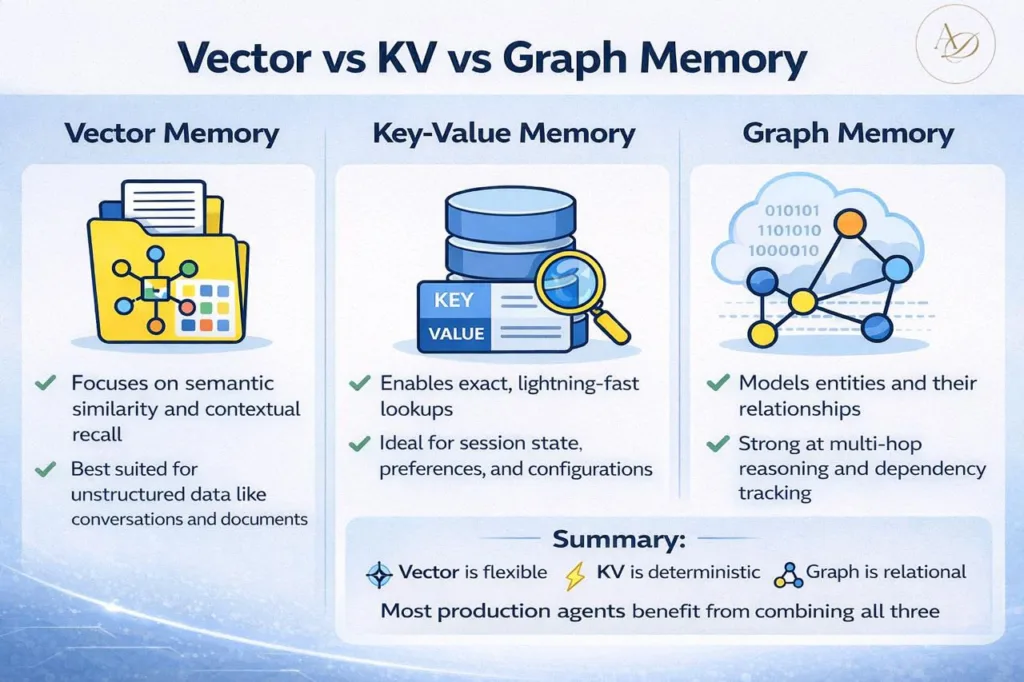
The decision of vector, KV, and graph memory is determined by the thought process of your agent.
| Feature | Vector Store | KV Store | Graph Store |
| Search Type | Semantic similarity | Exact key match | Relational traversal |
| Data Type | Unstructured text | Structured state | Interconnected entities |
| Latency | Medium | Very low | High |
| Reasoning | Associative | None | High |
There are flexible, fast, and smart-but-heavy types of stores.
Choosing the Right Memory Store for AI Agents
No one best memory store exists. The correct decision will be based on the job of the agent. In case the agent requires recalling of similar experiences, then the vector memory is applicable. In case it requires precise values, KV memory is the winner. Graph memory is necessary in case it is required to reason about relationships.
The majority of real world agents do not make the choice of a single one.
Hybrid Memory Architectures for Agents
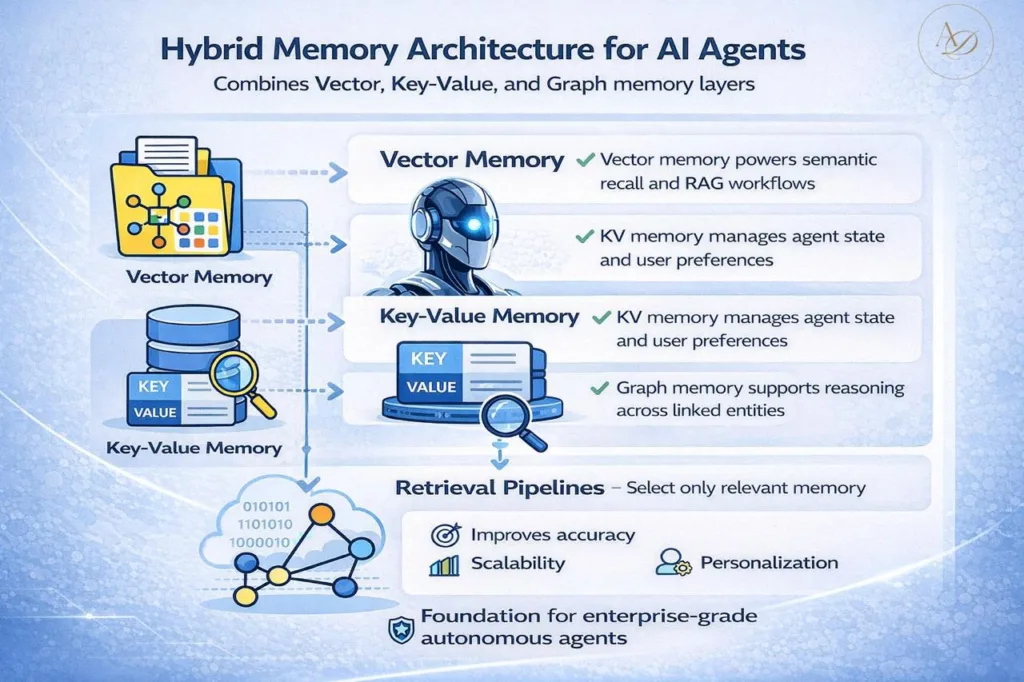
Hybrid memory systems merge several types of memory into layered memory systems. One popular architecture is to use KV memory as state, vector memory as recall and graph memory as reasoning.
Such a mixed solution is representative of human cognition: fast facts, hazy memories and organized knowledge are functioning in the same direction. Hybrid RAG systems are becoming the rule in production.
Memory Retrieval Strategies for Agents
Storage is equally significant like retrieval. In injection of memories into the context, smart agents utilize pipelines to filter, rank, and prioritize them.
Agents end up being overloaded with memories without careful retrieval. Relevance scoring and context selection ensure that memory is not noisy.
Memory Update & Forgetting Strategies for AI Agents
The forgetting is a quality, rather than a vice. To prevent bias and confusion, the agents need to cut off the outdated or irrelevant memories.
Experience compression through summarization assists in creating information that is durable. This maintains long-term memory mean and doable.
Security & Privacy Considerations in Agent Memory Systems
Sensitive information is usually stored in memory. AI agent secure memory must have access controls, encryption and per-user isolation.
The issue of compliance is particularly relevant in the regulated industry. The design of memory must conform to the legislations and ethics on privacy at the very beginning.
Real-World Applications of Memory for Agents
Customer support bots, enterprise automation, and personal assistants operate using memory-driven agents. They stream, automate and enhance uniformity.
In legal, finance, and healthcare, memory-enabled agents assist in the complex workflow with accountability, which is particularly important in case of Legal Agents working with sensitive cases.
Future of Memory for Agentic AI
The future is in the direction of self-curating memory systems. The agents will know what to memorize, what to summarize and what to forget.
The faster adoption of agentic AI will be achieved through standardized memory APIs and more intelligent architectures that propel agentic AI to business operations.

Conclusion: How to Choose the Right Memory
The answer to this question is a simple one; this is, does my agent require to locate something like it, access a particular value, or learn about a complex relationship? The solution governs your decision of memory.
The bottom line is apparent: the majority of production systems will be converted to hybrid memory architectures, consisting of the combination of both a vector store, KV store, and a graph store into one intelligent memory layer.
FAQs
1. What is memory for AI agents?
Memory for agents enables AI systems to store and recall information across interactions, supporting learning and continuity.
2. Why are vector stores popular for agent memory?
They excel at semantic search and recalling unstructured information based on meaning rather than exact matches.
3. When should I use KV memory for agents?
KV memory is ideal for fast, deterministic storage of structured data like user preferences or session state.
4. Are graph stores necessary for all agents?
No, Graph memory is best for agents that need relational reasoning, not simple recall or state management.
5. What is the best memory architecture for production agents?
Most real-world agents benefit from hybrid memory systems that combine vector, KV, and graph stores.
