


Multi-agent reasoning loops Reasoning loops in Multi-agent Systems are at the center of contemporary artificial intelligence. Suppose that a population of intelligent agents is continuously monitoring its surroundings, choosing, taking action and learning about the consequences. It is this looping process commonly referred to as decision-making loop that enables intelligent agents to operate independently in dynamic environments.
The reasoning loop in AI agent systems determines the perception of the information, the choice evaluation, and the action of the agents without the involvement of a human being. They are particularly crucial in multi-agent environments since the agents do not act independently. They have to take into account the existence, activities and intentions of other agents and this renders autonomous reasoning strong and difficult.
In a more profound way, reasoning loops relate the reasoning, the action, and the learning into one stream. An agent thinks concerning its environment, performs according to this thinking and learns through the actions. With time, this loop is refined to the point where the agents are able to adapt, coordinate and even out-perform traditional rule based systems.
What Are Multi-Agent Systems in Artificial Intelligence?
Multi-Agent Systems (MAS) Multi-agent systems (MAS) are a sub-field of distributed artificial intelligence in which autonomous agents are allowed to co-exist in a common environment. All the agents possess their duties, perception and decision making abilities, but they frequently require to collaborate or contend in order to attain greater targets.
In contrast to single agent architectures, agent based systems establish the decentralization of intelligence among multiple agents. They are more scaled, flexible and resilient because of this design. When a single agent fails, others are able to keep on running and this is why MAS are used in a mission critical application.
Multi-agent systems are utilized in the real world. MAS allows large-scale, high-problem, solution finding, from traffic control systems and robotic swarms, financial trading bots and smart grids. Organizations today are finding that a Startup Needs an Internal AI Agent ecosystem, and not a monolithic AI, is needed, particularly with Workflow Automation and decision support.
Understanding Reasoning Loops in Autonomous Agents
The inner mechanism, which propels the actions of an agent, is called a reasoning loop. Most loops are based on a variation of classic perception-action cycle, and the agent perceives its environment and processes information and acts.
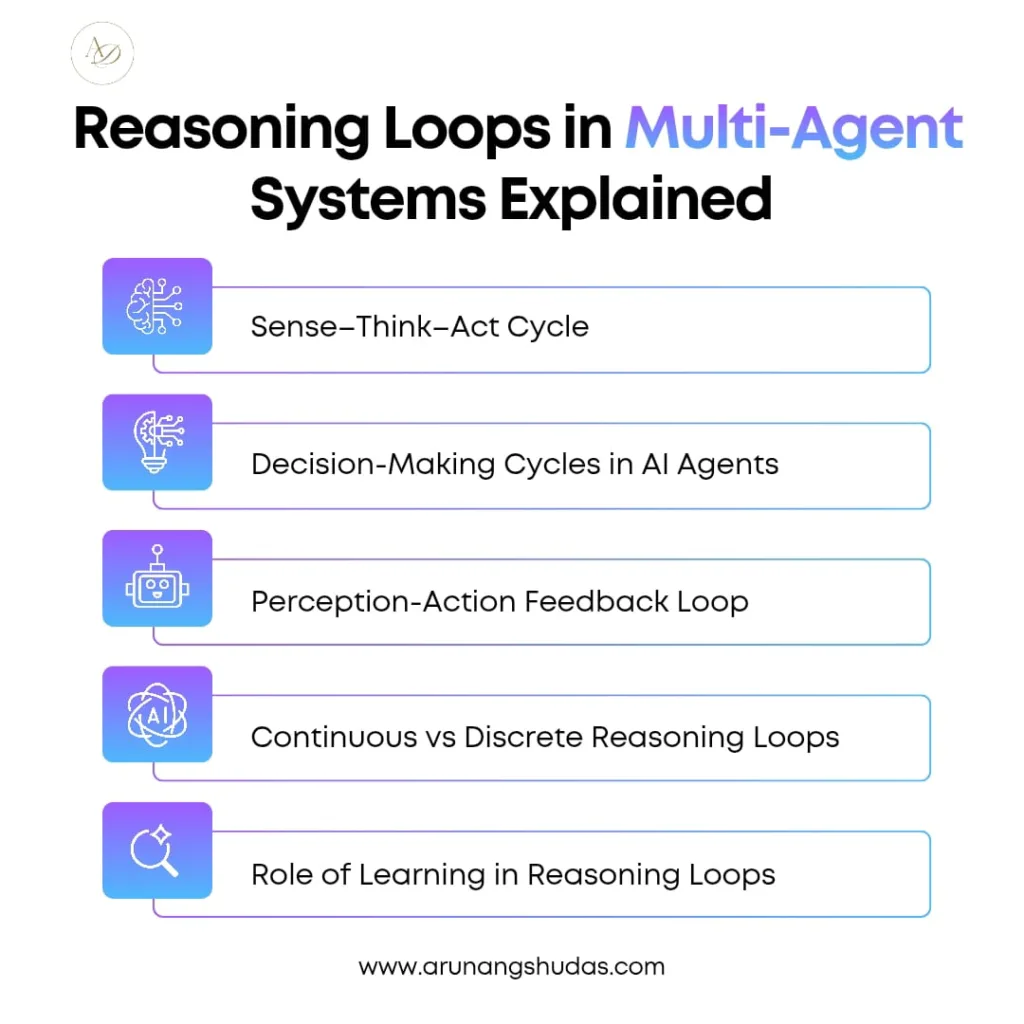
One of the basic models is the SenseThinkAct cycle. As a preliminary, the agent collects data by sensors or inputs. It then compares this data with some internal logic or models learnt. Lastly, it does something that has an impact on the environment. The result in turn feeds back on the subsequent cycle.
Loops of reasoning are either continuous or discrete. Continuous loops are running in real-time and constantly adjust actions, and discrete loops are running at definite intervals. Constant repetitions are necessary in highly dynamic fields such as robotics or autonomous vehicle development. Conversely, strategic planning systems can be based on discrete cycles in order to achieve accuracy and efficiency.
Types of Reasoning Loops in Multi-Agent Systems
1. Reactive Reasoning Loops in Agent Systems
Reactive reasoning involves instant action. These agents are rule-based and that is why they are well suited in a real-time and event-driven environment. The agent reacts when something happens, no profound thought is needed.
Reactive loops are relatively quick and computationally lean, and that is why they are frequently applied in swarm robotics as well as game AI. Nevertheless, their simplicity restricts the ability to plan over the long term and be flexible.
2. Deliberative Reasoning Loops for Intelligent Agents
Planning and goal-oriented behavior is brought about by deliberative reasoning. Before making action these agents consider a variety of future states, based on symbolic reasoning or planning algorithms. Planning agents entail the generation, evaluation and the selection of plans.
This method allows smarter behavior though at the cost of greater computation. Deliberative agents are prevalent in the logistics, scheduling, and scenarios of decision-making that have long-term implications.
3. Hybrid Reasoning Loops in Multi-Agent Architectures
Hybrid agent reasoning is a combination of deliberative and reactive speed. Layered agent models enable rapid responses at the bottom-level whilst the higher levels deal with tactical thought. This tradeoff allows the adaptive behavior of agents without resource saturation of a system.
Hybrid systems are becoming very common in practical implementations, particularly where organisations seek to train an AI Agent that can be responsive and also be able to plan as well.
Reflection in Multi-Agent Systems Explained
Multi-Agent Systems Reflection goes a step further in regards to intelligence. Reflection enables agents to be reflective regarding their thinking. Such self-reflective agents are able to analyze their reasoning process, decision making and result to enhance the subsequent behavior.
The major distinction between reasoning and reflection is focus. Logic provides the answer to the question What shall I do? This question is reflected; was my reasoning effective? Through introspection of AI, the agents may detect errors, inefficiencies, and biases.
Reflection enhances agent intelligence, as it allows the agent to correct himself. Reflective agents do not follow the same route blindly, but restructure their strategies resulting in a stronger and more trustworthy performance as time goes on.
Meta-Reasoning and Self-Reflection in Agent Architectures
Multi-Agent Systems Multi-agent reasoning entails reasoning about reasoning. Agents keep track of their own decision processes as they consider issues such as accuracy, speed and consumption of resources.
Systems can use self-monitoring agents to optimize behavior in a dynamic manner. An example is that in a real-time setting, an agent can discover that its planning process is too slow and change to a simpler one.
Meta-reasoning is also important in the detection of errors. Through making analysis on previous conclusions, agents can determine the pattern of failure and correct on the same. This is a necessary cognitive positive feedback loop to create scalable trustworthy AI systems.
Reasoning Loops vs Reflection in Multi-Agent Systems
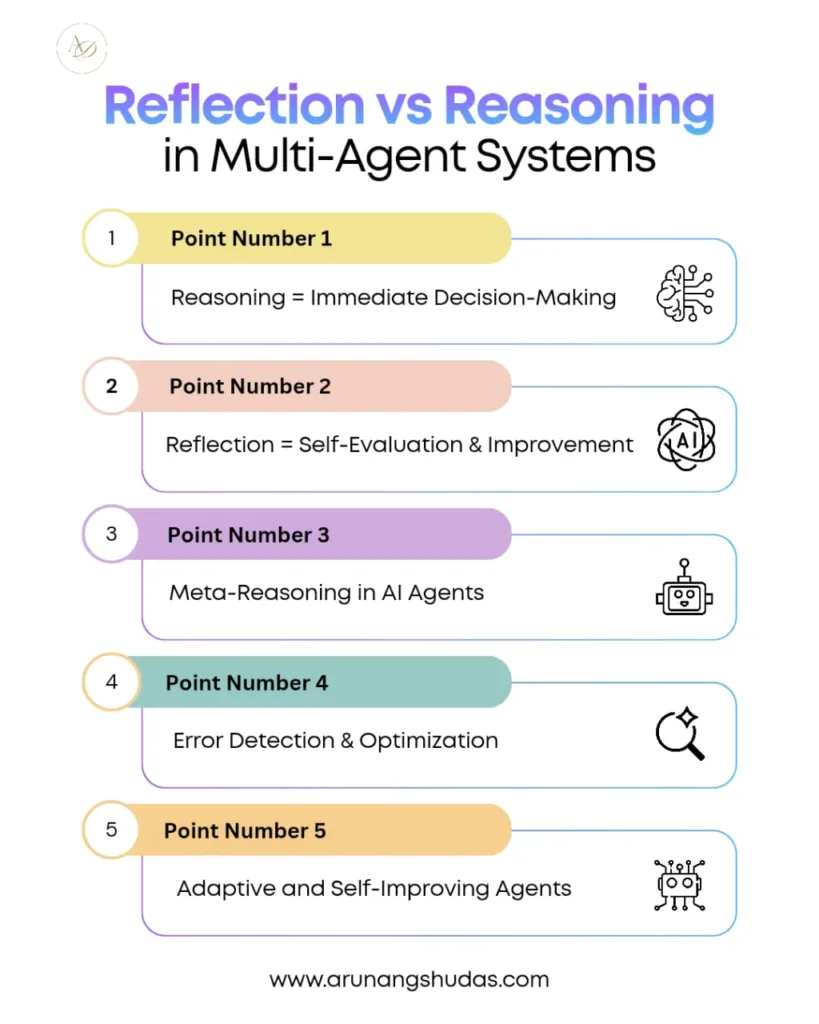
Reasoning loops and reflection are almost synonymous but do not accomplish the same purpose. Reasoning loops deal with short-term decision-making and reflection is based on long-term improvement.
In most cases, simple circuits of reasoning are adequate particularly in foreseeable contexts. Nevertheless, reflection is required as the systems become more complicated. Reflective agents are able to accommodate the unplanned events, can work together more effectively, and can streamline the performance through time.
MAS are the most developed ones that combine both methods and develop agents that make decisions in the moment and constantly improve their strategies.
Learning-Enhanced Reasoning Loops in Multi-Agent Systems
Reasoning cycles are changed into self-improving cycles through learning. In reinforcement learning agents, the choices made by the agent are rated on the basis of rewards and over time the agent can improve on the choice made.
This is enhanced by reflection learning. The agents are able to modify learning parameters and strategies by examining some of the reasons behind the success or failure of certain actions. This leads to adaptive thinking which changes as experience advances.
Modern business Workflow Automation involves learning-enhanced reasoning loops that become the focus of Workflow Automation and even Replacing Teams with AI Agents to perform repetitive or data-intensive work.
Coordination and Communication Through Reasoning Loops
Everything is coordinated in the multi-agent environment. Agents have to negotiate, communicate and coordinate their activities. Common sense paths allow agents to coordinate actions and prevent disagreements.
Reflection can be used to solve conflicts by being able to analyze communication breakdowns or conflicting interests. With time, the agents come up with common strategies and hence collective intelligence in MAS that is even more than individual capabilities.
Use Cases of Reasoning Loops and Reflection in Multi-Agent Systems
Reasoning Loops have wide uses in MAS in the fields of robotics to finance. Simple reasoning loops, which are augmented with reflection, are used to coordinate movements in swarm robotics. Agents learn through the outcomes and adjust strategies in autonomous trading where the agents observe the markets and analyze them.
Multi-agent reasoning is used in smart cities and Internet of Things to optimize the use of traffic, energy and resources. These systems show how reflective MAS is able to deal with scale in complexity.
Challenges in Implementing Reflection and Reasoning Loops
Reflective systems despite their advantages present challenges. Reflections introduce calculations overheads, and this may affect real-time performance. The complexity of a system is also made higher by synchronizing multi-reflective agents.
There is a need to strike a balance between intelligence and efficiency by the designers. Reflective responses can be sluggish in time-sensitive applications and, therefore, architecture design is important.
Best Practices for Designing Reflective Multi-Agent Systems
Good design begins with the knowledge of knowing when to be reflective. Not all agents require profound reflection. Modulating the reasoning loop frequency is useful in ensuring that performance is not sacrificed at the expense of adaptability.
It is also important to balance between autonomy and control. The agents must be empowered to be flexible but conform to the system-level constraints.
Future of Reasoning Loops and Reflection in Multi-Agent AI
The future is toward more autonomous agents who are more self-aware. Studies on reflection-based general intelligence are gaining momentum and we are now nearer to the goal of having agents that are not only task-aware but self-aware.
Nevertheless, moral and control issues are also vital. The more the agents are autonomous, the more transparency, accountability, and alignment with human values have to be ensured.

Conclusion
Intelligent Adaptive AI is based on Reasoning Loops and Reflection in Multi-Agent Systems. Reasoning loops help agents to do things and reflection to do things better. They combine to open and open scale, resilient and intelligent systems.
To both businesses and researchers, these are the concepts that can be mastered in order to create next-generation AI, which could be automating workflows, training smarter agents, or creating collaborative AI ecosystems.
FAQs
1. What are reasoning loops in multi-agent systems?
They are repetitive decision making processes whereby agents feel, reason, take action and learn in a common environment.
2. How does reflection improve AI agents?
Reflection enables the agents to analyze their personal decisions, which results in constant enhancement and flexibility.
3. Are reflective agents computationally expensive?
Admittedly, reflection is an overhead, and that is why it should be balanced with performance requirements.
4. Where are reasoning loops commonly used?
They are applied in the field of robotics, autonomous vehicles, trading systems, and smart infrastructure.
5. Can multi-agent systems replace human teams?
In some areas, yes. They can supplement or even substitute teams in case of repetitive and data-driven tasks with an appropriate design.
