


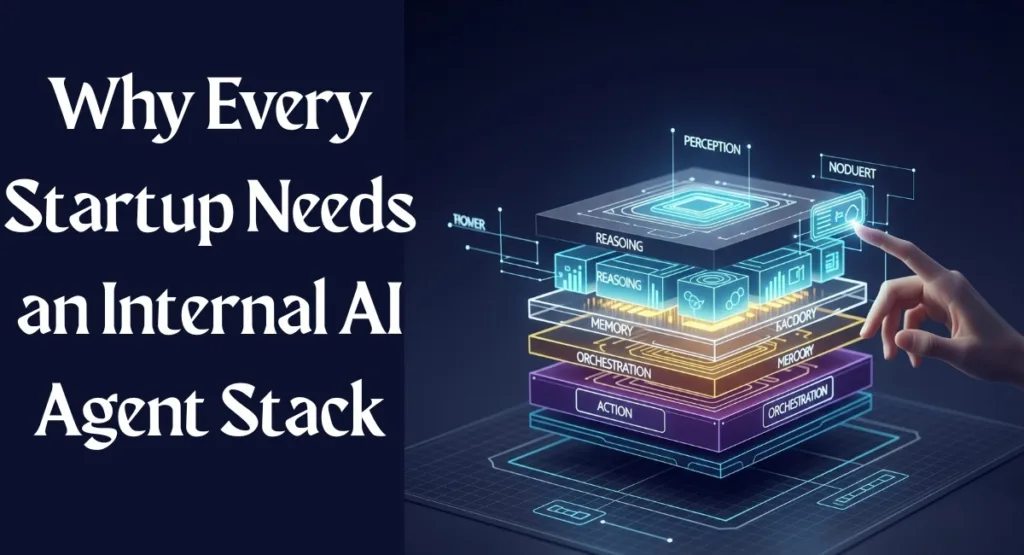
Introduction: The New Competitive Advantage for Startups
Startups win when they move fast. Speed beats size. Execution beats everything.
Nowadays, the startups that come out winners are no longer the one with the biggest team but one that has smart automation built into its workflow. Teams achieve immediate competitive advantage when workflow repetition processes are automated and reduced on a daily basis to hours.
That is where the idea of a bold Internal AI Agent Stack takes a new direction.
Rather than isolated chatbots, startups are currently developing interconnected AI ecosystems – webs of agents that interact with each other across tools, data and tasks. Bold artificial intelligence automation, bold artificial intelligence agent coordination, and bold artificial intelligence internal startup solutions put young businesses to work with lean, quick and smart.
This guide demystifies the very manner in which such stacks operate and why all startups should create their stack immediately.
What Is an Internal AI Agent Stack?
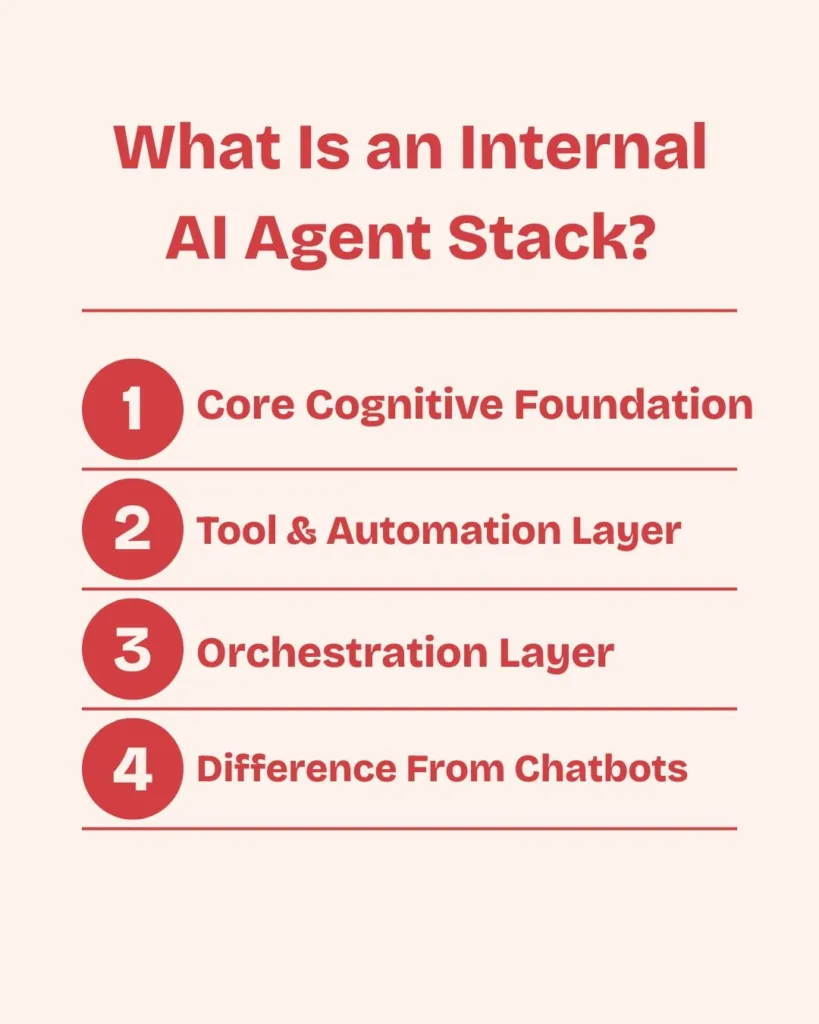
An bold internal ai agent stack is a complete set of AI agents crafted to coordinate their efforts throughout the activities of a start-up, not as a set of isolated tools, but as an inter-relational layer of intelligence.
It is a combination of three fundamental layers:
The Core Cognitive Foundation
Your system has a brain driven by this layer:
- Memory
- Reasoning
- Planning
These abilities enable agents to know context, remember previous action and pursue long term objectives. The basis of this enables aggressive AI agentic framework functions.
Tool & Automation Layer
Agents do not simply think, they act.
It has integrations with:
- APIs
- SaaS platforms
- Internal databases
- CRMs
- Analytics platforms
It is this layer that facilitates actual bold AI tool use in which the agent is allowed to operate automatically as opposed to the human agent taking action.
Orchestration Layer
Here comes the whole together.
It allows:
- Multi-step workflows
- Agent-to-agent collaboration
- Notifications
- End-to-end execution
This forms the core of the bold AI agents workflow automation whereby agents are capable of completing processes as a whole.
How It Differs From a Simple Chatbot
Chatbot reacts to messages.
An AI agent stack acts.
A chatbot cannot:
- Plan
- Connect systems
- Remember past actions
- Handle multi-step workflows
- Verify outputs
All this can be done by an AI agent stack in an autonomous and reliable manner.
Why Startups Cannot Rely on Traditional Automations Anymore
Zapier and other tools of this kind were groundbreaking… and that is no longer sufficient.
Limitations of Rigid Automation Tools
Traditional tools depend on:
- If-this-then-that logic
- Rigid triggers
- No situational comprehension.
- No reasoning
- No learning
The new work processes need flexibility – not strict regulations.
Human Bottlenecks Slow Early-Stage Teams
All startups are confronted with the following problems:
- Waiting for approvals
- Manual entries
- Slow follow-ups
- Repetitive tasks
- Multi-app switching
The delays increase with the size of teams.
Adaptive, Reasoning-Driven Systems Are the Future
Startups require thoughtful, rather than executory, systems.
Agents operate with:
- Context
- Learning
- Decision-making
- Autonomy
This enables it to operate faster using fewer resources and boldly automate small businesses to scale like large companies.
The Key Components of a Startup AI Agent Stack
A robust AI agent stack has a number of basic components. Let’s break them down.
Company Knowledge Graph
This system structures:
- Domain knowledge
- Processes
- Policies
- Task and tool relations.
It turns out to be the guide of the brain.
Centralized Long-Term Memory
Agents store:
- Past decisions
- Documents
- Repeated workflows
- Approvals
- Historical actions
This guarantees continuity and eradication of redundant explanations.
Internal Tool Integrations
Agents connect with:
- Slack
- Notion
- HubSpot
- GitHub
- Google Analytics
- Asana
- Billing systems
This allows startups to have an enterprise-level bold ai agent stack.
Agent Governance & Roles
Agents need scopes, such as:
- Sales agent
- Support agent
- Analytics agent
- Compliance agent
Both having a set boundary, accountabilities and guardrails.
Audit Logs & Output Verification
This enables:
- Transparent actions
- Safe operations
- Reviewability
- Compliance-friendly records
Security & Permission Controls
This includes:
- Access boundaries
- Password vaults
- Tool-level permissions
- Safe execution infrastructure.
AI-driven teams can not compromise on security.
How AI Agents Replace Workflows — Not Just Tasks
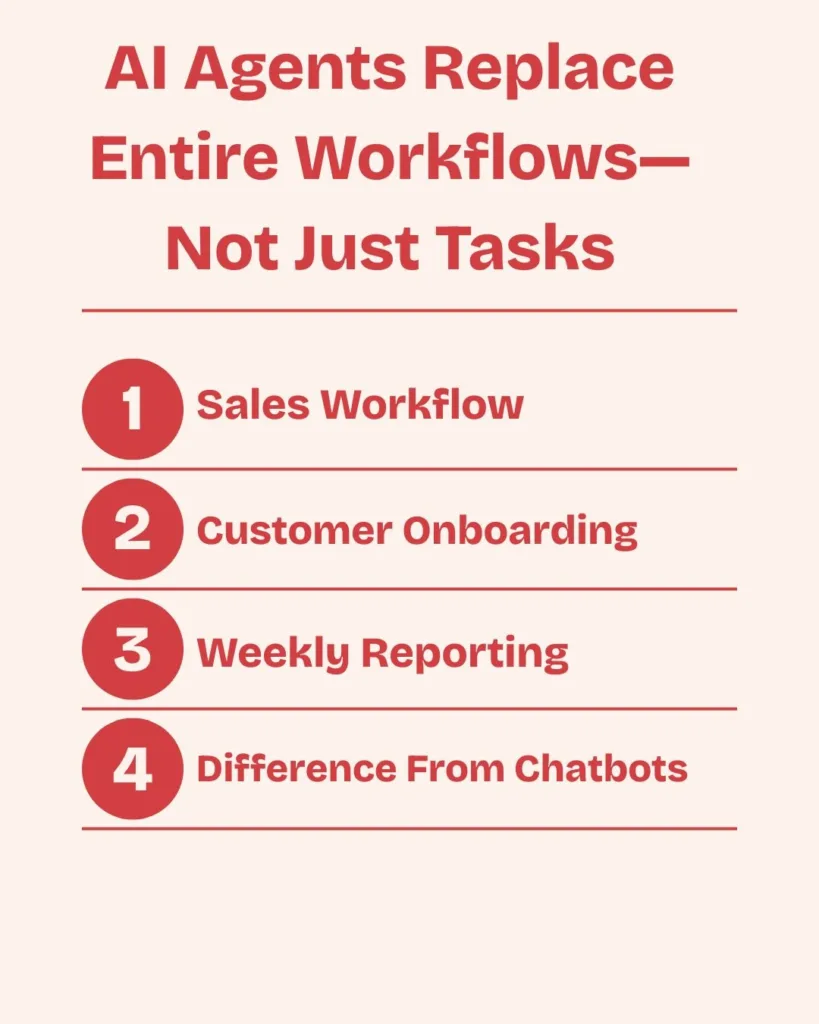
Agents are able to perform entire processes as opposed to automations, which accomplish specific tasks.
Lead Qualification → Enrichment → Outreach → Follow-Up
The agent:
- Collects inbound leads
- Enriches profiles
- Updates CRM
- Generates outreach emails
- Schedules follow-ups
Full pipeline No human beings.
Customer Onboarding Workflow
The agent handles:
- Document collection
- Data updates
- Welcome emails
- Slack reminders
- Setup support
Everything done end-to-end.
Weekly Team Reporting
Agents automatically:
- Pull data
- Format reports
- Conduct analysis
- Summarize insights
- Post updates in Slack
No additional dashboards, filters, and spreadsheets.
Customer Support Triage
The agent:
- Classifies tickets
- Suggests responses
- Routes to the right team
- Summarizes escalations
This saves human efforts by 70 percent or more.
Startup Use Cases Where AI Agent Stacks Create Immediate Impact
These are the most valuable categories that have an immediate ROI.
Sales & Growth Automation
Agents handle:
- Outreach
- Qualification
- CRM updates
- Follow-ups
These are aggressive AI marketing automation.
Customer Support
- Auto-classification
- FAQ responses
- Routing
- Escalation summaries
Support becomes 24/7 instantly.
Product Development
Agents assist with:
- Code reviews
- Documentation
- Testing
- Deployment summaries
Marketing
Agents create:
- Content briefs
- Drafts
- Social calendars
- Distribution schedules
HR & Hiring
Agents handle:
- Resume screening
- Candidate outreach
- Interview reminders
- Onboarding workflows
Finance & Compliance
Agents manage:
- Invoice handling
- Reconciliation
- Reporting
- Compliance documentation
Benefits: Why Every Startup Should Deploy an Internal AI Agent Stack
The following are the strongest strengths.
Faster Execution
Jobs that would take hours are only done within minutes.
Lower Operational Costs
Robots substitute tedious work, not human beings.
Teams are lean and able to remain efficient.
Reduced Dependency on Large Teams
Operations may be scaled without the need to add more head.
Higher Accuracy
The number of manual errors decreased, with increased consistency.
Institutional Memory From Day One
All this is memorized, stored and recollected.
Scalable Systems
The agents will evolve as your startup expands – without recruiting new staff.
How to Build Your Internal AI Agent Stack (Step-by-Step)
The following is a straightforward action plan.
1. Identify Repetitive Workflows and Bottlenecks
Look for:
- 5+ minute repetitive tasks
- Daily manual processes
- Multi-app workflows
- Delays caused by humans
2. Map Every Data Source and Tool
Document:
- Where your data lives
- Which tools connect
- Required permissions
3. Create Role-Based Agents
Examples:
- Sales agent
- Growth agent
- Support agent
- Data agent
4. Connect Systems Through APIs
Integrate:
- CRMs
- Slack
- Databases
- Google Sheets
- Notion
- Billing tools
5. Add Human-in-the-Loop Where Needed
For approvals like:
- Customer refunds
- Compliance documents
- High-risk operations
6. Deploy, Measure, Improve
Evaluate:
- Workflow speed
- Error reduction
- Cost savings
- Team satisfaction
Then refine.
Challenges & Misconceptions Startups Face
It will help to explain why not all teams get started.
It’s too complex.
The use of modern tools renders implementation very easy.
We don’t have enough data.
Agents do not need big data sets – they need context.
Security is too risky.
AI may be safer than people with the correct permissions.
Automation might break everything.
Agents act logically and within parameters, rather than by absolute rules.
Future Outlook: Agent-Driven Startups Become the Default
The current startups constructed on the basis of integrated agents will perform better by leaps and bounds than the traditional firms.
We are moving toward:
- Autonomous workflows
- Lean, hyper-efficient teams
- AI-native companies
- Machines that do not need to be handled manually.
The future does not have competitive advantages of agents, they are the norm.

Conclusion
Developing a courageous internal AI agent stack is a must, not an option.
Startups that pursue aggressive building an ai agent stack, aggressive ai agent orchestration, and aggressive workflow automation receive:
- Faster execution
- Lower costs
- Scalable operations
- Long term growth that is sustainable.
The integrators of the agents today are founders that will be rulers of the markets tomorrow.
FAQs
1. What makes an AI agent stack different from a chatbot?
Agents reason, plan, recall and act. Chatbots only respond.
2. Can small startups use an AI agent stack?
Yes — agent stack is affordable and powerful with bold ai automation of small businesses.
3. Are AI agent stacks secure for internal operations?
They are secure with permissions and audit logs as compared to the traditional workflows.
4. Do I need technical skills to build one?
No – AI systems of the day make the whole process easier.
5. What’s the biggest benefit for startups?
The speed of agent-driven startups is 5-10 times higher than that of a typical team.
