


For decades, enterprise security followed a simple mental model. Build a strong perimeter around your network, keep the bad guys out, and trust everyone who makes it inside.
And honestly, this “castle-and-moat” approach worked tolerably well when employees sat at desks inside corporate offices, accessing resources on on-premises servers.
But if you look at how businesses operate today, that model starts to feel outdated almost immediately.
People are working from home, cafés, and airports, accessing company data from coffee shops in five time zones. Applications are spread across AWS, Azure, Google Cloud, and dozens of SaaS platforms. Contractors and third-party tools are deeply embedded into workflows.
A single compromised credential can grant an attacker broad access to sensitive systems because, once they’re “inside,” traditional security trusts them completely.
Key Takeaways:
Before finalizing your organization’s cybersecurity roadmap, keep these core insights from Zero Trust Architecture (ZTA) in mind:
- Perimeters are Completely Obsolete: The traditional “castle-and-moat” security model fails in modern business. With cloud meshes (AWS, Azure) and distributed remote workforces, security must move away from network boundaries to individual users and devices.
- Governed by Three Strict Laws: A true Zero Trust framework operates strictly on Verifying Explicitly (using contextual real-time data signals), Enforcing Least Privilege Access (via JIT/JEA models), and Assuming Breach (minimizing the internal blast radius).
- Identity and Devices are the New Perimeter: Trust is never granted implicitly based on location. Every single access request—whether from an external home network or an executive inside the office headquarters—is treated as a potential threat until continuously validated.
- Defeats Lateral Threat Movement: Traditional networks allow hackers to move freely once inside. Zero Trust utilizes strict network micro-segmentation, ensuring that if a single device or credential is compromised, the attacker remains trapped in an isolated zone.
- Driven by Compliance and Risk Factors: Rapid market adoption (projected to pass $90 billion by 2030) is fueled by modern security risks like ransomware, complex supply-chain vulnerabilities, and stringent federal mandates (such as NIST 800-207 and executive compliance orders).
- An Ongoing Strategy, Not a Single Tool: Implementing ZTA is a phased transformation journey. It spans across consolidating identity controls (IAM/MFA), validating endpoint device health (MDM/EDR), deploying Policy Decision Points (PDP), and monitoring behavior loops with live analytics.
Also Read:- How to Use Copilot in Software Testing
What Is Zero Trust Architecture?
Zero Trust Architecture (ZTA) is a modern cybersecurity framework built on a single, uncompromising premise: never trust, always verify. Introduced by Forrester Research analyst John Kindervag in 2010 and later codified by the NIST Special Publication 800-207, Zero Trust completely eliminates the concept of “implicit trust” from an organization’s network. In a legacy security model, anyone inside the network perimeter was automatically trusted. In a Zero Trust environment, every user, device, application, and data flow is considered a potential threat until it is explicitly authenticated, authorized, and continuously validated.
Never trust. Always verify.
In a Zero Trust model, every user, device, application, and network flow is considered untrusted until explicitly authenticated, authorized, and continuously validated.
In practical terms, this means:
- Every user must prove their identity
- Every device must be validated
- Every request must be authenticated and authorized
- And this doesn’t happen once, it happens continuously
Even if the request is coming from inside your network.
Traditional “Castle-and-Moat” Security vs. Zero Trust Architecture
| Security Parameter | Traditional Security Model | Zero Trust Architecture (ZTA) |
| Core Philosophy | Trust, but verify. Anyone inside the network perimeter is automatically trusted. | Never trust, always verify. Implicit trust is completely eliminated everywhere. |
| Network Perimeter | Flat network structure protected by a corporate firewall, VPN, and DMZ. | Micro-segmented architecture where the network is broken into granular, isolated zones. |
| User & Device Trust | Authenticated once at entry. Internal users face minimal friction or re-validation. | Continuously validated. Every single user and device is verified at every step of a session. |
| Access Rights | Broad network access is often granted by default once a user passes the perimeter. | Least Privilege Access. Enforces Just-in-Time (JIT) and Just-Enough-Access (JEA). |
| Handling Threats | Reactive Mindset. Focuses entirely on keeping external attackers outside the perimeter. | Proactive Mindset (Assume Breach). Operates under the premise that attackers are already inside. |
| Lateral Movement | High risk. If one endpoint or credential is compromised, attackers can freely move across systems. | Low risk. Network micro-segmentation tightly restricts and contains the attack blast radius. |
| Infrastructure Alignment | Built for on-premises servers and employees sitting at stationary desks in an office. | Purpose-built for remote workforces, multi-cloud meshes (AWS/Azure), and third-party SaaS tools. |
How Does Zero Trust Work in Practice?
Unlike traditional “castle-and-moat” security that assumes everything inside the network boundary is safe, Zero Trust operates under the assumption that threats exist both externally and internally.
To maintain total visibility and control, a Zero Trust framework continuously evaluates every single access request by analyzing real-time data points, including:
- User Identity: Who is requesting access, and are they utilizing Multi-Factor Authentication (MFA)?
- Device Health: Is the device authorized, updated, and free of malware?
- Contextual Factors: Where is the request originating from, and at what time?
- Data Sensitivity: What specific applications or workloads are they trying to access?
The Core Rules of Zero Trust Access
To achieve this level of security, the architecture enforces strict, continuous validation. Every time a request is made—even if it originates from an executive sitting inside the corporate headquarters—it must meet four strict criteria:
- Every user must continuously prove their identity.
- Every device must be verified and validated.
- Every request must be explicitly authenticated and authorized.
- Every session must be limited by Least Privilege Access and monitored in real time.
Once access is granted, the user’s micro-segment of the network remains tightly contained, continuously monitored, and constantly revalidated to prevent lateral threat movement and minimize the risk of a data breach.
Core Principles Behind Zero Trust
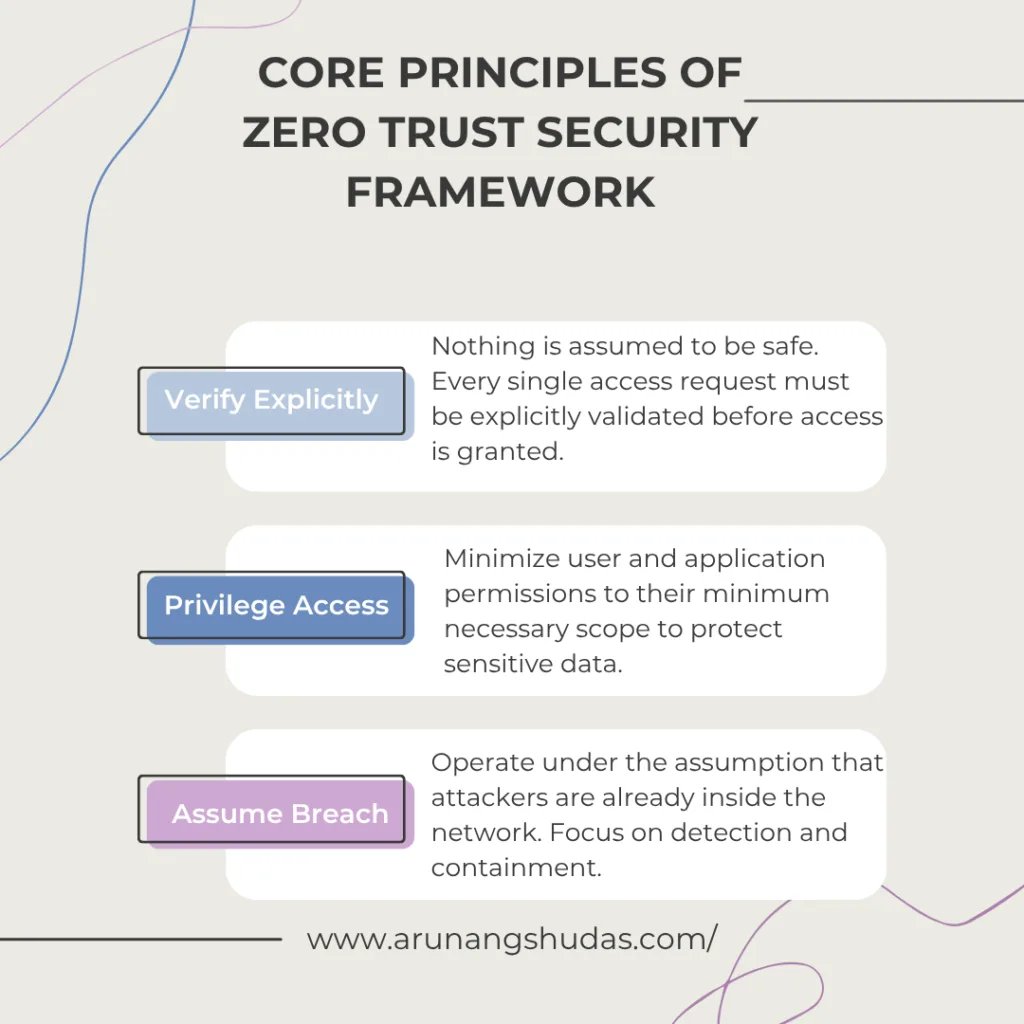
The entire foundation of Zero Trust Architecture relies on shifting from a reactive security mindset to a proactive one. This framework is governed by three foundational principles that dictate how every user, device, and network interaction is managed:
1. Verify Explicitly
In a Zero Trust framework, nothing is assumed to be safe. Every single access request must be explicitly validated before access is granted. Instead of relying on a simple password, security systems evaluate real-time data points simultaneously, including:
- User Identity & Role: Who is logging in, and what are their specific permissions?
- Device Posture: Is the device secure, compliant, and updated?
- Contextual Signals: What is the user’s location, time of day, and overall risk score?
2. Use Least Privilege Access
This principle ensures that users and applications are only given the absolute minimum access required to complete their specific tasks. By strictly limiting permissions, you prevent users from accessing sensitive data they don’t need to see. Zero Trust achieves this through two modern access models:
- Just-In-Time (JIT) Access: Granting elevated permissions only for the exact duration of a specific task.
- Just-Enough-Access (JEA): Restricting application scopes so users cannot wander into unrelated parts of the corporate network.
3. Assume Breach
Traditional security focuses entirely on keeping attackers out. Zero Trust flips this strategy by operating under the assumption that attackers are already inside the network. By designing systems with an “Assume Breach” mentality, organizations focus heavily on:
- Continuous Analytics: Utilizing real-time monitoring and threat detection to spot and neutralize anomalies immediately.
- Minimizing the Blast Radius: Using micro-segmentation to isolate networks, ensuring that if one device is compromised, the attacker cannot move laterally to other systems.
- End-to-End Encryption: Protecting data in transit and at rest so it remains unreadable to unauthorized parties.
Why Are Companies Adopting Zero Trust, and Why Now?
Zero Trust is not a new idea. But the pace of adoption has accelerated dramatically in the last five years. Several converging forces have made it not just attractive, but urgent.
Reason 1: The remote work revolution made perimeters obsolete
When employees started working from everywhere, the traditional network boundary became irrelevant. Employees are now accessing corporate resources from home networks, personal devices, and public Wi-Fi.
The corporate perimeter- the firewall, the VPN, the DMZ, became a fiction. Zero Trust’s model, which assumes all networks are hostile and validates every connection independently, was purpose-built for this environment.
Reason 2: Cloud adoption shattered the traditional network
When applications live in Azure, Salesforce, GitHub, and dozens of other SaaS platforms, there is no longer a single network to protect. Data flows between cloud providers, CDNs, mobile clients, and on-premises systems in a constant, complex mesh.
Zero Trust treats every interaction in this mesh, regardless of where it originates, with equal scrutiny.
Reason 3: Insider threats are a growing and underestimated risk
Not all threats come from outside.Traditional perimeter security is defenseless against threats that originate inside the organization , whether from a disgruntled employee, a contractor with excessive privileges, or a legitimate user whose credentials have been stolen.
Zero Trust’s principle of least privilege and continuous verification means that even a compromised internal account has minimal ability to cause damage. Access is scoped tightly, and anomalous behavior triggers re-verification or revocation.
Reason 4: Ransomware and lateral movement
Modern ransomware attacks rarely strike immediately after entry. Attackers typically spend weeks or months moving laterally through a network, escalating privileges, identifying valuable systems, and planting persistence mechanisms, before triggering their payload.
Zero Trust’s micro-segmentation and least-privilege access dramatically limit this lateral movement. Even if an attacker compromises one endpoint, they cannot freely traverse the rest of the network.
Reason 5: Regulatory pressure and compliance requirements
Frameworks including NIST 800-207, the U.S. federal government’s Executive Order 14028 (which mandated Zero Trust adoption across federal agencies), GDPR, HIPAA, and PCI-DSS increasingly align with Zero Trust principles.
Organizations operating in regulated industries including finance, healthcare, government contracting, are finding that adopting Zero Trust simultaneously satisfies multiple compliance mandates while strengthening their actual security posture.
Reason 6: Supply chain and third-party risk
The SolarWinds and Log4Shell incidents demonstrated that sophisticated attackers can infiltrate organizations through trusted third-party software and vendors.
Zero Trust treats even trusted vendors and software with skepticism, requiring explicit verification before granting access to internal resources. It reduces the blast radius when a supply chain component is compromised.
How Zero Trust Is Implemented
Implementing Zero Trust is not a single product purchase or a weekend migration, but an ongoing organizational transformation. Typical deployments progress through these phases:
- Identity and access management (IAM): Deploy strong MFA, single sign-on (SSO), and continuous authentication. Identity becomes the new perimeter.
- Device trust: Enroll all endpoints in a mobile device management (MDM) or endpoint detection and response (EDR) solution. Only compliant devices get access.
- Micro-segmentation: Replace flat network architectures with granular zones. Applications talk to each other only when explicitly permitted.
- Policy engine and enforcement: Implement a policy decision point (PDP) that evaluates contextual signals- user role, device health, location, time of day, and grants or denies access dynamically.
- Monitoring and analytics: Continuous telemetry, SIEM integration, and behavioral analytics create a feedback loop. Anomalies trigger automated responses.
The Path Forward
The adoption curve for Zero Trust has inflected sharply upward. According to market research, global spending on Zero Trust security solutions exceeded $35 billion in 2024 and is projected to surpass $90 billion by 2030. Governments, Fortune 500 enterprises, mid-market companies, and even startups are investing in Zero Trust capabilities to operate safely in an interconnected digital economy.
So the question is- how much of your business today is still running on trust that hasn’t been verified?
Also Read:- Beyond the MVP: How to Prioritize Features for Your Next Product Iteration
Frequently Ask Question
1. How does Zero Trust differ from traditional network security?
Traditional network security relies on a “castle-and-moat” approach, which trusts anyone and anything inside the network perimeter by default. In contrast, Zero Trust security operates on the principle of “never trust, always verify.” It treats all traffic, even if it originates from inside the network, as a potential threat and continuously authenticates every user and device.
What are the 5 pillars of Zero Trust Architecture (ZTA)?
According to CISA guidelines, the 5 pillars of Zero Trust Architecture are:
Identity: Verifying and securing unique user identities with strong authentication.
Devices: Monitoring and assessing the security posture of any device accessing the network.
Network/Environment: Segmenting and isolating network resources to control data flows.
Applications and Workloads: Securing applications, cloud services, and managing their access permissions.
Data: Categorizing, encrypting, and protecting data at rest and in transit.
What are the three core principles of Zero Trust?
Zero Trust is built on three strict operational principles:
Verify Explicitly: Always authenticate and authorize based on all available data points (user identity, location, device health).
Use Least Privilege Access: Limit user access with Just-In-Time (JIT) and Just-Enough-Access (JEA) models to protect sensitive data.
Assume Breach: Minimize the blast radius by segmenting access, verifying end-to-end encryption, and continuously monitoring for threats.
What is the main purpose of Zero Trust Architecture?
The main purpose of Zero Trust Architecture is to modernize enterprise security to match today’s cloud and remote-work environments. It aims to eliminate implicit trust, dramatically reduce the risk of lateral threat movement within a network, and protect sensitive data across distributed infrastructures.
What are the primary components of a Zero Trust environment?
A functional Zero Trust environment relies on three primary technology components:
Policy Decision Point (PDP): The brain that decides whether to allow, block, or limit access based on security policies.
Policy Enforcement Point (PEP): The gatekeeper (like a firewall or gateway) that executes the PDP’s decision.
Continuous Monitoring Tools: Systems that track user behavior and device health in real-time to detect anomalies.
