


Be frank–the majority of us take tests because we want to see what it will be. Real a/b testing, however, is not about guesswork; making certain data-supported decisions. In the modern digital age, a slight shift in the conversion rate will result in enormous profit margins. Based on more recent numbers, winning experiments have the potential to produce a median uplift of +2.77% revenue per visitor, and the best results are up to +9.5% uplifted. Not a big thing–a business changing thing.
Why then so many tests fail? Due to the misconception of how it works by people. They fine-tune the color of buttons, do a test run over a few days and declare it a win. Yet, until such results are properly arranged, these results are normally meaningless. A/B testing can be thought of as a scientific experiment: you would not quit four and five steps in and announce a discovery, would you?
The truth is the following: less than 36.3% of A/B tests generate meaningful results in terms of winners. That is, the majority of tests fail or are inconclusive. It is not merely to learn to test–but to test wittily.
What Is A/B Testing?
1. Simple Explanation
In the case you are asking yourself what is a b testing, the easiest way of learning about it is through the following:
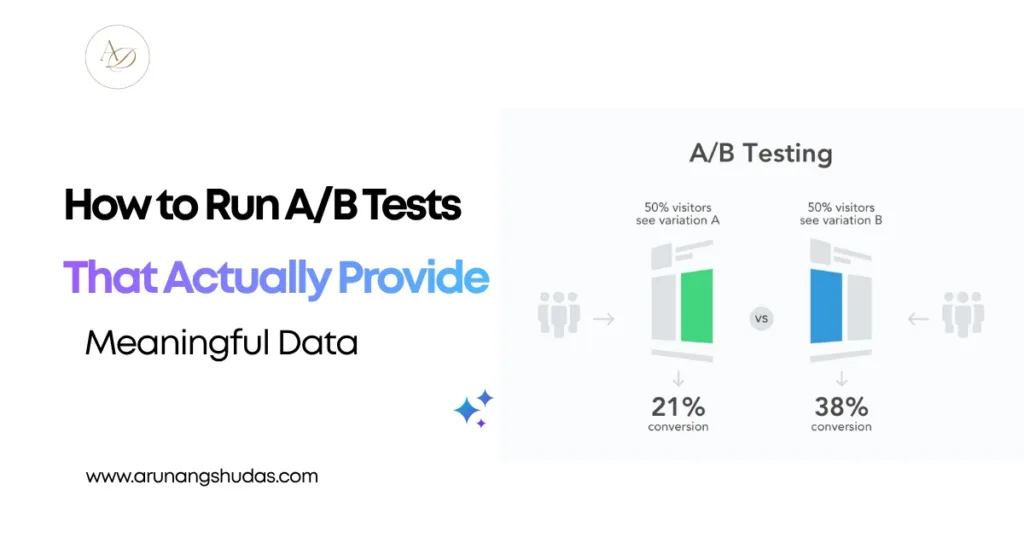
- You make an Original (Version A) and a Variation ( Version B ) and divide your audience in both of them to figure out which one works better.
That’s it. Sounds simple, right? But the trick is in designing and analysis of the test.
Suppose you are operating in an online shop. You present one half your visitors with a red button marked buy now and the other one with a green one. The one with more conversions wins. Here is the trick, however, you must have sufficient data and appropriate analysis to be able to give the result other than a mere accident.
2. Real-World A/B Testing Examples
We will consider some practical a b testing examples:
- In a control test, a landing page headline change enhanced conversions 13.5%.
- The brands in e-commerce boosted income through product bundling rather than individual product displays.
- To increase the number of sign-ups, SaaS firms made the forms easier.
These cases indicate that meaningful tests are not based on random adjustments but consider the actions and the intentions of the user.
Key Elements of a Successful A/B Test
1. Hypothesis Creation
Each test ought to begin with a hypothesis. Not: Let us have a change at it, but: Replacing the letters of CTA with Start Free Trial will lead to more subscriptions since the perception of risk will be minimized.
A good hypothesis maintains focus and measurability on your test.
2. Variables and Controls
When a/b testing, only a single variable should be altered at a time. Why? Since when you alter various components, you would be unable to determine what led to the betterment.
Imagine this to be like cooking. When you simultaneously replace salt, spices, and time cooking; you would never know what was better.
3. Metrics That Matter
Don’t simply follow clicks. Work on the measures that have an effect on your business:
- Conversion rate
- Revenue per visitor
- Customer lifetime value
In some cases a test can decrease conversions, but raise revenue- still a win.
Understanding Statistical Significance
1. Why Data Can Be Misleading
This is where majority of people fail. After two days they notice a 10 percent improvement and discontinue test. But that’s risky.
Your results are merely noise unless statistically significant.
2. Confidence Levels Explained
Industry guidelines recommend running tests until one achieves 95 per cent confidence level. This implies that you are quite certain that the outcome is not as a matter of chance.
Imagine that it is like the coin. When it falls heads 3 times, you cannot make a conclusion that it is biased. But when it falls heads 95 in 100 go round-that counts.
Step-by-Step Guide to Running A/B Tests
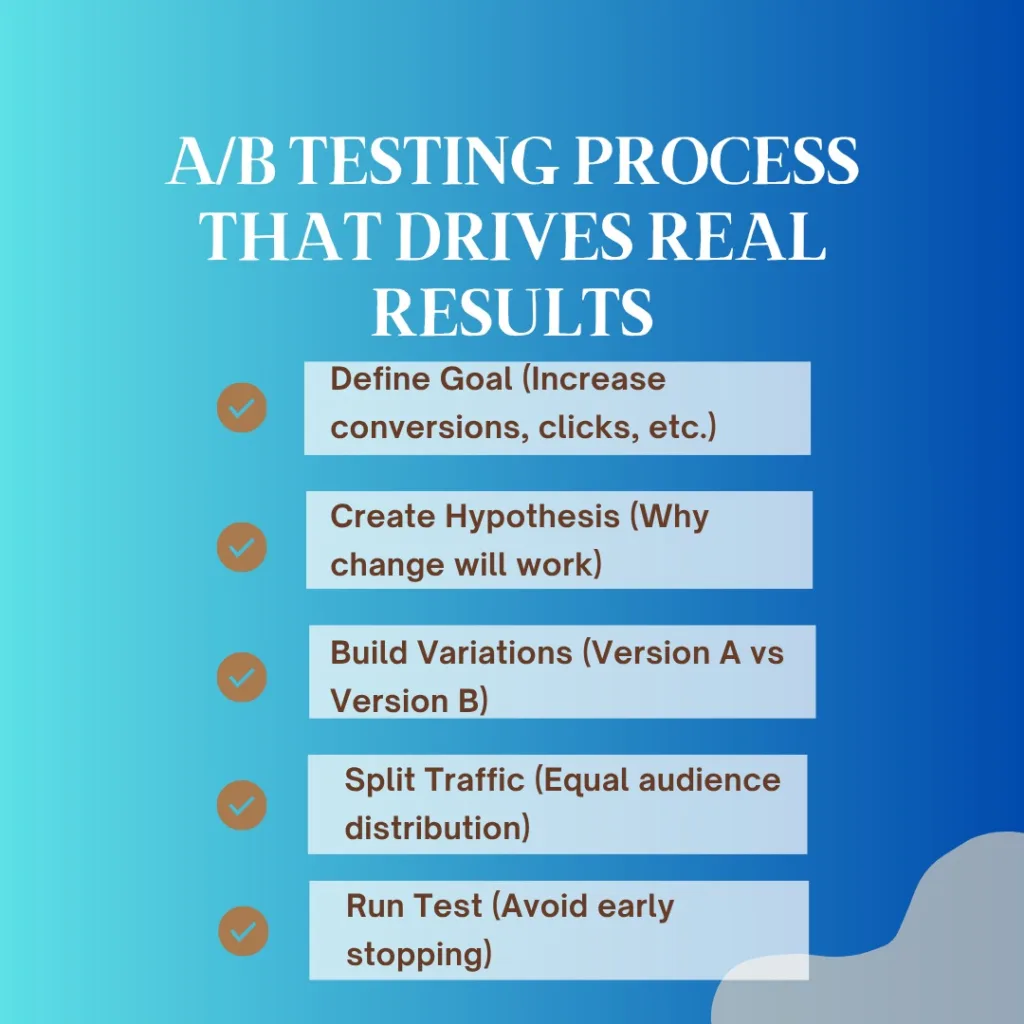
1. Planning the Test
Start with:
- Specific objective (e.g. get more sign-ups)
- Defined audience
- Hypothesis
Success can be most effective in planning.
2. Executing the Experiment
Balanced half-and-half with versions. Ensure:
- No external interference
- Equal exposure time
- Consistent user experience
3. Analyzing Results
See past superficial measures. Ask:
- Is that statistically significant?
- Does it affect revenue?
- Is it scalable in the long-term?
Common A/B Testing Mistakes to Avoid
1. Ending Tests Too Early
Terminating prematurely is equal to watching a movie partway and making conjectures about its conclusion. You don’t get the whole picture.
2. Testing Too Many Variables
Keep it simple. A single change = definite results.
Advanced Testing Techniques
1. Multivariate Testing
You do not test a single change, but a combination of changes. It is strong-but needs lots of traffic.
2. Personalization Testing
There is a variation in the behavior of various users. Experiences can be customized to achieve a great deal.
Role of Performance & Security Testing
1. Security Testing in Software
Although it is fine to maximize conversions, give Security Testing in Software a second thought. You have a high performing page that is useless when it is prone to attacks. Security testing assures protection of user data, generating trust and credibility.
2. Load Testing with Artillery
Performance matters too. To simulate traffic and make sure your system can withstand the demands in the real world, tools such as Load Testing with Artillery are used. Consider what happens when you are conducting a successful A/B test and doubling conversions, but your server crashes. That’s a nightmare to shun.
Real-Life Case Studies and Examples
1. Website Conversion Optimization
One company experimented with specific vs vague messaging and achieved better conversions. They have substituted Fast Delivery with Delivered in 24 Hours and this has contributed to increased trust and engagement.
2. Product Feature Testing
Technological companies frequently trial what they have before its implementation. This reduces risk and only effective features will be brought to live.
How Arunangshudas Helps Optimize Testing
Expert guidance can be the key when it comes to conducting meaningful A/B tests. Arunangshudas offers a systematic way of doing experiments and putting them to action – concentrating on data-driven intuitions and hypotheses, valid test design, and actionable feedback. The strategy focuses on learning the behavior of the users well and doing experiments that are aligned with business objectives instead of random testing. This means that any test will lead into quantifiable development, as opposed to superficial gains. When properly guided, businesses will eliminate using a mere guess to make their decisions with confidence and provide the backing with sound data.
Conclusion
The key to successful a/b testing is not to execute more tests but rather better tests. Your experiments will be a tool of growth when you concentrate on effective hypotheses, appropriate data gathering, and significant measures.
The distinction between average and high performing teams? Patience, strategy and discipline.
FAQs
1. What is a b testing in simple terms?
It’s a method of comparing two versions of something to see which performs better.
2. How long should an A/B test run?
Until you reach at least 95% statistical confidence, which may take weeks depending on traffic.
3. What are common a b testing examples?
Testing headlines, CTA buttons, pricing pages, and email subject lines.
4. Can small websites benefit from A/B testing?
Yes, but they need longer test durations due to lower traffic.
5. What tools are used for A/B testing?
Popular tools include Google Optimize alternatives, VWO, Optimizely, and custom analytics platforms.
