



Software security is one of the most critical concerns that developers, testers, and organizations consider nowadays in the fast-paced digital world. Large-scale app development, cloud computing, home wifi network connectivity and semiconductor supply chain dependency have opened up both the opportunities and threats to innovation and security. As cyberattacks become more and more frequent, data confidentiality, integrity, and availability have become a must rather than an option. This is the point at which software testing security testing comes in.
This software testing blog will discuss what security testing is, its importance, typical methods, and some real-life examples of security testing to make you see its importance.
Also Read :- How IoT is Revolutionizing Healthcare: A Breakthrough 2025 Perspective
What Is Security Testing in Software Testing?
So, before going into the methods and examples, the main question that should be answered is what is security testing in software testing?
Security testing is a form of software testing that can expose vulnerabilities, threats, risks, and weaknesses of a system. The goal is to ensure that data and resources are protected from possible intrusions while maintaining functionality. Unlike performance or usability testing, security testing is focused on safeguarding information and preventing malicious attacks.
To put it simply, software testing, security testing guarantees that unauthorized users will not access sensitive data, when authorized users can use the system without any types of unnecessary limitation.
Key objectives include:
- Securing user sensitive information like passwords, financial details and personal information.
- Full protection from hacking.
- Removal of interferences against business.
- Keeping up with the compliance of legal and regulatory standards.
What Is the Importance of Security Testing?
This is a hyper-connected environment wherein organizations rely on digital systems to perform almost all facets related to their businesses. Just one breach can lead to reputational damage, and customer mistrust accompanied by huge financial losses. Think of these examples:
- A banking application not protecting customer PINs.
- A healthcare system exposing patient records.
- A supply chain management tool used in semiconductor supply chains gets hacked leading to disruption in chip distribution globally.
This is why security testing matters. Apart from just defense, it helps in:
- Building trust with customers.
- Complying with cybersecurity regulations.
- Detects weak points before hackers exploit them.
- Optimize website speed while maintaining secure infrastructure, ensuring both performance and safety.
Types of Security Testing in Software Testing
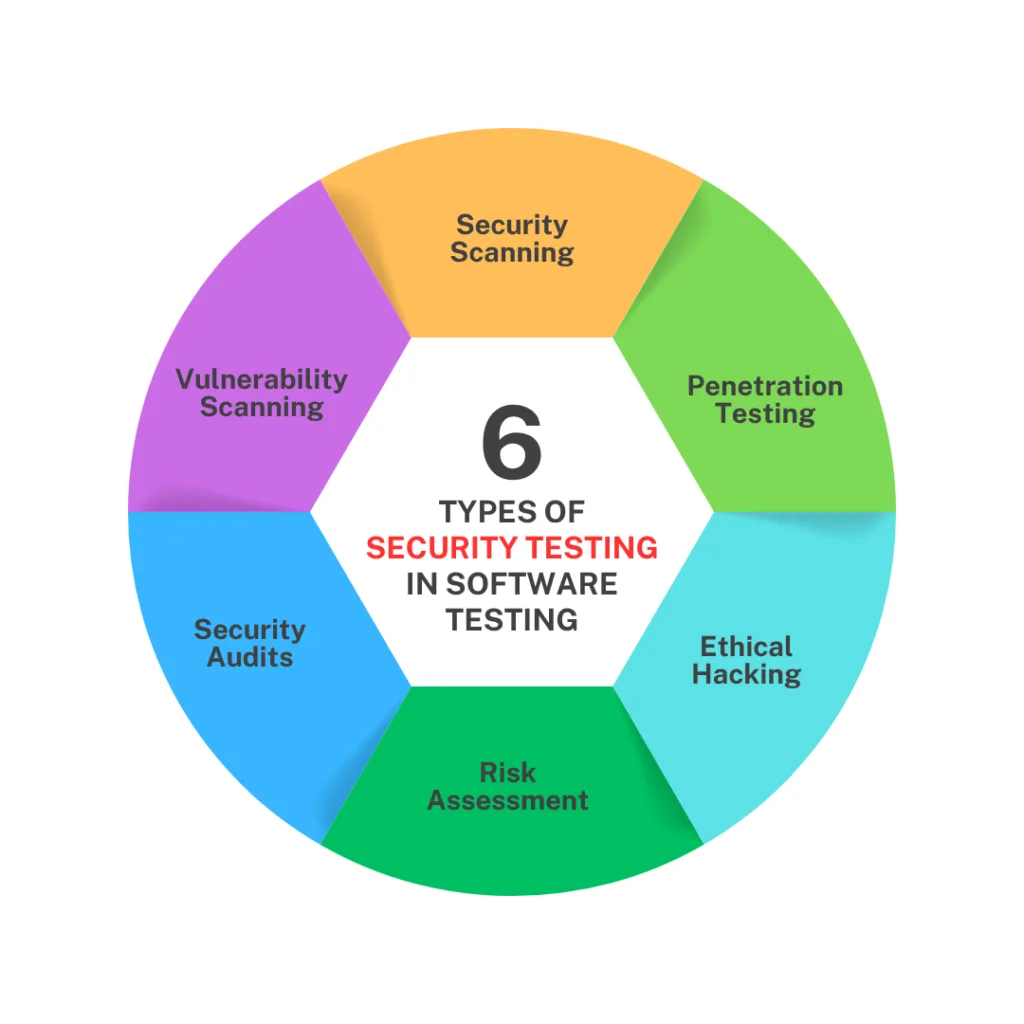
Security testing in software testing is a critical process that ensures applications are protected against threats, vulnerabilities, and unauthorized access. It involves multiple techniques, each focusing on different aspects of system security. Below are the most important types of security testing explained in detail with real-world examples:
1. Vulnerability Scanning
Vulnerability scanning is an automated process that identifies known weaknesses in a system, application, or network. It uses specialized tools to scan code, dependencies, and configurations against a database of known vulnerabilities.
This method is widely used because it is fast, scalable, and can be integrated into CI/CD pipelines for continuous monitoring.
Example:
A web application uses an outdated version of a third-party library. A vulnerability scanner detects this and flags it as a risk because it may allow attackers to perform SQL injection or cross-site scripting (XSS) attacks.
Why it matters:
It helps organizations detect issues early before they are exploited, reducing the overall risk.
2. Penetration Testing (Pen Testing)
Penetration testing is a simulated cyberattack performed by security experts to evaluate how secure a system actually is. Unlike automated scanning, pen testing is manual and more in-depth, focusing on real-world attack scenarios.
Testers attempt to exploit vulnerabilities just like hackers would, providing insights into how an attacker could gain access.
Example:
A tester tries to log into a system using brute-force techniques or exploits weak password policies. They may also simulate attacks on a company’s Wi-Fi network to uncover encryption flaws.
Why it matters:
It reveals hidden vulnerabilities that automated tools might miss and shows the real impact of a security breach.
3. Security Auditing
Security auditing involves a comprehensive review of the system’s code, architecture, and security policies. The goal is to ensure that the application follows best practices, compliance standards, and organizational security guidelines.
Audits can be internal or conducted by third-party experts.
Example:
An e-commerce platform undergoes a security audit to verify that payment data is encrypted and complies with standards like PCI-DSS.
Why it matters:
It ensures long-term security, compliance, and trustworthiness of the application.
4. Risk Assessment
Risk assessment identifies potential threats and evaluates their impact and likelihood. Each risk is categorized (low, medium, high), helping organizations prioritize security efforts.
This approach is more strategic and focuses on decision-making rather than just detection.
Example:
A fintech application identifies that a data breach could expose customer financial data. This is classified as a high-risk issue and is prioritized for immediate resolution.
Why it matters:
It helps businesses allocate resources effectively and focus on the most critical vulnerabilities.
5. Ethical Hacking
Ethical hacking is the practice of intentionally attempting to breach a system by authorized professionals. These hackers use the same techniques as malicious attackers but with the goal of improving security.
It goes beyond testing tools and involves creative thinking to uncover complex vulnerabilities.
Example:
An ethical hacker tries to bypass authentication mechanisms or gain admin access to a system to identify weaknesses in login security.
Why it matters:
It provides a real-world perspective on system security and helps organizations stay one step ahead of cybercriminals.
6. Security Scanning
Security scanning is a continuous process that monitors systems, networks, and applications for vulnerabilities and threats. It is often automated and runs regularly to ensure ongoing protection.
This includes scanning for malware, misconfigurations, and unusual activities.
Example:
A website uses a security scanning tool that runs daily checks to detect malware injections or unauthorized changes in files.
Why it matters:
It ensures continuous security and helps detect threats in real time before they cause damage.
Comparing Security Testing Types
| Testing Type | Execution Mode | Scope & Focus | Primary Benefit |
| Vulnerability Scanning | Automated | Scans code, ports, and dependencies for known CVEs. | Fast, repeatable, and easily integrates into CI/CD pipelines. |
| Penetration Testing | Manual & Automated | Simulates real-world cyberattacks on specific targets. | Exposes complex flaws and logical vulnerabilities. |
| Security Auditing | Manual Review | Validates system code and architecture against compliance standards. | Ensures regulatory adherence (e.g., PCI-DSS, SOC 2). |
| Risk Assessment | Analytical | Quantifies the likelihood and business impact of threats. | Prioritizes security budgets and development resources. |
| Ethical Hacking | Manual | Broad-scope adversarial attacks across the entire organization. | Offers an authentic, 360-degree real-world defense test. |
| Security Scanning | Continuous / Automated | Monitors production systems for live malware and misconfigurations. | Provides real-time threat detection and immediate alert |
Security Testing Examples
Learning examples from the real world makes things more understandable. Let’s consider a few:
- Example 1: E-commerce Platform
A web shopping site is tested for SQL injection vulnerabilities. The testers enter malicious SQL commands in the search field. If the system exposes database details, then the test fails. - Example 2: Banking App
Testers try brute-force attacks to try to guess user passwords. A secure system will lock the account after repeated incorrect attempts, protecting the data. - Example 3: Home Wi-Fi Network
Penetration testers attempt to break into a home Wi-Fi network to verify if default passwords and weak encryption allow unauthorized access. - Example 4: Semiconductor Supply Chains
A semiconductor supply chain logistics software is security tested to verify resilience against ransomware. This prevents interference with manufacturing and distribution of chips.
These security testing examples indicate the need for proactive measures in various industries.
Common Vulnerabilities Found in Security Testing
While conducting security testing in software testing, some vulnerabilities appear frequently:
- Weak authentication and authorization mechanisms.
- Storage of sensitive data without encryption.
- Cross-site scripting (XSS) vulnerabilities.
- SQL injection vulnerabilities.
- Unsecured APIs.
- Insufficient session management.
- Inadequate input validation.
Identifying and fixing these issues early saves companies from massive breaches.
Security Testing Best Practices for Software Testing
Security testing isn’t merely a matter of running tools; it involves a systematic process. The following are best practices:
- Start Early – Incorporate testing within the software development life cycle (SDLC).
- Use Automation – Automate scanning for quicker detection.
- Keep Tools Current – Cyber attacks change, and so should your tools.
- Mix Manual & Automated Testing – Automation detects common vulnerabilities, but manual testing detects deeper issues.
- Test for Both External & Internal Threats – Defense against external hackers isn’t enough; insider threats can be just as destructive.
- Balance Security with Performance – Optimize site speed always while instituting security measures.
- Continuous Monitoring – Security is not a once-off task; ongoing assessment is the way to go.
Security Testing and Performance: The Perfect Balance
One of the myths is that more secure systems are slower. With the proper practices, though, you can have both. For example, by employing encryption algorithms that protect data without impacting processing time significantly, businesses can provide customer security while still providing fast response times.
By optimizing web speed while not sacrificing security, businesses build seamless and secure user experiences.
Security Testing Across Industries
Security testing is not limited to IT companies. Sectors around the world adopt it:
- Finance – To protect online banking and online payments.
- Healthcare – Safeguarding patient data and compliance with HIPAA.
- Manufacturing – Securing digital assets in semiconductor supply chains.
- Retail – Anti-e-commerce fraud.
- Telecom – Protecting devices and home Wi-Fi networks.
The need for robust, secure, and user-friendly applications is across the board.
Security Testing in Modern IT Environment
The current IT environment is based on cloud computing, IoT devices, and AI-based solutions. While these technologies increase productivity, they increase with the attack surface too.
- Cloud applications are open to misconfigurations.
- IoT devices connected to a home Wi-Fi network can be hacked.
- Semiconductor supply chains are increasingly targeted due to their importance in technology and defense.
Therefore, incorporating security testing into development pipelines is imperative to foster trust and ensure long-term success.
Future of Security Testing in Software Testing
In future times, security testing within software testing will be increasing with next-gen AI-driven vulnerability scanning, real-time alerts, and predictive analytics. Companies will implement DevSecOps—security integrated throughout the entire development cycle.
Blockchain, quantum-resistant cryptography, and zero-trust architectures will influence the future of security testing as well.
Enhancing Software Security with Expert Testing Solutions
Successful security testing practices are not only about tools but about skills. This is where professionals such as Arunangshu Das can come in. Possessing practical experience in security testing within software testing, Arunangshu excels in vulnerability identification, conducting security testing examples across sectors, and assisting organizations in creating robust applications.
From protecting home Wi-Fi networks, making digital banking secure, protecting sensitive information, to integrity in semiconductor supply chains, the technical expertise of Arunangshu assures end-to-end solutions. He also ensures optimizing security without compromising on performance, so firms can maximize website speed without compromising even an ounce of protection.
By partnering with Arunangshu Das, organizations can obtain a trusted partner who not only strengthens their defense but also allows them to remain at the forefront in the rapidly changing digital security landscape.

Conclusion
Security testing as part of software testing is no longer an option—it’s a flat-out requirement in a digital-first world. From protecting data breaches to maintaining global semiconductor supply chains and home networks, security testing secures apps safe and reliable.
With the use of real-world security test scenarios and best practices, organizations can prevent risks, enhance customer trust, and guard sensitive data. And with experts like Arunangshu Das on board, businesses can safely traverse these challenges, achieving the optimal mix of security testing and performance while working to maximize the speed of websites.
Frequently Ask Questions
What is security testing in software testing with example?
Security testing in software testing is the process of identifying vulnerabilities and protecting applications from threats.
Example: A tester enters malicious SQL queries into a login form to check if the system is vulnerable to SQL injection attacks.
Why is security testing important in software development?
Security testing is important because it protects sensitive data, prevents cyberattacks, and ensures compliance with regulations. It also helps build customer trust and avoids financial losses caused by data breaches.
What are the main types of security testing?
The main types include vulnerability scanning, penetration testing, security auditing, risk assessment, ethical hacking, and security scanning. Each method focuses on identifying and fixing different types of security risks.
What are common vulnerabilities found during security testing?
Common vulnerabilities include weak authentication, SQL injection, cross-site scripting (XSS), unsecured APIs, poor session management, and lack of data encryption.
