


Who is a Full-Stack Developer?
If the backend developer is the specialized engineer working under the hood, the full-stack developer is the automotive architect who understands both the engine and the sleek exterior design.
A a is a generalist who possesses a working knowledge of both the frontend (client-side) and backend (server-side) of an application. They aren’t necessarily absolute masters of every single tool in the tech stack, but they are agile enough to build a functional prototype or bridge the gap between two different engineering teams.
Read more blog : Top 50 Software Developer Interview Questions and Answers (2026 Guide)
Core Areas of Focus
- System Integration: Because they understand both sides of the coin, they know exactly how a backend API will feed data into the user-facing UI component.
- Dual-Capability Development: They can build a database schema in the morning and style the user interface using CSS or a React framework in the afternoon.
- MVP Architecture: They are highly valued in startups because they can single-handedly build a Minimum Viable Product (MVP) from scratch.
Who is a Full-Stack Developer?
A full-stack developer is a versatile engineer capable of managing both the client-side (frontend) and server-side (backend) of a web application. Often described as the “Swiss Army knife” of engineering, they possess a comprehensive understanding of the entire software development lifecycle, ensuring that user interfaces communicate seamlessly with underlying database architectures.
Instead of specializing deeply in a single layer, full-stack engineers specialize in integration. They bridge the gap between user experience and technical execution by managing three core pillars:
Read more blog : Comprehensive Integration Tests for a Full-Stack Node.js Application
- Frontend Development (Client-Side) : They construct the visible, user-facing elements of an application. This includes building responsive, high-performance user interfaces (UIs) using foundational languages like HTML, CSS, and JavaScript, alongside modern reactive frameworks such as React, Angular, or Vue.
- Backend Architecture (Server-Side): They implement the core business logic, application processing, and data persistence layers. This involves writing server-side code and managing relational or non-relational databases (like PostgreSQL or MongoDB) using tools like Node.js, Python, or Java.
- DevOps & Cloud Deployment (The Modern Layer) : While historically optional, the modern full-stack role increasingly requires proficiency in cloud infrastructure. This includes managing application deployment, configuring server environments, and setting up CI/CD (Continuous Integration/Continuous Deployment) pipelines on platforms like AWS or Docker.
Why They Are High-Value Assets: Because they understand how data flows from a user click down to a database row, full-stack developers excel at rapid prototyping and building Minimum Viable Products (MVPs). They are highly efficient in startups and agile, cross-functional teams where development speed and cross-layer debugging are critical..
Backend vs. Full-Stack: Key Differences at a Glance
While both roles overlap on the server side, their scope, depth of knowledge, and daily responsibilities look very different.
| Feature | Backend Developer | Full-Stack Developer |
| Scope of Work | Hyper-focused on server-side architecture, data structures, and APIs. | Broad focus covering user interface, business logic, and databases. |
| Depth of Expertise | Deep. Mastery of complex system optimization, security, and database scaling. | Wide. Capable across multiple layers, but potentially less specialized in heavy backend infrastructure. |
| Primary Goal | Maximizing server performance, data integrity, and system security. | Connecting the user experience smoothly to the underlying technology. |
| Ideal For | Large enterprise systems, high-traffic platforms, and data-heavy applications. | Startups, agile cross-functional teams, and rapid prototyping. |
Backend vs. Full-Stack: Which Career Path is Right for You?
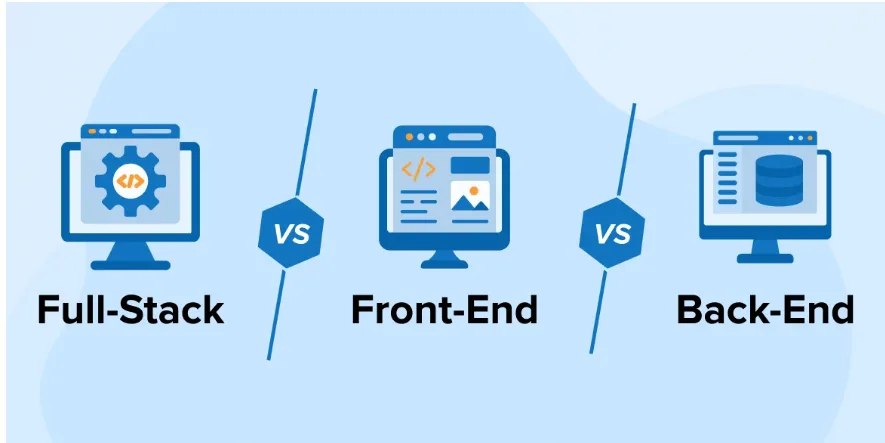
Choosing between backend and full-stack development depends on whether you prefer deep technical specialization or broad, cross-functional versatility.
Choose Backend Development If…
You have a passion for complex problem-solving, data logic, and invisible system architecture. This path is ideal if you want to master:
- Data Structures & Algorithms: Optimizing how large-scale data is processed and stored.
- System Scalability: Building infrastructure that handles millions of concurrent users without breaking.
- Security & Compliance: Implementing robust encryption, user authentication protocols, and secure API gateways.
Choose Full-Stack Development If…
You thrive on variety, rapid prototyping, and seeing a digital product come to life from end to end. This path is ideal if you want to master:
- Cross-Functional Agility: Pivoting between UI/UX design challenges and server-side logic in a single afternoon.
- State Management: Connecting user interactions on the screen flawlessly to backend data stores.
- Product-Minded Engineering: Understanding the holistic product lifecycle, making you highly valuable to startups and agile development teams.
Real-World Example: Building an E-Commerce Platform
To see how these roles collaborate in production, consider the architecture required to build a modern e-commerce storefront:
[ Frontend UI ] --------> [ Full-Stack Developer ] <-------- [ Backend API ]
(Product Displays)       (Connects UI to Checkout)          (Inventory & Payments)
- The Backend Developer’s Focus: They engineer the core engine. They design the relational database that handles product inventory, secure user authentication, and encrypted payment processing gateways. Their priority is ensuring the system remains fast, secure, and accurate during high-traffic events like flash sales.
- The Full-Stack Developer’s Focus: They build the end-to-end user journey. A full-stack engineer might take charge of the entire checkout feature—designing a responsive user interface for the cart, writing the client-side validation logic, connecting it to the backend payment API, and deploying the update safely to a live server.

Final Thoughts: Depth vs. Breadth
Ultimately, the choice between a backend developer and a full-stack developer isn’t about which role is superior—it’s about depth versus breadth.
Backend developers are the specialists who ensure an application’s foundation is hyper-efficient, secure, and built to scale. Full-stack developers are the systems-level generalists who provide a holistic approach, ensuring that every user-facing element works in perfect harmony with the underlying technology. Both are vital to the modern software engineering ecosystem..
You may also like:
1) How do you optimize a website’s performance?
2) Load Testing with Artillery: Prepare Your Node.js Application for Peak Traffic
3) Top 10 Questions in Software Development Interviews and How to Answer Them
4) Senior-Level JavaScript Promise Interview Question
5) What is Database Indexing, and Why is It Important?
6) Can AI Transform the Trading Landscape?
7) What is the purpose of a deployment pipeline?
8) Token-Based Authentication: Choosing Between JWT and Paseto for Modern Applications
9) API Rate Limiting and Abuse Prevention Strategies in Node.js for High-Traffic APIs
Read more blogs from Here
Share your experiences in the comments, and let’s discuss how to tackle them!
Follow me on Linkedin
Frequently Ask Question:
1: Do full-stack developers get paid more than backend developers?
Generally, experienced backend developers often earn slightly higher base salaries than full-stack developers at mid-to-senior levels, especially in large enterprise environments. This is because backend roles require rare, highly specialized knowledge in system scalability, database tuning, and infrastructure security. However, full-stack developers enjoy a massive demand in early-stage startups and small-to-medium businesses, which frequently offers them strong bargaining power and equity options.
2: Can a backend developer become a full-stack developer?
Absolutely. In fact, transitioning from backend to full-stack is often smoother than the reverse. Since backend developers already understand complex logic, databases, and APIs, they only need to bridge the gap by learning client-side technologies. By mastering HTML, CSS, JavaScript, and a modern frontend library like React or Vue, a backend developer can quickly expand into full-stack engineering.
3: Which is harder to learn: backend or full-stack development?
Full-stack development has a steeper initial learning curve because the sheer volume of technologies you must master is much wider (ranging from UI design and state management to databases and cloud deployment). Backend development, while requiring fewer tools on day one, demands a much deeper conceptual mastery of abstract logic, algorithms, and system architecture, which many developers find intellectually challenging over time.
4: Is full-stack development a dying role due to AI?
No, the full-stack developer role is adapting, not dying. While AI code assistants are excellent at writing boilerplate code for both frontend components and simple backend APIs, they lack the high-level architectural understanding needed to integrate complex systems flawlessly. Full-stack developers who leverage AI tools are becoming even more valuable because they can prototype, debug across the entire stack, and launch MVPs at unprecedented speeds.
5: What are the most popular tech stacks for full-stack developers?
The most widely adopted full-stack frameworks and ecosystems currently include:
MERN Stack: MongoDB (Database), Express.js (Backend Framework), React (Frontend Library), and Node.js (Runtime Environment).
MEAN Stack: Substitutes React for Angular on the frontend.
LAMP Stack: Linux, Apache, MySQL, and PHP (the classic, highly reliable open-source standard).
Next.js Ecosystem: A modern, dominant framework that allows full-stack JavaScript/TypeScript development inside a single framework.
