


As we move through 2026, cloud computing has evolved from a “tech utility” into the primary engine of the global economy. We are no longer just talking about digital storage; we are witnessing a Cloud Boom fueled by the industrialization of Generative AI, the rise of sovereign cloud mandates, and the massive shift toward Edge Computing.
For investors, the “Big Three”—Amazon Web Services (AWS), Microsoft Azure, and Google Cloud Platform (GCP)—remain the dominant players. However, the internal mechanics of how these giants grow have changed. Understanding these shifts is the difference between catching a wave and getting pulled under by the tide.
The 2026 Cloud Landscape: A New Era of Growth
The conversation around cloud computing has shifted. In 2024 and 2025, the world was obsessed with the potential of the cloud. In 2026, we are witnessing the performance. We are officially in the “Cloud Boom” era, where cloud spending is no longer just an IT expense—it is the foundation of the global economy.
For investors, the stakes have never been higher. The infrastructure provided by AWS, Azure, and Google Cloud is the “digital real estate” upon which all modern software, AI, and data analytics are built. But as the market matures, the way these giants generate value is changing.
1. Amazon Web Services (AWS): The Undisputed Infrastructure King
AWS continues to hold the largest slice of the cloud pie. In 2026, its strength lies in its massive scale and custom silicon hardware.
Why Investors Look at AWS:
- Custom Chips (Graviton & Trainium): AWS has moved away from relying solely on third-party hardware. By designing their own chips, they offer better performance at lower costs, protecting their profit margins and attracting budget-conscious enterprises.
- Bedrock & Generative AI: AWS Bedrock has become the “Amazon.com” of AI models, allowing businesses to “shop” for different AI models (like Claude, Llama, and Titan) in one place.
- Operational Maturity: With the most extensive network of data centers globally, AWS is often the default choice for government contracts and massive global logistics firms.
Investor Insight: AWS is the “Value Play.” It offers stability and consistent cash flow, serving as the backbone for Amazon’s overall valuation.
2. Microsoft Azure: The Enterprise AI Powerhouse
If AWS is the world’s digital warehouse, Microsoft Azure is the world’s digital office. Azure’s growth in 2026 is inextricably linked to its deep integration with the Microsoft 365 ecosystem and its partnership with OpenAI.
The Azure Advantage:
- The “Copilot” Ecosystem: By embedding AI into Excel, Word, and Teams, Azure has created a seamless “on-ramp” for enterprises to adopt cloud AI services without leaving their existing workflows.
- Hybrid Cloud Supremacy: Azure Arc allows businesses to run Azure services on-site or on other clouds. This flexibility makes Azure the top choice for “legacy” industries like banking and manufacturing that aren’t ready to go 100% public cloud.
- Cybersecurity Integration: In an era of high-frequency cyberattacks, Azure’s built-in security suite (Sentinel) has become a major revenue driver.
Investor Insight: Azure is the “Growth Play.” Its ability to upsell AI services to existing enterprise customers gives it a unique “moat” that is difficult for competitors to breach.
3. Google Cloud Platform (GCP): The Data & Intelligence Specialist
Long considered the third-place contender, Google Cloud has carved out a high-value niche in Data Analytics and Open AI. In 2026, GCP is no longer just a “third option”; it is the specialist’s choice.
GCP’s Strategic Edge:
- BigQuery & Data Sovereignty: Google’s ability to handle massive datasets is unparalleled. As countries implement stricter data residency laws, Google’s “Sovereign Cloud” solutions have gained massive traction in Europe and Asia.
- Vertex AI: While Azure focuses on office productivity, Google’s Vertex AI focuses on the developers. It is the preferred platform for companies building their own proprietary AI models from scratch.
- Eco-Friendly Computing: Google leads in “Green Cloud” initiatives. For ESG-focused investors (Environmental, Social, and Governance), GCP’s commitment to carbon-free energy is a significant differentiator.
Investor Insight: Google Cloud is the “Innovation Play.” It attracts the world’s most tech-forward startups and data-centric enterprises, offering high-margin specialized services.
Read More blog : AI in Cloud Computing: AWS, Azure, and Google AI Compared
Key Comparison: AWS vs. Azure vs. Google Cloud (2026 Metrics)
| Feature | AWS | Microsoft Azure | Google Cloud (GCP) |
| Market Share | ~31% (Leader) | ~25% (Fastest Growth) | ~11% (Specialist) |
| Core Strength | Infrastructure & Scale | Enterprise Integration | Data Analytics & AI |
| Target Audience | Everyone (Startups to Gov) | Large Corporations (B2B) | Data Scientists & Tech-First |
| Pricing Model | Complex / High Customization | Tiered / Bundled with 365 | Aggressive / Performance-base |
The “Silent” Growth Drivers for 2026
Investors should look beyond the big names and understand how the cloud is expanding:
A. The Rise of Edge Computing
In 2026, the cloud is moving closer to the user. Whether it’s autonomous vehicles or smart factories, data needs to be processed instantly. AWS Wavelength and Azure Edge Zones are leading this charge, turning 5G towers into mini-data centers.
B. Multi-Cloud and Interoperability
Businesses no longer want to be “locked in” to one provider. Companies like Kanerika emphasize the importance of a multi-cloud strategy. Investors should favor providers that make it easy to move data between platforms (like Google’s Anthos).
C. Sovereign Clouds
Governments are demanding that their citizens’ data stay within national borders. This has led to “Cloud Sovereignty,” where providers build dedicated regions for specific countries. This is a massive, untapped market for the Big Three.
Strategic Advice for Investors
When evaluating these stocks in 2026, consider the following:
Watch the Margins: AWS usually has the best margins due to scale, but keep an eye on how much Azure and Google have to spend on marketing to keep up.
Look at CapEx (Capital Expenditure): If a company is spending billions on data centers and chips (like Microsoft and Amazon), it’s a sign they anticipate massive future demand.
Monitor AI Revenue, Not Just “Cloud” Revenue: General storage is becoming a commodity. The real profit is in Software-as-a-Service (SaaS) and AI compute power.
Key Metrics Investors Should Watch
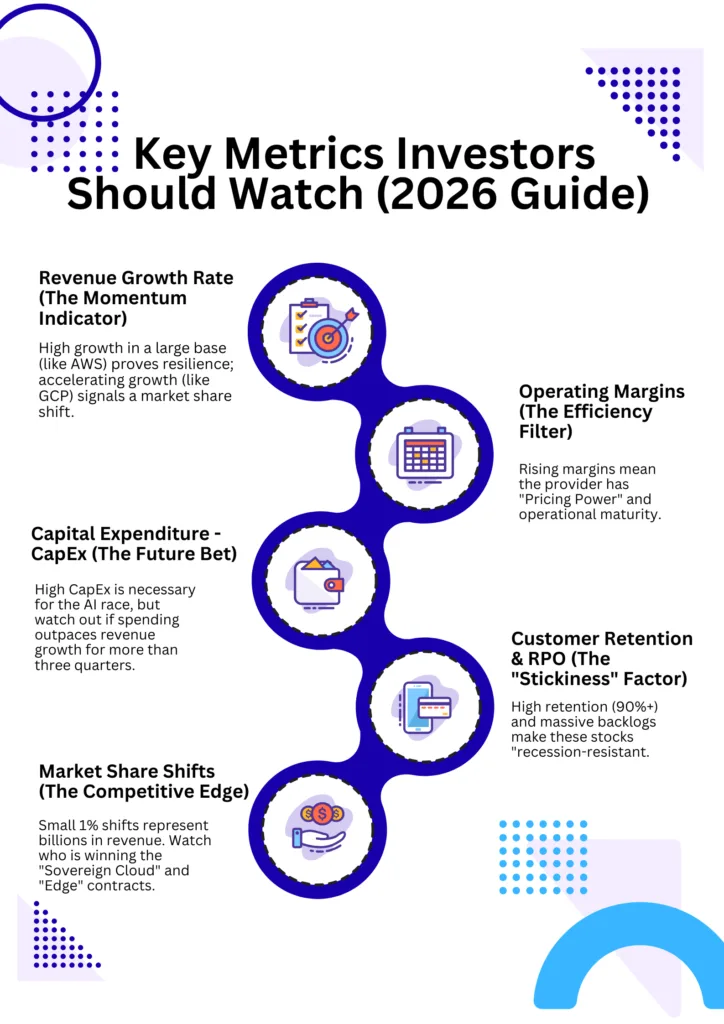
When evaluating AWS, Azure, and Google Cloud, investors should go beyond headline revenue and dig into metrics that reveal the quality and sustainability of growth.
1. Revenue Growth Rate
Top-line growth shows how quickly each platform is expanding its customer base and services. While AWS has historically led the market, Azure has consistently posted higher percentage growth, signaling strong enterprise adoption. Google Cloud’s rapid gains, though from a smaller base, are worth noting for investors looking for potential upside.
2. Operating Margins
Not all cloud dollars are equally profitable. AWS enjoys industry-leading margins, thanks to its scale and efficiency. Azure’s profitability is improving as it matures, while Google Cloud is still working toward sustained operating profits. Tracking margin trends helps investors spot which providers are turning growth into cash flow.
3. Customer Retention and Contract Value
Long-term contracts, renewal rates, and average deal sizes reveal how sticky these services are. High retention rates — often exceeding 90% — mean predictable revenue and lower acquisition costs.
4. Market Share Shifts
Even small percentage-point changes in market share can translate into billions of dollars. Keeping an eye on third-party market share reports highlights who’s winning large enterprise accounts.
5. Capital Expenditure (CapEx)
Cloud providers must invest heavily in data centers, AI hardware, and global networks. Rising CapEx can indicate aggressive expansion — but if spending grows faster than revenue, it may pressure margins.

Conclusion: The Sky is Not the Limit
The cloud computing boom of 2026 proves that we are only in the middle chapters of this story. For investors, the choice between AWS, Azure, and Google Cloud isn’t about picking a “winner”—it’s about understanding which strategy fits your portfolio.
AWS offers the foundation, Azure offers the enterprise interface, and Google Cloud offers the intelligence. Together, they are the most important investment themes of the decade.
Frequently Asked Questions (FAQs)
Which cloud provider is the best for AI investors?
Microsoft Azure is currently perceived as the leader in “Applied AI” (tools people use daily), while Google Cloud is considered the leader in “Deep AI” (data infrastructure and training). AWS is the leader in “AI Hardware” through its custom chips.
Is the cloud market becoming saturated in 2026?
No. While basic storage is common, the migration of specialized industries (like Healthcare and Manufacturing) and the integration of AI mean there is still significant “blue ocean” for growth.
How does the “Multi-Cloud” trend affect investors?
Multi-cloud (using more than one provider) is good for the industry but creates competition. Investors should look for providers that offer the best “Management Tools” (like Azure Arc) to control these complex environments.
What are the risks of investing in cloud stocks?
The primary risks are regulatory intervention (antitrust laws), energy costs (data centers require massive power), and cybersecurity breaches that could damage brand trust.
Why is Google Cloud still in third place?
Google entered the enterprise market later than AWS and Microsoft. However, its growth rate in specialized sectors like retail and data science is higher than its competitors, making it a “quality over quantity” player.
