


Introduction to Modern Computing Architectures
Suppose you run a business where every millisecond counts and all actions are based on the speed of data transport. In today’s digital-first world, speed is money. This is exactly where the edge computing vs cloud computing debate starts. These two technologies are designed to process data in very different manners, and understanding the difference between edge computing and cloud computing is essential for any modern tech strategy.
While cloud and edge computing both aim to provide powerful processing and storage, they operate on opposite ends of the spectrum. To put it in simple human terms:
Edge Computing: This is like having a high-end washing machine right in your own house. It’s immediate, handles your specific needs instantly, and eliminates the commute.
Cloud Computing: Imagine washing your laundry in a massive industrial plant a few miles away. It’s powerful and handles huge volumes, but there is a travel time involved.
Read more blog : Edge Computing vs Cloud Computing for SaaS Applications in 2026
What Is Edge Computing?
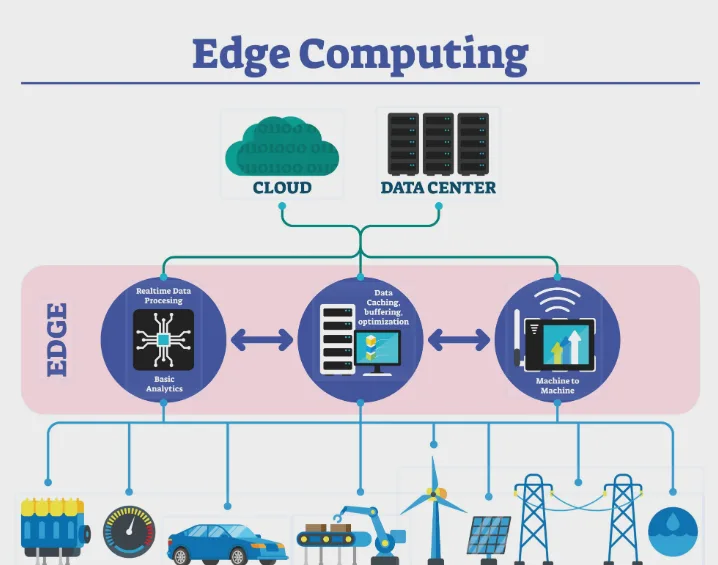
To understand what is edge cloud or edge computing, you have to look at the source. Unlike traditional setups, edge computing works with data that is physically nearer to the source—such as IoT devices, industrial sensors, or the end-user’s smartphone.
How Edge Computing Works
In the edge versus cloud computing model, proximity is power. Edge devices are designed to handle data processing on-site or at nearby micro-data centers. Instead of transmitting every bit of raw information to a remote cloud server (which creates a “lag”), the “edge” processes the data locally and only sends the essential results to the mothership. This is the fundamental difference between edge computing and cloud computing architecture.
Key Characteristics of Edge Computing
When comparing cloud vs edge computing, the edge stands out for its “boots on the ground” approach. Its primary traits include:
- Ultra-Low Latency: Since data doesn’t travel thousands of miles, responses are near-instant.
- Real-Time Processing: Crucial for autonomous vehicles or medical hardware where a delay of a second is a second too long.
- Reduced Bandwidth Usage: By filtering data locally, edge and cloud computing networks stay unclogged and efficient.
- Localized Decision-Making: Devices can make smart “calls” without needing to “ask” a central server for permission first.
What Is Cloud Computing?
To truly grasp the difference between edge computing and cloud computing, you first have to look at the “big picture.” Cloud computing is the delivery of computing services—including servers, storage, databases, networking, and software—over the internet. Instead of relying on a local hard drive or a nearby sensor, you are tapping into a global network of high-powered resources.
How Cloud Computing Works
In the cloud vs edge computing model, the cloud acts as the centralized brain. User data is transmitted from a local device to massive, remote data centers. These centers process the information and deliver the results back to the user.
If you’ve ever stored a photo on Google Drive or streamed a movie on Netflix, you’ve seen cloud computing in action. These services rely on the cloud’s ability to store and stream massive amounts of data from a central hub to anywhere in the world.
Key Characteristics of Cloud Computing
When evaluating edge computing vs cloud, the cloud is defined by its massive scale and accessibility:
- Centralized Data Processing: All “heavy lifting” happens in one location, making it easier to manage large-scale analytics.
- High Scalability: You can increase your storage or processing power instantly as your business grows.
- Pay-as-you-go Pricing: You only pay for the resources you actually use, which is a major difference between edge computing and cloud costs.
- Internet-Dependent Access: Since the data lives “off-site,” a stable internet connection is the bridge that makes the cloud work.
Today, cloud and edge computing have become the backbone of modern tech. Specifically, cloud computing has taken center stage in software delivery through the SaaS (Software as a Service) model, allowing users to access powerful tools without needing to install anything locally.
Why the Debate: Edge Computing vs Cloud Computing Matters
In the modern era, businesses are drowning in data. However, as data volumes explode, it is not always viable (or cost-effective) to send every single byte to a central server. This is why the edge versus cloud computing debate has moved from the IT department to the boardroom.
Choosing between cloud and edge computing is no longer just a technical preference—it is a strategic business decision. Whether you prioritize global reach or local speed, understanding the difference between edge computing and cloud computing is the key to a scalable digital architecture.
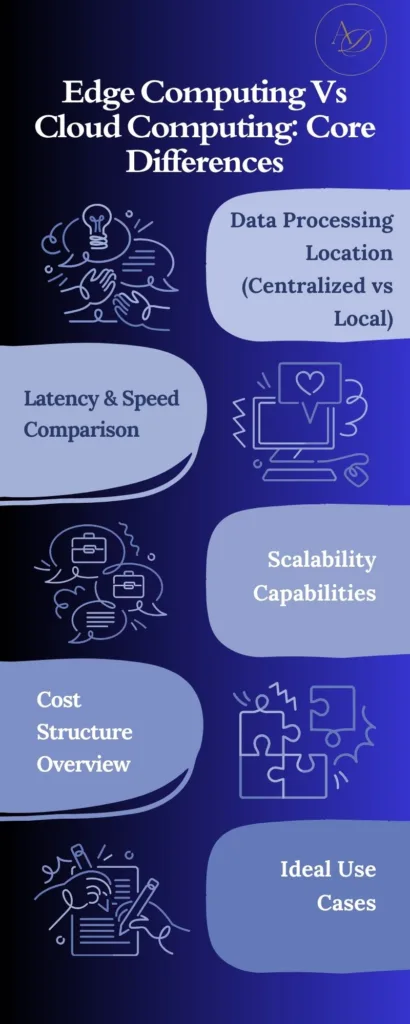
Edge Computing Vs Cloud Computing: Core Differences
1. Latency and Performance
In the edge vs cloud computing battle, Edge wins on speed. Because data is processed locally, the “round-trip” time to a distant server is eliminated. This results in a significant decrease in delay, making it the go-to for time-sensitive applications.
2. Data Processing Location
The most visible difference between edge computing and cloud is where the “thinking” happens:
- Cloud: Data is sent to massive, centralized data centers that could be thousands of miles away.
- Edge: Data stays on the “edge” of the network, processed by local devices, sensors, or nearby nodes.
3. Scalability
When comparing cloud computing vs edge computing, the Cloud is the king of growth.
- Cloud systems can expand virtually in real-time with the click of a button.
- Edge systems tend to grow more incrementally, often requiring the physical installation of one device or node at a time.
4. Cost Structure
The financial models for edge and cloud computing vary significantly:
- Cloud: Typically follows a subscription-based or pay-as-you-go pricing model, which is great for OpEx (Operating Expenses).
- Edge: Often requires a higher initial hardware investment (CapEx), though it can save massive amounts of money on data transmission costs in the long run.
Cloud Computing vs Edge Computing: Architecture Comparison
To visualize the difference between edge computing and cloud computing, it helps to look at them side-by-side. The following breakdown highlights the architectural gap between the two:
| Feature | Cloud Computing | Edge Computing |
| Data Processing | Centralized (Remote Hubs) | Decentralized (Local Nodes) |
| Latency | Higher (Due to distance) | Very Low (Near-instant) |
| Internet Dependency | High (Always-on required) | Low (Can operate offline) |
| Ideal For | SaaS, Big Data, Storage | IoT, AI, Real-time apps |
This table clearly illustrates why the cloud vs edge computing debate is so prevalent. While the cloud offers massive power, the edge offers the agility required for modern, “always-on” hardware.
Cloud vs Edge Computing: The Security Perspective
Security is often the “make or break” factor when choosing between edge and cloud computing. Both models offer unique protection profiles:
- Cloud Security: Major providers (like AWS, Azure, or Google) invest billions in high-level security protocols. However, because the data is centralized, these “data lakes” can become high-value targets for large-scale breaches.
- Edge Security: By keeping data local, edge computing reduces the “exposure window.” Since sensitive information doesn’t always have to travel across the public internet, it is inherently more private.
However, there is a catch. In the edge computing vs cloud security battle, the edge is only as strong as its weakest link. Because edge devices are physically distributed, they must be rigorously configured and updated to prevent them from becoming easy entry points for hackers.
Ultimately, whether you choose edge or cloud computing, your security strategy must adapt to where your data lives.
This is the most practical part of your blog. By showing edge versus cloud computing in action, you help the reader understand which one they actually need. I have optimized this section to use high-intent keywords while creating a clear contrast between “immediate action” (Edge) and “long-term analysis” (Cloud).
Edge vs Cloud in Real-World Use Cases
The difference between edge computing and cloud computing isn’t just theoretical—it’s changing how industries operate in real-time. Depending on the goal, businesses often find that cloud and edge computing work best as a team.
1. IoT and Smart Cities
In the world of Internet of Things (IoT), speed is everything. Edge computing is essential for smart homes and smart cities, providing the instant responses needed for automated lighting or traffic management. Without the low latency of edge vs cloud computing, a smart car might wait seconds for a “stop” command—which is seconds too long.
2. Healthcare and Wearables
The healthcare sector relies heavily on edge and cloud computing for patient safety. Wearable devices act as real-time monitors, using edge computing to process vitals like heart rate or glucose levels instantly. However, that data is later sent to the cloud for long-term health trend analysis and medical record storage.
3. Manufacturing and Industrial IoT (IIoT)
In modern “Smart Factories,” the edge vs cloud choice is clear:
- Edge: Used on the factory floor to identify machine failures or safety hazards in milliseconds.
- Cloud: Used to aggregate data from multiple global factories to optimize the entire supply chain.
4. Retail and E-commerce
Retailers are perfectly blending cloud vs edge computing to improve the customer journey. Edge computing enhances the speed of checkout systems and “just-walk-out” technology, while cloud computing handles the massive backend inventory analytics and personalized marketing data.
Cloud Computing for SaaS Applications
Today, SaaS (Software as a Service) is flourishing on the cloud platform. Because the cloud offers centralized updates, easy scalability, and the ability to access data from anywhere in the world, it is the perfect home for CRM, ERP, and team collaboration tools.
When you look at cloud and edge computing, the cloud acts as the “anchor” for these global applications, ensuring every user—no matter where they are—is running the same version of the software.
Cloud vs On-Premise Software: Where Edge Fits In
To understand the modern landscape, we have to look at how the difference between edge computing and cloud computing bridges the gap between old and new:
- Conventional On-Premise: Everything stays local. It’s secure but lacks the flexibility of the internet.
- Cloud Computing: Everything goes online. It’s incredibly flexible but can be limited by bandwidth and latency.
- Edge Computing: This is the “best of both worlds.” It integrates local processing (On-Premise speed) with cloud backup (Cloud flexibility).
This hybrid model is emerging as the preferred choice for modern companies. In a comparative analysis of cloud vs on-premise software, edge computing provides the localized control that pure cloud solutions sometimes lack.
Performance & Cost: The Ultimate Cloud vs Edge Showdown
If you are evaluating edge vs cloud computing for your budget or your dev team, these tables break down the “hidden” factors:
Performance Comparison: Edge vs Cloud
| Metric | Edge Computing | Cloud Computing |
| Response Time | Milliseconds (Instant) | Seconds (Delayed) |
| Bandwidth Usage | Low (Processes locally) | High (Transfers everything) |
| Offline Capability | Yes (Autonomous) | No (Requires Internet) |
Cost Comparison: Edge vs Cloud
| Cost Factor | Edge Computing | Cloud Computing |
| Initial Setup | High (Hardware required) | Low (No physical servers) |
| Maintenance | Moderate (Local upkeep) | Low (Provider managed) |
| Long-Term Cost | Lower (Less data transit) | Higher (Scaling fees) |
Final Verdict: Which One Should You Choose?
Deciding between edge versus cloud computing depends entirely on your specific goals. Here is a quick cheat sheet:
Choose Cloud Computing if you need:
- Global Accessibility: Your team is spread across the world.
- Rapid Scalability: You need to double your server capacity in minutes.
- SaaS Deployment: You are building or using web-based software tools.
Choose Edge Computing if you need:
- Real-Time Processing: You are running autonomous tech or high-speed manufacturing.
- Ultra-Low Latency: Every millisecond matters for your user experience.
- Local Decision-Making: You need your devices to work even if the internet goes down.
Read more blog : Can Edge Computing do Real-Time Data Processing for Faster, Smarter Applications?
Hybrid Approach: Best of Both Worlds

In the majority of businesses, they do not have to make a choice. The combination of edge and cloud is flexible, fast and can be scaled.
Strategic Insight: Balancing the Edge and the Cloud
Industry experts increasingly advise that the most successful digital transformations aren’t about choosing one technology over the other—they are about strategic orchestration. The goal is to move away from “all-in” migrations and toward a model that solves specific business needs:
- Deploy at the Edge specifically where latency is a dealbreaker (e.g., autonomous safety systems or instant biometric auth).
- Leverage the Cloud where massive computational power and global data accessibility are required.
By taking this balanced approach, businesses avoid the trap of over-investing in a single model and missing out on the unique opportunities offered by the other. It’s about being “performance-first” rather than “platform-first.”
Future Trends in Edge and Cloud Computing
The difference between edge computing and cloud computing is narrowing as the two technologies begin to merge into a single, seamless ecosystem. Keep an eye on these three trends:
- AI-Powered Edge Devices: We are moving toward “Edge AI,” where devices don’t just collect data—they analyze it using on-device machine learning.
- 5G-Enabled Edge Networks: The rollout of 5G is the “turbocharger” for edge vs cloud computing, allowing for massive data transfer speeds that make the edge more powerful than ever.
- Cloud-Edge Orchestration Systems: New software layers are being built to manage cloud and edge computing as a single unit, automatically moving workloads to wherever they run most efficiently.
Conclusion: The Synergy of the Future
In the edge versus cloud computing debate, there is no single “winner.” The real victory lies in making the right architectural decisions for your specific business goals.
The Cloud provides the scale, ease of management, and global reach that modern enterprises demand. The Edge provides the localized speed, privacy, and real-time accuracy that the next generation of IoT and AI requires. Together, they constitute the backbone of the next-generation digital infrastructure.
When you stop viewing it as cloud vs edge and start viewing it as a partnership, you unlock the full potential of your data.
Frequently Asked Questions (FAQs)
1. Is edge computing replacing cloud computing?
No, edge computing is not a replacement for the cloud. Instead, edge and cloud computing are complementary technologies. While the cloud handles heavy data processing and long-term storage, the edge manages immediate, time-sensitive tasks. The future of infrastructure is a hybrid model that uses both.
2. Which is cheaper: edge vs cloud computing?
In the edge computing vs cloud cost debate, it depends on your timeline. Cloud computing typically has lower upfront costs due to its pay-as-you-go model. However, edge computing can be more cost-effective in the long term by significantly reducing data transmission costs and bandwidth usage.
3. Can SaaS applications benefit from edge computing?
Yes. While most SaaS tools live in the cloud, integrating edge computing in cloud computing architectures can lead to much faster user experiences. By processing certain UI elements or data inputs at the edge, SaaS providers can reduce lag and improve application performance.
4. Can SaaS applications use edge?
Not always. Because of the physical distance between the user and the data center, the cloud can suffer from latency (delay). For real-time applications like autonomous driving or surgical robotics, edge computing is the superior choice because it processes data instantly at the source.
5. What industries see the most difference between edge computing and cloud usage?
The industries that benefit most from this synergy include Healthcare (remote monitoring), Manufacturing (predictive maintenance), IoT, Retail (instant inventory), and Smart Cities (traffic management). These sectors rely on the “instant” nature of the edge combined with the “analytical” power of the cloud.
