


Cloud-native application development has revolutionized how modern businesses design, build, and deploy software to meet the dynamic demands of today’s digital landscape. Unlike traditional monolithic architectures, cloud-native applications leverage the power of cloud computing, microservices, containerization, and continuous delivery to create scalable, resilient, and agile systems.
As organizations increasingly adopt cloud technologies, understanding the best practices for cloud-native development becomes essential for staying competitive and delivering high-quality solutions. This guide explores the core principles, strategies, and techniques that define cloud-native development, offering actionable insights for developers, architects, and business leaders alike. From embracing microservices to optimizing DevOps workflows, learn how to build applications that thrive in the cloud.
Why Cloud-Native Application Development Matters
The shift toward cloud-native application development is driven by the urgent need for speed, scalability, and resilience. Traditional development methods often result in rigid, tightly coupled systems that struggle to adapt to sudden change or handle severe spikes in user demand. In contrast, cloud-native applications are purpose-built to exploit the elasticity and distributed nature of modern cloud environments.
Key Benefits for Modern Engineering Teams:
- Accelerated Time-to-Market: By breaking applications into smaller, independent components—known as microservices—developers can update, scale, and deploy individual features without risking the entire system.
- Improved Fault Tolerance: Modularity isolates failures to specific services, preventing system-wide outages and ensuring continuous availability.
- Optimized Resource Usage: Dynamic scaling allows organizations to utilize infrastructure efficiently, significantly reducing operational costs.
- DevOps & CI/CD Alignment: Cloud-native architecture naturally integrates with automated deployment pipelines, enabling friction-free releases with minimal downtime.
Industry analysts emphasize that cloud-native adoption is dominating enterprise IT strategies, making it a critical requirement for future-proofing technology stacks.
Read more blog : 7 Advantages of Microservices Over Monolithic Architecture
Traditional Monolithic vs. Cloud-Native Architecture
To understand the practical impact of cloud-native development, it helps to compare it directly against legacy monolithic systems:
| Architectural Dimension | Traditional Monolithic Architecture | Cloud-Native Architecture |
| Structure | Single, tightly coupled codebase | Independent, loosely coupled microservices |
| Deployment | Large, risk-heavy, periodic releases | Rapid, automated, continuous deployments (CI/CD) |
| Scaling | Vertical scaling (upgrading machine hardware) | Horizontal scaling (adding light container instances) |
| Fault Tolerance | Single component failure can crash the entire system | Isolated service failures with automated self-healing |
| Infrastructure Integration | Tied to specific physical or virtual hardware | Infrastructure-agnostic via containers & orchestrators |
| Team Operations | Siloed development and operations teams | Integrated DevOps culture with shared accountability |
Core Principles of Cloud-Native Development
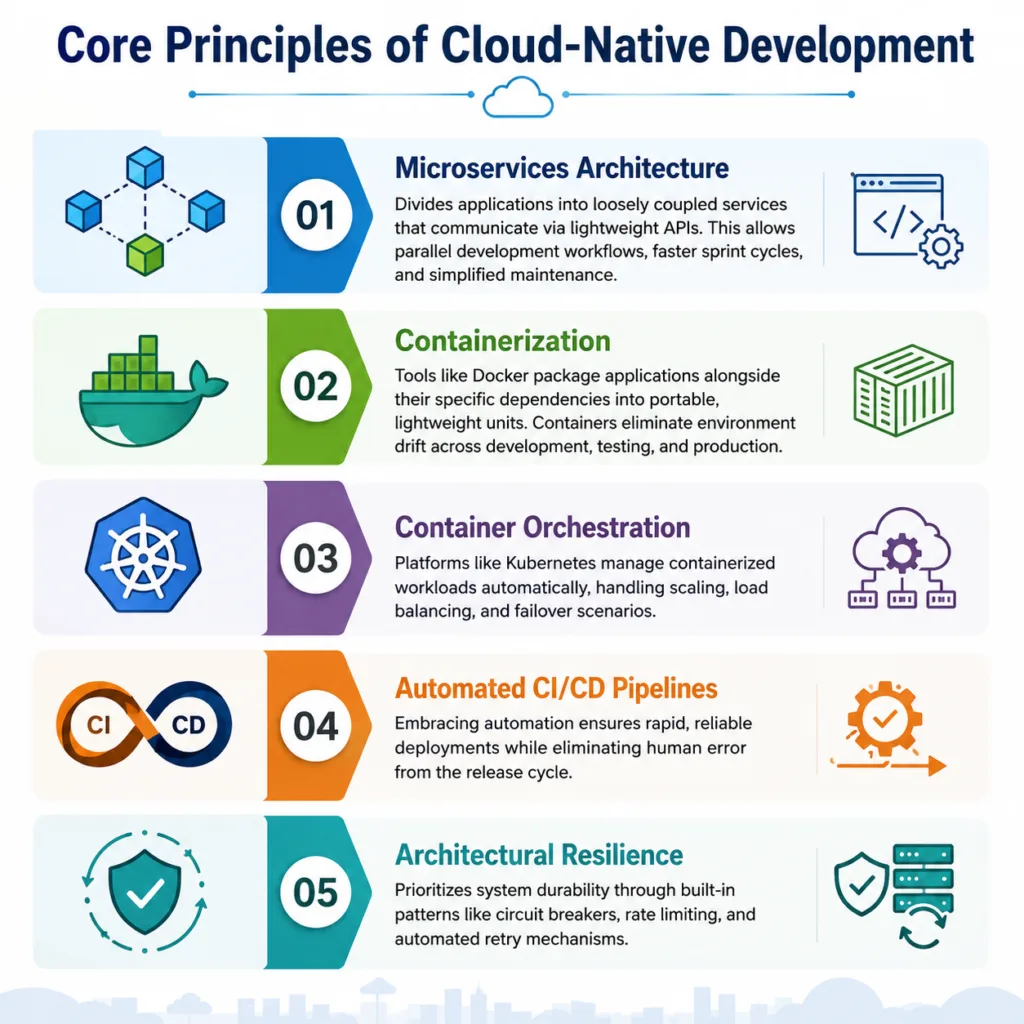
At the heart of cloud-native application development lie several foundational principles that guarantee system robustness and efficiency:
- Microservices Architecture: Divides applications into loosely coupled services that communicate via lightweight APIs. This allows parallel development workflows, faster sprint cycles, and simplified maintenance.
- Containerization: Tools like Docker package applications alongside their specific dependencies into portable, lightweight units. Containers eliminate environment drift across development, testing, and production.
- Container Orchestration: Platforms like Kubernetes manage containerized workloads automatically, handling scaling, load balancing, and failover scenarios.
- Automated CI/CD Pipelines: Embracing automation ensures rapid, reliable deployments while eliminating human error from the release cycle.
- Architectural Resilience: Prioritizes system durability through built-in patterns like circuit breakers, rate limiting, and automated retry mechanisms.
Read more blog : Difference Between Docker and Kubernetes
Best Practices for Building Cloud-Native Applications
Implementing cloud-native development successfully requires strict adherence to industry-tested engineering standards:
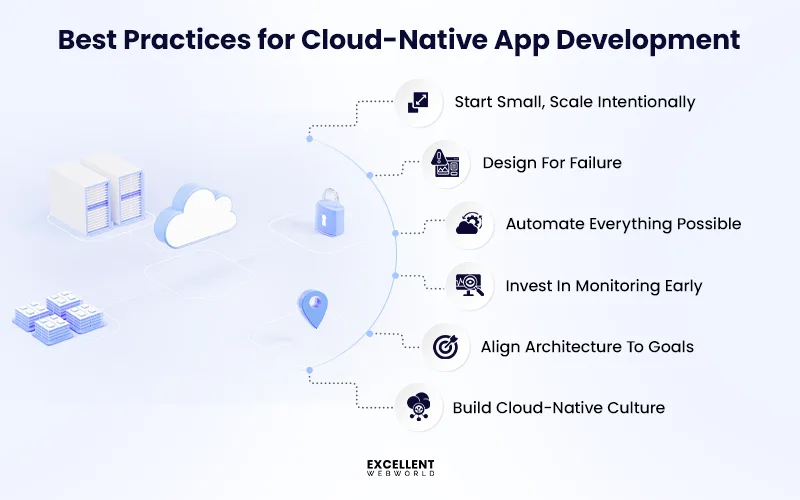
- Design for Failure: Assume components will fail. Build redundancy, fallbacks, and self-healing mechanisms directly into your service architecture.
- Prioritize Full-Stack Observability: Integrate comprehensive logging, real-time metrics, and distributed tracing (using platforms like Prometheus and Grafana) to detect and resolve issues proactively.
- Adopt Infrastructure as Code (IaC): Use tools like Terraform or AWS CloudFormation to define and provision infrastructure through version-controlled, repeatable code.
- Implement Zero-Trust Security: Secure every layer of your application stack—from base container images and secrets management to API endpoints—following OWASP security guidelines.
- Foster a DevOps Culture: Break down operational siloes by encouraging continuous collaboration between software developers and IT operations.
Essential Tools and Technologies for Cloud-Native Success
Building a resilient cloud-native stack relies on selecting the right tools for each layer of your infrastructure:
- Containerization & Orchestration: Docker provides foundational container packaging, while Kubernetes automates container deployment and operational management.
- CI/CD Automation: GitHub Actions, GitLab CI, and Jenkins drive automated build, test, and deployment workflows.
- Service Mesh: Istio and Linkerd streamline microservice communication, providing advanced traffic routing, telemetry, and encrypted security.
- Managed Cloud Databases: Services like Amazon RDS or Google Cloud Spanner offer distributed databases that scale elastically without manual management overhead.
- Observability & Monitoring: The Elastic Stack (ELK), New Relic, and Prometheus deliver end-to-end monitoring and operational insights.
- Serverless Compute: Frameworks like AWS Lambda or Azure Functions allow execution of event-driven logic without managing underlying server instances.
Overcoming Common Cloud-Native Challenges
While cloud-native application development offers clear business advantages, navigating its inherent complexities requires proactive management:
Challenge 1: Microservice Complexity & Sprawl
- The Issue: Managing dozens of interconnected services can quickly lead to operational noise and tracing difficulties.
- The Solution: Establish strict API governance, enforce standardized service blueprints, and utilize API management tools like Postman or OpenAPI specifications.
Challenge 2: Expanded Attack Surface
- The Issue: Distributed applications expose more endpoints and integration pathways to security threats.
- The Solution: Implement automated vulnerability scanning (using tools like Snyk), enforce least-privilege access controls, and adopt end-to-end encryption across all internal service communications.
Challenge 3: Unpredictable Cloud Costs
- The Issue: Dynamic auto-scaling can cause resource expenditure to spiral out of control if unmonitored.
- The Solution: Set up granular cost tracking, implement strict budget alerts via cloud provider dashboards, and regularly right-size underutilized container deployments.
Conclusion
Cloud-native application development represents a fundamental paradigm shift. By embracing microservices, containerization, automation, and a DevOps mindset, modern organizations can build software that easily adapts to shifting market conditions.
While the transition introduces new operational considerations—such as service sprawl and cloud cost management—adopting these core best practices provides a clear roadmap for long-term technical success. Whether you are modernizing an existing enterprise application or architecting a cloud-first system from scratch, aligning your strategy with cloud-native principles ensures your technology stack remains scalable, resilient, and competitive.
Frequently Asked Questions (FAQs)
What is cloud-native application development?
Cloud-native application development is an approach to designing, building, and running applications that fully leverage cloud computing models. It relies on microservices, containers, automated pipelines, and scalable infrastructure to deliver high agility and system resilience.
Why are microservices preferred in cloud-native development?
Microservices split large applications into independent, self-contained units. This modularity allows engineering teams to update, scale, or fix specific parts of an application without causing system-wide downtime.
How does Kubernetes support cloud-native applications?
Kubernetes acts as the container orchestrator. It automates container deployment, balances traffic load across instances, dynamically scales resources up or down based on demand, and automatically replaces failed containers.
How can teams control security risks in cloud-native environments?
Security is maintained by integrating automated container scanning, enforcing zero-trust policies, utilizing centralized secrets management, encrypting data in transit and at rest, and adhering to standard OWASP guidelines.
