


AI in healthcare is no longer a new thing: several years ago, it became the primary driver i the domain. If you plan to develop AI-based healthcare software in 2025 (e.g., an image-processing model for radiology, a virtual care application, or a clinical trial assistant powered by machine learning), selecting an appropriate development partner is important. We’ve listed the most successful companies you can choose from
1. Accenture
Accenture merges management consulting, digital transformation, and technical delivery, which can be used when AI-related projects require an organizational change: integrating AI outputs into clinical workflows, updating care pathways, and creating business cases that are easy to procure.
Their strength lies in: multi-hospital rollouts, integrating EHRs, and establishing a governance system to monitor the model and reduce bias.
Project they suit: implementation of an AI triage and bed-management system into a regional health system – linking patient flow models with EHR data, development of clinician dashboards, and the change management that is required to implement the change.
2. IBM Consulting
IBM has been in the healthcare industry since the early 1980s: A history of clinical AI projects, computer-generated understanding of clinical notes, and enterprise-scale implementations. IBM Consulting is a combination of domain expertise and scalable infrastructure, and they have been putting significant emphasis on incorporating AI into provider processes.
Their weaknesses: they are weak at natural language processing of clinical notes, organization of unstructured data, and providing federated learning conditions where data does not have to leave hospital premises.
Project they fit best: recovering meaningful phenotypes on millions of de-identified notes to speed up cohort discovery research without compromising patient privacy.
3. EPAM Systems
EPAM has software engineering rigor and culture of high delivery. They tend to collaborate with digital health scaleups and established medtech businesses to productize models, all the way from a prototype up to a full-fledged, monitored production service.
Their strength is high quality codebases, CI/CD of ML, data engineering at scale, and cross platform integrations (mobile, web, desktop).
Project of the right fit: converting a research-quality diagnostic model into a production-level web application with end-to-end test coverage, observability, and self-training pipelines.
4. Cognizant
Cognizant is a mix of systems integration with the sphere of healthcare. They do well where the technical solution needs to be highly integrated with other major backend systems such as billing, claims, and ERP.
Their strength lies in: enterprise integrations, payer-provider solutions, and developing analytic stacks to support population health programs.
Project they can fit: roll out a payer-facing risk stratification engine, which combines claims data, social determinants of health, and clinical records to rank case management interventions.
5. HCLTech
HCLTech has put money into cloud engineering and the introduction of AI into distributed settings. In the case of medtech devices and remote monitoring, edge processing with secure cloud sync, the experience of HCL with cloud computing is useful.
Strengths: medical device embedded software, remote patient monitoring, and secure cloud pipeline.
Project they are suited: the construction of an edge-and-cloud architecture to continuous glucose monitoring performing on-device anomaly detection and transmitting events to a clinician dashboard.
6. Cleveroad
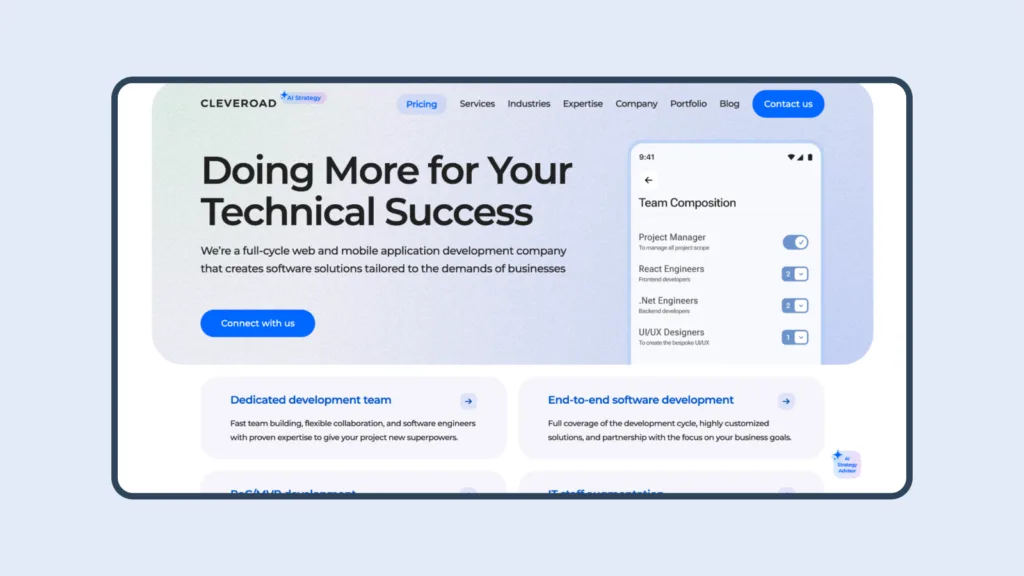
You want Cleveroad to be there–and not without cause. Cleveroad is a boutique store that has already demonstrated the capability of quickly transitioning to an idea and MVP without making user experience secondary. They are mobile and web engineers who bring together quick ML prototyping and ship products to startups and mid-market companies.
Their areas of strength are: the creation of MVPs and production-quality applications within a very short time, UX of patient- and clinician-facing applications, and the ability to extend existing core engineering teams.
Project that suits them: a telemedicine application with built-in symptom triage, asynchronous image capture and dermatology, and a back-end that identifies cases that require an urgent review with an ML-based solution.
7. Optum / UnitedHealth Group
Optum combines technology and scale with clinical operations expertise never before seen before. Unless the deep clinical data, payer-provider process, or solution requires is needed and must be deployed within a large health system, the resources of Optum are difficult to match.
Strengths: algorithms of population health, claims-to-clinical analytics, scale deployments.
Project they can work with: creating an engine to build care-gap closures that would suggest interventions to minimize readmissions in thousands of primary care practices.
8. Infosys
Infosys is a company that is global, with delivery experience and EHR integrations and enterprise AI implementations. They are strong in providing stable results over mass, spread out client groups.
Their strengths include: end-to end platform development, automation of workflow processes by clinicians, and interoperability with existing hospital systems.
Project which suits them: automating pre-authorizations with an AI assistant who reads clinical notes, fills out forms and connects to payer portals.
Key capabilities to check when choosing a partner
When you’re evaluating vendors, ask for concrete evidence across these areas:
- Regulatory and clinical validation experience. Do they have FDA 510(k)/PMA or MDR experience? Can they support clinical trials or retrospective validation cohorts?
- Data engineering and interoperability. Can they pull data from major EHRs and map to FHIR, HL7, and common clinical terminologies?
- Model lifecycle and MLOps. Do they implement continuous training, drift detection, and explainability tooling?
- Security and privacy. HIPAA, HITRUST, GDPR — do they have documented processes and infrastructure to back it up?
- User-centered design for clinicians and patients. AI only helps if people use it — do they co-design workflows with clinicians?
- Evidence of outcomes. Can they show measurable improvements — shorter time-to-diagnosis, reduced readmission rates, or improved throughput?
If a vendor can demonstrate at least three of the above with case studies, they’re probably worth a pilot.
Steps to Build an AI Healthcare Project
A healthcare AI project can commonly work through established stages. This assists you in determining the ability of a vendor to meet all milestones.
- Discovery & data readiness. Learn about EHR schemas, data gaps, and consent. Numerous projects fail at this point due to the fact that clinical data is disorganized.
- Prototype modelling + feasibility. Train retrospective data baseline models, receive clinician feedback, and generate early metrics.
- Clinical validation. Conduct a healthy validation on the held-out cohorts or external locations; correct biases and calibration.
- Productization & integration. Wrap services, develop APIs, interface with EHRs, and develop clinician UIs.
- Regulatory & deployment. Make documentation, risk assessment, and select an appropriate regulation pathway. Deploy on-observation and incident response.
- Continuous improvement/monitoring. Monitor drift in the track model, user behavior, and clinical outcomes; repeat.
An effective partner will be clear on time and artifacts at any given stage.
Pricing and engagement models
Costs vary dramatically. The fees by big consultancies are more expensive, though capable of handling regulatory risk on an enterprise level. Boutique firms that work across regulated domains — including healthcare and fintech software development services — are often more flexible in pricing and can move faster during MVP and pilot phases.
Common models:
- Fixed-price MVP (good focusing features).
- Milestone-based time-and-materials (typical of exploratory AI work).
- Outcome-based contracts (like riskier but more aligned such as shared savings due to fewer readmissions).
You should also plan to spend on data work: labeling, cleaning, and governance can be the lion share of work.
Non-technical risks that sink projects (and how top vendors avoid them)
- Absence of clinician participation. Get clinicians involved in the design to deployment.
- Data access delays. To maintain momentum, top partners bind data deals at an early stage and test on fake or de-identified data.
- Workflow mismatch. Interrupting deployments are unsuccessful. The most successful teams design along with real users.
- Regulatory surprises. Vendors who are well-versed in healthcare predict the documentation requirements and design in advance to be in compliance.
What success looks like
Effective AI healthcare software development initiatives deliver visible effect. A triage model has the potential to decrease the wait times in ER by a quantifiable percentage. A proactive sepsis algorithm could identify the worsening situation hours earlier, which reduces the number of transfers to the ICU. A robot to automate the revenue cycle could also minimize denials and accelerate reimbursement.
When a vendor can demonstrate certain measures that were achieved in previous engagements, not only improved efficiency, but as an example, reduced average ED length-of-stay by X minutes, or improved coding accuracy by Y percent, that is what you want.
Quick vendor-match cheat-sheet
- You require enterprise change & governance: Accenture, Cognizant, Optum.
- Strong engineering, MLOps, productization. You want EPAM, Infosys, HCLTech.
- You are not an established company or require a fast MVP with polished UX: Cleveroad, niche startups.
- You require privacy-first federated learning in the EU: Nordic/EU experts.
- You demand end-to-end cloud-native implementation: AWS/Google/Microsoft professional services.
- Your area is genomics/radiology/oncology: Specialty companies that have curated data.
Final thoughts
You’ll need a company that has both regulation and deployment capability, coupled with technical excellence and clinical humility, and experience. A company like Cleveroad can get you idea-to-product (with great UX) in very little time; more consultancies can offer scale and governance. Niche companies provide you with expertise in the domain when you have to advance the clinical edge. Artificial intelligence in the healthcare industry will still be in a state of surprise, but when it works, it saves time, money, and lives. Select a partner that realizes the impact of AI, not glossy demos.
