


Cloud innovation is no longer just supported by Artificial Intelligence—it is built on it. Whether you are a lean startup testing generative AI or an enterprise scaling global infrastructure, choosing between Amazon Web Services (AWS), Microsoft Azure, and Google Cloud Platform (GCP) is the most consequential tech decision you’ll make this year.
Selecting a provider isn’t about following trends; it’s about aligning your technical architecture with your long-term business objectives.
Understanding Cloud AI Landscape
Why does comparing these hyperscale giants matter in 2026? Because the choice of a cloud platform is no longer just a technical preference—it is a long-term business strategy. With the rise of Agentic AI and autonomous workflows, cloud-based platforms provide the essential elasticity and “pay-as-you-scale” economics required to turn data into a competitive moat. By critically evaluating AWS, Azure, and Google Cloud, you ensure your technology stack isn’t just a “fashionable” choice, but a high-performance engine aligned with your specific ROI and operational goals.
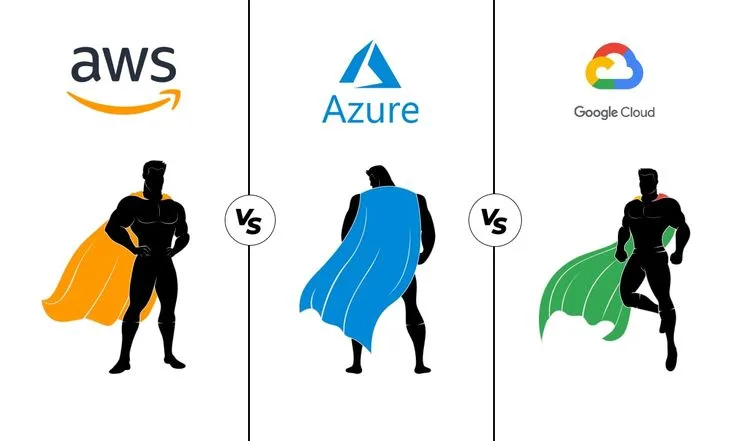
Overview of Major Providers
AWS AI: The Infrastructure Architect
The Amazon ecosystem is the “builder’s choice,” offering unmatched flexibility through its tiered service model. In 2026, the focus has shifted from simple hosting to Agentic AI and cost-efficient scaling.
- Flagship Tools: Amazon Bedrock provides a single API to access the world’s leading models (Claude 4.5, Llama 4, and Amazon’s own Nova series). Amazon SageMaker remains the gold standard for custom MLOps, now featuring automated “Zero-Code” pipelines.
- The Edge: Developers choose AWS for its custom silicon. Using Trainium and Inferentia chips, businesses can slash training and inference costs by up to 50% compared to standard GPUs.
Azure AI: The Enterprise Orchestrator
Microsoft has transitioned Azure from a cloud platform into an “AI Factory.” It is designed for businesses that want to deploy high-reasoning agents directly into their existing operational workflows.
- Flagship Tools: Azure AI Foundry is the new unified portal for building and governing AI agents. It offers exclusive, enterprise-grade access to OpenAI’s GPT-5.4 and the specialized o-series reasoning models.
- The Edge: Integration is king here. Azure is the natural home for organizations deep in the Microsoft stack (M365, Teams, GitHub), allowing them to deploy “Copilots” that already understand their internal enterprise data.
Google Cloud AI: The Data Scientist’s Frontier
Google Cloud continues to lead in “bleeding-edge” research and multimodal capabilities. It is the platform of choice for those who treat data as their primary competitive advantage.
The Edge: Google’s innovation in multimodal reasoning (processing text, video, and audio simultaneously) and its high-performance TPUs make it the undisputed leader for large-scale deep learning and research-intensive startups.
Flagship Tools: Vertex AI has been reimagined around Gemini 3.1 Pro, which features an industry-leading 1-million-token context window. For data teams, BigQuery ML allows for the creation of sophisticated models using only SQL, keeping data processing “in-place.”
Read more related blog : Future Trends in Cloud Computing and AI Integration: A Deep Dive into the Next Frontier
Architecting Your Future: A Comparison of the Big Three AI Hubs
| Feature | Amazon Web Services (AWS) | Microsoft Azure | Google Cloud (GCP) |
| Primary AI Hub | Amazon Bedrock & SageMaker | Azure AI Foundry | Vertex AI |
| Flagship Models | Claude 4.5, Llama 4, Nova 2 | GPT-5.4, o-series (OpenAI) | Gemini 3.1 Pro & Flash |
| Best For | Model flexibility & custom silicon | Microsoft ecosystem & Agents | Big data & Multimodal research |
| Hardware Edge | Trainium & Inferentia chips | Massive NVIDIA H200 clusters | TPU v5p (Tensor Processing Units) |
| Standout Feature | Nova Forge: Custom frontier models | Foundry Agents: Built-in orchestration | Agentic Vision: Real-time visual reasoning |
| Pricing Model | Granular pay-as-you-go | Hybrid benefits & Provisioned units | Automatic sustained-use discounts |
| Compliance | Highest (HIPAA, SOC, FedRAMP) | Enterprise-grade guardrails | Zero-trust data grounding |
AI Services on AWS
AWS is an AI Swiss army knife. AWS has a full toolkit with powerful Large Language Model support in SageMaker JumpStart to NLP and computer vision APIs. The level of security is at its best, making it possible to have Artificial Intelligence Apps Safe implementation in such industries as in healthcare and finance.
AI Services on Azure
Azure has cognitive services that include speech services, vision services, and decision-making. Its incorporation in the ecosystem of Microsoft renders the collaboration smooth. In evaluating the features of Azure AI vs Google Cloud AI, the former will frequently prevail due to its integrations-friendliness to enterprises and its flexibility in hybrid clouds.
AI Services on Google Cloud
Google Cloud is research oriented. Vertex AI makes model training simple and built-in support of Large Language Models drives tools such as PaLM and Gemini. They have a zero-trust architecture that ensures the safety of Artificial Intelligence Apps, particularly when deployed on a global scale.
Pricing and Scalability Secrets
While all three use a pay-as-you-go model, there are “hidden” ways to save in 2026:
- AWS: Use Spot Instances for non-critical training to save up to 90%.
- Azure: Leverage the Azure Hybrid Benefit if you already own Windows or SQL Server licenses.
- Google: Take advantage of Sustained Use Discounts, which apply automatically if you run a resource for a large portion of the month—no upfront commitment required.
The Verdict
Choose Google Cloud if you are building the next generation of multimodal apps or need to process massive datasets instantly.
Choose AWS if you need total control and want to experiment with multiple different AI models.
Choose Azure if you want the safest, most integrated path to deploying OpenAI’s tech across your existing workforce.
Performance Benchmarks
AWS is best at various workloads in performance tests, Azure has the best balance between enterprise reliability and Google is best at large scale data processing, which is important when training massive Large Language Model architecture.

Best Use Cases: Selecting Your Strategic Fit
In 2026, the “best” provider is the one that aligns with your specific operational architecture.
- AWS: The powerhouse for high-scale retail (e-commerce), real-time medical imaging, and adaptive video streaming. Its custom chips make it the most cost-effective for sustained, high-traffic AI workloads.
- Azure: The gold standard for integrated enterprise ecosystems. If your team uses the Microsoft 365 stack, Azure allows you to deploy “Agentic Copilots” that securely access your internal Word, Excel, and Teams data.
- Google Cloud: The home of predictive big data and multimodal research. It is the go-to for startups and research labs building next-gen apps that require simultaneous processing of text, video, and live data streams.
Security and Compliance: Building “Safe AI”
Trust is the currency of 2026. All three providers have moved beyond basic encryption to Zero-Trust AI Architectures.
- Certifications: They maintain rigorous compliance with ISO, SOC 1/2/3, and HIPAA, ensuring your “Artificial Intelligence Apps” remain safe.
- Governance: New for 2026 are Policy-Aware Agents—automated guardrails that monitor AI behavior in real-time to prevent “hallucinations” or unauthorized data access.
The Verdict: Choosing Your Provider
The decision rests on your primary business driver:
- AWS is the “Jack of all trades” with the deepest toolbox for custom development.
- Azure wins on enterprise support and speed-to-market for office-integrated AI.
- Google Cloud remains unrivaled in frontier research and multimodal reasoning.
Future Trends: What’s Next in Cloud AI?
The next 12 months will be defined by three major shifts:
Small Language Models (SLMs): A shift toward smaller, industry-specific models that run faster and cheaper than massive LLMs.vs Google, and making sure to select solutions that are in line with your objectives.
Agentic AI Ecosystems: Moving from chatbots that talk to “Agents” that do—executing complex tasks like autonomous procurement and security remediation.
Multi-Cloud Sovereignty: More businesses will adopt “Multi-Cloud” strategies, using Google for research and AWS for global production to avoid vendor lock-in.
Strategic Guidance: Navigating the Cloud AI Roadmap
Choosing between AWS, Azure, and Google Cloud is a high-stakes decision that requires more than just a surface-level feature comparison. To ensure long-term ROI, businesses must look beyond the marketing hype and focus on technical feasibility and cost-efficiency.
Professional guidance in this space is essential for:
- Identifying Hidden Costs: Moving from a pilot program to a global production environment often reveals unexpected “data egress” and “inference” fees.
- Infrastructure Matching: Determining whether your specific workload—such as a custom ML model or a generative AI agent—is better suited for the flexibility of AWS or the enterprise-ready guardrails of Azure.
- Future-Proofing: Implementing a Multi-Cloud strategy that allows you to use Google for research while maintaining AWS for global reliability, preventing “vendor lock-in.”
By bridging the gap between deep technical architecture and high-level business strategy, expert insights help organizations build scalable AI solutions that don’t just work—they compete.

Final Thoughts: Scaling with Confidence
As we move further into the era of Agentic AI, the cloud provider you choose today becomes the nervous system of your business tomorrow. AWS, Azure, and Google Cloud each offer distinct advantages in security, scalability, and model access. The key to a successful deployment lies in a balanced approach: start with your budgetary constraints, factor in your team’s technical expertise, and select the ecosystem that offers the most seamless path to growth.
1. Which provider is most cost-effective for AI?
Google typically sets the price high when it comes to intensive AI training yet AWS can provide options that are flexible and pay-as-you-go.
2. Is a Large Language Model necessary for all AI projects?
Not always, but a Large Language Model is important for natural language and generative tasks.
3. How secure are AI apps on these platforms?
All the three are Artificial intelligence applications safe with encryption and compliance certifications.
4. Which platform is best for startups?
Google is frequently the choice of startups because it is relatively cheap and research-friendly, but AWS credits are appealing as well.
5. Can I combine services from multiple providers?
Yes, there is a multi-cloud strategy that is embraced by many businesses to be flexible and resilient.
