


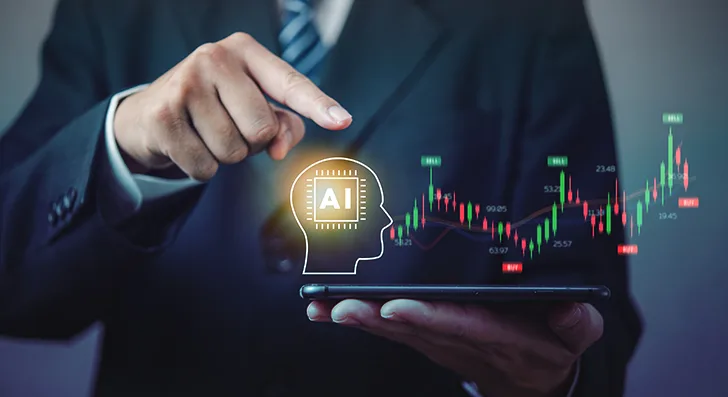
The stock market trading has always been a battleground of numbers, news, and nerves—but in recent years, a new player has entered the arena: AI and machine learning (ML). These technologies are transforming the way traders, investors, and financial institutions analyze markets, make decisions, and manage risk.
Unlike traditional trading strategies that rely heavily on human intuition and fixed rules, AI systems can process massive amounts of data, learn from patterns, and adapt in real time.
From predicting price movements to optimizing portfolios, AI and ML are rewriting the rules of stock market trading and shaping a future where machines may execute trades with minimal human intervention.
Understanding AI and Machine Learning in Trading
Artificial Intelligence (AI) and Machine Learning (ML) are no longer futuristic buzzwords—they’re active tools reshaping how financial markets operate.
At the core, AI refers to computer systems designed to perform tasks that usually require human intelligence, such as recognizing patterns or making decisions. Machine learning, a subset of AI, enables these systems to improve their performance by learning from data rather than relying on fixed rules.
In trading, this means models can analyze enormous amounts of historical price data, market trends, corporate earnings reports, and even global news in seconds. Unlike traditional algorithms, which follow pre-set instructions, ML models adjust their behavior as new information emerges.
Techniques like supervised learning (training on labeled data to predict outcomes) and unsupervised learning (finding patterns in unlabeled data) allow traders to uncover opportunities that humans might miss.
This adaptability gives AI-driven systems an edge in fast-moving markets, where conditions change minute by minute. By recognizing subtle patterns and correlations, they provide insights that go far beyond conventional chart reading or fundamental analysis.
Faster and Smarter Market Analysis
In today’s stock markets, information moves at lightning speed. News headlines, corporate earnings, global events, and even social media chatter can influence prices within seconds. Traditional analysis methods often struggle to keep pace—but AI and machine learning excel in this environment.
AI-driven systems can process millions of data points simultaneously, separating meaningful signals from background noise. For example, natural language processing (NLP) tools can scan breaking news or financial reports in real time to detect sentiment and potential market impact. Machine learning algorithms also analyze historical price movements alongside current conditions to identify opportunities before they become obvious to human traders.
This speed and precision are particularly valuable in high-frequency trading (HFT), where firms execute thousands of trades in fractions of a second to capitalize on tiny price fluctuations. By continuously learning and refining their models, these systems stay ahead of market shifts, enabling traders to make better-informed decisions faster than ever before.
Predictive Models for Price Movements
One of the most powerful applications of machine learning in stock trading is predicting price movements. These models are trained on massive datasets containing historical prices, trading volumes, technical indicators, and macroeconomic variables. By identifying recurring patterns, they can forecast short-term price trends or highlight when a stock is likely to break out of its usual range.
Unlike static technical analysis tools, machine learning models continuously update as new data flows in. For instance, neural networks and decision trees can detect subtle correlations between market conditions and price behavior that human traders might overlook. Some models even factor in alternative data sources, such as weather reports, satellite imagery, or consumer spending patterns, to gain a competitive edge.
These predictive capabilities don’t guarantee perfect accuracy—markets are influenced by countless unpredictable factors—but they improve the odds of making profitable trades. By combining these insights with risk management strategies, traders can make data-driven decisions rather than relying solely on intuition or emotion.
Risk Management and Portfolio Optimization
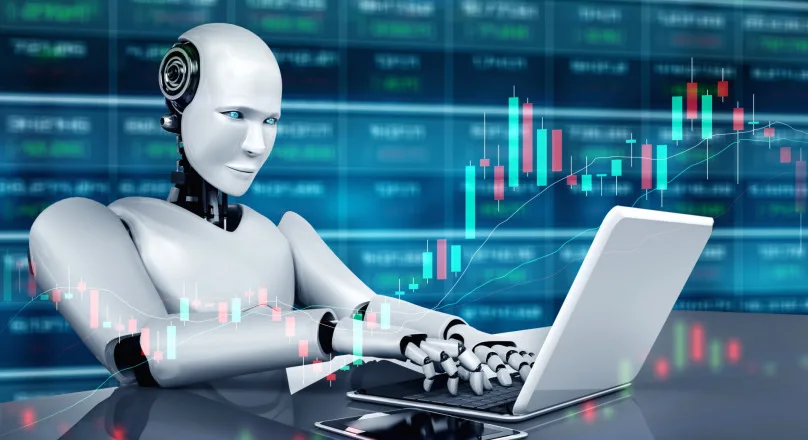
Stock trading isn’t just about finding opportunities—it’s about protecting capital when markets turn volatile. AI and machine learning have revolutionized this area by helping investors identify risks early and manage them with precision.
Machine learning models can analyze correlations between assets, detect early warning signs of market stress, and simulate different market scenarios to predict potential losses. This allows traders and institutions to rebalance portfolios dynamically rather than waiting for quarterly reviews or reacting after damage is done.
Robo-advisors, powered by AI, use these same principles to optimize investment strategies for individuals. They assess risk tolerance, goals, and time horizons, then recommend portfolios that adjust automatically as market conditions change. For large funds, AI can fine-tune diversification strategies by continuously scanning for hidden exposures or overconcentration in certain sectors.
By combining predictive analytics with real-time monitoring, AI-driven systems minimize surprises and create strategies that are both resilient and adaptive—essential qualities in today’s unpredictable markets.
AI-Driven Autonomous Trading
The next frontier in financial markets is fully autonomous trading powered by artificial intelligence. Instead of serving as tools for human decision-making, AI systems are beginning to operate as independent traders, executing strategies without direct oversight. These advanced platforms combine deep learning, real-time data processing, and adaptive algorithms to make split-second decisions that outperform many human-led approaches.
However, this shift raises important questions. If machines are trading against machines, will markets become more efficient—or more volatile? Regulators are already grappling with how to monitor algorithmic systems that evolve on their own, potentially creating “black box” scenarios where even developers can’t fully explain a model’s behavior.
Ethical and systemic risks also emerge. Sudden market crashes, known as “flash crashes,” could be amplified if autonomous systems react in unison. Despite these challenges, the potential benefits—greater liquidity, faster price discovery, and reduced human error—make AI-driven trading an inevitable part of the market’s future. The key will be balancing automation with transparency and safeguards to ensure that innovation strengthens, rather than destabilizes, global markets.
Conclusion
Artificial intelligence and machine learning are no longer experimental technologies in the stock market—they’re central to how modern trading operates. From lightning-fast data analysis and predictive price modeling to advanced risk management and even fully autonomous trading, AI is transforming every stage of the investment process.
While these tools offer unprecedented speed, accuracy, and adaptability, they also introduce new challenges. Regulatory oversight, ethical concerns, and the risk of overreliance on “black box” systems must be carefully addressed to prevent unintended consequences.
As markets evolve, one thing is certain: the traders and institutions that embrace AI thoughtfully—balancing human judgment with machine intelligence—will have a distinct edge. The future of stock trading won’t be purely human or purely automated, but a collaboration where technology enhances decision-making and drives smarter, more efficient markets.
