


In recent years, deep learning has made tremendous strides in transforming various industries, and one of the most remarkable fields it has impacted is image processing. Image processing traditionally relied on techniques like filtering, thresholding, and segmentation. However, with the advent of deep learning, especially through neural networks, the process has become significantly more sophisticated, leading to groundbreaking results in areas such as computer vision, medical imaging, and even facial recognition technology.
We’ll explore the key deep learning techniques that are revolutionizing image processing and delve into the transformative breakthroughs in this field.
1. Understanding Deep Learning in Image Processing
Deep learning is a subset of machine learning focused on using artificial neural networks to analyze and make decisions. In the realm of image processing, deep learning provides systems with the ability to learn features and patterns in images without explicit programming. This approach allows machines to “see” and interpret images similarly to human vision, unlocking potential in tasks previously unimaginable for machines.
Comparison of Deep Learning Architectures in Image Processing
| Technique | Primary Function | Key Strength | Common Use Case |
| CNN | Feature Extraction & Classification | Recognizes spatial patterns and hierarchies. | Object detection, facial recognition. |
| GAN | Image Synthesis & Generation | Creates new data that mimics the training set. | Deepfakes, photo restoration, super-resolution. |
| RNN/LSTM | Sequence & Temporal Analysis | Handles time-dependent data (frame-to-frame). | Action recognition in video, image captioning. |
| Autoencoder | Dimensionality Reduction | Learns to compress and reconstruct data. | Denoising, anomaly detection in X-rays. |
| U-Net | Semantic Segmentation | Provides pixel-level classification accuracy. | Medical imaging (tumor segmentation). |
Why Deep Learning in Image Processing?
Traditional image processing methods often require hand-crafted features and extensive pre-processing, which could be time-consuming and error-prone. With deep learning, systems learn from vast datasets, capturing complex patterns that allow for higher accuracy and efficiency. This adaptability makes deep learning indispensable in applications such as autonomous driving, medical diagnostics, and video surveillance.
Read more blog : Top 5 Essential Tools for Deep Learning Beginners
2. Key Deep Learning Techniques in Image Processing
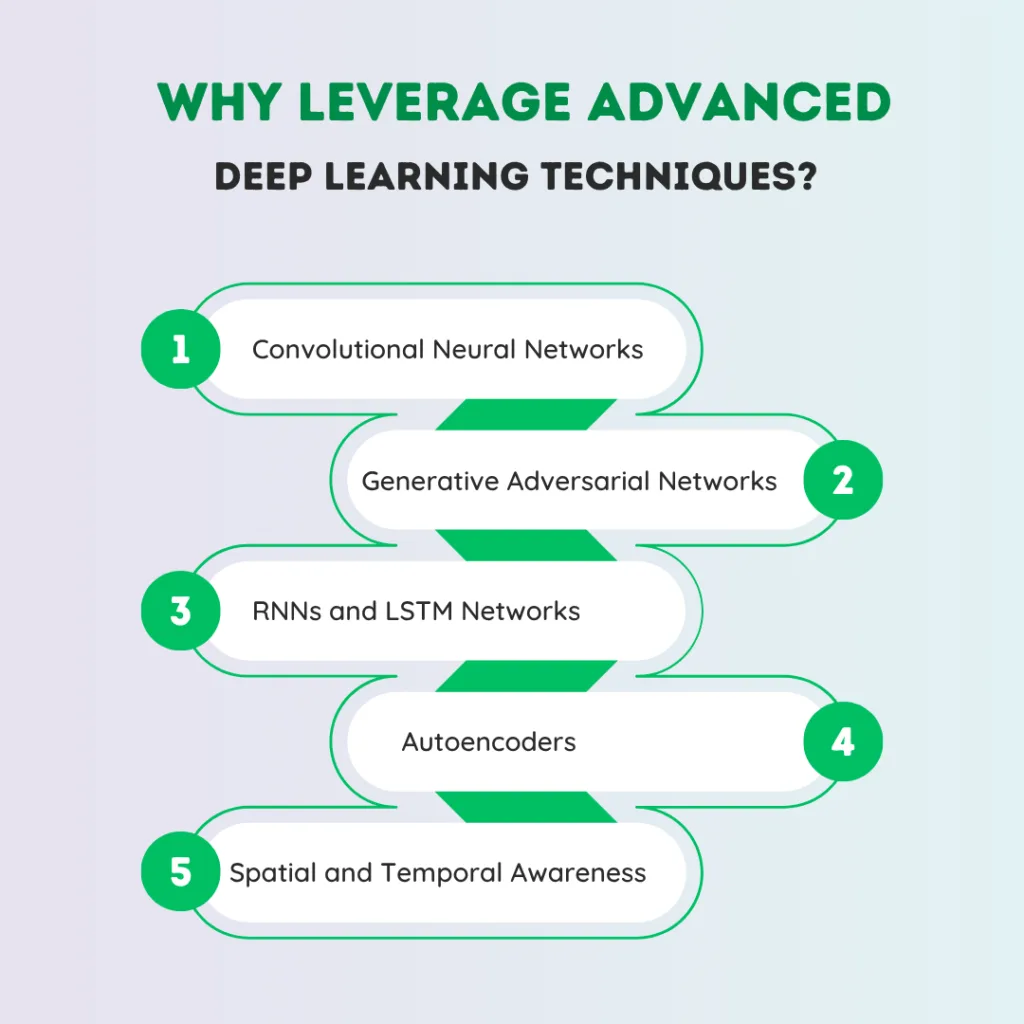
Deep learning’s impact on image processing can be credited to a set of powerful techniques that are advancing the field. Below are some of the most important techniques used in deep learning-based image processing.
a) Convolutional Neural Networks (CNNs)
Convolutional Neural Networks (CNNs) are arguably the most critical architecture in deep learning for image processing. CNNs are designed to recognize spatial hierarchies in images, making them particularly effective for tasks such as object recognition and classification.
- How CNNs Work: CNNs use filters (kernels) to scan through an image and capture features, such as edges and textures, which are crucial for identifying objects within an image.
- Applications: CNNs are widely used in facial recognition, medical image analysis, and autonomous driving systems to detect and classify objects like pedestrians, road signs, and other vehicles.
b) Generative Adversarial Networks (GANs)
Generative Adversarial Networks (GANs) consist of two networks: a generator and a discriminator. These networks are set up in a competitive relationship where the generator creates images, and the discriminator evaluates them. Over time, GANs improve the quality of the generated images to the point where they can be indistinguishable from real images.
- Applications: GANs are highly effective in tasks like image synthesis, style transfer, and image super-resolution, allowing for realistic image creation and enhancement.
- Breakthroughs: GANs have been used to generate photorealistic images, restore old or damaged photos, and create synthetic data for training models when real data is limited.
c) Recurrent Neural Networks (RNNs) and Long Short-Term Memory (LSTM)
While RNNs and LSTM networks are commonly associated with sequential data, they also play a role in image processing, particularly in video analysis and image captioning.
- How RNNs Work: RNNs process data sequentially, making them useful for interpreting temporal information in videos. LSTMs help retain information over longer periods, which is crucial for understanding scenes in video sequences.
- Applications: In video processing, these networks are employed in action recognition and scene understanding, while in image captioning, they enable systems to generate descriptive text for images.
d) Autoencoders
Autoencoders are a type of neural network that compresses input data into a smaller representation before reconstructing it. They are especially useful in image denoising and anomaly detection.
- How Autoencoders Work: By encoding an image into a smaller form and then decoding it, autoencoders can learn the essential features of an image, enabling tasks like noise removal or image compression.
- Applications: Autoencoders are widely used in removing noise from images, image compression, and even reconstructing missing parts of images.
3. Breakthroughs in Deep Learning for Image Processing
Deep learning has paved the way for several breakthroughs in image processing. Here are some of the most noteworthy advancements.
a) Image Super-Resolution
Image super-resolution, or enhancing the quality of low-resolution images, has become highly achievable with deep learning. Techniques like GANs and CNNs are instrumental in upscaling images while preserving quality and detail.
- Real-World Applications: Super-resolution techniques are used in satellite imaging, medical imaging, and surveillance, where high-quality visuals are crucial.
- Breakthroughs: Projects like ESRGAN (Enhanced Super-Resolution GAN) have demonstrated the ability to create highly detailed images from low-resolution sources, pushing the boundaries of what is possible in digital imaging.
b) Image Segmentation
Image segmentation involves dividing an image into multiple segments or regions to make analysis easier. In deep learning, this task is often performed using fully convolutional networks (FCNs) and U-Nets, which are highly effective at distinguishing objects within an image.
- Applications: Image segmentation is vital in medical imaging, autonomous driving, and object detection, where understanding each segment of an image is necessary.
- Breakthroughs: Deep learning models like U-Net have been groundbreaking in medical image analysis, enabling precise segmentation of organs and tissues, which is essential for accurate diagnoses and treatment planning.
c) Object Detection and Recognition
Object detection has improved dramatically with the use of deep learning, enabling machines to identify multiple objects within an image accurately. Modern approaches, such as Region-based CNNs (R-CNN) and You Only Look Once (YOLO), provide both accuracy and real-time performance.
- Applications: Object detection is used in autonomous vehicles, retail (for inventory management), and even security (for identifying persons or objects of interest).
- Breakthroughs: YOLO has been revolutionary in providing near real-time object detection, making it ideal for applications requiring quick response, such as self-driving cars and robotics.
d) Style Transfer and Image Generation
Style transfer allows the transformation of an image’s style while maintaining its content. This breakthrough has gained popularity in creative applications and digital art. By training neural networks on specific art styles, models can re-imagine photographs in the style of famous painters or unique textures.
- Applications: Used extensively in digital art, social media filters, and video game design.
- Breakthroughs: Neural style transfer has opened up creative possibilities, allowing images to be rendered in various artistic styles, and creating an intersection between technology and art.
4. Challenges and Future Directions
Despite the impressive achievements, deep learning in image processing faces challenges, such as the need for vast amounts of labeled data and significant computational power. Furthermore, ensuring ethical AI practices in areas like surveillance and facial recognition is essential to prevent misuse.
Looking to the future, research is exploring ways to make deep learning models less data-intensive and more interpretable. Hybrid approaches combining deep learning with traditional methods also promise to achieve better performance with less data.

Conclusion
Deep learning has transformed image processing by providing powerful techniques that allow machines to interpret and analyze visual data like never before. Techniques like CNNs, GANs, and autoencoders have led to super-resolution, object detection, and image generation breakthroughs, making previously complex tasks more achievable and scalable. Additionally, regression in deep learning plays a crucial role in tasks that require predicting continuous values, which can be essential for applications like image restoration and colorization. While challenges remain, the future holds exciting potential as deep learning continues to evolve, with applications spanning industries from healthcare to entertainment. The impact of deep learning on image processing has only just begun, promising a world where machines see and understand visual data with remarkable sophistication.
If you’re interested in learning more about the latest advancements in deep learning, image processing, and AI-driven technologies, let’s connect! I regularly share insights, industry news, and cutting-edge trends to help professionals and enthusiasts stay informed in this fast-evolving field. Connect with me on LinkedIn to join the conversation and keep up with the latest developments in AI and tech.
Read more blog : YOLO Algorithm Guide: Master Real-Time Vision in 7 Simple Steps
Frequently Asked Questions
1. How does Deep Learning differ from Traditional Image Processing?
Traditional methods (like SIFT or HOG) rely on “hand-crafted” features, where humans define what the machine should look for (e.g., specific edge shapes). Deep Learning, particularly CNNs, learns these features automatically from raw pixel data through backpropagation, making it more adaptable to complex, real-world variations.
2. Why are CNNs preferred over standard Neural Networks for images?
Standard Multi-Layer Perceptrons (MLPs) treat every pixel as an independent input, ignoring the spatial relationship between neighboring pixels. CNNs use “parameter sharing” and “pooling” to maintain the spatial hierarchy, which allows them to recognize a pattern regardless of where it appears in the frame.
3. What is the role of Transfer Learning in image processing?
Since training deep models requires massive datasets and GPU power, developers often use Transfer Learning. This involves taking a pre-trained model (like ResNet or VGG16 trained on ImageNet) and “fine-tuning” it on a smaller, specific dataset. This saves time and computational resources.
4. Can deep learning handle real-time video processing?
Yes. Architectures like YOLO (You Only Look Once) are specifically optimized for speed, allowing them to process video frames at 30+ frames per second, which is essential for autonomous driving and live surveillance.
