


Deep learning is a concept in artificial intelligence (AI) and machine learning based of neural networks with multiple layers. They are designed to work in the same way as a human brain would, which allows the layers within these networks of neuron nodes that process inputs and results to absorb large volumes of data and act upon it as we do.
Essential Concepts in Deep Learning for Image Processing
Deep learning has fundamentally shifted how computers interpret visual data. By moving away from manual feature engineering, neural networks automatically learn to recognize complex visual patterns directly from raw pixels.
Convolutional Neural Networks (CNNs)
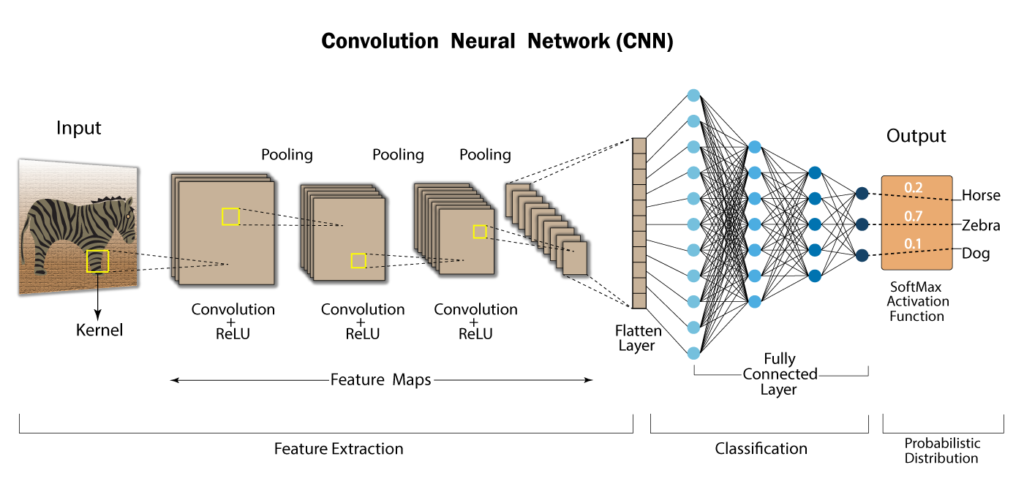
Most modern computer vision applications rely on Convolutional Neural Networks (CNNs). Unlike traditional algorithms that require separate pre-processing steps to detect edges or shapes, CNNs extract features automatically using specialized layers called filters.
- How it works: An image is passed through sequential convolutional layers.
- The Feature Hierarchy: In the initial layers, the network learns basic visual components like edges and corners. As the data flows deeper into the network, these basic shapes are combined to recognize complex patterns, structures, and ultimately, distinct objects.
The Role of 1×1 Convolutions
A 1×1 Convolution (or “network-in-network” layer) applies a filter with a height and width of exactly one pixel, stretching across the entire depth (channels) of the input feature map.
While a 1×1 filter cannot capture spatial context across neighboring pixels, it serves as a powerful tool for manipulating the depth channel of an image.
Key Benefits of 1×1 Convolutions:
- Dimensionality Reduction: It reduces the number of feature maps (channels) while preserving the critical spatial structure of the image, keeping models computationally light.
- Non-Linearity Injection: By applying activation functions like ReLU immediately after the 1×1 layer, the network can learn more complex, non-linear relationships without increasing spatial filter sizes.
- Feature Projection: It acts as a pooling mechanism across channels, weighting and blending diverse feature representations into a more dense, useful output.
Read more blog : Top 5 Essential Deep Learning Tools You Might Not Know
Deep Learning Applications in Image Processing
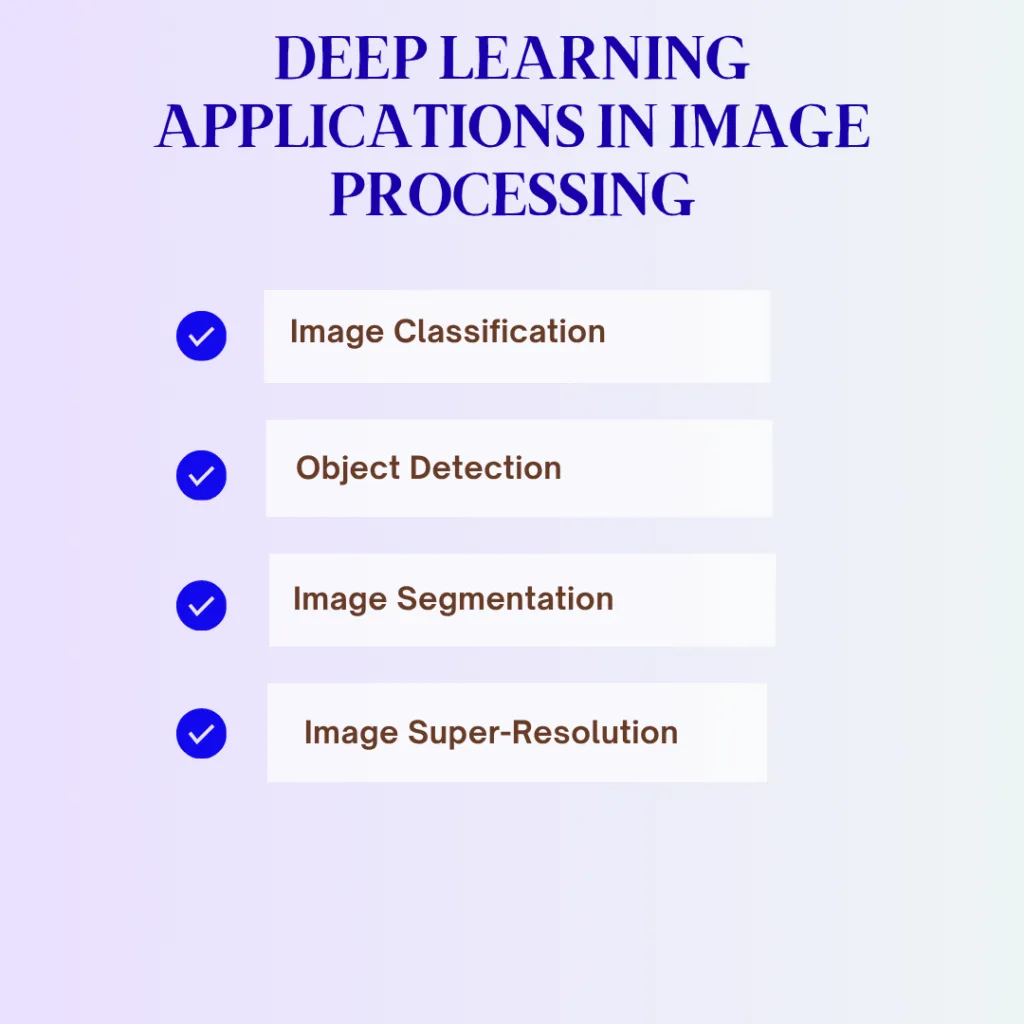
The integration of CNNs and efficiency tools like 1×1 convolutions has driven breakthroughs across four primary computer vision tasks.
1. Image Classification
Image classification assigns a single categorical label to an entire input image (e.g., identifying whether an image contains a cat, a dog, or a vehicle).
The 1×1 Advantage: In classification networks, 1×1 convolutions reduce network complexity and floating-point operations (FLOPs) with negligible impact on accuracy. This efficiency makes real-time classification viable for high-stakes applications like autonomous driving and diagnostic medical imaging.
2. Object Detection
While classification identifies what is in an image, object detection determines where those objects are by drawing bounding boxes around them. 1×1 convolutions are critical here for compressing deep features before regional proposals are calculated, keeping the localization process fast and efficient.
3. Image Segmentation
Unlike global classification, image segmentation operates at the pixel level. It partitions an image into distinct regions, assigning a specific class label to every individual pixel. This is used to map precise boundaries, such as isolating a tumor in an MRI scan or identifying road lanes for self-driving cars.
4. Image Super-Resolution
Super-resolution leverages deep learning to reconstruct high-resolution images from low-resolution inputs. Instead of simply blurring or interpolating pixels, the network predicts missing details based on learned textures and patterns. This technique has transformed industries relying on high-fidelity visual data, including satellite imaging, medical diagnostics, and digital video enhancement.
The Next Frontier: Deep Learning in Image Processing 2.0
The future of computer vision relies heavily on balancing hyper-accuracy with computational efficiency. As datasets grow exponentially and edge devices (like smartphones and autonomous vehicles) demand real-time processing, model optimization is becoming the primary focus of modern research.
Advancements in architectures—specifically the evolution of lean layers like the 1×1 Convolution—are driving this next wave of innovation. By stripping away computational overhead, these techniques are unlocking capabilities that were previously throttled by hardware limitations.
Expected Breakthroughs in the 2.0 Era:
- Real-Time Edge Analytics: Processing complex visual data directly on-device without relying on cloud latency.
- Next-Gen Augmented Reality (AR): Seamless, instantaneous spatial mapping and object occlusion in dynamic environments.
- Next-Level Medical Diagnostics: Ultra-precise, automated pixel segmentation capable of assisting radiologists in identifying anomalies in real time.

Conclusion
Deep learning has sparked a true renaissance in image processing. By replacing rigid, manual feature engineering with self-learning neural networks, the technology has redefined what machines can “see” and understand.
From fundamental image classification to pixel-level segmentation and super-resolution, deep learning is no longer a experimental technology—it is the foundational infrastructure powering automated industries. As efficiency techniques continue to bridge the gap between heavy computational models and real-world application, the integration of deep learning in image processing will only deepen, driving breakthroughs we are just beginning to imagine.
Read more blog : How AI Models Work: A Beginner’s Guide to Neural Networks and Deep Learning
FAQ: Deep Learning for Image Processing
Q1: What is the main role of a 1×1 convolution in deep learning?
The primary role of a 1×1 convolution is channel-wise dimensionality reduction (or expansion). While it doesn’t alter the spatial height or width of an image, it pools and weights data across the depth channel. This significantly reduces computational complexity, lowers training costs, and allows the network to learn non-linear features efficiently without shrinking the image size.
Q2: Why are CNNs preferred over traditional image processing methods?
Convolutional Neural Networks (CNNs) are preferred because they eliminate the need for manual feature engineering. Traditional methods require developers to hand-code algorithms to detect edges, textures, or shapes. CNNs automate this entire process by learning a visual hierarchy directly from raw pixels during training.
Q3: What is the difference between image classification and object detection?
The key difference lies in localization:
Image Classification: Assigns a single label to an entire image (e.g., “This is a car”).
Object Detection: Goes a step further by identifying multiple objects within a single image, labeling each one, and drawing a bounding box around them to show exactly where they are located.
Q4: How does deep learning power image super-resolution?
Traditional super-resolution relies on simple mathematical interpolation (like blurring or stretching pixels). Deep learning super-resolution uses neural networks trained on pairs of low- and high-resolution images. The network actually predicts and reconstructs missing details, textures, and sharp edges based on patterns it has previously learned.
Q5: Can deep learning models for image processing run on smartphones?
Yes. Thanks to architecture optimizations like 1×1 convolutions, mobile-first networks (e.g., MobileNet), and model quantization, deep learning models can run directly on edge devices like smartphones. This enables real-time features like face ID unlock, augmented reality (AR) filters, and instant photo processing without needing an internet connection.
