



SaaS metrics help founders understand whether a software business is actually growing, retaining customers, and generating sustainable revenue. Revenue alone does not tell the full story. A SaaS company can increase sales while losing customers quickly, spending too much to acquire users, or generating insufficient cash to support future growth.
That is why founders need to monitor a combination of SaaS KPIs covering revenue, customer acquisition, retention, profitability, and growth. The right metrics can reveal where a company is performing well and where immediate changes are needed.
For early-stage founders, tracking dozens of numbers can quickly become overwhelming. A better approach is to focus on a small group of meaningful SaaS metrics that directly explain business performance.
Table of Contents
Why SaaS Metrics Matter for Founders?
SaaS businesses have a unique economic model. Customers typically pay recurring subscription fees, which means the value of a customer can extend over months or years.
This creates both an advantage and a challenge.
A company may spend significant money acquiring a customer today but recover that investment over time through recurring revenue. Founders therefore need to understand not only how many customers they acquire, but also how long those customers stay and how much revenue they generate.
Tracking SaaS KPIs helps founders answer important questions:
- Are we growing?
- Are customers staying?
- Is acquisition becoming more efficient?
- Are customers upgrading?
- Is the company becoming more profitable?
- How predictable is recurring revenue?
The answers provide a clearer picture than revenue alone.
SaaS Metrics Every Founder Must Track
1. Monthly Recurring Revenue (MRR)
Monthly Recurring Revenue, or MRR, measures the recurring revenue a SaaS company generates each month.
For example, if 100 customers each pay $50 per month, the company’s MRR is $5,000.
MRR is one of the most important SaaS metrics because it helps founders understand recurring revenue growth and forecast future performance.
It is useful to break MRR into components such as:
- New MRR from new customers
- Expansion MRR from existing customers
- Contraction MRR from downgrades
- Churned MRR from canceled subscriptions
Looking at these components explains why MRR changed rather than simply showing that it changed.
2. Annual Recurring Revenue (ARR)
ARR is the annualized value of recurring subscription revenue.
A simple calculation is:
ARR = MRR × 12
ARR is particularly useful for businesses focused on long-term growth and enterprise sales.
For example, a company with $100,000 in MRR has approximately $1.2 million in ARR, assuming the revenue is recurring and stable.
Founders often use ARR to measure company scale, set growth targets, and communicate performance to investors or stakeholders.
3. Customer Acquisition Cost (CAC)
Customer Acquisition Cost measures how much a company spends to acquire a new customer.
A basic formula is:
CAC = Total Sales and Marketing Costs ÷ Number of New Customers Acquired
Suppose a company spends $20,000 on sales and marketing and acquires 100 new customers. Its CAC is $200.
Tracking CAC over time helps founders determine whether customer acquisition is becoming more or less efficient.
A rising CAC can indicate stronger competition, declining marketing performance, an inefficient sales process, or increasing advertising costs.
4. Customer Lifetime Value (LTV)
Customer Lifetime Value estimates how much revenue or gross profit a company can generate from a customer throughout their relationship with the business.
A simplified version can be calculated using average revenue per customer and expected customer lifetime.
LTV is important because CAC should be evaluated against the value generated by customers.
If a business spends $500 to acquire customers who generate only $300 in lifetime gross profit, the business model may be unsustainable.
However, founders should avoid treating LTV as an exact prediction. It depends on assumptions about retention, margins, expansion, and customer behavior.
5. LTV:CAC Ratio

The LTV:CAC ratio compares customer lifetime value with acquisition cost.
For example, if LTV is $3,000 and CAC is $1,000:
LTV:CAC = 3:1
A stronger ratio generally indicates that the business is generating substantially more value from customers than it spends acquiring them.
However, a very high ratio isn’t automatically good. It can also indicate that a company is underinvesting in growth opportunities.
Founders should interpret the ratio alongside growth, retention, margins, and payback period rather than using one benchmark blindly.
6. Churn Rate
Churn measures the percentage of customers or revenue lost during a specific period.
There are two particularly important versions:
Customer churn: the percentage of customers who cancel.
Revenue churn: the recurring revenue lost because customers cancel or downgrade.
For example, if a SaaS company begins a month with 1,000 customers and 20 cancel, the customer churn rate is 2% for that period, assuming no other adjustments.
Churn is one of the most important SaaS KPIs because recurring-revenue businesses depend heavily on retention.
Even strong acquisition can struggle to compensate for persistent customer losses.
7. Net Revenue Retention (NRR)
Net Revenue Retention measures how recurring revenue from an existing customer group changes over time after accounting for expansion, contraction, and churn.
A simplified formula is:
NRR = (Starting Revenue + Expansion − Contraction − Churn) ÷ Starting Revenue × 100
An NRR above 100% means the existing customer base is generating more recurring revenue than it did at the beginning of the measurement period.
This can happen when customers upgrade, buy additional products, or increase usage.
NRR is particularly valuable for SaaS companies because it shows whether the existing customer base can grow revenue without relying entirely on acquiring new customers.
8. Gross Revenue Retention (GRR)
Gross Revenue Retention measures how much recurring revenue remains from an existing customer base after churn and downgrades, without including expansion revenue.
GRR provides a clearer view of how well a business protects existing recurring revenue.
A company may have excellent NRR because some customers upgrade significantly, while other customers are still churning at an unhealthy rate. GRR helps expose that underlying retention problem.
9. Average Revenue Per User (ARPU)
Average Revenue Per User measures the average revenue generated per customer or account over a particular period.
A simple monthly calculation is:
ARPU = Monthly Recurring Revenue ÷ Number of Customers
ARPU helps founders understand customer monetization.
If ARPU increases, the company may be attracting larger customers, increasing prices, introducing higher-value plans, or successfully selling upgrades.
However, ARPU can also rise because smaller customers are leaving, so it should always be viewed alongside customer count and churn.
10. Conversion Rate
Conversion rate measures the percentage of prospects who complete a desired action.
For SaaS companies, this can include:
- Website visitors who start a trial
- Trial users who become paid customers
- Leads who become customers
- Demo attendees who purchase
Conversion rates help founders identify where prospects are dropping out of the customer journey.
For example, a company may generate thousands of website visitors but have a poor visitor-to-trial conversion rate. In this situation, increasing traffic alone may not solve the problem.
11. Free-to-Paid Conversion Rate
For SaaS businesses using freemium or free trials, the free-to-paid conversion rate is especially important.
It measures how many free users eventually become paying customers.
A low conversion rate could indicate that the free product provides too much value without creating a reason to upgrade. It could also mean that paid plans are poorly positioned or that customers don’t understand the additional benefits.
This metric should be analyzed together with activation and retention.
12. Customer Payback Period
Customer payback period estimates how long it takes a business to recover the cost of acquiring a customer through gross profit contribution.
For example, a company with a $1,200 CAC and $200 in monthly gross profit per customer has a simplified payback period of six months.
A shorter payback period generally improves cash efficiency because the company recovers acquisition spending more quickly.
This is especially important for startups with limited cash reserves.
How to Prioritize SaaS KPIs?
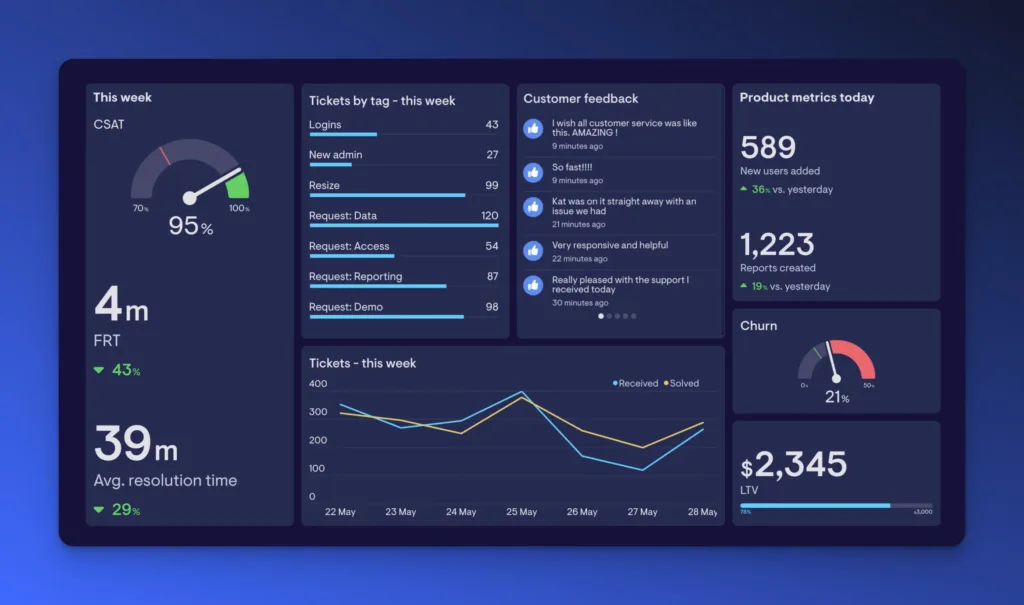
Founders should avoid turning their dashboard into a collection of every possible number.
A useful approach is to organize SaaS metrics into four categories:
Growth: MRR, ARR, new customers, and conversion rate.
Acquisition: CAC, lead-to-customer conversion, and payback period.
Retention: churn, GRR, and NRR.
Monetization: ARPU, expansion revenue, and upgrade rate.
This makes it easier to identify the relationship between metrics.
For example, if MRR growth slows, a founder can examine whether the problem comes from fewer new customers, higher churn, lower conversion, or weaker expansion revenue.
How Often Should Founders Track SaaS Metrics?
Not every metric needs to be checked every day.
Daily monitoring can be useful for operational indicators such as signups, purchases, failed payments, or website conversions.
Weekly reviews can help identify changes in acquisition and product usage.
Monthly reporting is typically more useful for strategic SaaS KPIs such as MRR, ARR, CAC, churn, NRR, and customer lifetime value.
The key is consistency. A metric is only useful when founders track it using the same definitions and time periods.
Common SaaS Metrics Mistakes

One common mistake is focusing only on top-line revenue.
Revenue can grow while churn, CAC, or customer profitability deteriorates.
Another mistake is mixing different definitions. For example, calculating churn one way in January and differently in February makes comparisons unreliable.
Founders should define each metric clearly, use consistent formulas, and keep historical data available.
It is also important to avoid optimizing one metric at the expense of the overall business. Increasing conversion by heavily discounting subscriptions may improve short-term sales while damaging long-term revenue quality.
Final Thoughts
The right SaaS metrics give founders a practical view of how their business is performing. MRR and ARR show recurring revenue growth, CAC and payback measure acquisition efficiency, while churn, GRR, and NRR reveal the strength of customer retention.
Metrics such as LTV, ARPU, and conversion rate help founders understand monetization and customer economics.
There is no need to monitor every possible number. Start with the metrics most closely connected to your business model, define them consistently, and review them regularly.
The most valuable SaaS KPIs are not simply numbers displayed on a dashboard. They are signals that help founders make better decisions about pricing, marketing, product development, retention, and sustainable growth.
FAQs About SaaS Metrics
1. What are the most important SaaS metrics for startups?
MRR, ARR, CAC, churn, LTV, NRR, conversion rate, and customer payback period are among the most useful metrics. Early-stage founders should focus on the few metrics most closely tied to their current growth stage.
2. What is a good SaaS metric to measure customer retention?
Churn is a basic retention measure, while NRR provides a broader view because it includes expansion, contraction, and churn within the existing customer base.
3. How often should SaaS metrics be reviewed?
Operational metrics can be monitored daily or weekly, while strategic metrics such as MRR, ARR, CAC, churn, and NRR are often reviewed monthly.
4. Why is CAC important for a SaaS company?
CAC shows how much the company spends to acquire customers. Comparing CAC with LTV, gross margin, and payback period helps founders determine whether customer acquisition is economically sustainable.
