


Preparing for Java Spring Boot Interview Questions with Answers is one of the best ways to improve your chances of securing a backend development role. Recruiters often begin with core java questions asked in interviews before moving on to framework-specific topics. If you have already practiced java developer interview questions, learning Spring Boot concepts such as dependency injection, REST APIs, and auto-configuration will help you answer technical questions with confidence.
Although many candidates also prepare wordpress interview questions for CMS-based roles, Java developers should focus on backend technologies and enterprise application development. This guide covers the most commonly asked spring boot interview questions, helping freshers and experienced professionals prepare for technical interviews in startups, product companies, and MNCs.
Why Learn Spring Boot for Interviews?
Spring Boot simplifies Java application development by reducing configuration, providing embedded servers, and supporting rapid application development. Preparing interview questions on spring boot helps candidates understand practical implementation rather than memorizing theoretical concepts.
Whether you are preparing for basic technical interview questions or advanced technical rounds, these java spring boot interview questions will strengthen your backend development knowledge and improve your interview performance.
Spring Boot Interview Preparation Roadmap
| Experience Level | Topics to Prepare | Difficulty |
| Fresher | Spring Boot Basics, REST APIs, Dependency Injection | Easy |
| Associate Software Engineer | JPA, Security, Validation | Medium |
| Mid-Level Developer | Microservices, Docker, Testing | Medium-High |
| Senior Developer | Performance, System Design, Cloud | Advanced |
1. What is Spring Boot?
Answer:
Spring Boot is an open-source framework built on top of the Spring Framework that simplifies Java application development. It eliminates complex XML configurations through auto-configuration and starter dependencies, enabling developers to build production-ready applications quickly.
Key Features
- Auto Configuration
- Embedded Tomcat Server
- Starter Dependencies
- Spring Boot Actuator
- Microservice Support
2. What Are the Advantages of Spring Boot?
Answer:
Spring Boot offers several advantages that make it a preferred framework for enterprise development.
- Faster application development
- Minimal configuration
- Embedded web server
- Easy deployment
- Production-ready features
- Strong community support
- Excellent testing capabilities
These spring boot interview questions and answers are commonly asked because interviewers want to assess your understanding of Spring Boot’s practical benefits.
3. Explain Auto Configuration.
Answer:
Auto Configuration automatically configures Spring Boot applications based on the dependencies available in the project. For example, adding the Spring Web dependency automatically configures the DispatcherServlet and other required components without manual setup.
This feature reduces boilerplate code and improves developer productivity.
4. What Is Spring Initializr?
Answer:
Spring Initializr is a web-based project generator that creates a ready-to-use Spring Boot project.
Developers can select:
- Java version
- Spring Boot version
- Maven or Gradle
- Dependencies
- Packaging type
It generates the project structure within seconds, allowing developers to start coding immediately.
5. What Are Starter Dependencies?
Answer:
Starter dependencies are predefined dependency packages that include commonly required libraries.
Some popular starters are:
spring-boot-starter-web

spring-boot-starter-data-jpa

spring-boot-starter-security

spring-boot-starter-test
Using starter dependencies reduces configuration time and prevents dependency conflicts.
Popular Spring Boot Starter Dependencies
| Starter Dependency | Purpose |
| spring-boot-starter-web | Develop REST APIs |
| spring-boot-starter-data-jpa | Database Operations |
| spring-boot-starter-security | Authentication & Authorization |
| spring-boot-starter-test | Unit Testing |
| spring-boot-starter-actuator | Monitoring & Health Checks |
6. What Is Dependency Injection?
Answer:
Dependency Injection (DI) is a design pattern where Spring automatically injects required objects instead of developers creating them manually.
Benefits
- Loose coupling
- Better code maintenance
- Easier testing
- Improved scalability
Spring Boot mainly uses the @Autowired annotation for dependency injection.
7. What Is Inversion of Control (IoC)?
Answer:
Inversion of Control (IoC) means the Spring Container manages the lifecycle of objects instead of the developer.
The container creates, initializes, and injects dependencies automatically, making applications easier to maintain and test.
Understanding IoC is important for candidates preparing for associate software engineer interview questions, as it is a fundamental Spring concept.
8. What Is a Spring Bean?
Answer:
A Spring Bean is an object managed by the Spring IoC Container. Beans are automatically created using annotations such as:
@Component
@Service
@Repository
@Controller
These annotations help organize application layers and improve code readability.
9. What Is the Difference Between @Component, @Service, and @Repository?
Answer:
Although all three annotations create Spring-managed beans, they serve different purposes.
| Annotation | Purpose |
| @Component | Generic Spring Bean |
| @Service | Business Logic Layer |
| @Repository | Database Access Layer |
| @Controller | Handles HTTP Requests |
Knowing these annotations is useful when preparing for backend questions for interview because they represent the standard architecture of Spring Boot applications.
10. What Is @SpringBootApplication?
Answer:
@SpringBootApplication is the main annotation used to start a Spring Boot application. It combines three important annotations into one:
@Configuration

@EnableAutoConfiguration

@ComponentScan
Using this annotation simplifies project setup and automatically enables key Spring Boot features.
Candidates preparing for java full stack developer interview questions should understand how this annotation works because it is present in every Spring Boot application.
11. What Is Component Scanning?
Answer:
Component Scanning is a Spring Boot feature that automatically detects and registers Spring Beans during application startup. Instead of manually configuring every class, Spring scans packages for annotations like @Component, @Service, @Repository, and @Controller.
This feature reduces configuration effort and improves project maintainability. Understanding Component Scanning is important while preparing springboot interview questions because it forms the foundation of Spring’s dependency management.
12. What Is an Embedded Tomcat?
Answer:
Spring Boot includes an embedded Tomcat server, allowing developers to run applications without installing an external web server.
Advantages
- No separate server installation
- Faster deployment
- Easy application execution
- Simplified project management
This feature makes Spring Boot an excellent choice for enterprise and cloud-native applications.
13. What Is application.properties?
Answer:
The application.properties file stores application configuration such as server ports, database connections, logging settings, and environment-specific values.
Example configurations include:
- Server port
- Database URL
- Username and password
- Logging level
Spring Boot also supports application.yml, which offers a cleaner and more structured configuration format.
14. What Is Spring Data JPA?
Answer:
Spring Data JPA simplifies database interaction by providing repository interfaces that reduce the need to write SQL queries manually.
Benefits
- Automatic CRUD operations
- Query generation
- Pagination
- Sorting
- Easy integration with relational databases
Knowledge of JPA is frequently tested in software engineering interview questions because database management is a core backend skill.
Spring Boot Repository Interfaces
| Repository | Primary Use |
| CrudRepository | Basic CRUD Operations |
| PagingAndSortingRepository | CRUD with Pagination |
| JpaRepository | Advanced JPA Features & Batch Operations |
| MongoRepository | MongoDB Integration |
15. What Is Spring Security?
Answer:
Spring Security is a powerful framework that secures applications by handling authentication and authorization.
Features
- User Authentication
- Role-Based Authorization
- Password Encryption
- CSRF Protection
- JWT Authentication
- OAuth2 Support
Security is one of the most important topics in backend questions for interview, especially for enterprise applications.
16. What Is JWT?
Answer:
JWT (JSON Web Token) is a secure token format used for authenticating users in REST APIs.
A JWT consists of:
- Header
- Payload
- Signature
JWT enables stateless authentication, making applications faster and more scalable.
Interviewers frequently include JWT while asking restful api interview questions because modern APIs commonly rely on token-based authentication.
17. What Is Exception Handling in Spring Boot?
Answer:
Spring Boot supports centralized exception handling using @ControllerAdvice and @ExceptionHandler.
Benefits
- Standardized error responses
- Cleaner controller code
- Better debugging
- Improved user experience
Global exception handling ensures that applications return meaningful error messages instead of generic server errors.
18. What Are Microservices?
Answer:
Microservices divide a large application into multiple independent services that communicate through APIs.
Advantages
- Independent deployment
- Better scalability
- Easier maintenance
- Faster development
- Fault isolation
Microservices are commonly discussed in top system design interview questions, especially for experienced backend developers.
Spring Boot vs Spring Framework
| Feature | Spring Framework | Spring Boot |
| Configuration | Extensive | Minimal |
| Server | External | Embedded |
| Deployment | More Complex | Simple |
| Setup Time | Longer | Faster |
| Productivity | Moderate | High |
19. How Can You Improve Spring Boot Application Performance?
Answer:
Performance optimization is an important topic in senior developer interview questions. Some common techniques include:
- Enable caching
- Optimize database queries
- Use connection pooling
- Implement asynchronous processing
- Compress API responses
- Monitor performance using Spring Boot Actuator
- Minimize unnecessary object creation
These practices help applications handle higher traffic with better efficiency.
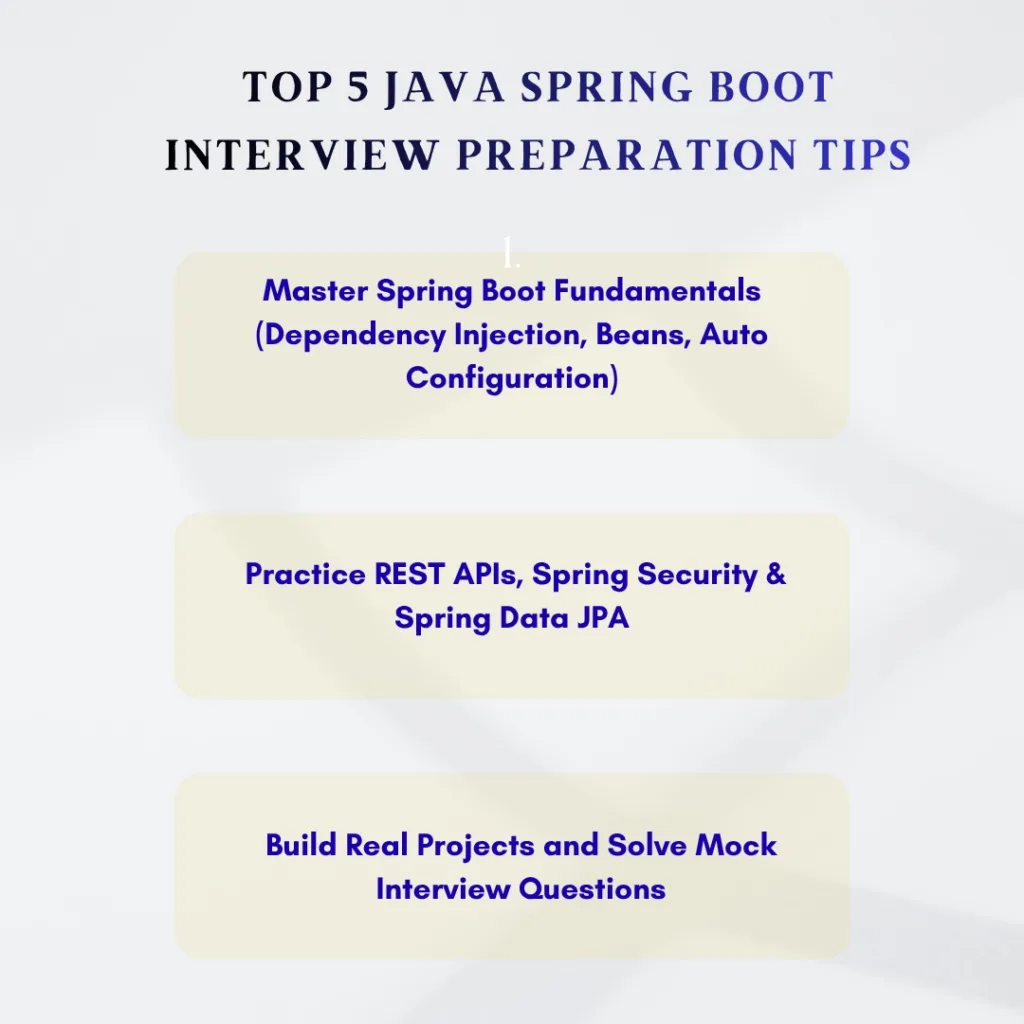
20. What Are the Best Tips for Cracking a Spring Boot Interview?
Answer:
Success in a Spring Boot interview requires both theoretical knowledge and practical experience.
Focus on:
- Core Java fundamentals
- Object-Oriented Programming
- REST API development
- Spring Boot annotations
- Spring Data JPA
- Spring Security
- CRUD applications
- Exception handling
- Microservices
- Testing with JUnit
Candidates should also practice interview questions for data structures and algorithms and coding interview questions with solutions, as many companies include coding rounds alongside framework-based discussions.
Professionals preparing for full stack interview questions should strengthen their understanding of frontend integration, while developers targeting AI-enabled platforms can also review ai engineer interview questions and interview questions on machine learning to broaden their technical expertise.
Similarly, reviewing front developer interview questions, interview questions on html css, seo marketing interview questions, seo interview question, and wp interview questions can be useful if you’re applying for multidisciplinary or full-stack roles that require collaboration across different technologies.
Conclusion
Preparing for Java Spring Boot Interview Questions with Answers is one of the smartest investments for aspiring Java developers. A solid understanding of Spring Boot fundamentals, dependency injection, REST APIs, Spring Security, JPA, microservices, and testing enables you to perform confidently in technical interviews. Along with practicing real-world projects, regularly revising interview questions and coding exercises will strengthen your backend development skills.
Whether you’re applying for a fresher role or an experienced position, consistent preparation and hands-on experience are the keys to success. By mastering these concepts and staying updated with industry trends, you’ll be well-equipped to crack Spring Boot interviews and build a successful career in Java development.
Frequently Asked Questions (FAQs)
1. What are the most commonly asked Spring Boot interview questions?
Interviewers usually ask about dependency injection, Spring Boot architecture, annotations, REST APIs, Spring Data JPA, Spring Security, exception handling, validation, and microservices. These topics appear regularly in spring boot interview questions for both freshers and experienced developers.
2. Is Spring Boot suitable for freshers?
Yes. Spring Boot is one of the most in-demand Java frameworks, making it an excellent choice for fresh graduates. Recruiters often include basic technical interview questions on Spring Boot, REST APIs, and dependency injection during entry-level interviews.
3. How should I prepare for Java Spring Boot interviews?
Build real-world projects, revise Java fundamentals, practice coding regularly, understand Spring Boot annotations, create REST APIs, and work with databases. Combining practical experience with java spring boot interview questions improves your confidence during interviews.
4. Are coding questions asked along with Spring Boot interviews?
Yes. Most companies include Java programming challenges, SQL queries, debugging tasks, and coding interview questions with solutions to evaluate your problem-solving abilities alongside framework knowledge.
5. Which additional skills improve my chances of getting hired?
Besides Spring Boot, candidates should study Git, Maven, Docker, Kubernetes, Microservices, SQL, cloud deployment, and system design. Reviewing associate software engineer interview questions and java full stack developer interview questions can also help you prepare for a wider range of technical roles.
