

In software development, change is the only constant. Requirements evolve, markets shift, and technologies emerge rapidly. Adaptive Software Development (ASD) is an Agile methodology built to thrive in this high-uncertainty environment. Rather than viewing unpredictable shifts as project risks, ASD treats change as a key driver for innovation and customer value.
What is Adaptive Software Development (ASD)?
Adaptive Software Development (ASD) is an iterative, human-centric framework created by James A. Highsmith and Sam Bayer in the 1990s. Evolving from Rapid Application Development (RAD), ASD shifts the focus from rigid upfront planning to dynamic, emergent solutions.
Highsmith later co-authored the Agile Manifesto in 2001, anchoring ASD as one of the foundational frameworks of modern Agile practices. Its core philosophy relies on three pillars: adaptability, deep collaboration, and continuous value delivery.
The Core Principles of Adaptive Software Development
Traditional software frameworks rely on deterministic, predictive planning. ASD operates on an adaptive model designed for complex adaptive systems (CAS).
1. Speculate Instead of Plan
Traditional project management relies on detailed upfront requirements. ASD replaces rigid planning with speculation. Teams define project visions, mission statements, and initial architectural boundaries while acknowledging that detailed requirements will emerge as development progresses.
2. Collaborate Over Control
Complex problems require collective intelligence. ASD prioritizes cross-functional collaboration over bureaucratic control. Teams work closely with product owners, stakeholders, and end users to make quick decisions, resolve blockers, and align deliverables.
GeeksforGeeks
3. Learn Rather Than Execute
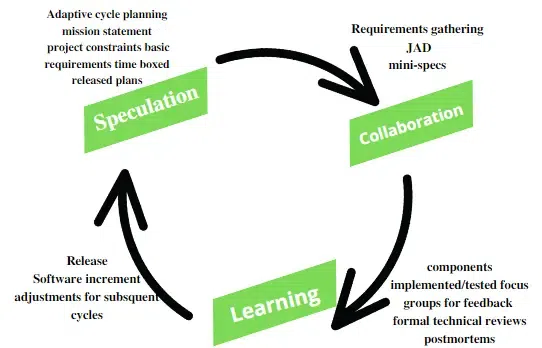
Instead of treating deviation from a plan as a failure, ASD treats every cycle as a learning loop. Continuous feedback through focus groups, technical reviews, and retrospectives helps teams refine code, assumptions, and processes.
The 3 Phases of the ASD Life Cycle
The ASD framework is built around a non-linear, repeating life cycle: Speculate, Collaborate, and Learn.
1. Speculate (Mission-Driven Planning)
During initial speculation, the team sets high-level project goals, evaluates architectural risks, and outlines release schedules. Rather than locking down feature specifications, the team defines target delivery dates and iteration scopes, leaving granular details flexible.
2. Collaborate (Concurrent Development)
In the collaboration stage, cross-functional teams build components concurrently. ASD places heavy emphasis on interpersonal dynamics, psychological safety, and open communication. Pair programming, joint application development (JAD) sessions, and continuous integrations happen here.
3. Learn (Quality & Value Verification)
After each iteration, the software undergoes thorough inspection. Learning takes place across three main touchpoints:
- Focus Groups: Gathering direct usability input from customers and end users.
- Technical Reviews: Assessing architecture, code quality, and performance.
- Project Postmortems: Evaluating team dynamics, workflow bottlenecks, and efficiency gains.
ASD vs. Waterfall vs. Scrum: Key Differences
Understanding how ASD compares to traditional and popular Agile models highlights its specific strengths:
| Methodology Feature | Adaptive Software Development (ASD) | Waterfall Model | Scrum Framework |
|---|---|---|---|
| Core Philosophy | Adaptive, emergent, mission-driven | Predictive, linear, process-driven | Iterative, empirical, time-boxed |
| Primary Life Cycle | Speculate → Collaborate → Learn | Requirements → Design → Code → Test | Sprint Planning → Sprint → Review |
| Handling Requirement Change | Core feature; change drives innovation | Difficult; change causes scope creep & budget hits | Managed via product backlog refinement |
| Customer Involvement | Continuous throughout learning cycles | High at start and end; low during execution | High at Sprint Demos/Reviews |
| Best Suited For | High uncertainty, exploratory, innovative projects | Fixed-scope, well-defined, compliance projects | Cross-functional product development |
Why Teams Choose ASD
- Resilience in Unstable Markets: Teams can pivot product strategy based on user data without scrapping entire development cycles.
- Higher Technical & Feature Relevance: Because feedback is gathered after every phase, products align with real-time end-user demands.
- Better Shared Ownership: Cross-functional collaboration breaks down departmental silos and elevates team accountability.
- Focus on Value Delivery: Eliminates bloated documentation and unnecessary features, keeping resources focused on high-impact deliverables.
Core Challenges of ASD
- Cultural Shifts: Legacy enterprises used to rigid timelines and fixed scope may struggle to accept speculative planning.
- Dependence on High Trust & Communication: Weak collaboration or toxic team dynamics can cause phase execution to break down. GeeksforGeeks
- Predictability Trade-Offs: Hard delivery deadlines and fixed budgets can be more difficult to forecast upfront.
How to Get Started with Adaptive Software Development
- Form Cross-Functional Teams: Group developers, designers, product managers, and QA engineers together from day one.
- Shift to Iterative Cycles: Set up short development iterations (2–4 weeks) focused on delivering testable components. Cleverworks
- Institutionalize Feedback Loops: Schedule mandatory focus groups and technical reviews at the end of every cycle.
- Decouple Architecture: Build modular, microservice-based, or service-oriented systems to support frequent component updates without system-wide breaking changes.
Accelerated Knowledge Base & Web Development Resources
- How to Optimize a Website’s Performance
- Load Testing with Artillery: Prepare Your Node.js Application for Peak Traffic
- Top 10 Questions in Software Development Interviews and How to Answer Them
- Senior-Level JavaScript Promise Interview Question
- What is Database Indexing, and Why is It Important?
- Can AI Transform the Trading Landscape?
- What is the Purpose of a Deployment Pipeline?
- Token-Based Authentication: Choosing Between JWT and Paseto for Modern Applications
- API Rate Limiting and Abuse Prevention Strategies in Node.js for High-Traffic APIs
Conclusion
Mastering Adaptive Software Development (ASD) allows modern engineering teams to move away from rigid, legacy plans and build products that thrive under constant market change. By shifting from deterministic planning to dynamic speculation, fostering continuous cross-functional collaboration, and short-circuiting feedback loops through systematic learning, ASD turns uncertainty into a strategic advantage.
Frequently Asked Questions (FAQs)
What is the main difference between Agile and Adaptive Software Development (ASD)?
ASD is a specific framework under the broader Agile umbrella. While all Agile frameworks value flexibility, ASD explicitly uses a non-deterministic process (Speculate-Collaborate-Learn) designed for high uncertainty, whereas frameworks like Scrum use structured ceremonies and fixed sprint backlogs.
Who developed Adaptive Software Development?
ASD was developed in the 1990s by James A. Highsmith and Sam Bayer as an evolutionary step beyond Rapid Application Development (RAD).
When should a project use ASD instead of Waterfall?
Use ASD when business requirements are fluid, technology choices are evolving, or the market demands fast innovation. Use Waterfall only when project scope, regulatory requirements, and technical steps are fully known and fixed upfront.
What are the three phases of the ASD life cycle?
The three phases are Speculate (setting vision and direction), Collaborate (concurrent execution by cross-functional teams), and Learn (evaluating progress through user feedback, technical reviews, and retrospectives).
Does ASD support automated testing and DevOps integration?
Yes. Modern ASD workflows rely heavily on automated continuous integration (CI/CD) and automated testing infrastructure to support rapid iterations, quick releases, and refactoring.
