


Scalable application design is a core skill for modern software engineers preparing for technical interviews. Whether you are working with data analysts, preparing for a security analyst interview, using DevOps tools, or reviewing Git commands, understanding how applications handle increasing users, traffic, and data is essential. A strong system design interview focuses on how engineers structure reliable applications while balancing performance, scalability, security, and maintainability.
For data analysts, collaboration with engineering teams often requires knowledge of application architecture and data flows. Candidates preparing for a security analyst interview can also benefit from understanding how systems are designed and protected. Familiarity with DevOps tools supports automated deployment and monitoring, while knowledge of Git commands helps engineers manage source code efficiently. These foundations become especially useful when discussing scalable system design and architectural trade-offs during interviews.
What Is Scalable Application Design?
Scalable application design refers to building software that can handle growing workloads without a major decline in performance or reliability. A scalable application should be able to support additional users, requests, transactions, and data while maintaining acceptable response times.
Interviewers commonly evaluate whether candidates can identify bottlenecks, choose suitable architectural patterns, and explain why a particular technology or approach is appropriate.
Key scalability considerations include:
- Application performance
- Database capacity
- Network traffic
- Storage requirements
- Fault tolerance
- Security
- Monitoring
- Deployment strategies
- Cost optimization
Why Is System Design Important in Software Engineering Interviews?
A system design interview tests more than technical knowledge. It evaluates how candidates approach ambiguous problems and make architectural decisions.
A typical interview may ask you to design:
- A social media platform
- An online shopping application
- A video streaming service
- A ride-sharing system
- A payment platform
- A messaging application
- A URL-shortening service
The interviewer may expect you to discuss requirements, APIs, databases, caching, scalability, reliability, and security.
Common Architecture Components
A scalable application normally consists of several interconnected components.
| Component | Primary Role | Scalability Benefit | Common Example |
| Load Balancer | Distributes incoming traffic | Prevents one server from becoming overloaded | NGINX |
| Application Server | Processes business logic | Multiple instances can run simultaneously | Node.js |
| Database | Stores application data | Replication and partitioning improve capacity | PostgreSQL |
| Cache | Stores frequently accessed data | Reduces database load | Redis |
| Message Queue | Handles asynchronous tasks | Separates services and smooths traffic | Kafka |
Understanding how these components interact is essential when answering architecture-based interview questions.
Top Scalable Application Design Interview Questions
1. What is scalability in software architecture?
Scalability is the ability of a system to handle increasing workloads by adding resources or improving the architecture.
There are two common approaches:
Vertical scaling: Increasing the CPU, memory, or storage capacity of an existing server.
Horizontal scaling: Adding more servers or application instances to distribute workloads.
Horizontal scaling is generally preferred for large distributed applications because it allows systems to grow across multiple machines.
2. What is the difference between vertical and horizontal scaling?
Vertical scaling upgrades an existing machine, while horizontal scaling adds additional machines.
| Scaling Type | Approach | Advantages | Limitations |
| Vertical | Increase server resources | Simple implementation | Hardware limits |
| Horizontal | Add more servers | Highly scalable | More complex architecture |
| Database Scaling | Replication or sharding | Handles large datasets | Increased operational complexity |
For applications expected to experience continuous traffic growth, horizontal scaling often provides greater flexibility.
3. What are distributed systems?
A distributed system consists of multiple computers or services that communicate over a network to perform tasks collectively.
During a distributed systems interview, candidates may be asked about service communication, consistency, fault tolerance, replication, partitioning, and failure recovery.
Examples include:
- Microservices platforms
- Cloud applications
- Distributed databases
- Content delivery networks
- Large-scale payment systems
The key challenge is coordinating multiple independent components while maintaining reliability.
4. What is load balancing?
Load balancing distributes incoming requests across multiple servers.
For example, if four application servers are available, a load balancer can distribute traffic among them rather than sending every request to a single server.
Common load balancing questions include:
- What is round-robin load balancing?
- How does weighted load balancing work?
- What is health-check-based routing?
- What happens when one server fails?
- How do sticky sessions work?
Load balancing improves availability, performance, and resource utilization.
5. What is caching and why is it important?
Caching stores frequently accessed information in a faster storage layer so that applications do not repeatedly retrieve the same data from slower systems.
Common caching interview questions include:
- What is cache-aside?
- What is cache invalidation?
- What is cache eviction?
- What happens when cached data becomes stale?
- When should an application avoid caching?
Redis and Memcached are commonly used caching technologies.
A good caching strategy can significantly reduce database workload and improve application response times.
6. What are high availability systems?
High availability systems are designed to remain operational even when individual components fail.
Common techniques include:
- Server redundancy
- Database replication
- Automated failover
- Health monitoring
- Multiple availability zones
- Backup systems
- Disaster recovery planning
For example, if one application server becomes unavailable, traffic can automatically move to another healthy instance.
7. How do you design an application for high traffic?
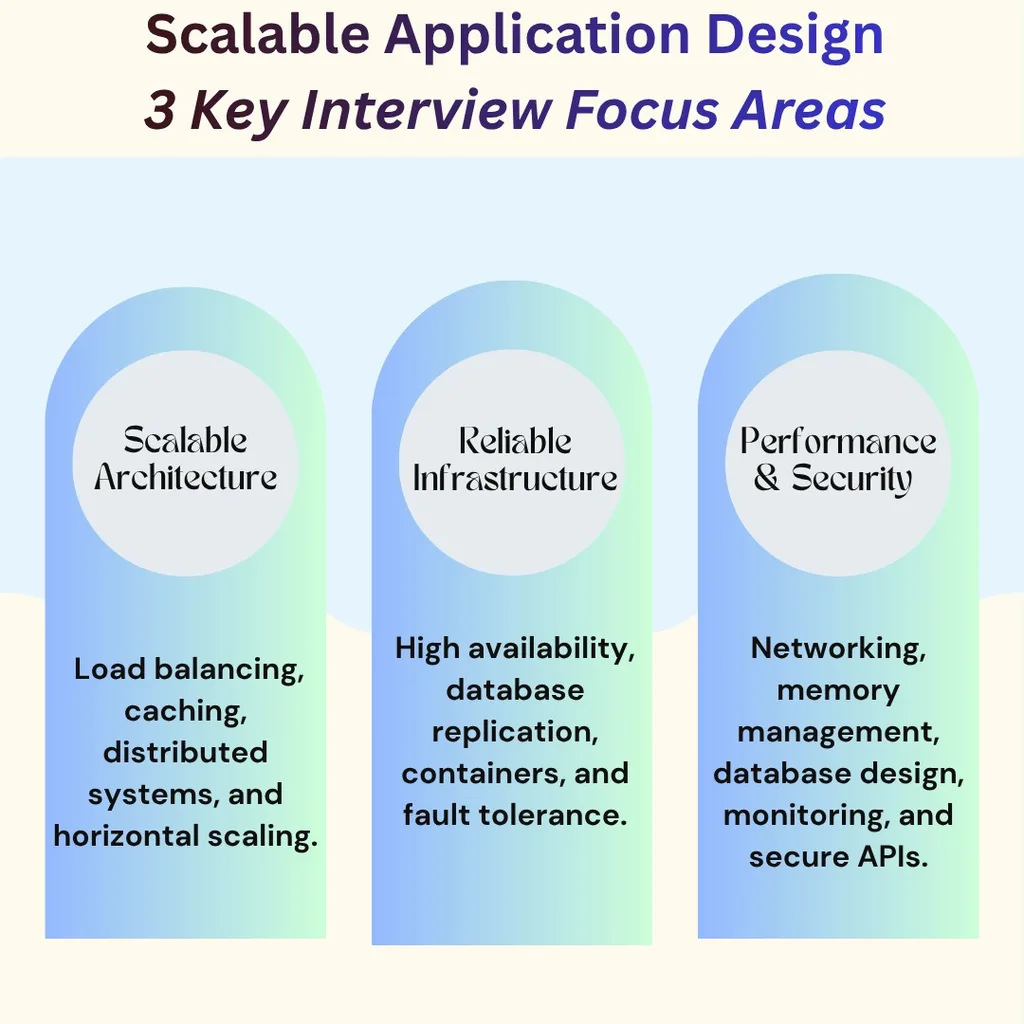
A high-traffic architecture may use:
- DNS-based routing
- Load balancers
- Multiple application servers
- Distributed caching
- Database replication
- Message queues
- CDN services
- Monitoring and alerting
The correct architecture depends on traffic patterns, business requirements, consistency requirements, and budget.
8. What are containerized applications?
Containerized applications package application code and its dependencies into isolated, portable environments.
Containers provide consistency between development, testing, and production environments.
Benefits include:
- Portability
- Faster deployment
- Resource efficiency
- Environment consistency
- Easier scaling
- Service isolation
Docker is widely used for containerization, while Kubernetes can manage container workloads at scale.
9. How does database normalization support application design?
Database normalization organizes relational data to reduce redundancy and improve data integrity.
Common normal forms include:
- First Normal Form (1NF)
- Second Normal Form (2NF)
- Third Normal Form (3NF)
- Boyce-Codd Normal Form (BCNF)
However, highly scalable applications sometimes use controlled denormalization to improve read performance. Engineers must balance data consistency, query performance, and system complexity.
10. What networking concepts should a software engineer know?
Strong knowledge of networking concepts helps engineers understand communication between distributed components.
Important concepts include:
- TCP/IP
- HTTP and HTTPS
- DNS
- IP addresses
- Ports
- Proxies
- Firewalls
- REST APIs
- WebSockets
- TLS
- Network latency
Interviewers may ask candidates to explain what happens when a user enters a URL into a browser.
11. How does memory management affect scalable applications?
Memory management involves allocating, using, and releasing memory efficiently.
Poor memory management can cause:
- Memory leaks
- Application crashes
- Slow performance
- Excessive garbage collection
- Increased infrastructure costs
Developers should monitor memory usage and understand how their programming language manages objects and garbage collection.
12. How do SDLC and STLC relate to scalable application development?
SDLC and STLC are important software development and testing frameworks.
The Software Development Life Cycle covers activities such as:
- Requirement analysis
- Design
- Development
- Testing
- Deployment
- Maintenance
The Software Testing Life Cycle focuses specifically on testing activities, including planning, test design, execution, defect reporting, and closure.
| Lifecycle | Main Focus | Typical Activities |
| SDLC | Complete software development | Planning, design, coding, deployment |
| STLC | Software testing | Test planning, execution, defect tracking |
| DevOps Lifecycle | Continuous delivery | Build, test, deploy, monitor |
| Agile Process | Iterative development | Sprints, reviews, continuous feedback |
Understanding these processes helps engineers design applications that remain maintainable throughout their lifecycle.
13. How would you design a scalable URL shortener?
A URL shortener requires several components:
- API service
- URL database
- Unique ID generator
- Cache
- Load balancer
- Analytics service
When a user submits a long URL, the application generates a unique short identifier and stores the mapping. When another user accesses the short URL, the system retrieves the original URL and redirects the request.
Caching popular URLs can reduce database queries.
14. What is database replication?
Database replication creates copies of database data across multiple database servers.
A common architecture uses:
- Primary database
- One or more replica databases
The primary handles writes while replicas may handle read operations.
Replication can improve read scalability and availability, but engineers must consider replication lag and consistency.
15. What is database sharding?
Database sharding divides a large dataset across multiple database servers.
For example, customer records could be distributed according to customer ID ranges or geographic regions.
Sharding can increase storage capacity and distribute database workloads, but selecting an appropriate shard key is critical.
16. What is the role of message queues?
Message queues allow services to communicate asynchronously.
Instead of forcing one service to wait for another, a producer can place a message in a queue while a consumer processes it later.
Common use cases include:
- Email processing
- Payment workflows
- Notifications
- Background jobs
- Data pipelines
Message queues can help absorb traffic spikes and improve system resilience.
17. How do you design a fault-tolerant application?
Fault tolerance means that an application can continue operating despite failures.
A fault-tolerant design may include:
- Redundant servers
- Replicated databases
- Health checks
- Automatic failover
- Retry mechanisms
- Circuit breakers
- Monitoring
- Disaster recovery
Engineers should also identify single points of failure before finalizing an architecture.
18. How can AI concepts appear in modern system design interviews?
Modern software systems increasingly integrate AI capabilities. Interviewers may ask candidates to discuss LLM prompting, model-serving architectures, token usage, inference latency, and API integration.
Knowledge of generative AI concepts can help candidates explain systems that generate text, code, images, or other content.
For applications that make predictions from historical data, predictive modeling can also become part of the architecture. Engineers may need to consider model deployment, feature pipelines, monitoring, data quality, and inference performance.
19. How do you choose between SQL and NoSQL databases?
The choice depends on data structure, consistency requirements, query patterns, and scalability needs.
| Requirement | SQL Database | NoSQL Database |
| Structured relational data | Strong choice | Possible but less natural |
| Complex joins | Strong choice | Usually limited |
| Flexible schema | Less flexible | Strong choice |
| Strong transactions | Strong choice | Depends on database |
| Massive distributed workloads | Possible | Often strong |
| Horizontal scaling | Supported with architecture | Common design goal |
Candidates should avoid claiming that one database type is always superior. The correct decision depends on application requirements.
20. How should you approach a system design problem in an interview?
A structured approach makes complex questions easier.
Step 1: Clarify Requirements
Ask about users, traffic, data volume, performance, and availability requirements.
Step 2: Estimate Scale
Estimate requests per second, storage requirements, concurrent users, and bandwidth.
Step 3: Design the High-Level Architecture
Identify APIs, servers, databases, caches, queues, and external services.
Step 4: Identify Bottlenecks
Consider database load, network latency, memory usage, CPU consumption, and service dependencies.
Step 5: Discuss Trade-Offs
Explain why you selected a particular database, caching strategy, communication protocol, or scaling approach.
Step 6: Address Reliability and Security
Discuss authentication, authorization, encryption, monitoring, backups, and failure recovery.
Key Skills to Prepare for Scalable Application Design Interview
| Skill Area | Important Topics | Interview Relevance |
| Architecture | Scalability, microservices, APIs | High |
| Databases | Normalization, replication, sharding | High |
| Networking | HTTP, DNS, TCP/IP, TLS | High |
| Infrastructure | Containers, cloud, load balancing | High |
| Reliability | Failover, redundancy, monitoring | High |
Common Mistakes in System Design Interviews
Candidates sometimes focus too much on technologies without explaining the underlying requirements.
Avoid these mistakes:
- Jumping into architecture without clarifying requirements
- Ignoring scalability
- Choosing technologies without justification
- Forgetting failure scenarios
- Ignoring database limitations
- Overcomplicating simple requirements
- Not discussing security
- Failing to explain trade-offs
A strong candidate communicates decisions clearly rather than simply listing technologies.
How to Prepare for Scalable Application Design Interviews
Preparation should combine theory with practical architecture exercises.
Focus on:
- System design fundamentals
- Distributed systems
- Database architecture
- Networking
- Caching
- Load balancing
- Cloud infrastructure
- Containers
- Monitoring
- API design
- Security
- Data consistency
Practice designing familiar applications and explain your decisions step by step. This approach helps you become more comfortable with open-ended architecture problems.

Conclusion
Scalable application design requires more than adding additional servers. Software engineers must understand how application components, databases, networks, caches, queues, and infrastructure work together under increasing workloads.
For a successful system design interview, focus on scalability, reliability, performance, security, and maintainability. Strong knowledge of distributed architecture, load balancing, caching, database design, networking, containers, and modern AI concepts can help candidates confidently approach complex software engineering interview scenarios.
FAQs
1. What is the most important topic in a scalable application design interview?
System architecture, scalability, databases, caching, load balancing, distributed systems, and reliability are among the most important areas. Candidates should also be able to explain architectural trade-offs clearly.
2. Are distributed systems questions difficult for software engineers?
They can be challenging because they involve multiple components communicating over networks. Practicing replication, consistency, partitioning, fault tolerance, and service communication can make these questions easier to approach.
3. Should software engineers study database design for system design interviews?
Yes. Database selection, normalization, indexing, replication, partitioning, and sharding can significantly affect application scalability and performance.
4. Are containers important for scalable applications?
Yes. Containerized applications can make deployment, isolation, portability, and horizontal scaling easier. Technologies such as Docker and Kubernetes are commonly associated with modern scalable infrastructure.
5. How can I improve my system design interview performance?
Practice designing real-world systems, clarify requirements before proposing solutions, estimate scale, identify bottlenecks, discuss trade-offs, and explain how the system handles failures. Combining architecture knowledge with practical development experience provides a strong foundation.
