


The demand for machine learning professionals continues to grow as organizations integrate artificial intelligence into their products and services. Whether you are preparing for associate software engineer interview questions or targeting advanced AI roles, understanding the most common machine learning interview questions can significantly improve your chances of success. Recruiters increasingly assess candidates on their understanding of algorithms, model evaluation, data preprocessing, and real-world implementation challenges.
Apart from machine learning concepts, hiring managers also evaluate candidates through basic technical interview questions and software engineering interview questions to measure problem-solving ability, coding expertise, and system design knowledge. A successful software engineer must demonstrate both theoretical machine learning knowledge and practical software development skills.
Why Machine Learning Interviews Matter
Machine learning is no longer limited to data scientists. Software engineers, backend developers, and full-stack developers are expected to understand AI systems, model deployment, and data-driven decision-making. This is why companies frequently include ml interview questions, machine learning engineer interview questions, and interview questions on machine learning during technical hiring processes.
Candidates should be prepared to explain concepts, solve coding challenges, and discuss practical applications of machine learning models.
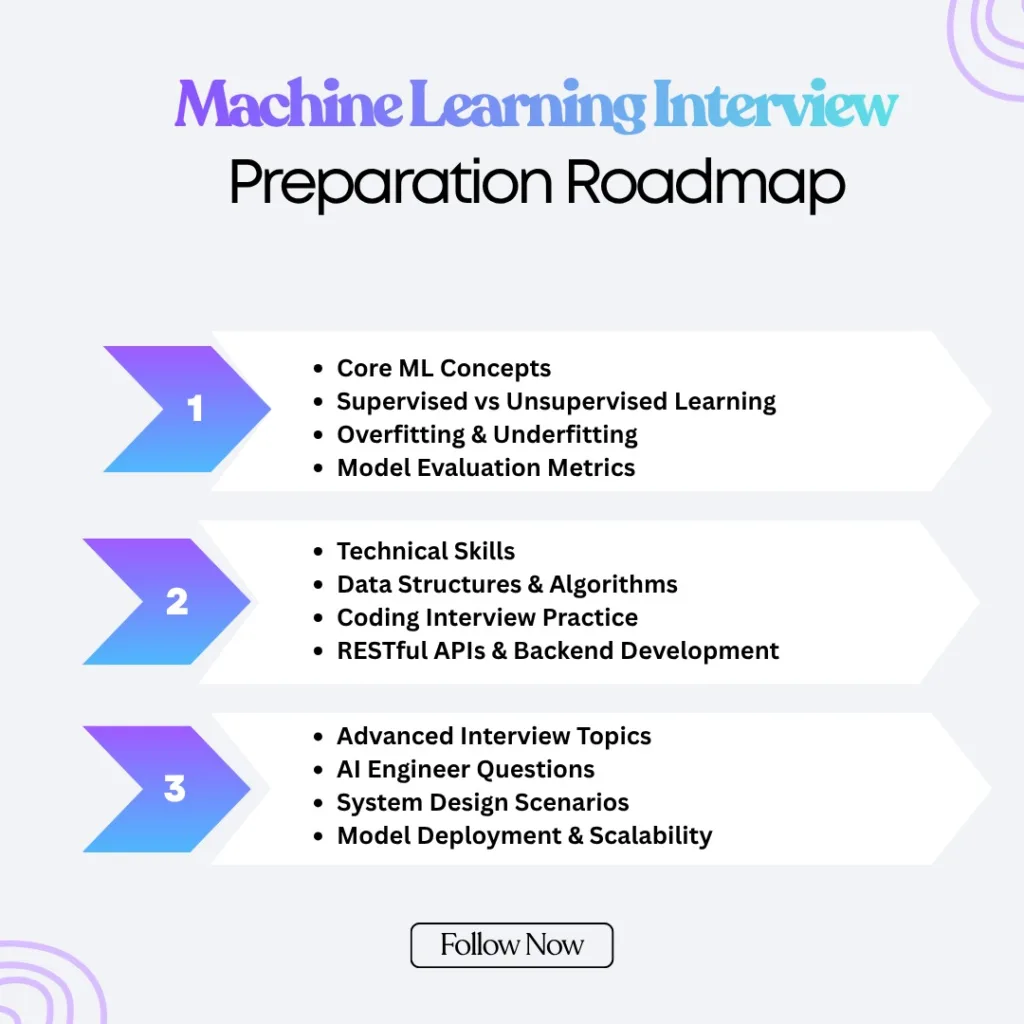
Common Machine Learning Concepts Asked in Interviews
| Topic | Description | Importance |
| Supervised Learning | Learning from labeled data | High |
| Unsupervised Learning | Finding patterns without labels | High |
| Reinforcement Learning | Learning through rewards and penalties | Medium |
| Feature Engineering | Creating meaningful input features | High |
| Model Evaluation | Measuring model performance | High |
Top Machine Learning Interview Questions and Answers
1. What is Machine Learning?
Machine learning is a subset of artificial intelligence that enables systems to learn from data without being explicitly programmed. Models identify patterns and make predictions based on historical information.
2. What are the main types of Machine Learning?
The three primary categories include:
- Supervised Learning
- Unsupervised Learning
- Reinforcement Learning
These questions frequently appear in machine learning interview questions and answers rounds.
3. What is Overfitting?
Overfitting occurs when a model performs exceptionally well on training data but poorly on unseen data because it learns noise instead of general patterns.
4. What is Underfitting?
Underfitting happens when a model is too simple to capture the underlying relationships in data, resulting in poor performance on both training and testing datasets.
5. What is the Bias-Variance Tradeoff?
Bias refers to errors caused by overly simplistic assumptions, while variance refers to sensitivity to training data fluctuations. Successful models maintain a balance between the two.
Popular Algorithms and Their Applications
| Algorithm | Use Case | Learning Type |
| Linear Regression | Price Prediction | Supervised |
| Logistic Regression | Classification | Supervised |
| Decision Tree | Customer Segmentation | Supervised |
| Random Forest | Fraud Detection | Supervised |
| K-Means | Customer Clustering | Unsupervised |
| Neural Networks | Image Recognition | Deep Learning |
Essential ML Interview Questions for Software Engineers
What is Feature Engineering?
Feature engineering involves selecting, transforming, and creating variables that improve model performance.
What is Cross-Validation?
Cross-validation helps evaluate model reliability by splitting data into multiple training and testing subsets.
What is a Confusion Matrix?
A confusion matrix measures classification performance through:
- True Positives
- True Negatives
- False Positives
- False Negatives
What is Gradient Descent?
Gradient descent is an optimization algorithm used to minimize the loss function by iteratively adjusting model parameters.
These are among the most frequently asked interview questions machine learning candidates encounter.
Machine Learning Engineer Interview Questions
Candidates applying for AI-focused roles often face advanced machine learning engineer interview questions that test practical implementation skills.
How Would You Handle Missing Data?
Common techniques include:
- Mean/Median Imputation
- Forward Filling
- KNN Imputation
- Removing Missing Records
What is Regularization?
Regularization reduces model complexity and prevents overfitting using methods such as:
- L1 Regularization (Lasso)
- L2 Regularization (Ridge)
What is ROC-AUC?
ROC-AUC measures a model’s ability to distinguish between classes and is widely used for classification evaluation.
Frequently Asked Evaluation Metrics
| Metric | Purpose | Best Use Case |
| Accuracy | Overall correctness | Balanced datasets |
| Precision | Positive prediction quality | Fraud detection |
| Recall | Detection completeness | Medical diagnosis |
| F1 Score | Precision-Recall balance | Imbalanced datasets |
| ROC-AUC | Classification quality | Binary classification |
AI Engineer Interview Questions Beyond Machine Learning
Modern companies often combine AI engineer interview questions with software engineering assessments.
Some examples include:
- Explain Transformer Architecture.
- What is Generative AI?
- How do Large Language Models work?
- What is Transfer Learning?
- How would you fine-tune a pretrained model?
These questions evaluate a candidate’s understanding of emerging AI technologies.
System Design and Backend Interview Questions
Machine learning engineers frequently work with production systems. Therefore, recruiters ask top system design interview questions and backend-related topics.
Common System Design Questions
- Design a recommendation engine.
- Design a real-time fraud detection system.
- Design a scalable ML inference service.
- Design a distributed training pipeline.
Common Backend Questions
Typical backend questions for interview include:
- Explain caching strategies.
- How do load balancers work?
- What is database indexing?
- Explain microservices architecture.
Technical Areas Covered in Modern Interviews
| Interview Area | Example Questions |
| Machine Learning | Classification, Regression |
| System Design | Scalable AI Platforms |
| Backend Development | APIs and Databases |
| Coding | DSA Problems |
| Full Stack | Frontend and Backend Integration |
RESTful API Interview Questions
Many machine learning applications expose predictions through APIs. Therefore, restful api interview questions are commonly included in interviews.
Examples:
- What is REST architecture?
- Explain GET, POST, PUT, and DELETE methods.
- What are HTTP status codes?
- What is API authentication?
- How do you secure REST APIs?
Full Stack Developer Interview Questions
Software engineers transitioning into AI roles may also face full stack developer interview questions such as:
- Explain React lifecycle methods.
- What is state management?
- How does JWT authentication work?
- Explain frontend-backend communication.
- What are webhooks?
Coding Interview Questions with Solutions
Recruiters evaluate problem-solving skills using coding interview questions with solutions.
Popular topics include:
- Array Manipulation
- String Processing
- Dynamic Programming
- Graph Algorithms
- Binary Trees
Candidates should practice writing optimized solutions and discussing time complexity.
Interview Questions for Data Structures and Algorithms
Strong DSA skills remain essential regardless of specialization.
Common interview questions for data structures and algorithms include:
- Reverse a Linked List.
- Detect a Cycle in a Graph.
- Find the Lowest Common Ancestor.
- Implement a Hash Map.
- Solve the Two Sum Problem.
Interviewers often focus on optimization and scalability.
Senior Developer Interview Questions
For experienced professionals, senior developer interview questions emphasize architecture and leadership.
Examples include:
- How would you mentor junior engineers?
- Explain system scalability strategies.
- How do you manage technical debt?
- Describe a challenging production issue you solved.
- How do you review code effectively?
Machine Learning Job Interview Questions Answer PDF
Many candidates search online for machine learning job interview questions answer pdf resources to prepare efficiently. While PDFs can be helpful for revision, practical coding experience, project implementation, and mock interviews provide the strongest preparation.

Final Thoughts
Preparing for machine learning interview questions requires a balanced understanding of algorithms, mathematics, software engineering, coding practices, system design, and deployment strategies. By mastering common ml interview questions, reviewing machine learning interview questions and answers, practicing coding interview questions with solutions, and strengthening your knowledge of top system design interview questions, you can confidently approach technical interviews and improve your chances of securing a machine learning or AI engineering role.
FAQs
1. What are the most common machine learning interview questions?
Questions about supervised learning, overfitting, bias-variance tradeoff, evaluation metrics, and feature engineering are among the most common.
2. How should I prepare for machine learning engineer interviews?
Focus on algorithms, model evaluation, coding practice, SQL, system design, and real-world machine learning projects.
3. Are coding rounds important for machine learning roles?
Yes. Most companies include coding interview questions with solutions and DSA-focused assessments.
4. What system design topics are asked in ML interviews?
Candidates may be asked to design recommendation systems, ML pipelines, fraud detection systems, and scalable inference architectures.
5. Where can I find machine learning job interview questions answer PDF resources?
Many educational platforms provide downloadable interview guides, but practical project experience and mock interviews remain the most effective preparation methods.
