


Introduction
In the rapidly evolving landscape of artificial intelligence (AI) and machine learning (ML), terminologies frequently intertwine. For newcomers and tech enthusiasts alike, this often leads to a common question: Are neural networks and deep learning the same thing? While the terms are closely related and frequently used interchangeably, they are not technically identical. Understanding the distinction is fundamental to grasping how modern AI systems process data and solve complex problems.What is a Neural Network?
An Artificial Neural Network (ANN) is a foundational machine learning model inspired by the structural framework and biological function of the human brain.
At its core, a neural network consists of interconnected processing units called nodes (or neurons) organized into distinct layers:
- Input Layer: Receives the raw data or features.
- Hidden Layer(s): Processes the data by applying mathematical weights and activation functions.
- Output Layer: Delivers the final prediction, classification, or decision.
How Neural Networks Learn
The core strength of a neural network lies in its ability to learn from data through training.
- Forward Propagation: Data passes through the layers, and the network generates a predicted output.
- Loss Evaluation: The system calculates the error (the difference between the predicted output and the actual ground truth).
- Optimization: Through a process called backpropagation, the network adjusts its internal parameters—specifically its weights and biases—to minimize errors and optimize accuracy.
Common neural network architectures include Feedforward Neural Networks (FNNs), Recurrent Neural Networks (RNNs) for sequential data, and Convolutional Neural Networks (CNNs) for image recognition.
The Crucial Difference: Neural Networks vs. Deep Learning
To answer the core question simply: Neural networks are the foundational building blocks, while deep learning is a specific, advanced subset of those building blocks.
| Feature | Artificial Neural Networks (ANN) | Deep Learning (DL) |
| Definition | A broad class of machine learning algorithms structured like biological neurons. | A specialized subfield of machine learning that exclusively uses deep neural networks. |
| Network Depth | Typically consists of 1 to 3 layers (shallow networks). | Features a massive architecture with dozens or hundreds of hidden layers. |
| Feature Extraction | Often requires manual feature engineering and human intervention to guide data processing. | Automatically discovers and extracts features from raw data without human intervention. |
| Data Requirements | Can perform well on smaller, structured datasets. | Requires massive volumes of data (Big Data) to achieve high accuracy. |
Deep Learning: A Deeper Dive
While traditional machine learning models hit a performance ceiling as data scales, deep learning thrives on complexity. As a specialized subset of machine learning, deep learning achieves its predictive power by passing data through highly scaled, multi-layered neural networks.
The word “deep” specifically refers to the structural depth of these networks. While a standard artificial neural network (ANN) might rely on just one or two hidden layers to process information, a deep learning architecture can feature dozens, hundreds, or even thousands of interconnected layers working in tandem.
Anatomy of a Deep Neural Network
To understand how deep learning scales up traditional networks, consider how data flows sequentially through its multi-layered architecture:
- The Input Layer: Accepts raw, unstructured data (such as pixels of an image or characters of text).
- The Stacked Hidden Layers: Each subsequent layer takes the output of the previous layer and refines it. Early layers detect simple shapes or edges, middle layers group those edges into features, and deep layers identify complex, abstract concepts.
- The Output Layer: Formulates the final high-level prediction or generated result based on the cumulative patterns recognized.
How Deep Architectures Revolutionized AI
The introduction of deep neural networks completely transformed the artificial intelligence landscape by solving one of machine learning’s biggest bottlenecks: manual feature engineering.
Instead of requiring human engineers to program specific rules or pre-process data into rigid categories, deep learning algorithms automatically extract intricate patterns, representations, and features directly from massive, raw datasets.
Core Applications of Deep Learning
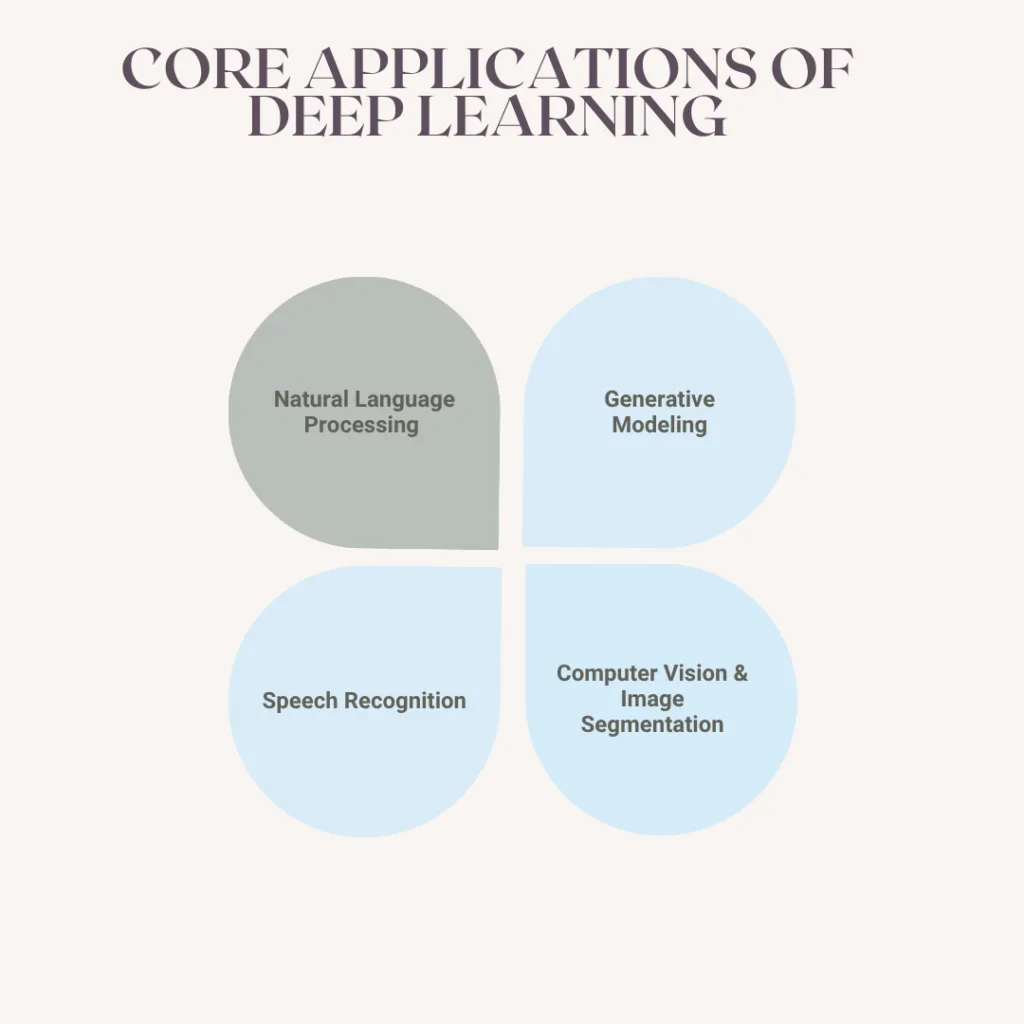
Because of this ability to master highly complex, non-linear data structures, deep learning has become the underlying engine for today’s most advanced technologies:
- Natural Language Processing (NLP): Powering large language models (LLMs) to understand context, sentiment, and human semantics.
- Generative Modeling: Creating completely new text, code, audio, and visual assets from simple prompts.
- Computer Vision & Image Segmentation: Enabling autonomous vehicles to distinguish pedestrians from street signs in real-time.
- Speech Recognition: Transforming raw audio waves into highly accurate text translations across multiple languages.
Key Takeaway: If neural networks are the engine, deep learning is a high-performance rocket booster. By stacking hundreds of layers together, deep learning moves away from basic data sorting and steps into the realm of human-like pattern recognition and automated problem-solving.
Key Differences and Similarities
Understanding where neural networks end and deep learning begins requires looking closely at their architecture, data handling, and processing power. While they share a foundational DNA, their execution scales quite differently.
Here is a direct breakdown of how these two concepts connect and diverge across four critical pillars.
1. Depth of Architecture
The most immediate differentiator between a standard neural network and a deep learning model is structural depth.
- Neural Networks: Can be incredibly simple. A neural network can feature a single layer (known as a perceptron) or a couple of hidden layers. These are often referred to as shallow neural networks.
- Deep Learning: Refers explicitly to neural networks with a high volume of hidden layers. The “deep” in deep learning is literal—it is defined by the massive stack of hidden layers processing the data sequentially.
2. Complexity and Representation Learning
How each technology identifies patterns determines the types of problems it can solve.
- Neural Networks: While highly capable of learning from data to perform classification or regression, shallow networks struggle with highly complex, non-linear patterns. They often require human engineers to pre-process data and manually highlight important features.
- Deep Learning: Excels at hierarchical representation learning. Because it passes data through hundreds of layers, it can ingest completely raw, unstructured data (like a raw video file) and automatically extract intricate features step-by-step without any human intervention.
3. Training, Optimization, and Resources
At their core, both systems learn using the same fundamental mathematical principles, but their operational costs are vastly different.
- The Similarity: Both traditional neural networks and deep learning models undergo training via optimization algorithms like gradient descent and backpropagation to minimize prediction errors.
- The Difference: Because deep learning architectures are incredibly complex, they require massive datasets (Big Data) to avoid overfitting. Consequently, deep learning requires significantly more computational power—relying heavily on specialized hardware like GPUs and TPUs—whereas standard neural networks can often be trained efficiently on basic CPUs.
4. Real-World Application Domains
While their use cases occasionally overlap, their scale dictating their placement in modern industry.
Deep Learning: Dominates the frontiers of unstructured data and perceptive AI. It is the driving force behind computer vision (autonomous driving), complex natural language processing (Large Language Models), real-time speech translation, and advanced generative AI modeling.
Neural Networks: Widely used across foundational, structured-data domains. They power predictive analytics in finance (credit scoring), healthcare diagnostics (tabular patient data risk assessment), basic robotics, and traditional gaming AI.

Conclusion
While neural networks serve as the foundation of deep learning, the two terms are not synonymous. Neural networks encompass a broader category of models, including shallow architectures, whereas deep learning specifically refers to neural networks with multiple layers. Deep learning represents a paradigm shift in machine learning, empowering models to learn complex representations from vast datasets, leading to remarkable advancements in artificial intelligence. Understanding the nuances between neural networks and deep learning is crucial for navigating the landscape of modern AI and leveraging these technologies to their fullest potential.
Want to dive deeper into the world of artificial intelligence and machine learning?
Follow our Facebook page for the latest updates, insights, and expert advice on neural networks, deep learning, and much more! Stay ahead of the curve by engaging with our community, sharing your thoughts, and exploring a wealth of resources that will help you master these cutting-edge technologies. Whether you’re a beginner or an expert, our page provides valuable content that will keep you informed, inspired, and ready to apply AI and ML in real-world scenarios. Don’t miss out—join us now!
Freqently Asked Question:
Is a neural network the same as deep learning?
No, they are not exactly the same, but they are deeply connected. A neural network is the foundational mathematical architecture inspired by the human brain. Deep learning is a specialized, advanced subset of machine learning that exclusively uses deep neural networks (networks with dozens or hundreds of hidden layers) to analyze complex data. Essentially, all deep learning models are neural networks, but not all neural networks are deep learning models.
How many layers make a neural network “deep”?
There is no hard mathematical cutoff, but the general consensus in the AI industry is that a neural network is considered “shallow” if it has only 1 to 3 hidden layers. Once a network features 4 or more hidden layers—and often extending into the dozens, hundreds, or thousands of layers to automatically extract features—it crosses the threshold into deep learning.
Can you do deep learning without a neural network?
No. By definition, deep learning requires the use of multi-layered artificial neural networks. The “deep” in deep learning literally refers to the depth of the stacked neural layers. Without a neural network architecture, you cannot perform deep learning.
When should I use a traditional neural network instead of deep learning?
You should choose a traditional, shallow neural network if your dataset is relatively small, well-structured (like Excel spreadsheets or SQL tables), and you have limited computational power (e.g., training on a basic CPU). Deep learning should be reserved for massive amounts of unstructured data (like raw video, audio, or millions of lines of text) where you have the budget and specialized hardware (GPUs/TPUs) to support it.
