


The demand for skilled backend developers continues to grow in 2026 as companies build scalable applications, cloud-native platforms, and secure APIs. Whether you are preparing for your next coding question for an interview round or hiring backend talent, understanding the most important backend concepts is essential. This guide covers some of the most relevant backend development topics and practical interview questions that employers frequently ask.
Why Backend Developer Interviews Matter in 2026
Backend developers are responsible for server-side logic, databases, APIs, authentication systems, scalability, and performance optimization. Modern companies assess candidates not only on programming skills but also on architecture design, security practices, and cloud technologies.
Many recruiters include backend developer interview questions as well as software developer interview questions to evaluate both theoretical knowledge and real-world problem-solving abilities.
Backend Developer Skills Assessed in Interviews
| Skill Area | What Recruiters Evaluate |
| Programming Languages | Java, Python, Node.js, Go, C# |
| Databases | SQL, NoSQL, Query Optimization |
| APIs | REST, GraphQL, Authentication |
| Cloud Computing | AWS, Azure, Google Cloud |
| Security | JWT, OAuth, Encryption |
| System Design | Scalability and Performance |
Top Backend Developer Interview Questions and Answers
1. What is a REST API?
Answer:
REST (Representational State Transfer) is an architectural style used to create web services. REST APIs use HTTP methods such as GET, POST, PUT, PATCH, and DELETE to communicate between clients and servers.
Key Benefits:
- Stateless communication
- Easy scalability
- Platform independence
- Improved performance
2. What is the difference between SQL and NoSQL databases?
Answer:
| SQL Database | NoSQL Database |
| Structured schema | Flexible schema |
| Uses tables | Uses documents, key-value pairs, graphs |
| Supports ACID properties | Prioritizes scalability |
| Examples: MySQL, PostgreSQL | Examples: MongoDB, Cassandra |
Backend engineers should understand when to use relational and non-relational databases depending on application requirements.
3. Explain ACID Properties.
Answer:
ACID ensures reliable database transactions:
- Atomicity: Entire transaction succeeds or fails.
- Consistency: Database remains valid before and after transactions.
- Isolation: Concurrent transactions do not interfere.
- Durability: Committed data remains stored permanently.
4. What is Database Indexing?
Answer:
An index is a data structure that improves data retrieval speed. It works similarly to an index in a book by helping the database locate records quickly without scanning every row.
Advantages:
- Faster query execution
- Better performance
- Improved search efficiency
5. What is Caching?
Answer:
Caching temporarily stores frequently accessed data to reduce database load and improve application performance.
Popular caching tools include:
- Redis
- Memcached
- Varnish
6. What is JWT Authentication?
Answer:
JWT (JSON Web Token) is a secure method for transmitting information between parties.
JWT Structure:
- Header
- Payload
- Signature
It is widely used for user authentication and authorization in modern web applications.
7. Explain Microservices Architecture.
Answer:
Microservices architecture breaks applications into smaller independent services that communicate through APIs.
Benefits:
- Easier deployment
- Independent scaling
- Better fault isolation
- Faster development cycles
Many modern enterprises include backend questions for interview related to microservices because they are widely used in cloud-native applications.
8. What is Dependency Injection?
Answer:
Dependency Injection (DI) is a design pattern where dependencies are provided externally rather than created inside a class.
Benefits:
- Loose coupling
- Easier testing
- Better maintainability
9. What is Load Balancing?
Answer:
Load balancing distributes incoming traffic across multiple servers to prevent overload and improve availability.
Common load balancers:
- NGINX
- HAProxy
- AWS Elastic Load Balancer
10. How Do You Prevent SQL Injection?
Answer:
Best practices include:
- Parameterized queries
- Prepared statements
- Input validation
- Stored procedures
- Least privilege access
Security-focused companies frequently ask backend interview questions related to SQL injection prevention.
Common Backend Technologies in 2026
| Category | Popular Technologies |
| Languages | Java, Python, Go, Node.js |
| Databases | PostgreSQL, MySQL, MongoDB |
| Caching | Redis, Memcached |
| Containers | Docker, Kubernetes |
| Cloud Platforms | AWS, Azure, GCP |
| Message Queues | Kafka, RabbitMQ |
Advanced Backend Interview Questions
11. What is Event-Driven Architecture?
Answer:
Event-driven architecture uses events to trigger communication between services. It helps applications become scalable, responsive, and loosely coupled.
12. Explain CAP Theorem.
Answer:
CAP Theorem states that a distributed system can only guarantee two of the following three properties:
- Consistency
- Availability
- Partition Tolerance
13. What is API Rate Limiting?
Answer:
Rate limiting restricts the number of API requests a user can make within a specific timeframe.
Benefits:
- Prevents abuse
- Improves security
- Protects server resources
14. What is Horizontal vs Vertical Scaling?
Answer:
| Horizontal Scaling | Vertical Scaling |
| Add more servers | Increase server resources |
| Better fault tolerance | Simpler implementation |
| Higher scalability | Hardware limitations |
15. Explain Message Queues.
Answer:
Message queues enable asynchronous communication between services.
Popular tools:
- Apache Kafka
- RabbitMQ
- Amazon SQS
These concepts often appear in software engineering questions because they are critical for distributed systems.
Preparing for Backend Interviews in 2026
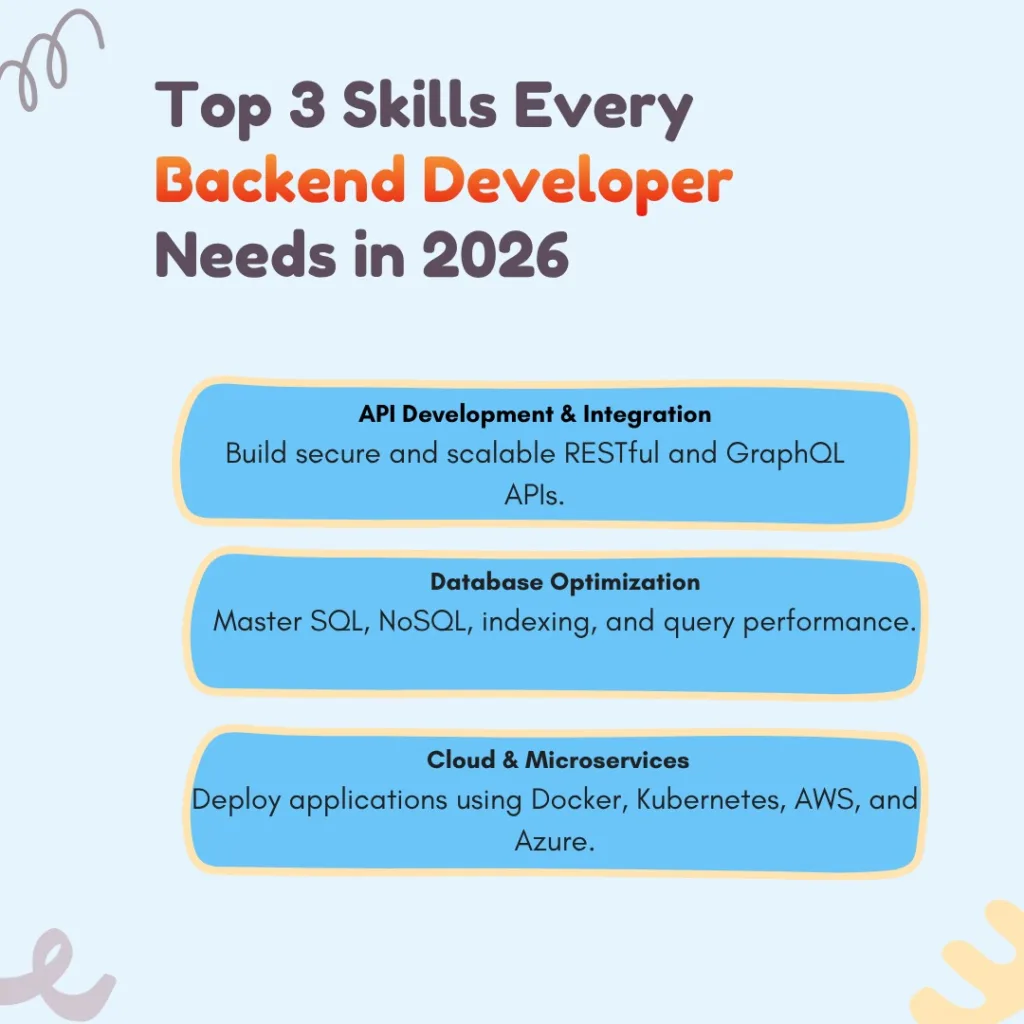
Modern employers increasingly focus on real-world implementation skills rather than memorized definitions. Candidates should practice API development, database optimization, cloud deployment, and system design. Many hiring managers combine technical interview questions with architecture discussions to evaluate problem-solving abilities.
Additionally, recruiters frequently ask software developer interview questions related to scalability, authentication, caching, and performance tuning. Experienced professionals can expect senior developer interview questions covering distributed systems, cloud infrastructure, and microservices architecture.
Strong knowledge of data structures and algorithms interview questions remains important because efficient code directly impacts backend performance and scalability.
Interview Preparation Roadmap
| Topic | Priority Level |
| Data Structures | High |
| Algorithms | High |
| Databases | High |
| APIs | High |
| System Design | Very High |
| Cloud Platforms | Medium |
| Security | High |
| DevOps Concepts | Medium |

Conclusion
Backend development continues to evolve rapidly in 2026. Employers seek professionals who understand databases, APIs, distributed systems, cloud technologies, and security best practices. Reviewing these backend developer interview questions can help candidates prepare effectively and improve their chances of success. Candidates preparing for advanced roles should also focus on senior developer interview questions that cover system architecture, scalability, leadership, and complex problem-solving scenarios. Consistent practice, project experience, and strong problem-solving skills remain the key to excelling in backend development interviews.
FAQs
1. What are the most common backend developer interview questions in 2026?
Common topics include REST APIs, databases, caching, authentication, microservices, cloud computing, and system design.
2. Are backend interview questions focused only on coding?
No. Employers evaluate coding skills, database knowledge, architecture design, security, and scalability concepts.
3. How important are SQL concepts in backend interviews?
SQL remains one of the most important topics because most applications rely on databases for data storage and retrieval.
4. What should senior backend developers focus on during interview preparation?
Senior candidates should focus on distributed systems, microservices, cloud architecture, scalability, and leadership-related technical discussions.
5. How can I prepare effectively for backend developer interviews?
Practice coding, build backend projects, study databases and system design, and review commonly asked interview questions regularly.
