


LLM-powered systems are automating business workflows in unimaginable ways. It isn’t just a flashy tech update; Enterprise AI adoption has jumped to 78% (from 55%). The top 1% of businesses are adopting LLMs to avoid grunt work and improve data extraction, process orchestration, and decision-making.
LLM agents enable faster workflow deployment. Businesses across industries are choosing these agents to build strong market leadership and channel staff towards high-value, strategic work.
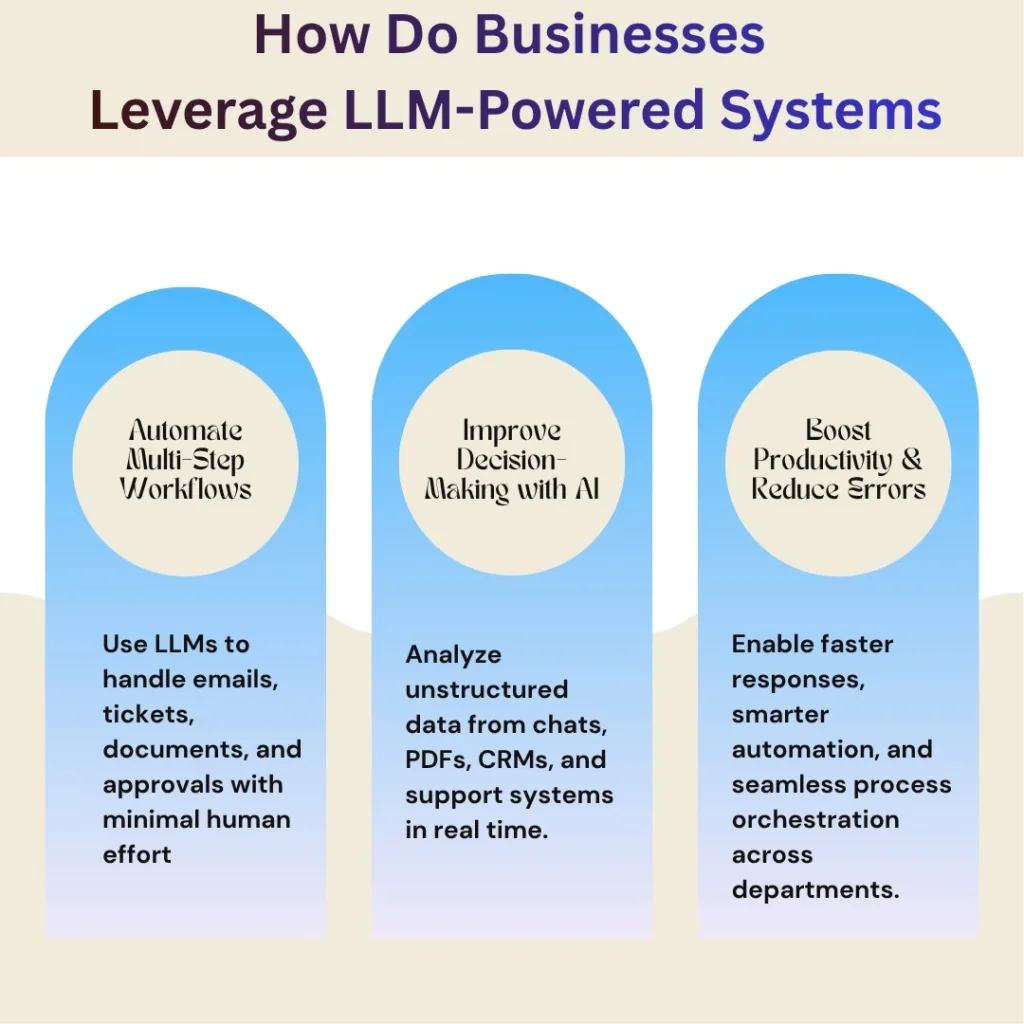
How Do Businesses Leverage LLM-Powered Systems?
Businesses are automating workflows using LLM-powered systems by integrating models like GPT-4 or Claude via APIs (like OpenAI and LangChain) into existing tools.
Agentic workflows, prompt chaining, and AI platforms likeMicrosoft Power Automate are enabling businesses to structure unstructured data and automate multi-step processes for quick decision-making. In turn, it’s doubling productivity, reducing errors, and supporting context-aware automation.
Why Isn’t Traditional Automation Enough?
Rule-based automation systems are highly effective for structured workflows such as invoice processing or payroll execution. However, they fail when handling:
- Unstructured data (e.g., chats, emails, PDFs)
- Context-based decision-making
- Dynamic customer interactions
- Multi-step workflows with complex reasoning
LLMs bridge these gaps by easily interpreting context, learning patterns, and adapting responses in real time.
Real-World Uses of LLM-Powered Automation
LLM-powered business systems are offering intelligent, context-aware automation for multi-step business workflows.
1. Intelligent Customer Support
LLMs help understand customer intent, context, and sentiment unlike chatbots. They help automate customer interactions across email, chat, and voice channels.
LLMs efficiently:
- Classify & categorise queries/tickets
- Generate & send personalized responses
- Escalate complex cases to human agents
The Impact Opportunity: This results in automated resolution, improved CSAT scores, and customer satisfaction.
2. Automated Document Processing
LLMs allow businesses with massive volumes of unstructured data (contracts, invoices & reports) to:
- Extract/categorise key information
- Summarize voluminous documents
- Validate and review data for compliance
The impact opportunity: It improves accuracy and speeds up processing cycles.
3. Sales & Lead Qualification
LLMs free sales teams’ time from fidgeting with hundreds of leads manually on Hubspot sales CRM or Salesforce sales cloud. It’s smart enough to analyze incoming leads from forms, emails, or CRMs and qualify them as per predefined criteria.
They can:
- Score & prioritise leads efficiently
- Draft dynamic follow-up emails
- Book meetings automatically
The impact opportunity: It ensures faster lead response times while aligning sales teams with high-value prospects.
4. Finance & Operations
LLM-powered systems can monitor the supply chain data, flag potential disruptions, and auto-draft contingency plans for the executives to review.
LLMs seamlessly connect multiple systems- CRM, ERP, and support tools, while automating end-to-end workflows. This creates a seamless, intelligent plan-act-observe loop.
How to Implement LLM-Powered Automation
Here are steps to build an interconnected ecosystem where LLM agents reason, plan, and execute complex workflows seamlessly.
Step 1: Identify High-Impact Use Cases
To begin with, it’s key to identify processes that involve:
- Repetitive communication
- Unstructured data
- Decision-making hassles
It’s key to identify rule-based, data-heavy tasks whose automation can free teams for strategic work. Especially in sales & marketing operations where revenue impact is direct. It’s often advisable to start small and pilot one small workflow before scaling.
Step 2 : Have a Solid Data & System Strategy
For building a strong foundation of successful automation, it’s crucial to prioritize:
Data Quality -> Data Privacy -> Data Accessibility
Before plugging LLMs into systems, it’s a must to examine current data sources and ensure the CRM’s data is
- Clean and structured
- Free from incomplete or duplicate records
Parallelly, CRMs must have APIs compatible to perform seamless data exchange that automation will require. And for failproof system security, compliance, and privacy, a robust governance framework is a must.
Step 3: Designing the Right Technical Architecture
Choosing between API-based foundation models and fine-tuning is always a concern. It totally depends on factors like cost, performance, and control. APIs like OpenAI and Anthropic are quite suitable for pilots wanting fast deployment, scalability & pay-as-you-go efficiency.
Fine-tuning requires significant time & resources, but it sure does deliver heightened domain-specific accuracy and contextual performance.
A practical approach is to start with APIs and keep on validating ROI. Pursuing fine-tuning is a smart choice for high-value, specialized use cases where general models fail.
Step 4: Choosing the Right LLM and Tools
Selection of LLM platforms highly depends on factors like accuracy, latency, integration flexibility, and data security needs. For example, no-code tools like Zapier or Power Automate enable fast deployment, while frameworks like LangChain support custom agentic workflows.
Enterprise platforms such as IBM Watsonx or Amazon Bedrock provide secure, scalable environments with governance and multi-model access. It also supports compliance controls for production-grade implementations.
Step 5: Design Prompt Engineering & Workflows
Prompts are the key instructions for LLMs. Well-designed prompts ensure:
- Consistent outputs
- Reduced errors
- Better contextual understanding
Businesses leverage well-structured prompting techniques, such as zero-shot, few-shot, and chain-of-thought, to guide foundation models like GPT-5 or Claude in executing task-specific workflows.
These prompts are integrated with orchestration tools like Zapier or custom backend systems to enable seamless, automated execution across processes.
Step 6: Human-in-the-Loop (HITL)
No doubt LLMs are powerful; however, human oversight is still crucial for:
- Quality assurance
- Handling extreme cases
- Continuous improvement
Building a Center of Excellence (CoE) is thus crucial. Setting a dedicated, cross-functional team helps with better AI governance and better knowledge sharing. It will help manage risk and stop siloed, inefficient AI projects from piling up.
Step 7: Monitor, Optimize, and Scale
Track performance metrics such as the following:
- Response accuracy
- Time saved
- Cost efficiency
It will help continuously refine prompts and workflows based on feedback and key performance indicators (KPIs).
Workflow automation is an unsurpassable future!
LLM-powered systems are redefining workflows for businesses to act fast. Rule-based AI isn’t enough. To unlock more sophisticated capabilities, businesses have to sign up for advanced and multimodal (capable of handling text, image & voice) LLMs.
LLM-powered systems are equipping businesses with intelligent, adaptive, and scalable workflows. From customer support to internal operations, they empower organizations to improve efficiency, reduce manual effort, and deliver exceptional experiences.
Businesses adopting this next best thing will not just be rewarded with streamlines operations but also with a massive competitive edge.
Stay tuned to know more.
FAQs
- How to choose the right LLM for a business?
Select based on task alignment, benchmark accuracy, latency, token cost, and API extensibility. Validate via controlled pilots, domain-specific evaluations, and compatibility with existing data pipelines, orchestration layers, and scalability requirements.
2. What are the biggest security risks with LLM integration?
Primary risks include data exfiltration, prompt injection, model hallucinations, and regulatory non-compliance. Mitigation requires encryption, role-based access control, input/output validation, audit logging, and human-in-the-loop governance frameworks.
- How to measure true ROI from LLM automation?
Quantify ROI via reductions in operational expenditure, cycle time, and manual intervention. Track metrics like throughput, accuracy, conversion uplift, and cost per transaction to assess efficiency and revenue impact.
- What is the realistic timeline for the initial pilot project?
A typical pilot spans 4–8 weeks, covering use case scoping, API integration, prompt engineering, testing, and iteration. Gradual scaling follows post-validation based on performance benchmarks and system reliability.
