


Master the technical interview process with these essential software engineering questions covering coding, system design, databases, APIs, cloud computing, and behavioral scenarios. This detailed guide includes expert explanations, examples, and practical answers for beginners and experienced developers preparing for top tech interviews in 2026.
Why Software Engineering Interview Preparation Matters
Modern tech interviews are designed to test more than just coding ability. Recruiters evaluate:
- Problem-solving skills
- Communication ability
- System design knowledge
- Data structure expertise
- Real-world development experience
- Team collaboration skills
Whether you are preparing for startup roles or product-based companies, practicing software engineer technical interview questions and answers improves confidence and helps you perform better under pressure.
These interviews often include:
- Coding rounds
- DSA questions
- Machine coding rounds
- System design interviews
- HR interviews
- Behavioral discussions
Preparing these software interview questions in advance helps candidates handle technical discussions more effectively.
Basic Software Engineering Interview Questions
1. What is Big O Notation?
Big O notation measures the efficiency of an algorithm based on input size.
Common Time Complexities
| Complexity | Meaning |
| O(1) | Constant Time |
| O(1) | Logarithmic |
| O(n) | Linear |
| O(n log n) | Efficient Sorting |
| O(n²) | Nested Loops |
Example
Binary search performs in logarithmic time.
T(n)=O(logn)T(n)=O(\log n)T(n)=O(logn)This means even for millions of records, the search remains fast
2. What is the difference between Stack and Queue?
A stack follows LIFO (Last In First Out), while a queue follows FIFO (First In First Out).
Stack Example
stack = []
stack.append(10)
stack.append(20)
print(stack.pop())
Output:
20
Queue Example
from collections import deque
queue = deque()
queue.append(10)
queue.append(20)

print(queue.popleft())
Output: 10
These are common software developer interview questions for freshers.
3. Explain Arrays vs Linked Lists
Arrays
- Fixed size
- Fast indexing
- Continuous memory allocation
Linked Lists
- Dynamic size
- Better insertion/deletion
- Sequential access
Example
arr = [1,2,3]
print(arr[1])
Linked list nodes use pointers to connect elements.
4. What is Recursion?
Recursion occurs when a function calls itself.
Example
def factorial(n):
   if n == 1:
       return 1
   return n * factorial(n-1)

print(factorial(5))
Output:
120
5. Explain OOP Principles
The four pillars are:
- Encapsulation
- Inheritance
- Polymorphism
- Abstraction
These are among the most asked software engineering viva questions.
6. What is a Hash Table?
A hash table stores key-value pairs.
Example
student = {
  "name": "Rahul",
  "marks": 90
}
Hash tables provide nearly constant-time lookups.
T(n)=O(1)T(n)=O(1)T(n)=O(1)
7. Explain SQL vs NoSQL
SQL Databases
- Structured schema
- ACID properties
- Examples: MySQL, PostgreSQL
NoSQL Databases
- Flexible schema
- Horizontal scaling
- Examples: MongoDB, Cassandra
8. What is a Binary Search Tree?
A BST stores smaller values on the left and larger values on the right.
Time Complexity
Average Time=O(logn)Average\ Time=O(\log n)Average Time=O(logn)
BSTs are heavily asked in software engineering interview questions.
9. Explain Synchronous vs Asynchronous Programming
Synchronous
Tasks execute one after another.
Asynchronous
Tasks run independently without blocking execution.
JavaScript Example
setTimeout(() => {
  console.log("Async Task");
}, 1000);
10. What are ACID Properties?
ACID ensures reliable database transactions.
- Atomicity
- Consistency
- Isolation
- Durability
Also Read:- Can You Answer This Senior-Level JavaScript Promise Interview Question?
Intermediate Software Engineering Interview Questions
11. How do you reverse a linked list?
Example
def reverse(head):
   prev = None
   current = head

   while current:
       next = current.next
       current.next = prev
       prev = current
       current = next

   return prev
12. Explain DFS and BFS
DFS
Uses stack/recursion.
BFS
Uses queue.
Complexity
T(V,E)=O(V+E)T(V,E)=O(V+E)T(V,E)=O(V+E)13. What is Dynamic Programming?
Dynamic Programming solves problems using stored subproblem results.
Fibonacci Example
def fib(n, memo={}):
   if n in memo:
       return memo[n]

   if n <= 1:
       return n

   memo[n] = fib(n-1) + fib(n-2)
   return memo[n]
14. What is an LRU Cache?
LRU Cache removes the least recently used items first.
Used in:
- Browsers
- Databases
- APIs
15. What is Multithreading?
Multithreading allows multiple threads inside one process.
Benefits
- Faster execution
- Better CPU utilization
- Parallel processing
16. Explain REST API
REST uses HTTP methods:
- GET
- POST
- PUT
- DELETE
Example Endpoint
GET /users/1
17. What is GraphQL?
GraphQL allows clients to request only required data.
Benefits
- Reduced payload
- Faster APIs
- Better frontend flexibility
18. What is Database Indexing?
Indexes improve query speed.
SQL Example
CREATE INDEX idx_name
ON users(name);
19. Explain Deadlock
Deadlock occurs when processes wait indefinitely for resources.
Conditions
- Mutual exclusion
- Hold and wait
- Circular wait
20. What is Dependency Injection?
Dependency Injection improves modularity by injecting dependencies externally.
Common in:
- Spring Boot
- Angular
- .NET
Advanced Software Engineering Interview Questions
21. Explain CAP Theorem
Distributed systems can provide only two:
- Consistency
- Availability
- Partition Tolerance
CAP=Consistency+Availability+Partition ToleranceCAP=Consistency+Availability+Partition\ ToleranceCAP=Consistency+Availability+Partition Tolerance
22. What is Microservices Architecture?
Microservices divide applications into independent services.
Benefits
- Independent deployment
- Better scalability
- Fault isolation
23. What is Rate Limiting?
Rate limiting prevents API abuse.
Example
requests_per_minute = 100
Common algorithms:
- Token Bucket
- Sliding Window
24. Explain Database Sharding
Sharding splits databases across multiple servers.
Benefits
- Scalability
- Faster queries
- Load balancing
25. What is Load Balancing?
Load balancers distribute traffic across servers.
Types
- Round Robin
- Least Connections
- IP Hash
26. What is Docker?
Docker packages applications inside containers.
Advantages
- Consistent environments
- Faster deployment
- Lightweight virtualization
27. What is Kubernetes?
Kubernetes manages container orchestration.
Features include:
- Auto scaling
- Load balancing
- Self healing
28. Explain Message Queues
Message queues handle asynchronous communication.
Examples:
- RabbitMQ
- Kafka
- Amazon SQS
29. What is Eventual Consistency?
Eventually all distributed nodes become consistent over time.
Used in:
- Cassandra
- DynamoDB
30. Explain CI/CD
CI/CD automates:
- Building
- Testing
- Deployment
Popular tools:
- Jenkins
- GitHub Actions
- GitLab CI/CD
Also Read:- Top 20 Node.js Questions Every Developer Should Know
Programming Language Interview Questions
31. Java Interview Question — What is JVM?
The Java Virtual Machine runs Java bytecode.
Features
- Platform independence
- Memory management
- Garbage collection
These are common Java interview topics.
32. Python Interview Question — Why is Python popular?
Python is widely used because:
- Easy syntax
- Large libraries
- AI/ML support
- Web development capabilities
33. JavaScript Interview Question — What is Closure?
Closures allow inner functions to access outer variables.
Example
function outer() {
  let count = 0;

  return function() {
     count++;
     return count;
  }
}
34. Explain Garbage Collection
Garbage collection removes unused memory automatically.
Languages using GC:
- Java
- Python
- C#
35. What is Exception Handling?
Exception handling manages runtime errors.
Python Example
try:
  x = 10 / 0
except ZeroDivisionError:
  print("Error")
System Design Interview Questions
36. How would you design WhatsApp?
Important components:
- Real-time messaging
- WebSockets
- Message queues
- Distributed storage
37. How would you design YouTube?
Consider:
- CDN
- Video encoding
- Distributed storage
- Recommendation systems
38. How would you design URL Shortener?
Features
- Short links
- Redirection
- Analytics
Example:
abc.com/xYz12
39. How would you scale a high-traffic application?
Methods include:
- Caching
- Load balancing
- Database replication
- CDN usage
40. Explain Caching Strategies
Popular caching:
- Redis
- Memcached
- Browser cache
Behavioral Software Engineering Interview Questions
41. Tell me about a challenging bug you fixed
Explain:
- Problem
- Root cause
- Solution
- Result
Interviewers evaluate debugging skills.
42. Describe a conflict with a teammate
Focus on:
- Communication
- Collaboration
- Resolution
43. Explain a project you are proud of
Discuss:
- Technologies used
- Challenges faced
- Results achieved
44. How do you handle deadlines?
Good answers include:
- Task prioritization
- Agile planning
- Team communication
45. Describe a time you learned new technology quickly
This tests adaptability and learning ability.
Fresher Software Developer Interview Questions
These are highly asked interview questions for fresher software engineer candidates.
46. What is SDLC?
Software Development Life Cycle includes:
- Planning
- Design
- Development
- Testing
- Deployment
47. What is Agile Methodology?
Agile focuses on:
- Iterative development
- Continuous feedback
- Team collaboration
48. What is Git?
Git is a version control system.
Common Commands
git clone
git commit
git push
49. Explain HTTP vs HTTPS
HTTPS provides encrypted communication using SSL/TLS.
50. Why should we hire you as a software developer?
Sample Answer
“I have strong problem-solving skills, a solid understanding of programming fundamentals, and a passion for learning modern technologies. I am also a team player who can adapt quickly and contribute effectively to software projects.”
Also Read:- Top 10 Questions in Software Development Interviews and How to Answer Them
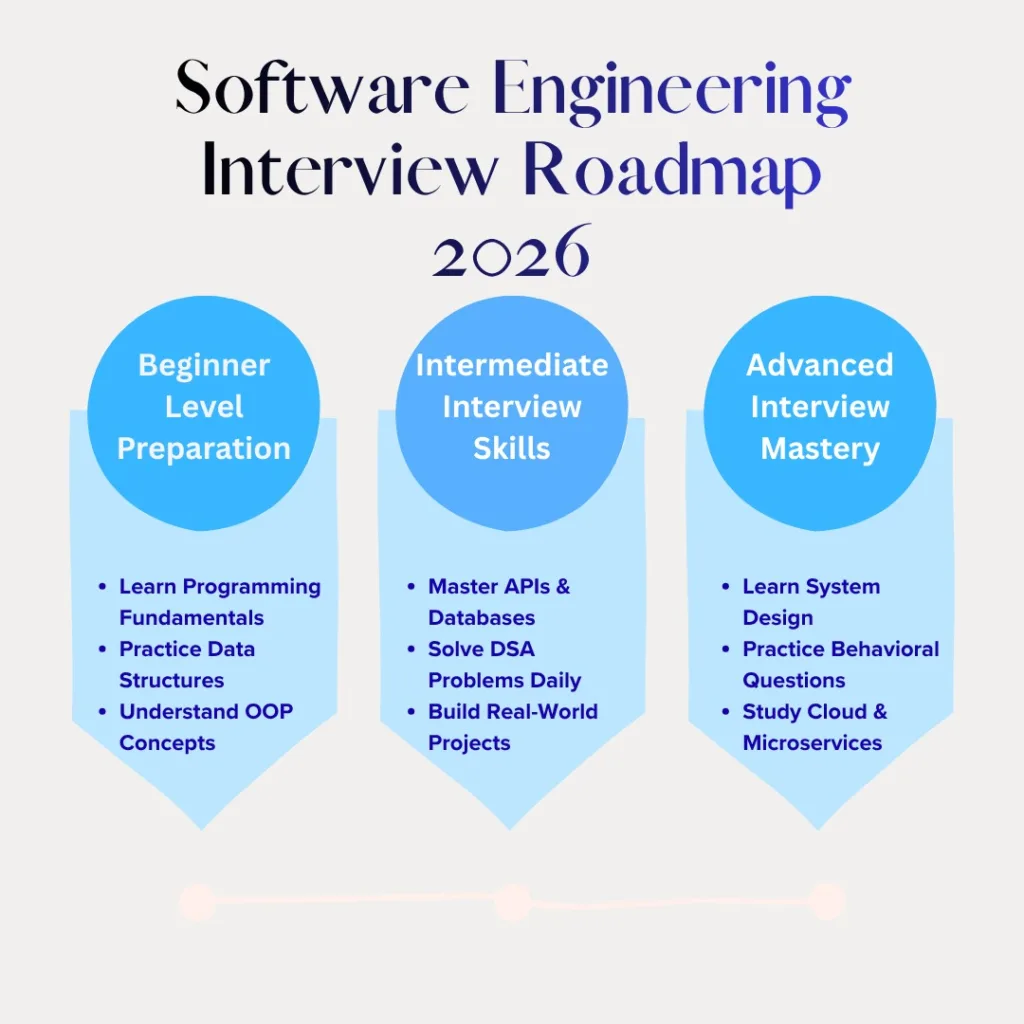
Tips to Crack Software Developer Interviews in 2026
1. Practice DSA Daily
Focus on:
- Arrays
- Trees
- Graphs
- Dynamic Programming
2. Build Real Projects
Create:
- Portfolio websites
- APIs
- Full-stack apps
3. Learn System Design
Especially important for experienced developers.
4. Improve Communication Skills
Clear explanation matters during interviews.
5. Practice Mock Interviews
Mock interviews improve confidence significantly.

Final Thoughts
Preparing for technical interviews requires consistency, problem-solving practice, and strong fundamentals. These software engineer technical interview questions and answers cover everything from beginner concepts to advanced distributed systems.
Whether you are preparing as a fresher or experienced developer, mastering these software developer interview questions for freshers and advanced concepts will improve your chances of landing high-paying tech roles in 2026.
By practicing these software engineering viva questions, improving coding skills, and building real-world projects, candidates can confidently clear modern technical interviews.
