


The demand for full stack developers continues to grow as organizations seek professionals who can manage both frontend and backend development efficiently. Whether you’re preparing for a basic technical interview or targeting a senior-level role in software engineering, understanding the most frequently asked full stack developer interview questions can significantly improve your chances of success.
Recruiters and hiring managers evaluate candidates through a combination of full stack interview questions, practical coding assessments, architecture discussions, and problem-solving exercises. From frontend frameworks and APIs to databases and system design, mastering these topics is essential for excelling in software engineering interviews and securing your dream job.
What Is a Full Stack Developer?
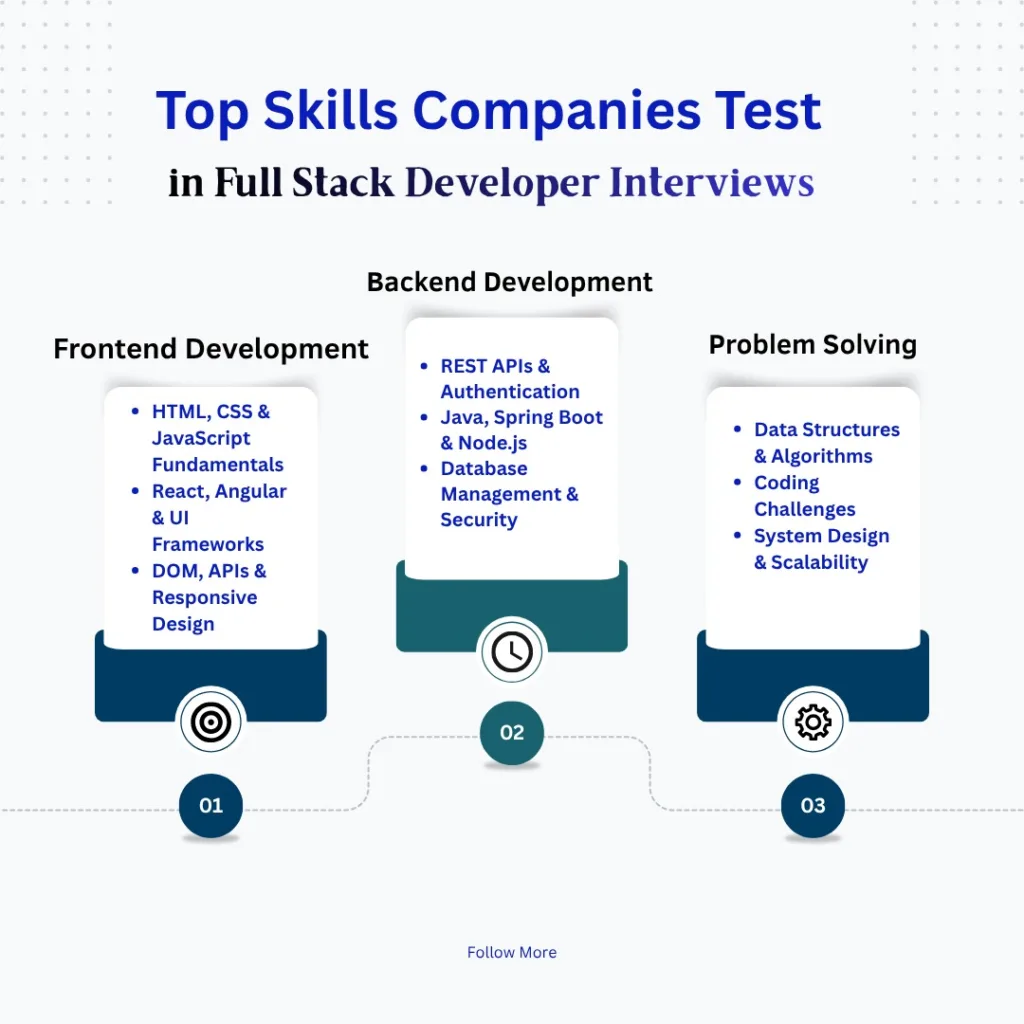
A full stack developer is a professional capable of working across all layers of a web application, including:
- Frontend Development (HTML, CSS, JavaScript, React, Angular, Vue)
- Backend Development (Java, Node.js, Python, .NET)
- Databases (MySQL, PostgreSQL, MongoDB)
- APIs and Integrations
- Cloud and DevOps Fundamentals
Many companies use interview questions for a full stack developer to assess technical expertise, coding skills, and the ability to build scalable applications from end to end.
Top Full Stack Developer Interview Questions
1. What Is Full Stack Development?
Full stack development refers to developing both the frontend and backend components of an application. It includes UI development, server-side logic, databases, APIs, deployment, and maintenance.
Key Areas:
- Frontend Technologies
- Backend Frameworks
- Database Management
- API Development
- Cloud Deployment
2. What Is the Difference Between Frontend and Backend Development?
| Frontend Development | Backend Development |
| Handles user interface | Handles server-side logic |
| Uses HTML, CSS, JavaScript | Uses Java, Node.js, Python |
| Focuses on user experience | Focuses on business logic |
| Runs in browser | Runs on server |
This is one of the most common full stack developer interview questions asked during technical rounds.
3. Explain MVC Architecture
MVC stands for:
- Model: Data layer
- View: User Interface
- Controller: Business Logic
Benefits:
- Better code organization
- Easier maintenance
- Scalability
4. What Are REST APIs?
REST APIs enable communication between frontend and backend systems using HTTP methods:
- GET
- POST
- PUT
- DELETE
REST architecture is widely used in modern web applications.
5. What Is Dependency Injection?
Dependency Injection is a design pattern that provides objects with their dependencies rather than creating them internally.
Advantages:
- Better testing
- Loose coupling
- Improved maintainability
6. What Is JWT Authentication?
JSON Web Token (JWT) is a secure method for user authentication.
JWT Structure:
- Header
- Payload
- Signature
It is commonly discussed in backend questions for interview sessions.
7. Explain SQL vs NoSQL Databases
| SQL Database | NoSQL Database |
| Relational | Non-relational |
| Fixed Schema | Flexible Schema |
| ACID Compliance | Horizontal Scaling |
| MySQL, PostgreSQL | MongoDB, Cassandra |
Understanding database selection is critical for answering full stack java developer interview questions.
8. What Is Database Normalization?
Database normalization reduces data redundancy and improves consistency.
Common Normal Forms:
- 1NF
- 2NF
- 3NF
- BCNF
9. Explain Microservices Architecture
Microservices divide applications into independent services.
Benefits:
- Scalability
- Independent deployment
- Fault isolation
- Faster development cycles
10. What Is Docker?
Docker is a containerization platform that packages applications and their dependencies into portable containers.
Advantages:
- Consistent environments
- Faster deployments
- Improved scalability
Coding and Problem-Solving Questions
Interviewers often include coding interview questions with solutions to assess logical thinking and implementation skills.
11. Reverse a String
Solution (Java)
String str = "Hello";
String reversed = new StringBuilder(str).reverse().toString();
System.out.println(reversed);
12. Find Duplicate Elements in an Array
Solution (Java)
HashSet<Integer> set = new HashSet<>();
for(int num : arr){
   if(!set.add(num)){
      System.out.println(num);
   }
}
13. Check If a String Is Palindrome
Solution (Java)
String original = "madam";
String reverse = new StringBuilder(original).reverse().toString();

if(original.equals(reverse)){
   System.out.println("Palindrome");
}
14. Explain Time Complexity
Time complexity measures the efficiency of an algorithm.
Common Complexities:
O(1)
O(log n)
O(n)
O(n log n)
O(n²)
Knowledge of data structures and algorithms is essential for cracking technical interviews.
15. What Data Structures Do You Use Frequently?
| Data Structure | Usage |
| Array | Sequential Storage |
| Linked List | Dynamic Data |
| Stack | LIFO Operations |
| Queue | FIFO Operations |
| HashMap | Fast Lookup |
| Tree | Hierarchical Data |
| Graph | Network Modeling |
Strong understanding of data structures and algorithms is frequently tested during associate software engineer and experienced hiring rounds.
Java Full Stack Developer Interview Questions
Many organizations specifically focus on java full stack developer interview questions and full stack java developer interview questions.
16. What Is Spring Boot?
Spring Boot simplifies Java application development by providing:
- Auto Configuration
- Embedded Servers
- Production-ready Features
17. What Is Hibernate?
Hibernate is an ORM framework that maps Java objects to database tables.
Benefits:
- Reduced boilerplate code
- Database independence
- Improved productivity
18. Explain Dependency Injection in Spring
Spring’s IoC container automatically injects dependencies into classes, promoting loose coupling.
19. Difference Between HashMap and ConcurrentHashMap
- HashMap is not thread-safe.
- ConcurrentHashMap is thread-safe.
This is among the most frequently asked java full stack developer interview questions.
20. What Is JPA?
Java Persistence API (JPA) provides a standard for object-relational mapping in Java applications.
Senior-Level Full Stack Questions
Candidates applying for leadership roles often face senior software developer interview questions focused on architecture and scalability.
21. How Would You Design a Scalable E-commerce Application?
Key Components:
- Microservices
- Load Balancers
- Caching
- CDN
- Database Replication
- Monitoring
22. How Do You Handle Application Security?
Best Practices:
- HTTPS
- Input Validation
- JWT Authentication
- Password Hashing
- Rate Limiting
23. Explain CI/CD Pipelines
CI/CD automates:
- Code Integration
- Testing
- Deployment
- Monitoring
Popular Tools:
- Jenkins
- GitHub Actions
- GitLab CI/CD
24. How Do You Optimize Application Performance?
Strategies:
- Database Indexing
- Lazy Loading
- Caching
- API Optimization
- Code Refactoring
25. Describe a Challenging Project You Worked On
Interviewers assess:
- Problem-solving skills
- Leadership abilities
- Communication
- Technical decision-making
Use the STAR Method:
- Situation
- Task
- Action
- Result
Tips to Crack Full Stack Interviews
- Practice common full stack interview questions regularly.
- Strengthen your understanding of data structures and algorithms.
- Prepare for backend questions for the interview thoroughly.
- Build real-world projects.
- Master Java, Spring Boot, React, and databases.
- Review coding interview questions with solutions daily.
- Focus on system design and architecture concepts.
- Study commonly asked interview questions for a full stack developer.
Conclusion
Preparing for modern full stack developer interview questions requires a combination of technical knowledge, coding expertise, and system design understanding. Whether you’re targeting entry-level opportunities as an associate software engineer or preparing for a senior software developer interview, mastering these concepts can significantly improve your confidence and performance.
Candidates preparing for java full stack developer interview questions, full stack java developer interview questions, and advanced backend questions for interview should focus on hands-on practice, project development, and continuous learning. With strong preparation and a solid understanding of data structures and algorithms, you can successfully clear interviews and advance your career as a full stack developer.
FAQs
1. What are the most common full stack developer interview questions?
Common topics include frontend development, REST APIs, databases, authentication, Java, Spring Boot, React, system design, and cloud deployment.
2. Are data structures and algorithms important for full stack interviews?
Yes. Most companies evaluate problem-solving abilities through data structures and algorithms questions during technical assessments.
3. How should I prepare for Java full stack developer interviews?
Focus on Spring Boot, Hibernate, REST APIs, databases, Java collections, multithreading, and system design concepts.
4. What backend questions are commonly asked in interviews?
Questions on APIs, authentication, database optimization, caching, microservices, Docker, and CI/CD pipelines are frequently asked.
5. What skills are required for a senior software developer interview?
Advanced architecture design, scalability, cloud computing, leadership, code optimization, security, and DevOps practices are essential.
