


Software engineering interviews often include OS interview questions to assess a candidate’s understanding of core operating system concepts, alongside practical development skills. Topics such as process management, memory allocation, concurrency, and system calls are especially important. Candidates may also encounter related areas such as Docker containers, an AWS cloud interview, API development, and SQL joins, depending on the role and interview format.
Modern software roles also connect operating systems with cloud and application infrastructure. Questions may cover Docker containers, virtualization, API development, and database operations, while an AWS cloud interview can test how operating system principles apply to cloud workloads. A strong foundation in processes, threads, files, and resource allocation helps engineers understand how applications behave across different environments.
Why Operating System Knowledge Matters in Software Engineering Interviews
Operating systems provide the foundation for running applications, managing hardware resources, and coordinating multiple tasks. Interviewers use OS questions to understand whether candidates can reason about performance, concurrency, resource utilization, and system reliability.
For freshers, interviewers may focus on definitions and fundamental concepts. Experienced software engineers may receive scenario-based questions involving CPU utilization, memory leaks, synchronization, process failures, and resource contention.
Understanding OS fundamentals can also support preparation for roles involving DevOps tools, cloud infrastructure, backend engineering, and security. Candidates working with Git commands, container platforms, or Kubernetes pods benefit from understanding how processes, resources, networking, and filesystems work underneath these technologies.
Core Operating System Interview Questions and Answers
1. What is an Operating System?
An operating system is system software that manages computer hardware and provides services for application programs. It acts as an interface between users, applications, and hardware.
Common responsibilities include:
- Process and thread management
- Memory management
- File management
- Device management
- Security and access control
- Resource allocation
- Input and output management
Examples include Windows, Linux, macOS, Android, and Unix-based systems.
2. What is a Process?
A process is a program that is currently being executed. It contains the program code along with information such as its current state, memory allocation, registers, and other resources.
A process can move through different states, including:
- New
- Ready
- Running
- Waiting or blocked
- Terminated
Process management is responsible for creating, scheduling, synchronizing, and terminating processes.
3. What is the Difference Between a Process and a Thread?
A process is an independent execution environment, while a thread is a smaller execution unit within a process.
| Feature | Process | Thread |
| Memory | Separate address space | Shares process memory |
| Creation | Relatively expensive | Generally lighter |
| Communication | Requires IPC mechanisms | Easier through shared memory |
| Failure impact | Usually isolated | Can affect the entire process |
| Context switching | More expensive | Generally faster |
Threads are useful when an application needs multiple tasks to execute concurrently.
4. What is Process Scheduling?
Process scheduling determines which ready process should receive CPU time. The operating system uses scheduling policies to efficiently distribute CPU resources among processes.
Common scheduling approaches include:
- First-Come, First-Served
- Shortest Job First
- Priority Scheduling
- Round Robin
- Multilevel Queue Scheduling
The appropriate scheduling strategy depends on system requirements such as response time, throughput, and fairness.
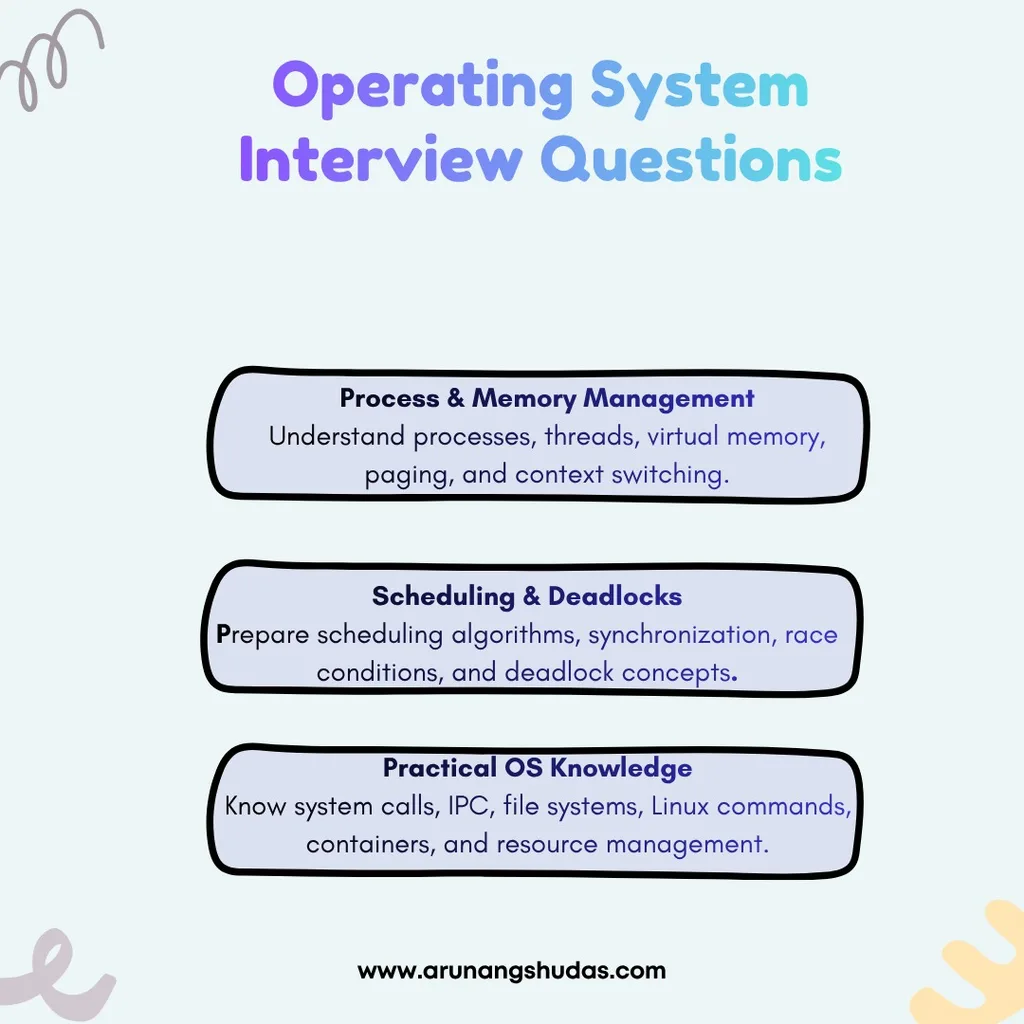
Scheduling Algorithms Interview Questions
5. What is Round Robin Scheduling?
Round Robin is a preemptive CPU scheduling algorithm where each process receives a fixed amount of CPU time called a time quantum. After the time quantum expires, the running process is moved to the back of the ready queue if it has not completed. This approach is useful in systems that handle predictive modeling workloads because it provides relatively fair CPU access among multiple processes and helps maintain responsive system performance.
6. What is Context Switching?
Context switching occurs when the CPU switches from one process or thread to another. The operating system saves the state of the currently running task and loads the saved state of another task.
Although context switching enables multitasking, excessive switching can introduce performance overhead.
7. What Is Preemptive Scheduling?
In preemptive scheduling, the operating system can interrupt a currently running process and allocate the CPU to another process.
Round Robin and many priority-based scheduling systems can use preemption.
8. What Is Non-Preemptive Scheduling?
In non-preemptive scheduling, a process generally keeps the CPU until it finishes execution or voluntarily enters a waiting state.
First-Come, First-Served is a common example.
Memory Management Interview Questions
Memory management is one of the most important operating system concepts for software engineers. The operating system manages physical memory and provides processes with controlled access to memory resources.
9. What Is Virtual Memory?
Virtual memory allows an operating system to provide processes with an address space that can be larger than available physical RAM.
The operating system can use secondary storage as an extension of memory through mechanisms such as paging.
Benefits include:
- Better process isolation
- Efficient memory utilization
- Support for larger applications
- Simplified memory allocation
10. What Is Paging?
Paging divides physical memory into fixed-size blocks called frames and logical memory into pages. When a process needs a page that is not currently in physical memory, the operating system may load it from secondary storage. This memory management concept is also relevant for data analysts working with large datasets, as efficient memory usage can help applications process data more effectively.
11. What Is a Page Fault?
A page fault occurs when a process attempts to access a page that is not currently available in physical memory.
The operating system handles the event by locating the required page, loading it into memory, updating the relevant page-table information, and allowing execution to continue.
12. What Is the Difference Between Paging and Segmentation?
| Feature | Paging | Segmentation |
| Division | Fixed-size pages | Variable-size segments |
| Based on | Physical memory management | Logical program structure |
| Fragmentation | Internal fragmentation possible | External fragmentation possible |
| Addressing | Page number + offset | Segment number + offset |
| Main purpose | Efficient memory allocation | Logical memory organization |
Deadlock Interview Questions
13. What Is a Deadlock?
A deadlock occurs when two or more processes remain blocked because each process is waiting for a resource held by another process.
For example, Process A may hold Resource 1 while waiting for Resource 2, while Process B holds Resource 2 and waits for Resource 1.
14. What Are the Four Necessary Conditions for Deadlock?
The four conditions are:
- Mutual Exclusion – A resource can be held by only one process at a time.
- Hold and Wait – A process holds one resource while waiting for another.
- No Preemption – Resources cannot be forcibly taken from a process.
- Circular Wait – Processes form a circular chain where each process waits for a resource held by the next process.
Removing at least one of these conditions can help prevent deadlock.
15. How Can Deadlocks Be Handled?
Operating systems can handle deadlocks through:
- Deadlock prevention
- Deadlock avoidance
- Deadlock detection
- Deadlock recovery
The choice depends on system requirements and resource-management policies.
File System and I/O Interview Questions
16. What Is a File System?
A file system organizes and manages data stored on storage devices. It provides mechanisms for creating, reading, modifying, and deleting files and directories.
Examples include NTFS, ext4, APFS, and FAT32.
17. What Is a System Call?
A system call is a mechanism through which an application requests a service from the operating system kernel.
Examples include operations related to:
- Creating processes
- Reading and writing files
- Allocating resources
- Communication
- Network operations
System calls provide a controlled interface between user-level programs and the operating system.
18. What Is Kernel Mode and User Mode?
Modern operating systems commonly separate execution into user mode and kernel mode.
| Aspect | User Mode | Kernel Mode |
| Access | Restricted | High-level hardware access |
| Typical software | Applications | OS kernel |
| Hardware control | Limited | Extensive |
| Security | More isolated | Highly privileged |
| Failure impact | Usually limited | Can affect the entire system |
This separation helps protect the operating system from faulty or malicious application behavior.
Synchronization and Concurrency Questions
19. What Is a Race Condition?
A race condition occurs when multiple threads or processes access shared data concurrently and the final result depends on the timing of their execution.
Synchronization mechanisms such as mutexes, semaphores, and locks can help prevent inconsistent results.
20. What Is a Semaphore?
A semaphore is a synchronization mechanism used to control access to shared resources.
Semaphores are commonly categorized as:
- Binary semaphores
- Counting semaphores
They are useful when multiple processes or threads need coordinated access to shared resources.
21. What Is a Mutex?
A mutex, or mutual exclusion lock, allows only one thread to access a protected critical section at a time.
It is commonly used to prevent concurrent modification of shared data.
Operating System Questions for Different Software Roles
Operating system knowledge can appear differently across technical roles. Backend developers may encounter process and memory questions, while engineers working with infrastructure may need stronger knowledge of containers, networking, and resource isolation.
Data analysts may encounter OS questions related to data-processing environments and resource utilization. A security analyst interview may include questions about permissions, processes, system calls, authentication, and operating system security.
Engineers working with AI systems may also connect system-level concepts with LLM prompting, large language models, and predictive modeling, particularly when discussing computational resources, model serving, and application infrastructure.
22. How Does an Operating System Support Containers?
Containers use operating-system-level isolation mechanisms to run applications in separated environments while sharing the underlying host kernel.
Technologies such as namespaces and control groups help isolate processes and control resource usage. This is particularly relevant when working with Docker-based development environments.
23. How Does OS Knowledge Help With Kubernetes?
Kubernetes manages workloads such as Kubernetes pods, which run containers. Understanding processes, CPU resources, memory limits, networking, and Linux fundamentals can make it easier to troubleshoot containerized applications.
Practical OS Interview Questions
| Question | Key Concept | What Interviewers Look For |
| What is a process? | Process management | Understanding of execution |
| What is virtual memory? | Memory management | Knowledge of address spaces |
| What is a deadlock? | Resource management | Understanding of resource contention |
| What is a system call? | Kernel interaction | Understanding of OS interfaces |
| What is a race condition? | Concurrency | Knowledge of synchronization |
Advanced Operating System Concepts
24. What Is Thrashing?
Thrashing occurs when a system spends excessive time moving pages between physical memory and secondary storage instead of executing useful processes.
It can significantly reduce system performance.
25. What Is Fragmentation?
Fragmentation occurs when available memory is not utilized efficiently.
There are two major types:
- Internal fragmentation: Allocated memory contains unused space within the allocated block.
- External fragmentation: Free memory exists but is divided into small, non-contiguous blocks.
26. What Is Inter-Process Communication?
Inter-Process Communication, or IPC, enables processes to exchange information and coordinate activities.
Common IPC mechanisms include:
- Pipes
- Message queues
- Shared memory
- Sockets
- Signals
The appropriate mechanism depends on communication requirements and system architecture.
27. What Is a Critical Section?
A critical section is a part of a program where shared resources are accessed or modified.
Only the appropriate number of threads or processes should enter the critical section at the same time to avoid inconsistent data.
OS Interview Questions Related to Modern Development
Modern software engineers frequently work across operating systems, cloud infrastructure, version control, and deployment platforms. Knowledge of Git commands helps developers manage source code, while DevOps tools automate building, testing, deployment, and infrastructure management.
Engineers may also encounter operating system concepts while working with cloud workloads, distributed applications, and services involving large language models. For data-focused roles, concepts such as predictive modeling can create workloads that require careful CPU and memory management.
Scenario-Based OS Interview Questions
28. A Server Is Running Slowly. How Would You Investigate It?
Start by checking:
- CPU utilization
- Memory usage
- Disk usage and I/O
- Running processes
- Network activity
- Application logs
- System-level errors
On Linux systems, tools such as top, htop, free, df, du, ps, and iostat can help identify resource bottlenecks.
29. How Would You Investigate High Memory Usage?
First, identify which processes are consuming the most memory. Then check whether the application is continuously allocating memory, whether garbage collection is involved, or whether a memory leak may be present.
The investigation should combine OS-level metrics with application-level monitoring.
30. How Would You Troubleshoot a Deadlock?
A practical approach includes:
- Identifying blocked processes or threads
- Checking which resources they hold
- Identifying what resources they are waiting for
- Constructing the dependency relationship
- Finding circular waits
- Reviewing locking and synchronization logic
The goal is to identify the resource cycle and determine how it can be safely resolved.

Quick Revision Table
| Topic | Important Terms | Interview Focus |
| Processes | PCB, states, context switching | Process execution |
| Memory | Paging, virtual memory, page fault | Memory allocation |
| Scheduling | Round Robin, SJF, Priority | CPU utilization |
| Deadlocks | Mutual exclusion, circular wait | Resource contention |
| Concurrency | Mutex, semaphore, race condition | Synchronization |
| File Systems | Files, directories, permissions | Storage management |
| IPC | Pipes, sockets, shared memory | Process communication |
Frequently Asked Questions
1. What are the most important OS topics for software engineer interviews?
Focus on processes, threads, CPU scheduling, memory management, virtual memory, synchronization, deadlocks, file systems, system calls, and IPC. Scenario-based questions are also useful for experienced engineers.
2. Are OS interview questions important for experienced software engineers?
Yes. Experienced candidates may be asked to apply OS concepts to performance troubleshooting, concurrency, resource management, backend systems, containers, and distributed applications.
3. Which scheduling algorithms should I prepare?
Prepare First-Come, First-Served, Shortest Job First, Priority Scheduling, and Round Robin. Understand their basic advantages, limitations, and scheduling behavior.
4. How can I prepare for OS interview questions quickly?
Start with core concepts, then practice short theoretical questions followed by scenario-based problems. Pay particular attention to process management, memory management, deadlocks, synchronization, and scheduling algorithms.
5. Do software developers need to know Linux for OS interviews?
Linux knowledge can be particularly useful because many development, backend, cloud, and DevOps environments use Linux. Familiarity with processes, permissions, memory, networking, and command-line tools can help with practical interview questions.
