


Every business wants more website visitors to become paying customers, but increasing traffic alone does not guarantee higher revenue. Modern businesses now focus on improving conversion rates using intelligent technologies that understand customer intent, predict behavior, and automate optimization. This is where AI agents are transforming Conversion Rate Optimization (CRO).
Unlike Traditional Automation, which follows predefined rules, AI agents continuously learn from user interactions, identify friction points, and recommend improvements without constant manual intervention. Businesses adopting conversion optimization AI are creating faster, more personalized digital experiences while improving Content Marketing at Scale across multiple channels.
Today’s AI-powered systems are also redefining Digital Marketing Workflows by analyzing customer journeys in real time. Instead of waiting weeks for manual reports, businesses receive instant recommendations powered by customer behavior analytics, helping marketers improve engagement and conversions with greater confidence.
Whether you run an ecommerce store, SaaS platform, B2B website, or service business, AI agents are becoming an essential part of modern optimization strategies.
What Are AI Agents in Conversion Rate Optimization?
AI agents are intelligent software systems capable of monitoring website performance, analyzing visitor behavior, identifying conversion obstacles, and implementing optimization recommendations automatically.
Instead of simply reporting data, AI agents actively improve conversion performance through continuous learning.
These systems can:
- Track visitor interactions
- Predict purchasing behavior
- Personalize website experiences
- Recommend UI improvements
- Optimize landing pages
- Automate testing
- Improve lead quality
- Monitor marketing campaigns
This modern approach combines machine learning, predictive analytics, behavioral science, and automation into one intelligent optimization engine.
Why Traditional CRO Is No Longer Enough
Traditional CRO typically relies on:
- Manual heatmap analysis
- A/B testing over several weeks
- Spreadsheet reporting
- Human interpretation
- Static personalization
Although effective, these methods require significant time and resources.
AI agents reduce manual effort while continuously learning from new customer interactions.
| Traditional CRO | AI-Powered CRO |
| Manual analysis | Continuous learning |
| Delayed optimization | Real-time optimization |
| Fixed audience segmentation | Dynamic personalization |
| Limited testing | Automated multi-variable testing |
| Human-driven insights | Predictive recommendations |
How AI Agents Improve Conversion Rates
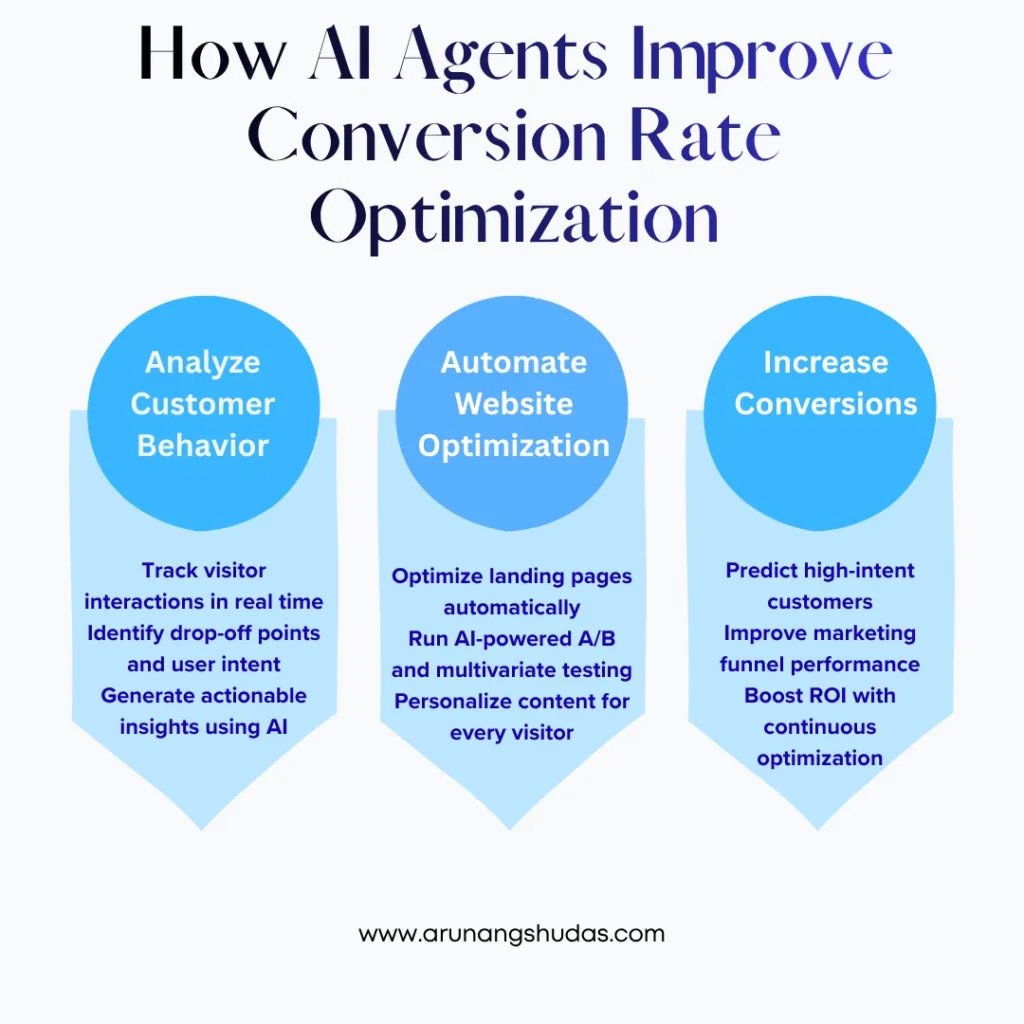
AI agents work across multiple stages of the marketing funnel to increase conversions while reducing customer friction.
1. Understanding Customer Behavior
Every visitor behaves differently.
AI systems analyze:
- Mouse movements
- Scroll depth
- Click patterns
- Session duration
- Exit pages
- Device usage
- Returning visitor behavior
Using advanced customer behavior analytics, businesses understand exactly where visitors lose interest.
Instead of assumptions, marketers receive data-backed optimization suggestions.
2. AI Landing Page Optimization
Landing pages significantly influence conversion rates.
Modern AI landing page optimization tools evaluate:
- Headlines
- CTA buttons
- Images
- Layout
- Page speed
- Forms
- Color combinations
- Mobile responsiveness
The AI automatically identifies which elements reduce conversions and recommends improvements.
Example:
Instead of manually changing one headline every month, AI can simultaneously test dozens of headline variations for different audience segments.
3. Predictive Conversion Systems
One of the biggest advantages of AI is prediction.
Predictive conversion systems estimate:
- Purchase probability
- Lead quality
- Cart abandonment risk
- Upsell opportunities
- Customer lifetime value
Businesses can prioritize high-value visitors before they leave the website.
AI Across the Marketing Funnel
AI agents optimize every stage of the customer journey.
| Funnel Stage | AI Agent Role | Business Benefit |
| Awareness | Audience analysis | Better targeting |
| Interest | Personalized content | Higher engagement |
| Consideration | Product recommendations | Increased trust |
| Decision | Smart CTA optimization | Higher conversions |
| Retention | Personalized follow-ups | More repeat customers |
This approach transforms the entire marketing funnel AI strategy.
Intelligent UX Optimization
Poor user experience often causes lost revenue.
AI agents improve:
- Navigation
- Content placement
- CTA visibility
- Form completion
- Mobile usability
- Checkout flow
- Accessibility
Using intelligent UX optimization, businesses continuously refine digital experiences based on actual user behavior rather than assumptions.
Website Optimization AI
Modern websites generate enormous amounts of behavioral data.
Website optimization AI processes millions of interactions to identify:
- Slow-loading pages
- Broken customer journeys
- Poor-performing content
- High bounce rate pages
- Weak navigation paths
Instead of manually reviewing analytics reports, businesses receive prioritized action plans.
CRO Automation in Action
One of the greatest benefits of CRO automation is reducing repetitive optimization work.
AI agents automatically:
- Monitor conversion metrics
- Detect sudden performance drops
- Recommend design changes
- Trigger personalization campaigns
- Launch automated experiments
- Generate optimization reports
Marketing teams spend less time gathering data and more time implementing strategic improvements.
AI-Driven Testing Tools
Traditional A/B testing often requires weeks before statistically significant results emerge.
Modern AI-driven testing tools accelerate experimentation through:
- Multi-variable testing
- Continuous optimization
- Adaptive traffic allocation
- Automatic winner selection
- Personalized experiments
This means businesses improve conversions much faster than manual testing approaches.
Conversion Analytics Automation
Reporting is no longer just about dashboards.
Conversion analytics automation enables AI agents to:
- Generate reports automatically
- Highlight anomalies
- Forecast trends
- Compare campaign performance
- Detect conversion bottlenecks
Executives receive actionable insights rather than overwhelming spreadsheets.
AI and Customer Journey Optimization
Customers rarely convert during their first visit.
AI continuously improves Customer Journey Optimization by analyzing interactions across:
- Website visits
- Email campaigns
- Social media
- Ads
- Chatbots
- CRM systems
Every touchpoint becomes smarter over time.
Supporting Digital Marketing with AI Agents
Conversion optimization doesn’t happen in isolation. AI agents strengthen multiple marketing activities.
1. Influencer Marketing Campaigns
AI measures influencer traffic quality, engagement, audience overlap, and resulting conversions to identify high-performing partnerships.
2. Automated Email Marketing
AI personalizes email timing, subject lines, product recommendations, and follow-up sequences to improve click-through and conversion rates.
3. B2B Marketing Strategies
For B2B companies, AI scores leads, identifies buying intent, predicts account readiness, and recommends personalized outreach.
4. Brand Monitoring
AI continuously tracks customer sentiment, online reviews, competitor mentions, and brand conversations to identify opportunities and risks.
5. Paid Advertising Campaign Performance
AI evaluates advertising spend across platforms, identifies underperforming campaigns, adjusts bidding strategies, and improves return on ad spend.
Benefits of AI Agents for CRO
| Benefit | Business Impact |
| Faster optimization | Higher conversion rates |
| Personalized experiences | Better customer satisfaction |
| Reduced manual work | Increased productivity |
| Predictive insights | Smarter business decisions |
| Continuous learning | Long-term performance improvement |
Best Practices for AI-Powered Conversion Optimization
Organizations should combine AI with strategic planning.
Recommended practices include:
- Define measurable conversion goals.
- Ensure high-quality data collection.
- Continuously monitor AI recommendations.
- Test AI-generated changes before full deployment.
- Integrate CRM, analytics, and marketing platforms.
- Maintain customer privacy and compliance.
- Regularly review model performance.
- Combine human expertise with AI insights.
Common Challenges
Despite its advantages, AI-powered CRO also presents challenges.
| Challenge | Recommended Solution |
| Poor data quality | Clean and standardize data |
| Privacy regulations | Follow GDPR and local compliance |
| AI bias | Regular model validation |
| Integration complexity | Use compatible marketing platforms |
| Over-automation | Maintain human oversight |
The Future of AI Agents in Conversion Optimization
AI agents are rapidly evolving beyond recommendation engines.
Future capabilities include:
- Autonomous website optimization
- Voice interface personalization
- Real-time behavioral adaptation
- Predictive customer engagement
- Hyper-personalized shopping experiences
- Self-optimizing marketing campaigns
- AI-generated user interfaces
Businesses adopting intelligent CRO today will be better prepared for increasingly competitive digital markets.
Conclusion
AI agents are redefining how businesses approach Conversion Rate Optimization. By combining conversion optimization AI, CRO automation, AI landing page optimization, customer behavior analytics, predictive conversion systems, intelligent UX optimization, marketing funnel AI, AI-driven testing tools, website optimization AI, and conversion analytics automation, organizations can build smarter, data-driven optimization strategies that continually improve performance.
When integrated with broader initiatives such as Influencer Marketing Campaigns, Automated Email Marketing, B2B Marketing Strategies, Brand Monitoring, Paid Advertising Campaign Performance, and Customer Journey Optimization, AI agents become a powerful engine for sustainable business growth. Companies that embrace these intelligent systems today will be better equipped to deliver exceptional user experiences, increase conversions, and stay ahead in the evolving digital landscape.
Frequently Asked Questions (FAQs)
1. What is conversion optimization AI?
Conversion optimization AI uses artificial intelligence to analyze visitor behavior, personalize user experiences, automate testing, and recommend improvements that increase website conversions.
2. How does CRO automation improve business performance?
CRO automation reduces manual optimization tasks by continuously monitoring website performance, identifying issues, and implementing data-driven improvements more efficiently than traditional methods.
3. What are AI-driven testing tools?
AI-driven testing tools automate A/B and multivariate testing, dynamically allocate traffic, identify winning variations faster, and continuously optimize website elements based on user behavior.
4. How does customer behavior analytics support AI agents?
Customer behavior analytics provides insights into visitor interactions, enabling AI agents to identify friction points, predict intent, personalize experiences, and recommend changes that improve conversion rates.
5. Can AI agents improve the entire customer journey?
Yes. AI agents optimize every stage of the customer journey—from awareness and engagement to conversion and retention—through personalization, predictive insights, and continuous learning, resulting in a more seamless user experience.
