


Content marketing has become one of the most important growth drivers for modern businesses. However, producing high-quality content consistently across blogs, websites, social media platforms, emails, and landing pages requires significant time and resources. This is where AI Marketing Agents are transforming the industry. By leveraging intelligent automation, businesses can streamline content creation, distribution, optimization, and performance tracking. Modern AI content marketing solutions are helping organizations build scalable strategies while reducing operational overhead.
Today, companies are increasingly adopting AI Agents for SEO and integrating them into complex Digital Marketing Workflows. These intelligent systems can research keywords, generate content briefs, create articles, optimize metadata, schedule publishing, and analyze performance metrics automatically. As a result, brands can accelerate content production while maintaining quality and consistency across channels.
Understanding AI Agents in Content Marketing
AI agents are autonomous software systems designed to perform specific tasks with minimal human intervention. Unlike traditional automation tools, AI agents can make decisions, adapt to new information, and collaborate with other systems.
In content marketing, AI agents support:
- Content ideation
- Keyword research
- Audience analysis
- Blog writing
- Content optimization
- Publishing automation
- Performance monitoring
- Content repurposing
Organizations using AI content marketing solutions can significantly increase productivity while improving campaign effectiveness.
What Makes AI-Powered Content Marketing Different?
Traditional content creation often relies on manual workflows involving multiple teams. AI-powered systems automate repetitive tasks while enabling marketers to focus on strategy and creativity.
Key capabilities include:
- Automated topic discovery
- Content brief generation
- SEO optimization
- Content scheduling
- Multi-channel distribution
- Analytics and reporting
These capabilities make automated content workflows a critical component of modern marketing operations.
The Rise of Generative AI Content
The emergence of advanced language models has accelerated the adoption of generative AI content across industries. Businesses can now create:
- Blog articles
- Product descriptions
- Email campaigns
- Social media posts
- Landing page copy
- Video scripts
- Ad creatives
Instead of spending hours creating content manually, teams can use content production AI to generate high-quality drafts within minutes.
Traditional vs AI-Powered Content Marketing
| Activity | Traditional Process | AI-Powered Process |
| Topic Research | Manual research | Automated trend analysis |
| Content Creation | Writer-dependent | AI-assisted generation |
| SEO Optimization | Manual audits | Real-time recommendations |
| Publishing | Manual scheduling | Automated deployment |
| Performance Analysis | Separate tools | Integrated AI insights |
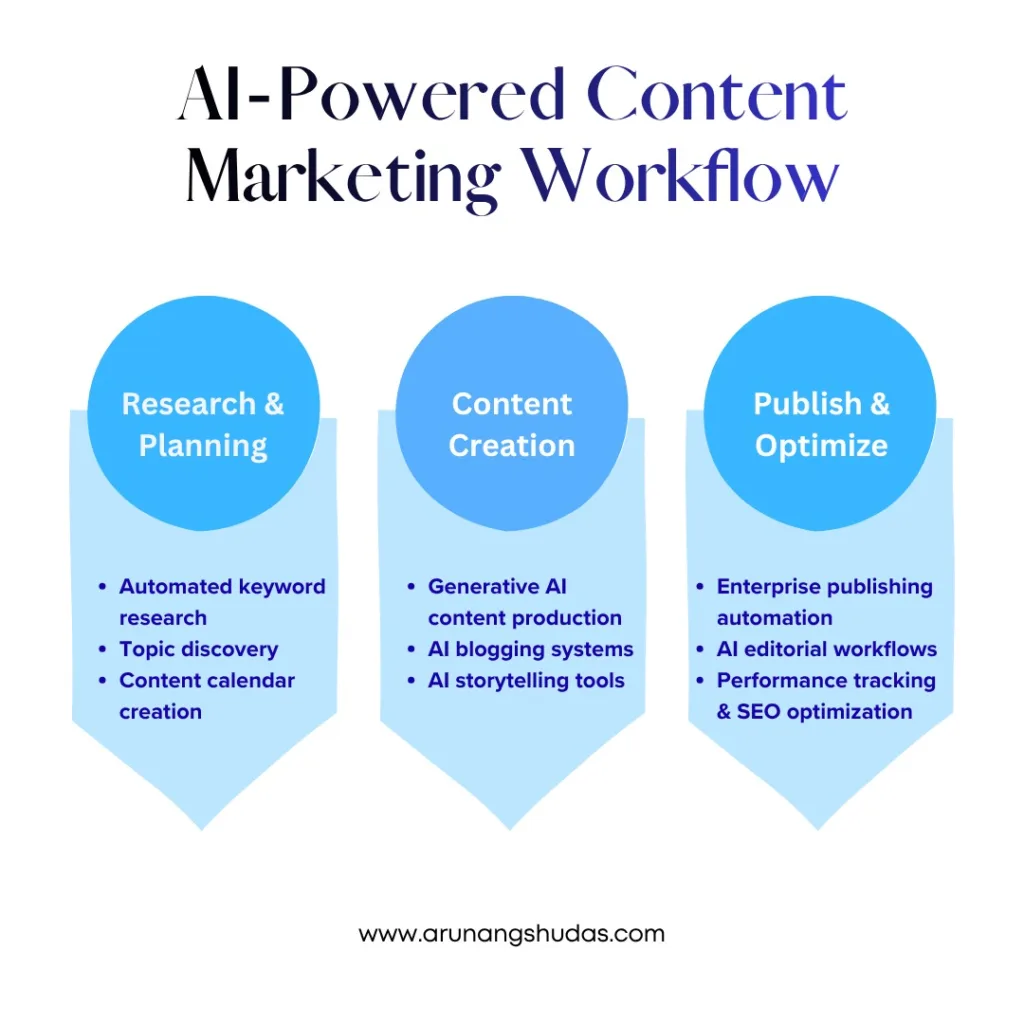
How AI Blogging Systems Transform Content Creation
Modern AI blogging systems can automate nearly every stage of blog production.
Step 1: Keyword Research
AI agents identify:
- Search intent
- Trending topics
- Keyword opportunities
- Competitor gaps
Step 2: Content Planning
The system automatically creates:
- Content calendars
- Topic clusters
- Internal linking strategies
- Editorial schedules
Step 3: Content Generation
Using generative AI content, AI agents can produce:
- Blog introductions
- Full-length articles
- Product content
- FAQs
- Meta descriptions
Step 4: SEO Optimization
AI agents optimize:
- Headers
- Keyword placement
- Readability
- Internal links
- Schema recommendations
This end-to-end process creates highly efficient AI editorial workflows.
Building an Internal AI Agent Stack
Many enterprises are developing an Internal AI Agent Stack to automate marketing operations.
An effective stack typically includes:
| AI Agent Type | Primary Function | Marketing Benefit |
| Research Agent | Topic and keyword discovery | Faster planning |
| Writing Agent | Content creation | Increased output |
| SEO Agent | Optimization recommendations | Better rankings |
| Publishing Agent | Content distribution | Faster deployment |
| Analytics Agent | Performance tracking | Continuous improvement |
The Internal AI Agent Stack allows organizations to scale content production without proportionally increasing team size.
How AI Agents Replace Workflows
One of the most significant developments in marketing technology is how AI Agents Replace Workflows that were previously manual.
Examples include:
Content Research Workflow
Previously:
- Researcher
- SEO specialist
- Content strategist
Now:
- AI research agents perform discovery and analysis automatically.
Publishing Workflow
Previously:
- Writer
- Editor
- Publisher
- Scheduler
Now:
- AI agents coordinate publishing and scheduling automatically.
The concept of AI Agents Replace Workflows is becoming increasingly important for enterprises seeking operational efficiency.
Inside an AI Agent: How It Works
Understanding Inside an AI Agent helps marketers appreciate the power of intelligent automation.
A typical AI agent consists of:
- Data Collection Layer
- Reasoning Engine
- Memory System
- Decision Framework
- Action Layer
Inside an AI Agent Architecture
| Component | Function |
| Memory | Stores previous interactions |
| Knowledge Base | Provides contextual information |
| Reasoning Engine | Makes decisions |
| Tool Integrations | Connects external platforms |
| Execution Layer | Performs actions automatically |
By understanding what happens Inside an AI Agent, organizations can better deploy and manage AI-driven systems.
AI Storytelling Tools for Better Engagement
Content success depends on compelling narratives. Modern AI storytelling tools help marketers create engaging content by:
- Identifying audience interests
- Structuring narratives
- Maintaining consistent tone
- Personalizing messaging
- Optimizing emotional appeal
These AI storytelling tools enhance brand communication while reducing content creation time.
Enterprise Publishing Automation at Scale
Large organizations often struggle with managing hundreds or thousands of content assets.
Enterprise publishing automation solves this challenge by:
- Managing approval workflows
- Scheduling content distribution
- Maintaining brand consistency
- Automating localization
- Tracking publishing status
Through enterprise publishing automation, global brands can efficiently manage high-volume content operations.
Marketing Content Automation Across Channels
Today’s consumers interact with brands across multiple touchpoints.
Marketing content automation enables businesses to:
- Publish blog content
- Schedule social media posts
- Generate email campaigns
- Update landing pages
- Repurpose existing content
The result is greater consistency and stronger audience engagement.
Creating Scalable Content Operations
As businesses grow, content demands increase exponentially. Building scalable content operations requires a combination of technology, strategy, and automation.
Best practices include:
- Centralized content management
- Automated workflows
- AI-powered analytics
- Cross-channel integration
- Continuous optimization
Organizations with mature scalable content operations can publish significantly more content without sacrificing quality.
Benefits of Scalable AI Content Operations
| Benefit | Impact |
| Faster Production | Increased content volume |
| Lower Costs | Reduced manual effort |
| Better Consistency | Stronger brand messaging |
| Improved SEO | Higher organic visibility |
| Data-Driven Decisions | Better campaign performance |
The Future of Content Production AI
The future of content production AI is moving toward fully autonomous marketing ecosystems. AI agents will increasingly handle:
- Strategy recommendations
- Audience segmentation
- Personalized content creation
- Predictive performance analysis
- Multi-channel campaign management
As AI technology evolves, businesses that adopt intelligent automation early will gain a significant competitive advantage.

Conclusion
AI agents are redefining modern content marketing by automating repetitive tasks and enabling faster, smarter decision-making. From AI blogging systems and AI editorial workflows to enterprise publishing automation and marketing content automation, organizations can now scale content production like never before. By implementing an Internal AI Agent Stack, understanding what happens Inside an AI Agent, and embracing how AI Agents Replace Workflows, businesses can build highly efficient, data-driven, and scalable content operations that support long-term growth.
FAQs
1. What is AI content marketing?
AI content marketing uses artificial intelligence technologies to automate content creation, optimization, distribution, and performance analysis.
2. How do AI blogging systems improve productivity?
AI blogging systems automate research, writing, SEO optimization, and publishing, reducing manual effort and increasing content output.
3. What are AI editorial workflows?
AI editorial workflows use intelligent agents to manage content planning, approvals, optimization, publishing, and analytics.
4. Can AI agents replace human content marketers?
AI agents can automate repetitive tasks, but human marketers remain essential for strategy, creativity, brand voice, and decision-making.
5. What is an Internal AI Agent Stack?
An Internal AI Agent Stack is a collection of specialized AI agents that collaborate to automate various marketing functions such as research, writing, SEO, publishing, and analytics.
