


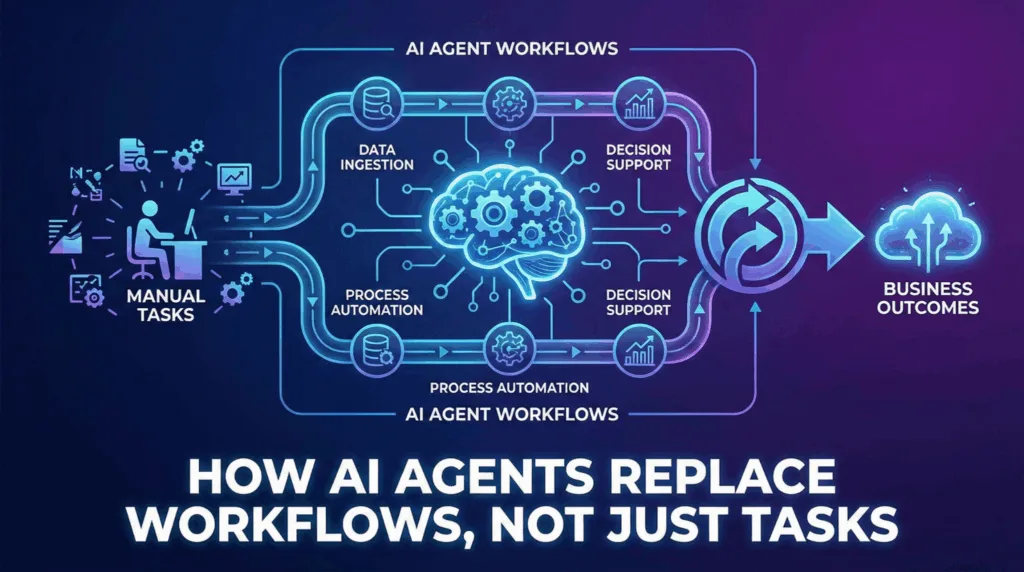
The thing with traditional automation was always the same: one thing, speedier, such as an email, a report, or document tag. It is useful, yet very limited. Businesses nowadays do not operate based on discrete tasks, but instead, they operate on multifaceted interconnected workflows which cut across several decisions, tools, and teams.
It is at this point that Artificial intelligence agents transform the game radically.
Rather than responding to an event or performing just a single task, AI agents are end-to-end systems and can execute workflows in entirety. They make use of reason, inner memory and environmental perception to complete processes as human beings do -only faster and without exhaustion.
Automation is not enough in businesses. They require work systems and not tasks. That is precisely why Artificial intelligence agents workflow automation is the next step of efficiency in the enterprise.
2. What “Replacing Workflows” Actually Means
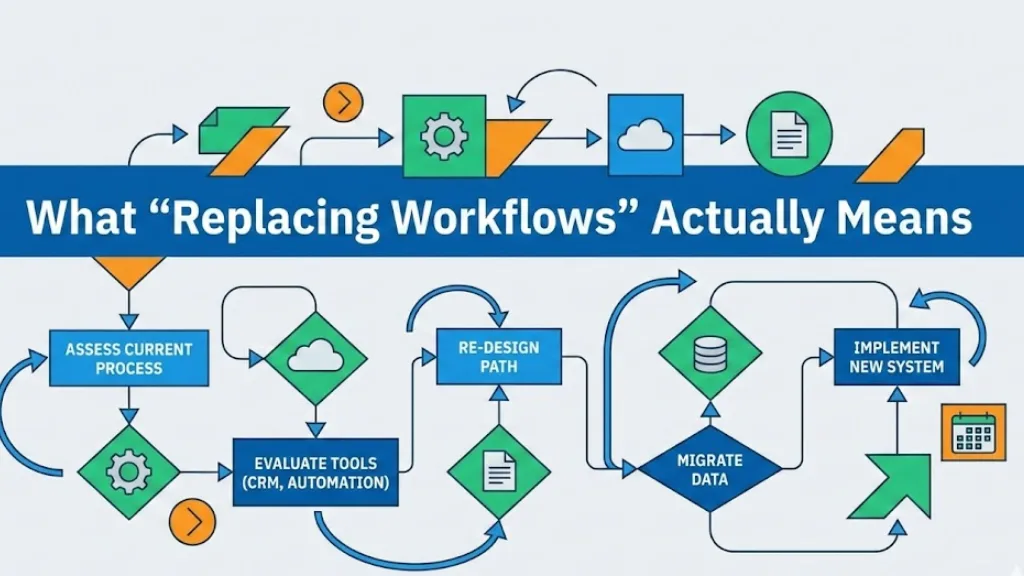
In order to see the shift, we will just break it down.
Task Automation
- One-off actions
- Trigger-based
- Rule-based
- No actual knowledge of context.
Example: Textual- Writing an email, creating a reply, labeling a photograph.
Workflow Automation
- Multifaceted, related procedures.
- Complex decisions
- Tool interactions
- Adaptive branching logic
Example: Lead qualification to outreach to tracking to CRM update to follow-ups.
Workflows are not sequences only – they entail:
- Decisions
- Dependencies
- Multiple tools
- Conditional steps
- Exceptions
- Context switching
This is the reason why conventional automation tools fail. They are also able to automate work but not end to end work flows.
Artificial intelligence agents resolve this disconnect by operating as problem-solvers on their own. Artificial intelligence agents are systems that in the industry:
- Understand goals
- Analyze conditions
- Take actions across tools
- Adjust steps dynamically
In simple words:
Tasks = actions
Workflows = outcomes
And agents are constructed to achieve results.
3. How AI Agents Work: The Core Building Blocks
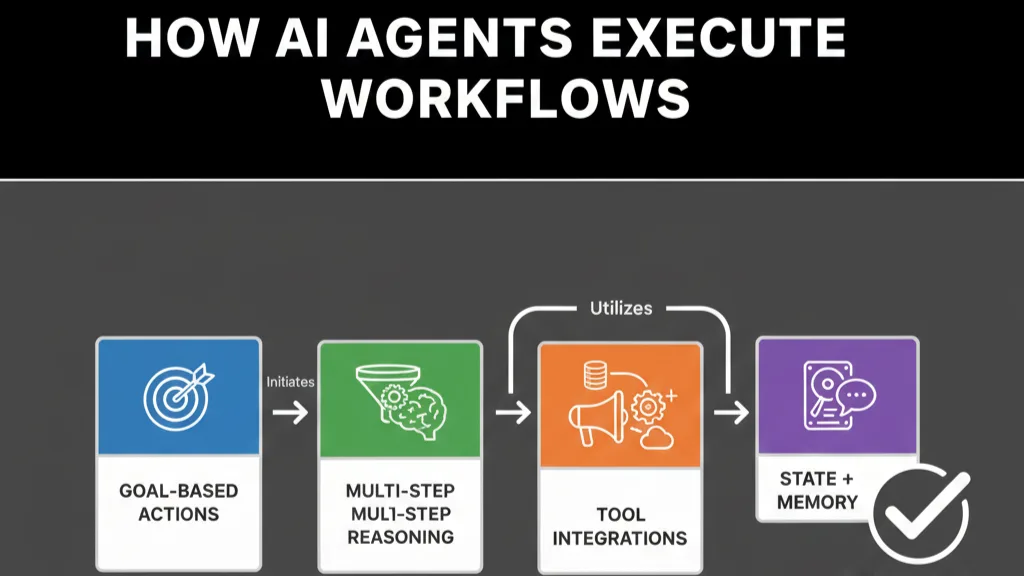
AI agents are not only chatbots. They are organized in such a way as to work in steps by providing them with architectural concepts.
1 Goal-Based Actions
Agents have goals unlike chatbots which answer questions.
Example: Qualify this lead and execute the entire outreach process.
The agent takes care of all that is needed to reach that goal not only a single action such as writing an email.
2 Multi-Step Reasoning
Agents construct a strategy, divide the activity, and smartly order activities.
They use:
- Business logic
- Decision-making
- Error recovery
- Planning and re-planning
This is a significant change of fixed automation scripts.
3 Tool Integrations
Directly operated agents:
- CRMs
- Email platforms
- Analytics dashboards
- Ticketing systems
- Spreadsheets
- APIs
That is how automation of the workflow with Artificial intelligence can be achieved – since the agent has the opportunity to manipulate tools, not only produce texts.
4 State + Memory
Agents:
- Do you remember what they were doing?
- Hold context across steps
- Resume work
- Learn preferences
This is what allows Artificial intelligence agents to automatize the whole workflows, but not just micro-actions.
Reference Architecture
Examples such as Vertex AI, Google Workspace AI and enterprise agent frameworks are agentic:
- Observation
- Planning
- Action
- Reflection
- Iteration
This system enables the agents to act as digital workers.
4. Why Agents Excel at Full Workflow Automation
Agents are better than traditional automation due to four reasons.
1 They Understand Dependencies
Agents perceive the way in which a step is affected by another.
Example: Escalate at once in case of a premium customer.
2 They React to Conditions Automatically
Agents adapt decisions based on variable variations unlike fixed automations:
- Customer type
- Stock levels
- Lead score
- Ticket priority
3 They Update Business Systems in Real Time
Reminders are maintained by agents:
- CRM
- Project management
- BI dashboards
4 They Learn Over Time
Agents refine:
- Preferences
- Messaging tone
- Decision patterns
- Workflow shortcuts
The more they are used the better they become.
5. Real Examples: Tasks vs Workflows
The following is a clear table of the difference:
| Task (One Action) | Workflow (End-to-End Process) |
| Write a product description | Keywords researching → outline/plan/map → drafting/writing of the paper, internal links, uploading the CMS |
| Reply to a support email | Sort ticket – get history – customize – update system – escalate |
| Write ad copy | Analyze audience→ review outcomes > generate creatives>publish > monitor |
Now we shall take three examples apart.
Example 1: Content Workflow
Task: Write a blog intro.
Workflow:
- Perform keyword research
- Generate an outline
- Write the full article
- Optimise for SEO
- Add internal links
- Format for CMS
- Publish
It is an entire workflow – and the agents will be able to perform all the steps, and not only the writing.
Example 2: Customer Support Workflow
Task: Reply to one ticket.
Workflow:
- Classify ticket
- Check customer history
- Write customized responses.
- Apply appropriate rules
- Prioritize
- Update CRM
- Escalate if required
This is not possible with traditional chatbots but possible with agents.
Example 3: Advertising Workflow
Task: Create an ad.
Workflow:
- Analyze past performance
- Identify audience segments
- Formulate innovative alternatives.
- Publish ads
- Track performance
- Optimize budget
- Adjust campaigns
This is full-funnel ad implementation, which can be performed only by agents.
6. Business Areas Where Agents Replace Workflows Today
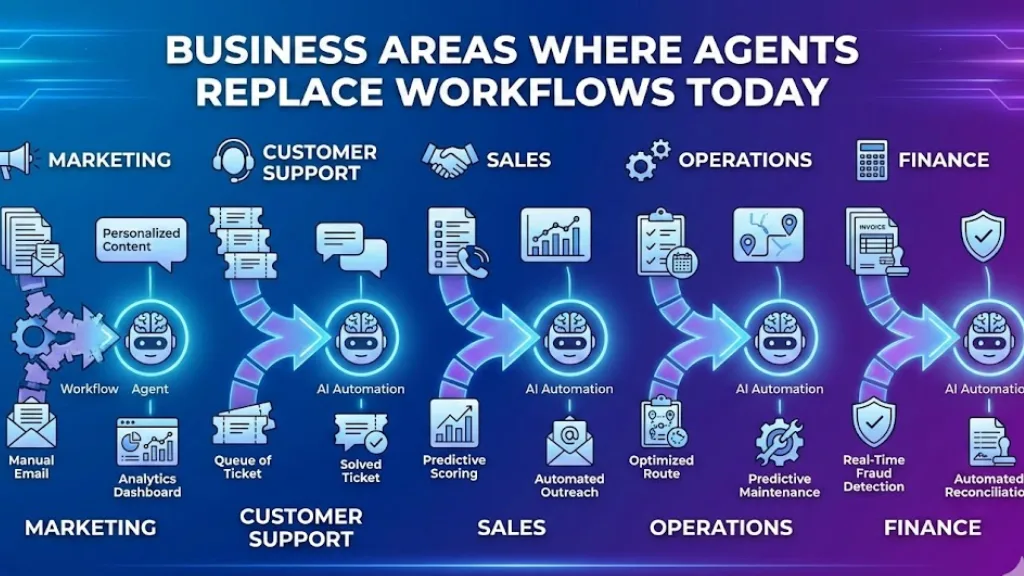
The end-to-end workflows in industries are already being eliminated by AI agents.
Marketing
- Campaign planning
- Content creation
- Publishing
- Performance optimization
Customer Support
- Ticket triage
- Personalized resolution
- Escalations
- Customer record updates
Sales & CRM
- Lead scoring
- Outreach sequencing
- Pipeline updates
- Meeting reminders
Operations
- Inventory management
- Vendor follow-ups
- Shipment tracking
- Reorder alerts
Finance
- Invoice parsing
- Categorization
- Matching
- Error escalation
Google Workspace Artificial intelligence and agent large platforms are enterprise tools that show practical application at a large scale.
7. Why This Matters: Operational Impact
Substitution of workflows rather than work replaces the way companies operate.
1 Faster Execution
Processes, which used to take days, are now done in hours.
2 Reduced Manual Dependencies
Waiting approvals and handoffs are long gone.
3 Fewer Errors
There is always a logic to agents.
4 Consistent Output Quality
All the emails, reports and updates are of the same standard.
5 Teams Move from Doing → Supervising
- Man checks strategy, the agent has to take action.
- This enhances performance in entire departments.
8. Limitations and Responsible Use
Agents are effective, yet they need intelligent implementation.
Clear Policies and Guardrails
Define rules:
- What agents can do
- What they cannot do
Data Structure Matters
Agents rely on clean:
- Databases
- CRMs
- Documentation
Monitoring Is Essential
Agents need periodic:
- Validation
- Error checking
- Exception handling
Aligned With Industry Safety Standards
Enterprise AI standards include:
- Transparency
- Human override
- Audit logs
- Controlled automations
These guarantee the safe use on scale.
9. Future Outlook: The “Workflow as a Service” Era
In the future, we are moving towards a time when:
- Organisations send representatives that are trained on their operations.
- The agents are acting as digital colleagues.
- Whole departments are run by multi-agent teams.
Imagine:
- One agent does research
- Another writes
- Another publishes
- Another analyzes
This is the following development of agentic AI examples, demonstrating how the agents will displace entire business processes.
10. Conclusion
AI agents evolve a radical departure between task automation and workflow automation using AI. These are not mechanisms that perform one task at a time, they control, carry out and maximize whole processes in marketing, sales, operations, support and finance.
Having the capacity to think, retain and adapt, as well as act using tools, they provide precisely what contemporary companies require; scalable, autonomous workflows.
Any organization that commences the adoption of agents today shall have a competitive drive tomorrow.
Frequently Asked Questions
1. What makes AI agents different from chatbots?
AI Agents vs Chatbots Chatbots will respond to messages; agents will do several steps of work between tools.
2. Can AI agents work without human supervision?
Workflows can be carried out autonomously by an agent and safely and correctly by oversight.
3. Do AI agents replace employees?
They substitute the tedious workflows which enable the employees to concentrate on strategic work.
4. Are AI agents safe to use for business data?
Yes, under good governance, role permissions and audit logs.
5. What workflows are easiest to automate first?
Basic, manual, well-documented procedures – such as lead qualification or ticket routing.
