


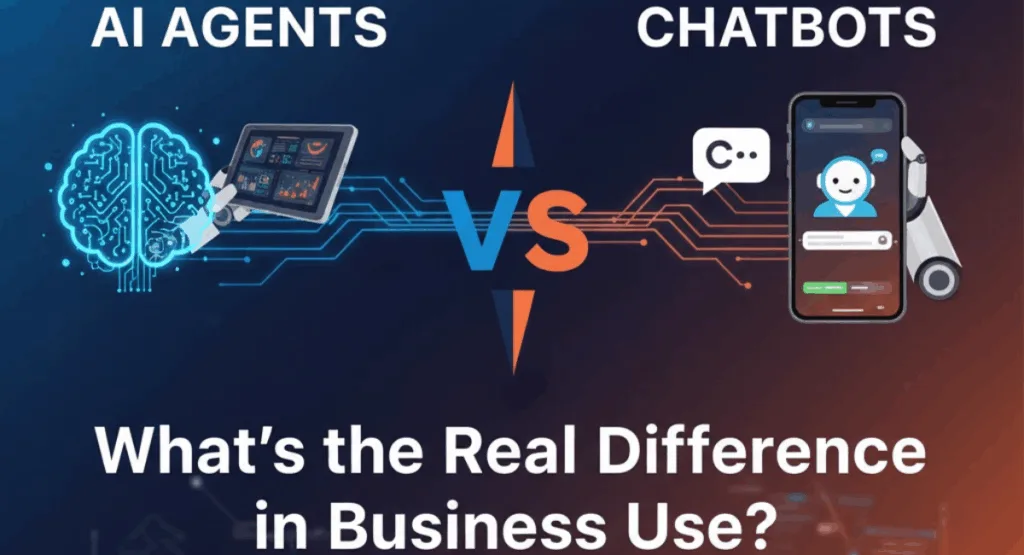
Introduction: Why This Comparison Matters Now
The discussion between AI agents and chatbots has gone off the scale, with businesses scrambling to modernize customer service, automate their workflows and expand operations with the help of artificial intelligence. However, as conversational Artificial intelligence develops incredibly fast, it has become a common pitfall among businesses to mix up the two technologies, and the misunderstanding of them results in poor investments in technologies, automation efforts that fail to achieve success, and a customer who is disappointed and unsatisfied.
It’s not your fault. The shift in the industry has been rapid.
Chatbots began as primitive rule-based responders, which provide a set of pre-programmed responses to each keyword. However, with the development of huge language models (LLMs), reasoning systems, and multi-step automation systems, a new type has been created: Artificial intelligence agents, independent digital employees that can plan, perform, and work autonomously without relying on people to lead them in each step.
The article demystifies the distinction between ai agent and chatbot, demonstrates practical functionality, identifies the utility of Artificial intelligence agent versus chatbot in business, and demonstrates when it would be better to use an Artificial intelligence agent rather than a chatbot. Towards the end you will have a road map to make smart and future proof automation decisions.
Let’s dive in.
Understanding the Basics
What Is a Chatbot?
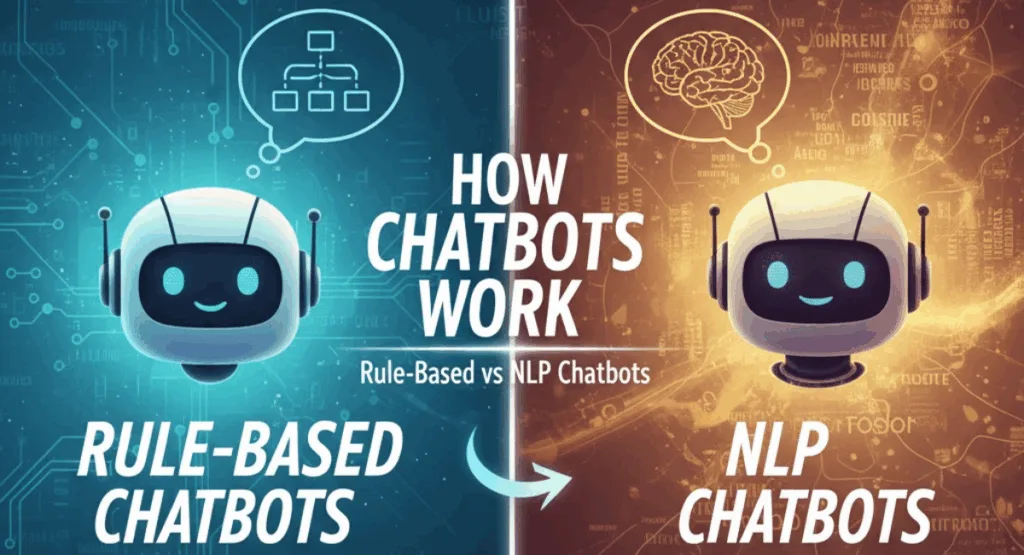
A chatbot refers to a conversation program that implies the simulation of the dialogue with a user. Chatbots are divided into two big categories depending on the technology used:
1. Rule-Based Chatbots
These are in responses to certain stimuli:
- Keywords
- Button selections
- Predefined questions
- Fixed conversation flows
They do not comprehend subtlety, do not adjust to different situations or learn with time. Consider them automated FAQ engines.
2. NLP-Driven Chatbots
These make use of natural language processing to:
- Recognize user intent
- Extract entities
- Provides answers in accordance with pre-established logic.
They are more flexible compared to bots that operate by rules, but limited in understanding. They do not think, they are patterners.
Chatbot Use Cases
Chatbots perform well in straightforward and repetitive interactions including:
- FAQ responses
- Hours in stores or product enquiries.
- Order-tracking updates
- Lead capture forms
- The preliminary discovery questions.
- Basic support responses
Concisely, chatbots are responsive in nature. They react, yet they do not take action.
What Is an AI Agent?
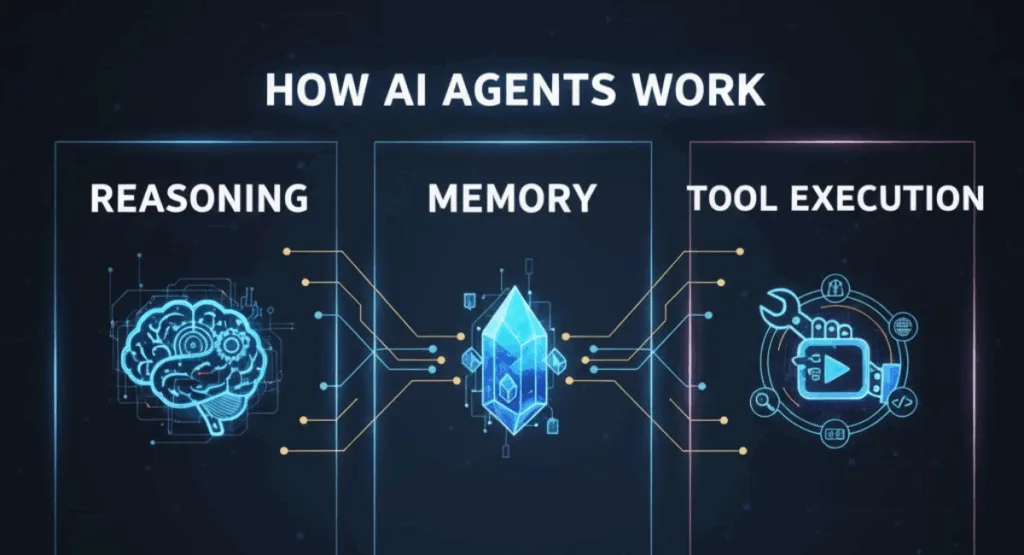
The Artificial intelligence agents are a different breed of technology, designed to go far beyond simple response-based chat tools. If you’re wondering what AI agents are, they are autonomous digital systems capable of reasoning, planning, and executing multi-step tasks without constant human direction. Think of them as intelligent digital teammates that can understand goals, make decisions, access tools, and complete real business workflows from start to finish.
An Artificial intelligence agent is an autonomous system that is able to:
- Understanding goals
- Dividing tasks into small steps.
- Reasoning and planning
- Working with a variety of tools or databases.
- Based on previous experiences.
- Implementing processes across their entirety.
AI agents use:
- LLMs
- Multi-step reasoning systems.
- Memory systems
- Integration of the tools (APIs, CRMs, databases)
- Independence and decision-making machineries.
Read More: What Is an AI Agent? The Core Concept Behind Modern Automation
Real Business Examples of Artificial intelligence Agents
Artificial intelligence agents are able to do digital work, such as:
- Automating sales follow-ups
- Updating CRM entries
- Managing the HR onboarding processes.
- Developing support tickets, problem analysis and problem solving.
- Insurance claims processing.
- Conducting financial reconciliation.
- Drawing reports, analyzing data.
Artificial intelligence agents do not simply talk but work unlike chatbots.
Core Technical Differences: Chatbots vs AI Agents
The differences between chatbots and AI agents are considered in detail, so we should divide them into pieces.
1. Autonomy
| Chatbots | AI Agents |
| Reactive responders | Proactive problem-solvers |
| Limited to replies | Execute multi-step actions |
| Unable to work on his own | Work with low human supervision |
Chatbots respond; Artificial intelligence agents get things done.
2. Context Handling
- Chatbots are based on the context of a session. As soon as the session is over, they forget.
- The Artificial intelligence agents have long term memory where they follow users, tasks, preferences and previous interactions.
This is the difference that will change the business experience.
3. Reasoning & Planning
Chatbots follow scripts.
Artificial intelligence agents think, strategise and change.
Agents can:
- Diagnose issues
- Choose the optimal next step
- Create multi-stage plans
- Decision making using real-time information.
4. Task Execution
This is the area that Artificial intelligence agents vastly outdo chatbots.
Chatbots
- Provide one step answers.
- Cannot perform real actions
Artificial intelligence Agents
- Execute workflows end-to-end
- Take advantage of CRM, ERP, email, databases.
- Trigger automations
- Perform dynamic tasks
They work as online workers.
5. Integration Capabilities
Chatbots mostly connect to:
- CMS
- Basic AI reply engines
- Simple scripts
Artificial intelligence agents integrate with:
- CRMs
- ERPs
- APIs
- Payment gateways
- Email services
- Databases
- Third-party tools
They do not answer questions; they create whole eco-systems.
6. Learning Ability
Chatbots are static.
Artificial intelligence agents train and learn with:
- Reinforcement
- Memory
- Real-world data feedback
- Updating reasoning in a continuous manner.
Side-by-Side Comparison Table
| Feature | Chatbots | AI Agents |
| Goal | Provide answers | Complete tasks |
| Technology | Rules, intents, basic NLP | LLMs, strategizing, tool integration |
| Memory | Short-term | Long-term contextual |
| Autonomy | Reactive | Proactive |
| Workflow Complexity | Simple & linear | Complex & dynamic |
| Integration Depth | Limited | Deep system-level access |
| Best For | FAQs, simple interactions | End-to-end business processes |
This table is a clear indication of the distinction between an agent and a chatbot.
Business Use Cases That Show the Difference
The best approach to the business use of an Artificial intelligence agent vs chatbot is by example.
Chatbot Use Cases
Chatbots are perfect in cases of simplicity.
1. FAQ Responses
Perfect for answering:
- Return policy
- Shipping details
- Business hours
2. Information Queries
Product or store information, short, snappy customer communications.
3. Simple Lead Collection
Like capturing:
- Name
- Interest
4. Basic Order Tracking
Status of orders can be retrieved by chatbots through an integrated API.
Artificial intelligence Agent Use Cases
The Artificial intelligence agents promote automation in the business.
1. Sales Automation
Agents can:
- Update CRM
- Assign leads
- Send follow-ups
- Build reports
- Score leads
2. IT & HR Helpdesk Automation
Diagnosis of problems to create the tickets to solving them.
3. Claims & Case Processing
Agents can:
- Verify documents
- Cross-check databases
- Flag anomalies
- Generate resolutions
4. Finance Automation
Tasks like:
- Reconciling transactions
- Detecting anomalies
- Generating expense reports
5. Operations & Supply Chain
Artificial intelligence agents can coordinate:
- Vendor communication
- Inventory updates
- Shipment tracking
- Demand forecasting
Chatbots answer questions.
The workflows are done by AI agents.
Impact on Productivity and Cost
The technology distinction is not the only difference between chatbots and agents; it impacts the bottom line.
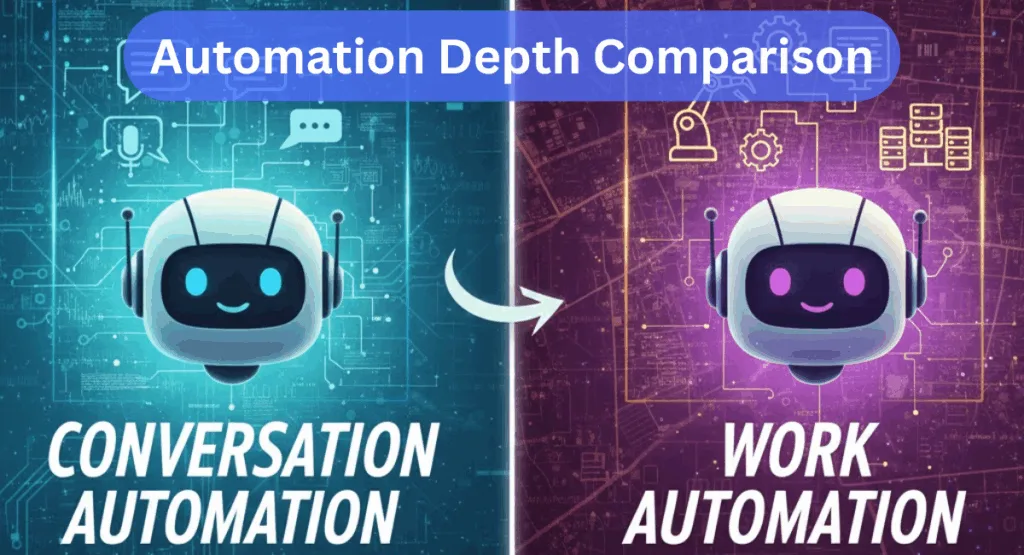
1. Automation Depth
- Chatbots are robots that automate the conversation.
- AI agents automate work.
2. Task Completion Speed
Agents radically decrease the amount of human intervention, which makes them 5-10x faster.
3. Reduction in Human Workload
The agents remove the routine work that typically cost the employees hours.
4. Accuracy & Consistency
There are no repetitive errors, and agents work efficiently.
5. Operational Cost Reduction
With automated skilled digital work, agents provide:
- Higher ROI
- Lower overhead
- Faster turnaround
6. Scalability
- Chatbots scale conversations between users.
- The AI agents automate business processes.
When to Choose a Chatbot vs an AI Agent
This is where the majority of firms fail, hence the obvious rulebook.
Choose a Chatbot When:
- Tasks are predictable
- Conversations are simple
- All you need are FAQ interactions.
- Budget is limited
- You would like a solution that is fast to deploy.
Chatbots are cheap and efficient – however, restricted.
Choose an AI Agent When:
- Multi-step automation of workflows is needed.
- You require system integrations (CRM, ERP, email, APIs).
- You require rational or situational choices.
- This is aimed at workforce augmentation.
- It entails dynamic rules or judgment on the part of humans.
Complex, enterprise-grade automation should be handled by Artificial intelligence agents.
Hybrid Approach: The Best of Both Worlds
Many companies use:
- Chatbots as the front-end
- AI agents as the back-end labor force.
Example: A chatbot gathers customer information -transfers it to an Artificial intelligence agent finishes the assignment and provides a response.
This is the hybrid model that will reign in the future.
Challenges and Considerations
Businesses should take into consideration before investing in AI agents:
1. Integration Complexity
Agents need access to deep systems and API connectivity.
2. Data Security
The management of customer or business data requires a strict adherence.
3. Model Training & Accuracy
Agents have to be in line with internal processes, workflows, and rules.
4. Budget
Agents are more expensive to start with and offer more long-term ROI.
5. Team Readiness
Businesses require groups with the knowledge that:
- Data
- Artificial intelligence deployment
- Integration workflows
Future Trends: Are AI Agents Replacing Chatbots?
The brief response: No–but they are changing automation.
Emerging Trends
- Surgence of agentic work in companies.
- LLMs with more powerful reasoning.
- Replacement of the repetitive digital work by agents.
- The chatbots are being used as interface layers.
- Hybrid agent + chatbots ecosystems.
Chatbots are never going to vanish, and they will no longer be the brains of business automation. Agents will.
Conclusion
It all depends on one thing the actual distinction between the Artificial intelligence agents and chatbots:
Chatbots are robots that automate the conversation. AI agents automate work.
Agents are not enhanced chatbots, they are digital workers, able to be autonomous, reason, plan, and perform multi-step functions. With the increased automation of businesses, it is important to know the time to apply for AI agents rather than chatbots. The future is with those companies that both integrate the two in a strategic manner and develop agentic enterprises which can easily scale.
FAQs
1. What is the main difference between an AI agent and a chatbot?
A chatbot responds to questions; an agent of Artificial intelligence performs tasks and workflows, based on reasoning and tools.
2. Are AI agents more expensive than chatbots?
Initial installation is more expensive, yet agents will provide much more ROI with the automation depth.
3. Can chatbots use long-term memory?
No, Multi-session memory with accurate context storage is only preserved in Artificial intelligence agents.
4. Do AI agents replace employees?
Not fully, they do repetitive computer labor allowing human beings to engage in strategic tasks.
5. Should every business upgrade to Artificial intelligence agents?
Not necessarily, A chatbot suffices in case you have simple needs (FAQs, lead capture). In complicated processes, agents are necessary.
