


Because IT organisations now use so many different platforms, managing the employee lifecycle from hiring to offboarding has never been more complicated. IT and HR professionals have to manage numerous platforms, manual processes, emails, and regulatory requirements. Creating a seamless employee experience presents extra challenges for HR professionals. Gaps, delays, and inefficiencies that affect security and productivity are the outcome.
According to one study, 67% of workers’ job satisfaction is greatly impacted by technology barriers, including system integration issues.
This blog examines the top five employee lifecycle management issues and how businesses can close those gaps to create a cohesive, legal, and effective workforce ecosystem with the aid of solutions like RoboMQ’s Hire2Retire.
1. Disparate Systems and Information Gaps
The Challenge:
Employee data resides in various locations across most organizations – employee records in HRIS, access in Active Directory or Entra ID, payroll software, and collaboration tools such as Google Workspace or Microsoft 365. Because they are not consolidated under one system, keeping everything harmonious is an ongoing struggle. One system being updated does not always translate to another system, leading to disparate information, compliance issues, and redundant manual updates.
Things become uneven when systems aren’t communicating with one another. A misspelling in one location or an update that is left out in another might cause duplicate records, mislead reporting, and even have an impact on crucial business decisions. These discrepancies eventually make it harder to trust your data and obtain a comprehensive picture of what’s going on in your company.
The Solution:
The most effective path is to implement a platform that integrates all these systems together so that they can automatically exchange information. Find a platform that closes the gap between HR and IT software, aligning HRIS systems like Workday, SAP SuccessFactors, or BambooHR with identity systems. When a new hire arrives or a record in an existing employee is updated, it is instantly replicated wherever it needs to be. No more manual data entry, no more redundant records, just one consistent source of truth that everyone can rely on.
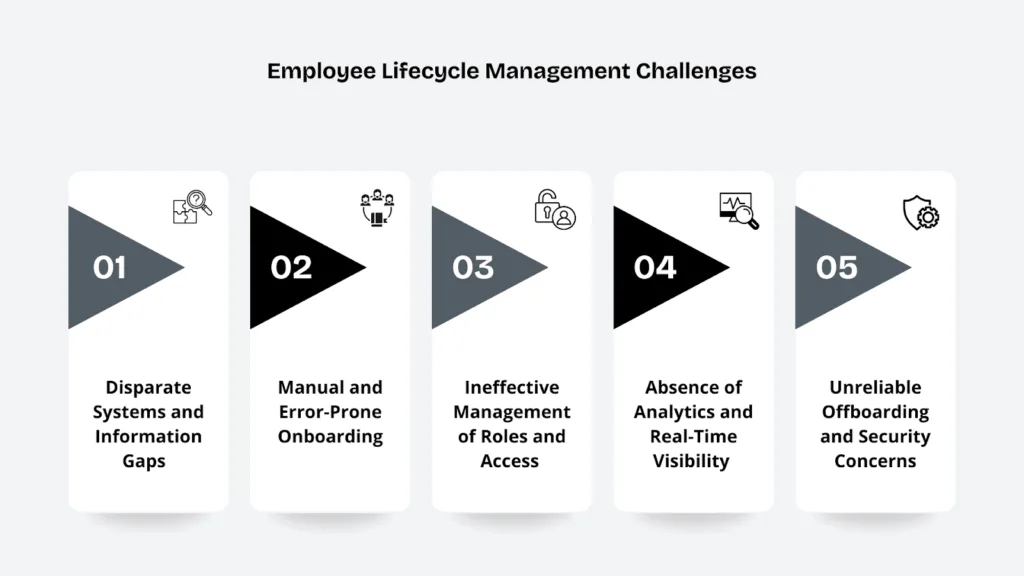
2. Manual and Error-Prone Onboarding
The Challenge:
Manual onboarding slows down the processes. HR must send spreadsheets to IT, IT must create accounts in multiple systems, and new hires often wait days for access. Delays and errors here directly impact first-day productivity and engagement.
The Solution:
A platform with which onboarding becomes automated and event-driven. When the candidate’s status changes to “hired” in the HRIS, the system automatically provisions user accounts, assigns groups, and sends credentials, ensuring new employees hit the ground running from day one. The candidate doesn’t have to juggle between teams and processes to get access. This improves employee satisfaction, lowers errors, and requires less manual IT work.
3. Ineffective Management of Roles and Access
The Challenge:
Employees’ access permissions should promptly be altered when they switch teams, get promoted, or take on new tasks. However, access permissions are delayed and frequently prone to errors when done manually. The candidate may be granted access to more information than is necessary, which could compromise security, or they may be denied access, which would again lead to a lack of productivity.
The Solution:
Consider an HR system that uses role-based access control (RBAC), in which permissions are dynamically and automatically modified anytime a role is changed. Adding someone to a new departmental group or eliminating outdated rights are two examples of actions that are automatically carried out to keep data safe and permissions in line with current roles.
4. Absence of Analytics and Real-Time Visibility
The Challenge:
The HR and IT teams must have a shared understanding of every employee lifecycle activity in order to properly grant access to the candidates. Without central visibility, HR and IT find it difficult to determine whether access changes have been made appropriately or where employees are in the lifecycle. Issues with auditing and compliance may arise from this. This lack of comprehension may result in audit and compliance concerns. Hiring and promotion decisions might be affected when inconsistent or improperly acquired data is applied. Furthermore, improper handling of employee data may result in security and compliance issues.
The Solution:
Choose a platform that provides audit trails and real-time visibility for all integrations and lifecycle events. To expedite compliance reporting and make more informed decisions, the teams can effortlessly monitor account provisioning, role adjustments, and deprovisioning all from a single dashboard.
5. Unreliable Offboarding and Security Concerns
The Challenge:
The Challenge: Offboarding is one of the most important but often ignored phases of the employment lifecycle. Sensitive information is exposed, and possible security risks arise when access is not immediately terminated upon exit.
The Solution:
As soon as an employee’s termination is entered into the HR system, the program ought to immediately start automating deprovisioning. All linked systems immediately stop user accounts, app access, and credentials, guaranteeing total compliance, getting rid of orphaned accounts, and protecting corporate information.
Managing the employment lifecycle by hand is no longer sufficient for larger businesses. HR and IT teams need a solid and trustworthy platform to eliminate their manual overhead. Solutions like Hire2Retire enable businesses to operate more efficiently, maintain compliance, and provide a smooth employee experience by automating every phase of the employee journey, from onboarding to offboarding. Leaders perceive value in the business processes, people start working right away, and HR and IT departments are free from manual processes.
