


I. Introduction: Defining the AI Agent
Artificial Intelligence (AI) has long since outgrown the scaled-down forms of chatbots and rule-based automation, and it is now in a paradigm shift of AI – intelligent autonomous systems with ability to understand complex tasks, thinking in a series of steps and make important decisions with minimum human involvement. When individuals inquire as to what an AI agent is, the response these days is much more than mere automation.
These advanced machines are not just reactive online partners, but proactive ones, which are capable of adapting, learning and evolving as time goes by. The combination of reasoning, planning, and execution has been rationally harmonized, and AI are the fundamental part of modern automation, which has changed the world of finance, healthcare, education, and technology. They re-establish the concept of human-machine cooperation demonstrating what AI agents are in contemporary automation.
A. What Is an AI Agent?
An AI agent is an autonomous and intelligent system that is intended to perform tasks, make decisions, and generally communicate with both digital and real-world environments with the help of artificial intelligence. This is the basis when we discuss what are agents in ai; the systems that can act independently. Unlike in the past with the traditional automation systems, whose main approach is to follow instructions or set rules of behavior, AI can reason, plan, process, and modify their behavior based on feedback and results.
They can also use tools, interpret complex situations and learn in the moment. This provides them with the flexibility of dealing with real-life situations that are dynamic and demand continuous upgrades as time progresses thus having a clear understanding of what are agents in artificial intelligence in the real world context. Finally, AI assist in the creation of a medium between autonomy of machines and human intelligence.
To put it simply:
An AI agent refers to an autonomous system capable of reasoning, using tools, and learning continuously to design and implement work processes in order to accomplish certain objectives.
Scope of AI Agents
AI are far superior to chatbots on NLP. Their scope includes:
- Contextual reasoning as regards to decision-making.
- Overall, the analysis of complex and multi-step problems which are not stated.
- Associating with APIs, external applications and other AI systems.
- Automating IT up to the code generation on a company scale.
With this wide functional scope, it can be used to respond to questions such as what of the AI, as well as what are the AI agents in real-life terms.
Purpose of AI Agents
The autonomous processing of repetitive, intricate and data-sensitive tasks, which would otherwise consume a huge amount of time and energy, is the very reality of the AI. These intelligent systems are taking over such operations and this is the reason why it is assisting the professionals to focus more on the strategy of making decisions, creative innovation and problem solving.
AI agents are emerging as the pillars of digital transformation in industries by improving processes in the fields of software design, data analytics, workflow optimization, and customer engagement. This is because being in a constant state of learning and being flexible makes them more productive, less prone to errors, and results in quicker smarter output and this shows that the are practical as per the ai case.
B. Agentic vs. Nongenetic AI Chatbots
That intelligent have been created off the foundation of the conventional chatbots is a profound shift in the AI functionality.
| Aspect | Agentic AI Systems | Nongenetic AI Systems |
| Core Ability | Reasoning, planning, tool use | Static response generation |
| Goal Orientation | Multi-step, long-term goals | Single query goals |
| Learning | Learn through feedback and memory. | Fixed to training data |
| Autonomy | High — acts independently | Low — user-dependent |
| Example | Workflow planning, booking, and management AI. | Chatbot answering FAQs |
Complete goal-oriented tasks can be achieved through agentic systems as he/she can access data, use tools, and apply reasoning using memory. Conventional nongenetic schemes, though, are only capable of giving pre-trained responses and not to learn or adapt, which is the functional distinction when speaking of what are agents in artificial intelligence.
II. The Agentic Framework: How AI Agents Work
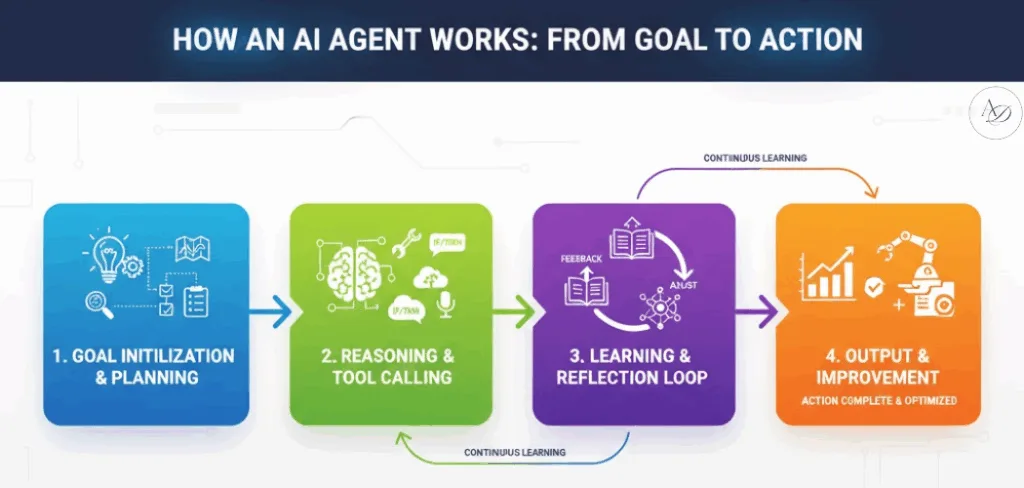
An intelligent agentic framework unites reasoning, memory, planning and tools together in a seamless, smooth flow to facilitate the intelligent task execution in the AI. The structure of such an organized system of AI is useful to them in splitting complex goals into simple ones, to evaluate many approaches, and to select the best mode of accomplishing them. Autonomous robots can make real-time adjustments to the results or the information that occurs through the contextual knowledge, and active learning. This multi-layered design is not only making them more skilled in decision-making but also allows them to carry out multi-step workflows in a specific, stable and efficient way in a broad range of digital and real-life settings.
A. The Role of the Large Language Model (LLM)
The simplest component of most AI-based is the Large Language Model (LLM) – a clever brain that does not only comprehend the context, but also thinks on information and writes sensible and human-like responses. These models enable AI agents to understand complex commands, have natural conversations and make rational decisions based on the situation. Advanced models such as GPT, Claude, Gemini, and Mistral are the core of the existing agentic AI frameworks and have been applied to run diverse applications within industries. These LLMs can provide cognitive depth by processing large amounts of language data to allow AI agents to accomplish tasks requiring understanding, creativity, and flexibility with unmatched speed and accuracy.
LLMs as the Core
LLMs empower agents to:
- Decipher complicated human directions and contextual delicacies.
- Produce organized products (code, text, plans).
- Design logical processes of executing tasks.
They are therefore commonly known as LLM-powered.
Limitations of Traditional LLMs
Although they have the ability, regular LLMs are fixed:
- They are unable to retrieve real time information or communicate with APIs.
- They do not have a long memory of the conversation at hand.
- They are confined by training information and real-time flexibility is restricted.
The identical competencies are transferred to AI model systems that augment the functions of the conventional models by using external tools, databases, and memory modules and emerge as intelligent executors rather than mere text predictors.
B. The Power of Tool Calling
The aspect enabling intelligent to outgrow predetermined answers is referred to as tool calling, and it enables intelligent agents to be dynamic. It allows them to interact and access external systems, applications, and sources of data in real-time, which the AI agent framework makes all too useful compared to what core models provide. Using tool calling, agents can execute functions such as accessing live information, data analysis, code execution or even software system management.
This instant integration makes them have a functionality of addressing advanced problems, robotizing operations and responding to dynamic environments. Tool calling, in a way, transforms into smart action-oriented systems capable of influencing the real world.
Examples of Tool Usage
- Web Search APIs: Find existing market trends or news.
- CRM Systems: Automatically update the client information or acquire reports.
- Calendars and Schedulers: Plan activities or meetings.
- Third-party Agents: Cooperation with special AI systems.
Tool calling is useful to convert an AI agent into a digital worker that is able to do and integrate results of commands, and refine its reasoning cycle.
Adaptation and Learning
By means of memory and feedback AI agents develop continuously:
- They retain past behavior and preference of the user.
- They examine the results in order to draw effective strategies.
- They enhance the workflows to become efficient.
This flexibility emulates the human experience of learning and this process offers the AI cumulative intelligence with time – solidifying the agentic framework and allowing long-lasting performance enhancement.
III. The Three Core Stages of Agentic Operation
The systematic decision-making process and action performance are the two aspects that guide the artificial intelligence agents, which are commonly known as the three core stages of agentic operation. This hierarchical cycle is the core of the operations model, which includes planning, reasoning, and learning all of which lead to the efficient automation. The stages of agentic operations also make sure that the agent is able to continually upgrade and change as time goes on.
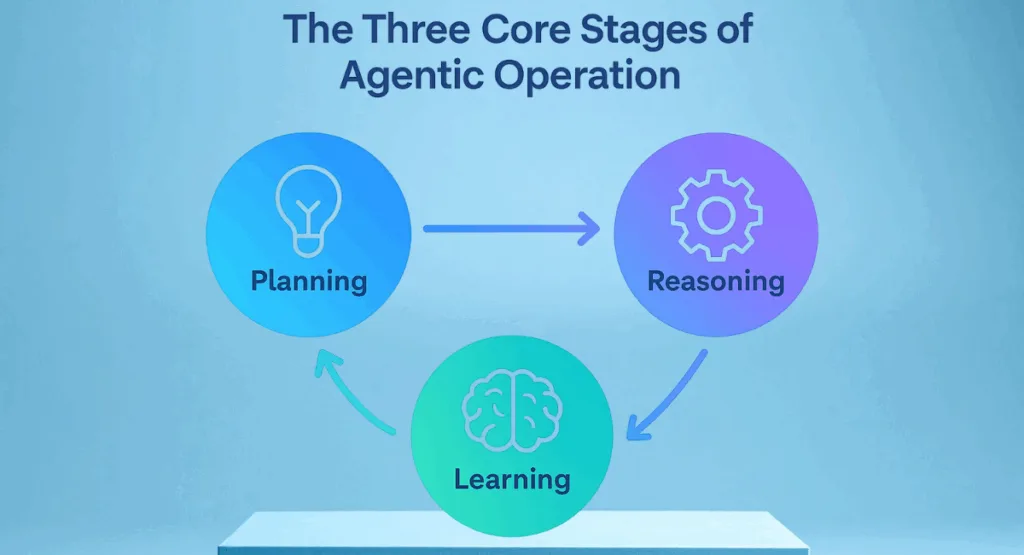
A. Goal Initialization and Planning
It starts by a human specifying an objective (e.g., automating the optimization of SEO content). The agent further subdivides this into subgoals that can be achieved, which is consistent with the first stage of the agentic system workflow three stages.
Task Decomposition
This involves:
- Determining fundamental goals.
- Mapping the tasks to the tools.
- Development of a hierarchic plan of subtasks.
For example:
Objective: Establish a marketing campaign.
Subtasks: Research Design Test Analyze results.
Agents may not have to plan everything out in smaller tasks; they can rely on iterative reflection and adapt their behavior after taking a step, which demonstrates that the first of the stages of agentic operation is flexible and adaptive.
B. Reasoning with Available Tools
The justification links the inner knowledge of the agent and the outer source of data, which is the second phase in the three core stages of agentic operation.
Agentic Reasoning Loop
- Evaluate progress and determine the gaps in data.
- Use the right instruments to fill those gaps.
- Generalize new knowledge on the plan.
- Make corrections on oneself.
Example: When organizing a surfing vacation, a classical system would simply list surf spots. However, an agentic AI uses real-time data—weather, airfare, equipment availability—to make optimal decisions. This capability highlights the strength of the operations framework in practical tasks.
Information Synthesis
AI agents by integrating various data streams can:
- Develop multi-layered insights.
- Produce cross-validated results.
- Enhance the accuracy of decisions.
C. Learning and Reflection (Iterative Refinement)
After each cycle, they gets to become an improved learner as a result of built-in feedback loops. This is the last step of the agentic system workflow, three stages that complete the cycle of continuous improvement of the agentic operation cycles.
Feedback Mechanisms
- AI-to-AI feedback Multi agent systems have peer evaluation.
- Human-in-the-loop (HITL): Experts are introduced to help in the improvement.
- Feedback on data: Metrics on system performance correct behavior.
Storing Knowledge
AI agents acquire a knowledge base to:
- Store successful patterns.
- Avoid past mistakes.
- Quicken performance in future.
The agentic operations framework is dynamic and intelligent as this looped development process is strongly resemblant to human professionals enhancing themselves by experience.
IV. Reasoning Paradigms: Building AI Agents
Two mainstream reasoning paradigms of AI are used in defining the way AI think: ReAct and ReWOO. Such frameworks form the basis of AI reasoning models, and these frameworks direct the decisions made by agents, their planning activities, and the learning process based on the outcome. The combination of them is the most common reasoning strategies in AI and the foundation of modern cognitive architectures. These paradigms of reasoning are critical in understanding necessary AI systems to achieve a reliable and intelligent system.
A. ReAct (Reasoning and Action)
The ReAct model is based on a Think, Act, Observe, Reflect cycle, which makes it one of the most powerful AI reasoning models that find applications in automation.
How It Works
- Rationality: It is the agent that determines what to do next.
- Action: Performs a tool or an operation.
- Review: Surveys the result.
- Reflection: Revises the plan.
This is similar to human problem solving where decisions are dynamic and change with new information. Chain-of-Thought prompting, in which the AI reasoned out how it reached its conclusion and then acted, is also incorporated in ReAct, an essential element of advanced reasoning paradigms in AI.
B. ReWOO (Reasoning Without Observation)
ReWOO is a method that focuses on reasoning that has been pre-planned as opposed to step-by-step reasoning. The model constructs an explicit plan in advance in lieu of generating each reasoning step during execution. This renders ReWOO a solid embodiment of predictability-focused structured AI reasoning models.
ReWOO enhances stability of workflow since the model is aware of the actions that would take place and the sequence. This method is especially employed in work where precision and control are necessary, which underlines its position in the range of high-reliability reasoning approaches in AI.
Workflow Modules
- Planning: Find out what is needed.
- Collecting: Find all the required outputs.
- Formulating: Develop a coordinated answer.
Advantages
- Lessens the amount of tokens used and time computing.
- Eliminates tool errors in-between.
- Enhances effectiveness of execution.
Both ReAct and ReWOO are fundamental reasoning paradigms in the construction of intelligent agent cognitive systems which allow more precise, predictable and efficient behavior.
V. Taxonomy: The 5 Types of AI Agents
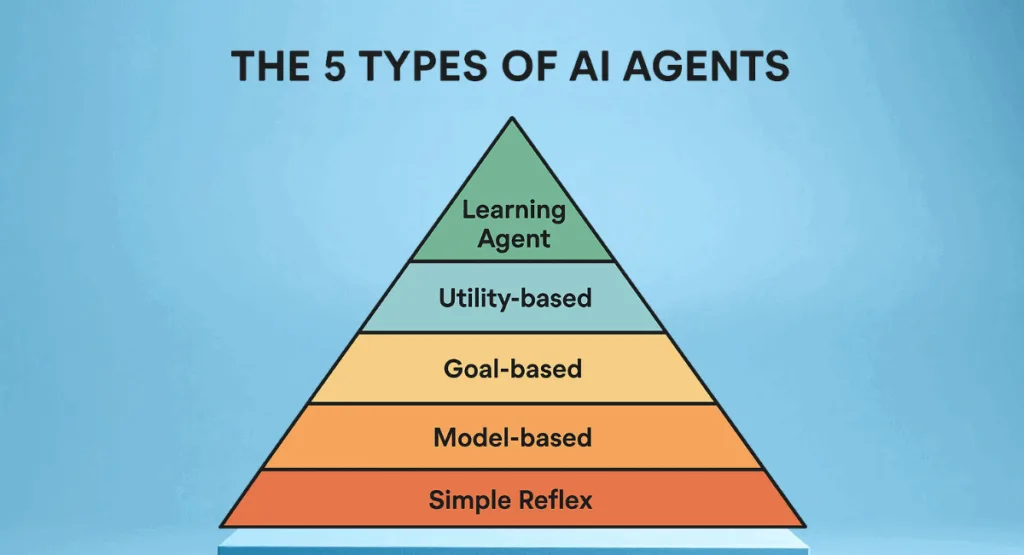
The AI agent taxonomy assists in classifying the fundamental types of the AI according to their perception, thinking, and behavior in an environment. All these categories denote the transition of rudimentary automation to high-order autonomous systems. The knowledge of the types of agent in AI is important in the design of intelligent working processes, constructing scalable automation, and choosing the appropriate types of the AI agent for specific applications. The following table is a summary of the key agent types AI utilized in contemporary systems.
| Type | Description | Key Feature |
| Simple Reflex Agents | Reacts directly to stimuli according to pre-established guidelines. | Condition-action logic. |
| Model-Based Reflex Agents | The models are internalized in stores to quantify environmental conditions. | Memories and situational awareness. |
| Goal-Based Agents | Take action in order to achieve certain things. | Planning as a decision making tool. |
| Utility-Based Agents | Writing rulings that are going to result in the highest satisfaction or reward. | Optimization-driven reasoning. |
| Learning Agents | I am a continuous learner, through experience. | Adaptive self-improvement. |
This AI agent taxonomy covers the spectrum of machine intelligence development such as reactive systems, to autonomous and self-improving decision-makers and includes the full range of modern forms of AI agents and their capabilities.
VI. Real-World Applications and Use Cases
AI agents are changing industries, and they are some of the most influential real world applications of artificial intelligence. These AI use cases show how intelligent systems are changing the daily operations of automation and reasoning.
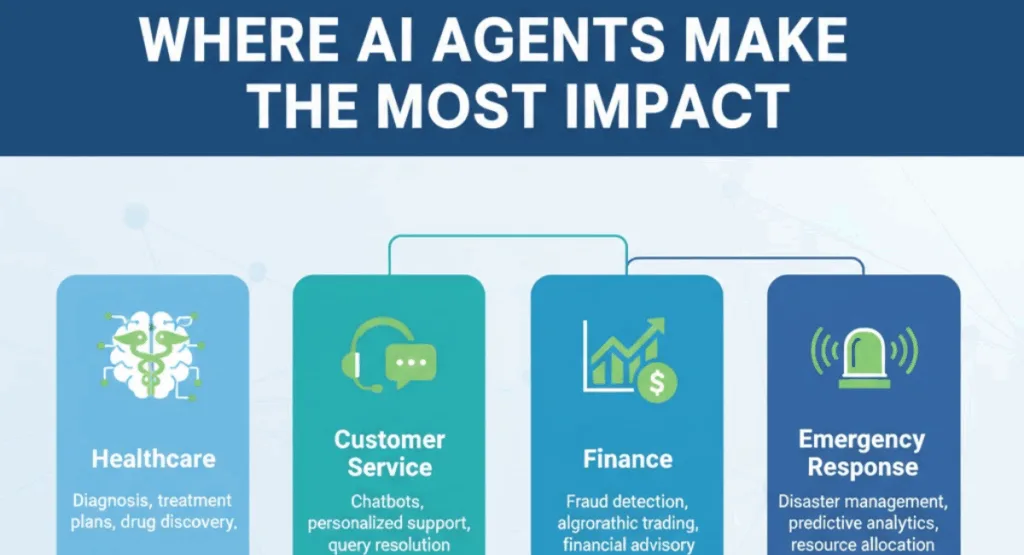
| Industry | Applications | Impact |
| Customer Experience | Virtual assistants, chat bots based on AI, simulations. | Individual service, 24/7 service. |
| Healthcare | Planning of treatment, drug discovery, diagnostics. | Lessened mistakes, enhanced productivity. |
| Emergency Response | Rescue mapping, prediction of disasters. | Quicker crisis handling |
| Finance & Supply Chain | Inventory optimization, fraud detection. | Live-time analytics, cost-cutting. |
These concrete examples demonstrate that in AI are no longer a figment of imagination but a business revolution that brings some of the most impactful examples of artificial intelligence applications in business today.
VII. Benefits, Risks, and Best Practices
A. Key Benefits
- Task Automation: Reduces the human resource of monotonous work, which is one of the main points of discussion of the advantages and disadvantages of artificial intelligence where bot replacement is a major benefit.
- Better Performance: Multi-agent systems enhance performance and scalability – one of the apparent benefits and risks of artificial intelligence that has frequently been mentioned
- Personalization: The agents use memory and context to personalise the response where the benefits of artificial intelligence in personalization are high and the disadvantages show a strong negative side with personalization being a foremost advantage in the artificial intelligence pros and cons.
B. Risks and Limitations
- Multiagent Dependencies: A single failure can spread within the system, which is typical disadvantages of artificial intelligence in complicated conditions.
- Infinite Feedback Loops: They are able to take work over tasks, in terms of ai advantages and disadvantages, where loops can be a constraint.
- Computational Complexity: The more the reasoning, the more the spending is incurred, which is a fundamental argument when examining the advantages and disadvantages of artificial intelligence
- Privacy Concerns: Data processing is a highly sensitive aspect of avoiding leakage, which is frequently mentioned in the discussion of benefits and risks of artificial intelligence and general advantages and disadvantages of AI.
C. Best Practices
- Remember logs of activity so as to strike a balance between artificial intelligence pros and cons
- Loops must have the human interruption system so that the disadvantages of artificial intelligence
- The measurement of evaluations(precision, price, response time) support the abilities to cope with advantages and disadvantages of AI in real systems.
- Introduce ethical governance to safe automation to reduce the benefits and risks of artificial intelligence and facilitate responsible implementation.
VIII. The Technology Behind AI Agents
Some of the technologies, which are interdependent and propel AI agents, are:
1. Machine Learning & Deep Learning – For Pattern Recognition and Adaptation
Machine Learning (ML) and Deep Learning (DL) enable to analyze huge datasets, record patterns, and make forecasts.
- ML models assist in categorizing data and suggest courses of action.
- In complex decision-making, such as image recognition or voice processing, Deep Learning networks (such as neural architectures) are capable of making these decisions.
These technologies help AI agents adapt to evolving environments without explicit reprogramming.
2. Natural Language Processing (NLP) – For Understanding Instructions and Context
NLP helps to understand human language, read intention, and converse.
- Applied to chat interfaces, documentation analysis and semantic search.
- Powers contextualizes, finds sentiments and summarizes.
And this is what enables such as ChatGPT or Gemini to get the fine-tuning of a prompt.
3. Reinforcement Learning (RL) – For Self-Improvement Through Feedback
A learning-by-doing mechanism is available in RL. obtain the best strategies by trial and error, as well as signalizing notes.
In reinforcement learning:
- Reward functions measure actions.
- The agent refreshes on policy to maximize accumulated payment.
This allows relentless application of improvement, particularly in independent decision making systems.
4. Knowledge Representation & Reasoning – For Contextual Decision-Making
Knowledge Representation (KR) is used to store structured (facts, rules, and relationships) information. This knowledge is then used by reasoning systems to make inferences and judgments as well as plan actions. They constitute a cognitive layer jointly providing contextual intelligence and explain ability to AI.
IX. Integration with Modern Systems
AI combine with:
- Cloud computing (to scale and do it remotely).
- IoT networks (physical-world data sensing).
- APIs and inter-agent (between agents) services.
These integrations allow AI to be deployed everywhere, whether it is a smart factory or an enterprise software environment.

X. The Future of AI Agents
The vision of AI agents is being developed into a future where AI can think, reason, and act intelligently and empathically as fully autonomous digital teammates. Not only will these be able to work effectively but also exhibit creativity, flexibility, and good moral judgment when faced with complicated and real life situations.
Future AI teammates will not just be given commands to follow, as is the case with traditional AI systems, but they will work with humans and provide valuable information. They will become full-fledged collaborators in innovation, able to think and make moral decisions on their own, finally transforming the model of human and machine cooperation in attaining common principles in a responsible, intelligent and ethical manner.
Emerging Trends
- Autonomous Co-pilot Systems: Real-time human team-work.
- Multi-agent Collaboration: Co-ordination of between departments.
- Human-in-the-Loop (HITL): Finding a balance between AI accuracy and human ethics.
Vision
The AI of tomorrow will not simply obey rules, but will make predictions and suggest solutions, and become co-creators.
XI. Conclusion
The next big breakthrough in automation are AI agents, which will combine logic, independence, and responsiveness to carry out complicated tasks that hitherto were done by humans. They are redefining how we design, implement, and optimise digital operations from customer experience to enterprise intelligence—especially as businesses compare AI agents vs chatbots to understand which technology can drive deeper automation.
There is no longer a need to fathom the concept of in AI since understanding its definition is mandatory to any business that is planning to survive in the AI-driven world. Organizations open the door to new efficiency, innovativeness and competitive advantage in the present day by adopting systems.
FAQ
1. What is an AI agent in simple terms?
An AI agent is one that can think, plan and take actions independently to complete objectives with the use of AI. It is able to reason, learn and use tools to work out intricate tasks independently.
2. What are agents in artificial intelligence?
In AI, are intelligent creatures that sense the surroundings, analyze data, and take actions to meet their goals, i.e., unlike digital assistants or robots.
3. How are AI agents different from chatbots?
The predetermined responses of chatbots can be thought of, can plan and learn, based on the memorizing and external information, with the help of AI.
4. What technologies power AI agents?
They rely on the application of the LLM, ML, NLP, RL, and knowledge representation systems connected with each other with the assistance of APIs and cloud environments.
5. Are AI agents safe?
Yes, Responsible automation is achieved by the establishment of ethical structures and human control under the right rules.
6. What industries benefit most from AI agents?
Healthcare, finance, customer service, logistics, and cybersecurity – in which intricate decision-making and data assessment are paramount.
7. What is the future of AI agents?
The AI will become cooperative workmates, and they can cooperate with humans in creative and strategic settings.
