


Introduction
In the evolution of computer vision, Convolutional Neural Networks (CNNs) have moved from experimental concepts to the backbone of modern AI. Two architectures stand as definitive milestones: LeNet-5 and VGG.
While LeNet-5 (1998) proved that machines could “see” handwritten digits, VGG (2014) demonstrated that sheer depth could conquer massive, real-world datasets. This article breaks down the architectural shift from the simplicity of the 90s to the deep-learning revolution of the 2010s.
LeNet-5: The Pioneer of Computer Vision
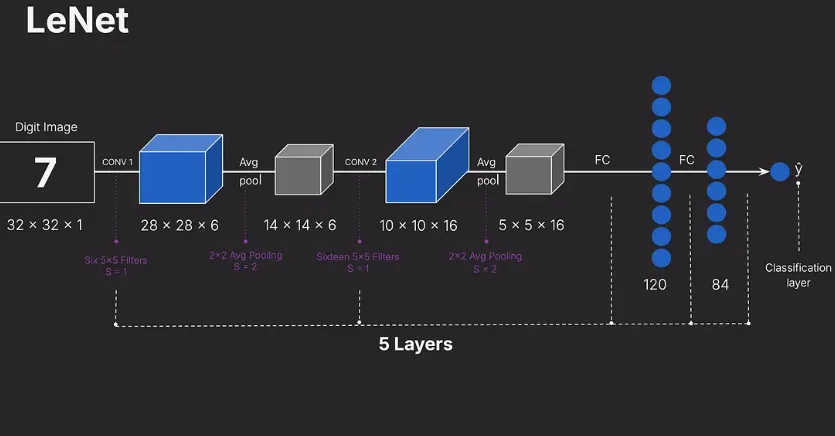
Developed by Yann LeCun, LeNet-5 was the first functional CNN to achieve commercial success, famously used by banks to read zip codes on checks. It established the “conv-pool-conv-pool” pattern that remains a standard today.
Key Features
- Architecture: A 7-layer design featuring two sets of convolutional and average pooling layers, followed by three fully connected layers.
- Input Dimensions: Designed for $32 \times 32$ grayscale images.
- Activation Functions: Relies on Sigmoid or Tanh, which were the industry standards before the rise of ReLU.
- Resource Efficiency: Extremely lightweight; it can run on basic CPUs without the need for modern GPU acceleration.
Read more blog : The Foundation of Convolutional Neural Networks
Advantages & Limitations
- Pros: Minimal computational footprint; paved the way for gradient-based learning.
- Cons: Shallow depth prevents it from capturing high-level abstractions; struggles with color (RGB) and high-resolution images.
VGG: The Power of Depth and Uniformity
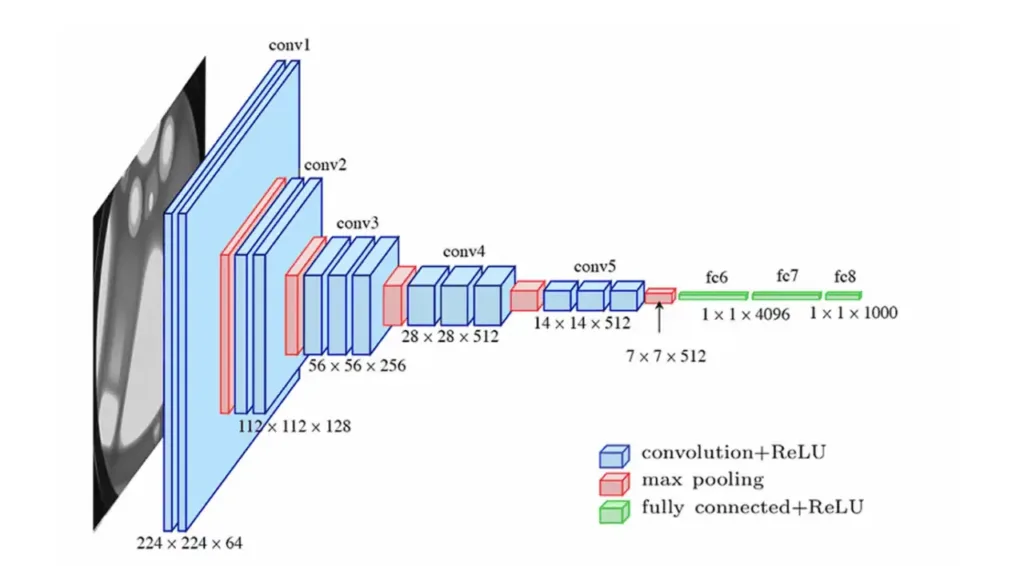
The VGG (Visual Geometry Group) network was a sensation at the 2014 ILSVRC. Its primary contribution was the realization that stacking many small filters ($3 \times 3$) is more effective than using a few large ones.
Key Features
- Architecture: Most commonly seen as VGG16 or VGG19, consisting of 16 and 19 weight layers respectively.
- Uniformity: It uses a consistent $3 \times 3$ convolutional stride and $2 \times 2$ max-pooling throughout the entire network.
- Input Dimensions: Optimized for $224 \times 224$ RGB color images.
- Modern Activation: Utilizes ReLU (Rectified Linear Unit), which solved the “vanishing gradient” problem and allowed for much faster training.
Advantages & Limitations
- Pros: Incredible feature extraction capabilities; the architecture is highly modular and easy to adapt for transfer learning.
- Cons: A “heavyweight” model with over 138 million parameters; it is memory-intensive and relatively slow to train.
Technical Comparison: LeNet-5 vs. VGG
While both are milestones in deep learning, the jump from LeNet-5 to VGG represents a massive shift in computational philosophy.
Comparison Matrix
| Feature | LeNet-5 (The Pioneer) | VGG (The Powerhouse) |
| Release Year | 1998 | 2014 |
| Network Depth | 7 Layers | 16–19 Layers |
| Input Dimensions | $32 \times 32$ (Grayscale) | $224 \times 224$ (RGB) |
| Convolutional Filters | Variable ($5 \times 5$) | Uniform ($3 \times 3$) |
| Activation Function | Sigmoid or Tanh | ReLU (Rectified Linear Unit) |
| Parameter Count | ~60,000 | ~138,000,000+ |
| Computational Load | Minimal: Efficient on CPUs | High: Requires GPU acceleration |
Real-World Applications: From Mailrooms to Medical Labs
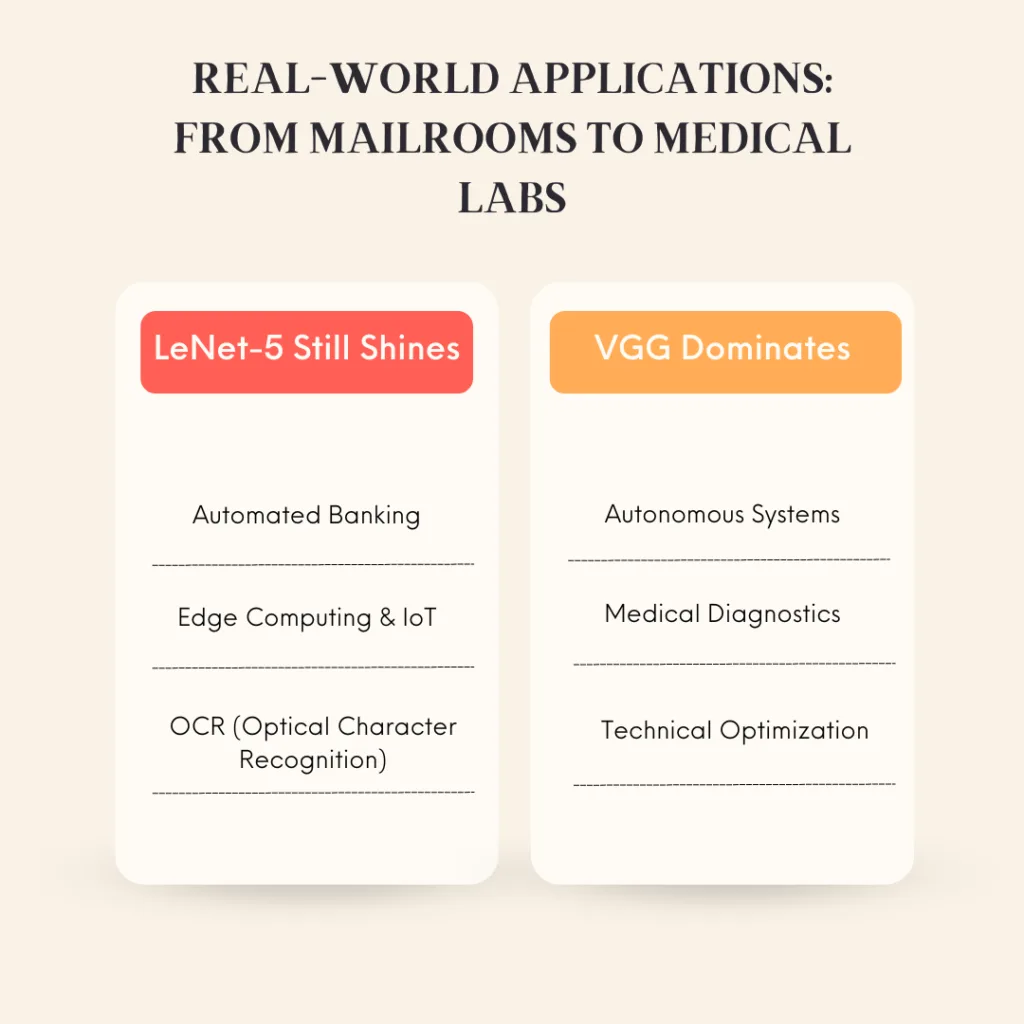
The shift from LeNet-5 to VGG isn’t just academic; it reflects how we’ve moved from simple pattern matching to complex scene understanding.
Where LeNet-5 Still Shines
Despite its age, LeNet-5 remains relevant in specialized environments:
- Automated Banking: Still the gold standard for high-speed check processing and ZIP code recognition.
- Edge Computing & IoT: Because it requires minimal RAM, it’s perfect for low-power microcontrollers (like identifying a “wake gesture” on a smartwatch).
- OCR (Optical Character Recognition): Highly effective for reading simple, structured text on production lines.
Where VGG Dominates
VGG’s depth makes it a “workhorse” for high-stakes visual tasks:
- Transfer Learning: VGG16 is the most popular “backbone” for other AI models. Developers take a pre-trained VGG and “fine-tune” it for specific tasks like identifying crop diseases.
- Medical Diagnostics: Its ability to see fine textures allows it to detect anomalies in high-resolution MRI and X-ray scans.
- Autonomous Systems: Used in the early stages of self-driving pipelines to classify complex objects like pedestrians, cyclists, and traffic signals in real-time.
The Evolutionary Leap
LeNet-5 and VGG represent the two great “Aha!” moments of Computer Vision:
- LeNet-5 proved that spatial hierarchy (pixels $\rightarrow$ edges $\rightarrow$ shapes) was the right way to process images.
- VGG proved that depth is a feature. By stacking layers, the network could learn more abstract concepts, paving the way for even deeper modern architectures like ResNet and EfficientNet.
Mastering Computer Vision with Arunangshu Das
Understanding the architectural differences between LeNet-5 and VGG is only the first step. The real challenge lies in deploying these models to solve specific business problems—whether that’s optimizing a supply chain or enhancing digital security. This is where Arunangshu Das brings expert-level clarity to your AI journey.

How Arunangshu Das Transforms Your AI Strategy
Navigating the transition from legacy systems to high-performance deep learning requires a mix of technical precision and strategic SEO insight. Here is how Arunangshu helps you stay ahead:
- Architecture Selection: Not every project needs a “heavyweight” model. Arunangshu evaluates your specific infrastructure to determine if a lightweight LeNet-inspired approach or a deep VGG-based feature extractor is more cost-effective for your goals.
- Custom Implementation: From fine-tuning pre-trained models for transfer learning to optimizing hyperparameters for faster convergence, he ensures your neural networks are built for performance, not just complexity.
Turn Complex Algorithms into Simple Success
Don’t let the technical density of deep learning slow down your digital transformation. With a focus on high-impact results and future-ready strategies, Arunangshu Das helps you navigate the “security landscape” of AI with confidence and chic, premium execution.
Conclusion
The journey from LeNet-5 to VGG is a testament to the rapid evolution of deep learning. While LeNet-5 provides the blueprint of efficiency, VGG offers the power of scale.
Understanding these two architectures is more than a history lesson—it’s a roadmap for choosing the right tool for the job. Whether you are building a lightweight embedded sensor or a massive image-recognition engine, the principles established by LeCun and the Visual Geometry Group remain the foundation of how machines see our world.
Let’s Build the Future Together
Are you looking to implement custom CNN architectures for your business? Whether you need the speed of a lightweight model or the precision of a deep neural network, our team is here to help.
Frequently Asked Questions: Navigating CNN Architectures
1. Why did VGG switch from the $5 \times 5$ filters used in LeNet to $3 \times 3$ filters?
The shift to $3 \times 3$ filters was a stroke of engineering genius. Stacking two $3 \times 3$ filters covers the same “receptive field” as one $5 \times 5$ filter, but it does so with fewer parameters and more non-linear activation layers (ReLU). This allows the network to learn more complex features without becoming exponentially more difficult to compute.
2. Can I still use LeNet-5 for modern projects?
Absolutely—if the use case fits. LeNet-5 is ideal for “Edge AI” where you are deploying a model on a device with very limited memory, such as an Arduino or a basic ARM processor. If you only need to recognize simple symbols, digits, or basic gestures, VGG would be overkill and waste battery power.
3. Why is VGG16 so popular for Transfer Learning?
VGG16 is highly “modular.” Because its architecture is so uniform and logical, it is very easy to “chop off” the final classification layers and replace them with your own. Its deep layers act as excellent general-purpose feature extractors that understand edges, shapes, and textures, which can be applied to everything from identifying car models to spotting defects in manufacturing.
4. What is the main difference between VGG16 and VGG19?
The number represents the total weight layers (convolutional and fully connected). VGG19 adds three additional convolutional layers. While VGG19 can theoretically capture more detail, it is also more prone to overfitting and requires more memory. In most practical applications, VGG16 offers a better balance of performance and speed.
5. Why do modern architectures like ResNet often replace VGG?
While VGG proved depth is powerful, it eventually hit a wall called the “Vanishing Gradient” problem. As networks got even deeper than VGG, the training signals would fade before they could reach the first layers. Modern architectures like ResNet solve this with “skip connections,” allowing them to be hundreds of layers deep—far surpassing VGG’s 19-layer limit.
