


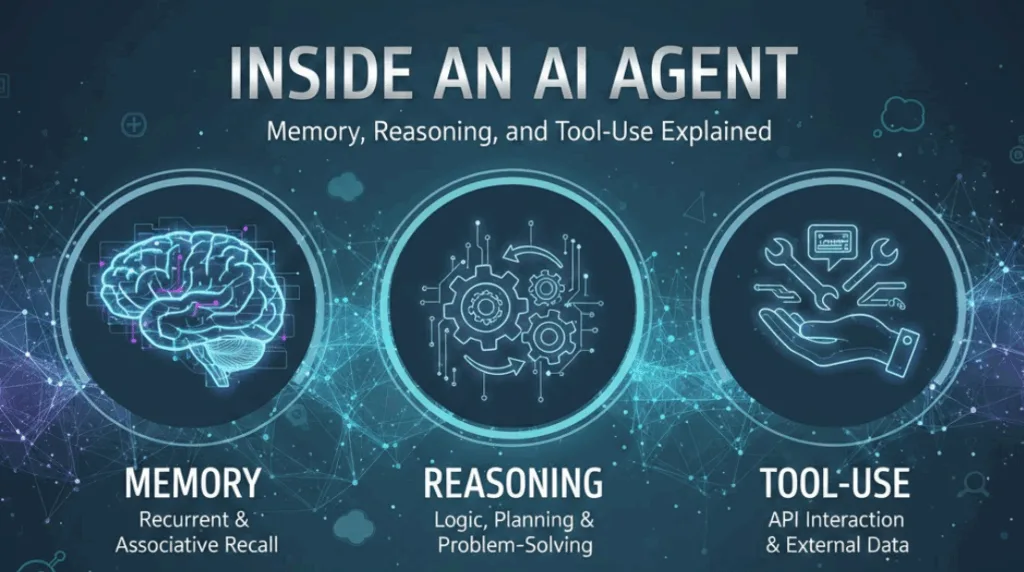
Suppose the following: You inform a chatbot that you need to be flown to New York next week. A typical LLM will give back instructions but an AI agent works more, he/she books the flight, adds it to your calendar, notifies your manager and even sends the invoice. This is what makes the distinction between talking to an AI and letting an autonomous assistant manage a workflow on your behalf.
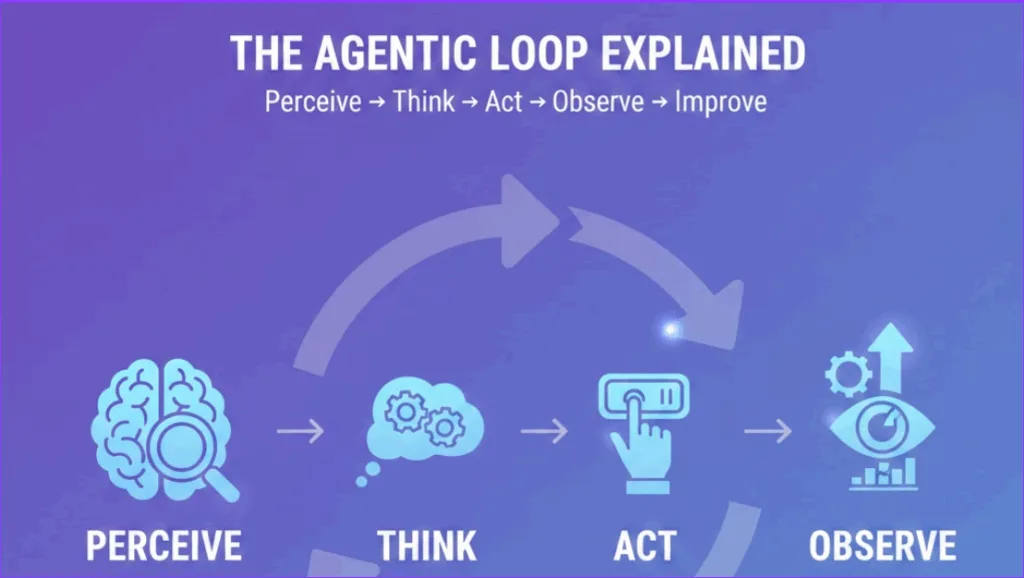
This ability is fueled by the so-called Agentic Loop:
Perceive → Think → Act → Observe → Improve
With the knowledge of how Artificial intelligence agents operate their memories, reasoning, and tool-use, the potential to automate complex processes rather than individual ones becomes accessible. Today, we are going to dissect the three pillars of Artificial intelligence agent architecture, discuss the real-world uses of agentic AI and how the systems perform better than traditional automation.
2. What Makes an AI Agent Different from Traditional Automation
Conventional automation is based on fixed, strict rules – it is possible to process a task as long as it is within the script, but it cannot handle any unexpected situation.
AI agents, on the other hand:
- Work dynamically on the basis of a situation.
- Organize work on plans in a multi-step manner.
- Real-time decision adaptations.
This change can be characterized as scalable, context-sensitive Artificial intelligence processes, capable of personalizing actions to individual users, evolving to new inputs and improving over time, which cannot be done with rule-based automation.
| Feature | Traditional Automation | AI Agents |
| Adaptability | Low | High |
| Multi-step task handling | Limited | Advanced |
| Context awareness | None | Full context integration |
| Learning | No | Continuous improvement |
| Tool integration | Fixed | Dynamic |
This table underscores the reason why companies are adopting autonomous AI more in order to substitute repetitive and highly complex work processes.
3. The Core Architecture of an AI Agent
An Artificial intelligence agent consists of a multi-layered architecture:
- Input Processing– Processes user commands, query or instructions.
- Context Retrieval – Retrieves pertinent memory, past information or domain knowledge.
- Reasoning Engine – Makes a choice about the next actions, which is often based on chain-of-thought or planning algorithms.
- Selection of tool – Selects the right API, application or resource to take action.
- Action implementation- Implements the action with the help of the chosen tools.
- Feedback Loop – Notices outcomes and makes changes in future.
The combination of these layers allows self-correcting, adaptive, and complex decision-making Artificial intelligence agent workflows.
4. Memory: How AI Agents Store and Use Information
AI agents depend on memory. In contrast to stateless LLMs, agents require continuity to complete complicated tasks:
- Short-term memory: Records live conversation context, recent actions and short-term goals.
- Long term memory: Stores preferences, past actions, and significant documents. Sainty, frequently stored in vector databases.
- Episodic memory: Records particular events in order to inform the decisions in the future.
- Semantic memory: Houses general knowledge and facts that don’t change frequently.
The reflection mechanisms enable agents to be able to summarize the past actions and prevent the repeat of actions that are wrong.
Example: An Artificial intelligence in project management recollects deadlines, past dialogues and personal interest of teams – so that every reminder or update is contextually correct.
5. Reasoning: How an AI Agent Thinks Through Problems
Rationality makes the Artificial intelligence agents become problem solvers rather than text generators.
- Chain-of-Thought (CoT): A logical thinking process.
- Planning and Decomposition: The subdivision of big objectives into small tasks.
- Multi-path reasoning / Tree-of-Thoughts: Comparing several solutions at the same time.
- ReAct Loop: Think Next Step Observe Act.
- Self-correction: Assessment and action improvement.
Example: When planning a trip in multi cities there is a need to balance the budget, timing, means of transportation, and personal preferences. An artificial intelligence agent is capable of creating an optimum itinerary independently.
6. Tool-Use: How AI Agents Interact with the Real World
LLMs do not exist in the real world. Tools bridge this gap:
- Types of tools:
- Web search APIs
- Browsers
- Databases
- Email/SMS automation
- Spreadsheets
- Execution environments Code environments Code execution environments
- Function calling: The model delivers structured data to the system which execute the system and the results are obtained.
- Execution feedback: The agent uses the results to guide the better making of decisions in future.
Example: A financial agent retrieves live stock information, trends, and trends generated as visual data, and reports have been prepared automatically.
7. Workflow Execution: How Memory + Reasoning + Tool-Use Work Together
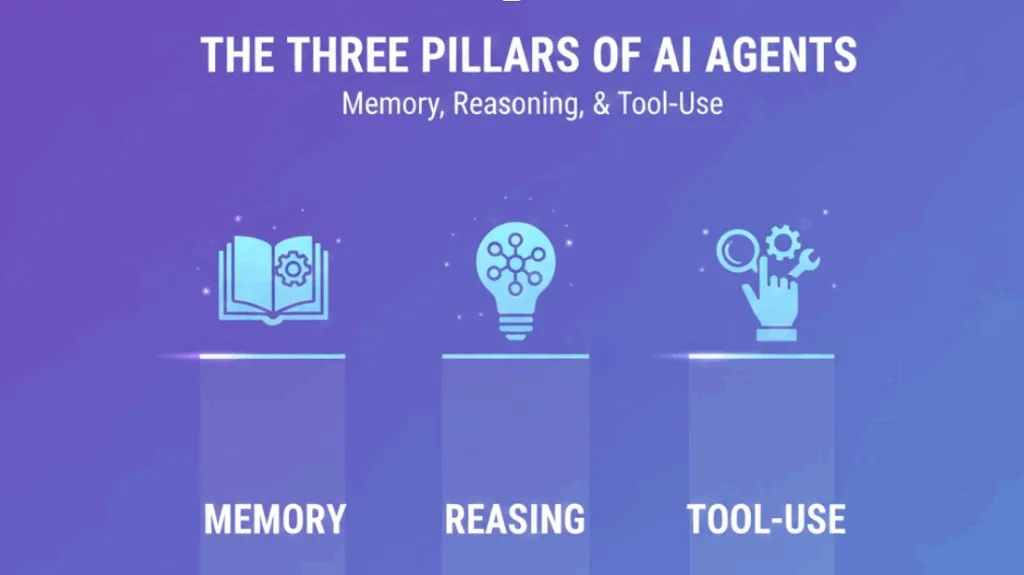
The magic consists in the convergence between memory, reasoning, and use of tools:
- Understand user intent
- Retrieve relevant memory
- Plan next steps
- Select appropriate tools
- Execute actions
- Observe results
- Repeat until completion
Example: Content pipeline Automation:
Keywords research → Briefing note → Drafting → Fact-checking → Publication.
This shows that AI agents replace workflows and not perform only specific tasks.
8. Real-World Examples of Agentic Workflows
- Lead qualification: Fetch lead info → score → categorize → update CRM
- SEO content processes Keyword clustering competitor analysis draft optimize upload.
- Marketing campaign management: Create creatives – Post – Report on performance.
- Triage- Customer support: Pull order history, check policy, resolve, and notify customers.
- Daily functions: Automate invoices, emails, reports and coordination.
These are examples of real world agentic Artificial intelligence examples driving efficiency in industries.
9. Limitations and Challenges of AI Agents
- Such failures are reliability and tool failures.
- Problems with reasoning hallucinations.
- Context window limitations
- Multi-step reasoning Latency and cost.
- Dependence on external APIs
- Security and privacy issues.
- Human supervision of important work required.
Regardless of these, these limitations are being quickly being dealt with by current research.
10. The Future of Agentic Artificial intelligence Systems
- Memory architectures that are expandable.
- Both high level planning models and reasoning models.
- Multimodal applications that deal with voice, image, and video.
- Secure, rich tool ecosystems
- Such collaboration as virtual teams is multi-agent.
- Finance, healthcare, law and operations domain agents.
The development of independent AI will have even more potent, context-aware, and competent agents.

11. Conclusion
Memory gives a sense of context, decisions are made through reasoning and action is possible through the use of tools. The combination is known as the foundation of Artificial intelligence agent architecture because it enables companies to automate whole processes instead of single tasks.
AI agents vs chatbots: Unlike chatbots, agents are autonomous, combine tools, and learn through experience – indeed, they completely redefine the concept of how Artificial intelligence agents operate.
The way forward is obvious: Artificial intelligence agents are no longer engines of conversation, but working partners who can revolutionize the work processes in all industries.
FAQs
1. What is an Artificial intelligence agent?
An Artificial intelligence agent is the system that perceives the environment around it, reasons, employs tools, and performs actions on its own.
2. How do Artificial intelligence agents use memory?
They apply live context, preferences, events and stable knowledge using short-term, long-term, episodic and semantic memories respectively.
3. Can Artificial intelligence agents replace human workflows?
Yes, they are able to automate multi-step processes such as the lead qualification process, the SEO content pipelines, and customer support triage.
4. What tools do Artificial intelligence agents use?
Web APIs, databases, automation of emails, spreadsheets, and code execution environments, among others, can be used by Artificial intelligence agents.
5. What’s the difference between Artificial intelligence agents and chatbots?
Chatbots respond with the input text, whereas Artificial intelligence agents make autonomous choices, perform workflows using memory, reasoning, and tools.
