


The private equity industry is evolving rapidly, and firms are now turning to artificial intelligence to improve decision-making, accelerate transactions, and reduce operational risks. Traditional due diligence methods often involve weeks of manual research, financial modeling, market assessment, and compliance reviews. Today, AI-powered due diligence is changing that landscape by enabling firms to process large volumes of data faster and more accurately.
Modern private equity AI platforms are helping investment teams identify opportunities, evaluate risks, and streamline acquisitions with far greater efficiency than traditional workflows. As competition for high-quality deals intensifies, AI agents are becoming a strategic advantage for firms that want faster insights and smarter investment decisions.
In many investment firms, concepts like Equity Dilution 101 have become increasingly important when evaluating startup investments and funding structures. AI systems can quickly analyze cap tables, shareholder distributions, and ownership changes to help investors understand long-term value implications before closing a deal.
Similarly, metrics such as Customer Acquisition Cost are now deeply integrated into AI-driven financial assessments. AI tools can evaluate customer spending trends, retention rates, and revenue patterns to determine whether a company’s growth model is sustainable.
What Are AI Agents in Private Equity?
AI agents are intelligent software systems capable of performing tasks autonomously using machine learning, predictive analytics, and automation technologies. In private equity, these agents assist with:
- Market research
- Financial document analysis
- Risk assessment
- Compliance reviews
- Investment forecasting
- Portfolio monitoring
Unlike traditional software tools, autonomous finance agents continuously learn from historical investment data and improve their recommendations over time.
These AI-driven systems are now transforming the entire investment lifecycle, from sourcing deals to post-acquisition portfolio management.
Why Private Equity Firms Are Adopting AI
Private equity firms manage enormous volumes of financial data, legal documentation, and operational reports. Manual review processes can delay transactions and increase the risk of overlooking critical details.
This is where due diligence automation becomes valuable.
Key Benefits of AI in Private Equity
| Benefit | Impact on PE Firms |
| Faster data analysis | Reduces due diligence timelines |
| Improved accuracy | Minimizes human errors |
| Predictive insights | Helps forecast investment outcomes |
| Real-time monitoring | Tracks portfolio company performance |
| Cost efficiency | Reduces operational overhead |
| Risk detection | Identifies hidden financial concerns |
By integrating PE workflow automation, firms can significantly improve operational efficiency while enabling investment professionals to focus on strategic decision-making.
AI-Powered Due Diligence in Action
Traditional due diligence often involves reviewing thousands of documents manually. AI systems can now process:
- Financial statements
- Tax records
- Legal contracts
- HR documents
- Vendor agreements
- Compliance reports
Using natural language processing and predictive analytics, AI-powered due diligence tools can detect inconsistencies, identify unusual financial behavior, and highlight hidden liabilities.
Example
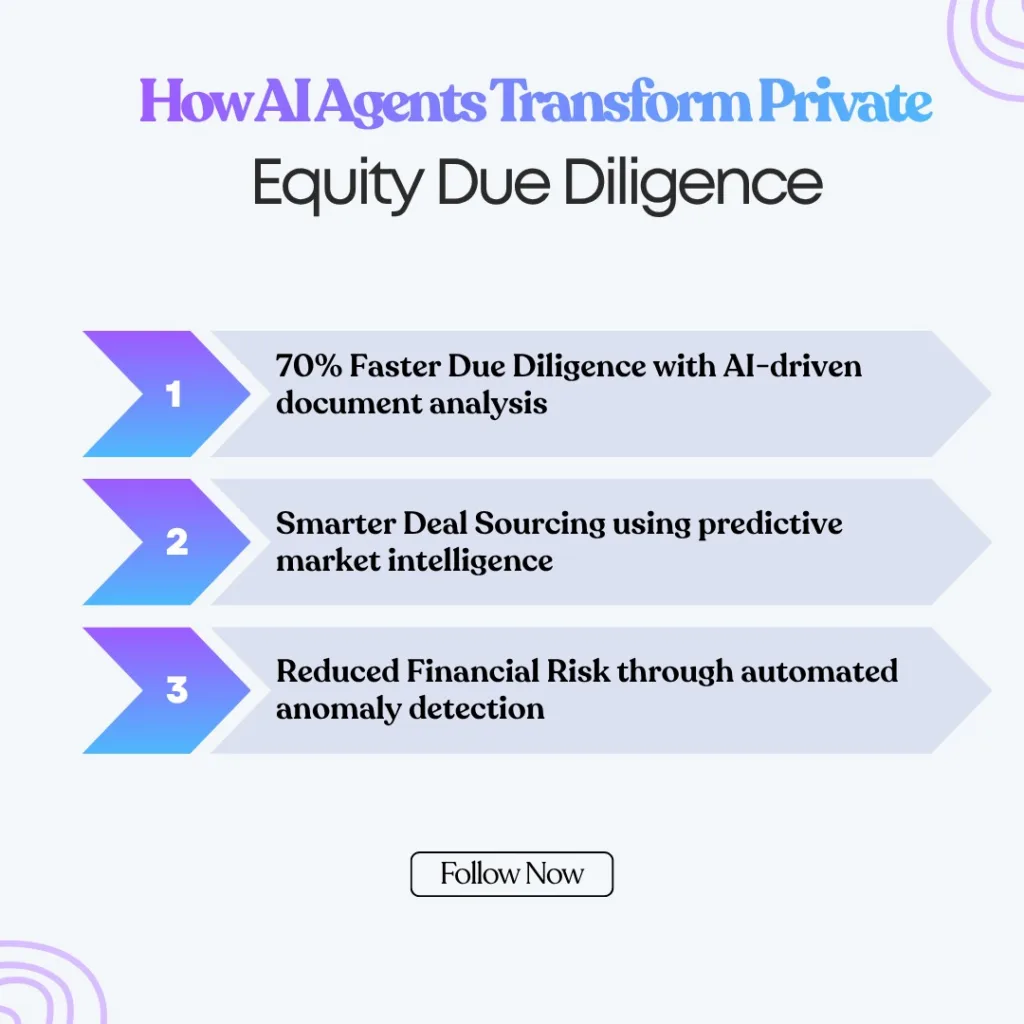
A mid-sized PE firm evaluating a SaaS company used AI tools to scan years of subscription revenue data. The AI system identified abnormal churn spikes hidden within quarterly reports, helping investors renegotiate the acquisition price before finalizing the deal.
This type of intelligent assessment is making acquisition analysis AI an essential tool for modern investment teams.
The Role of AI in Deal Sourcing
Finding the right acquisition target is often one of the most time-consuming tasks in private equity.
Modern deal sourcing AI platforms analyze:
- Industry trends
- Startup databases
- Funding announcements
- Revenue growth patterns
- Leadership changes
- Market expansion indicators
AI agents can automatically identify companies that align with an investment firm’s preferred criteria.
How AI Improves Deal Sourcing
| Traditional Deal Sourcing | AI-Driven Deal Sourcing |
| Manual research | Automated market scanning |
| Limited data points | Real-time multi-source analysis |
| Slower identification | Faster target discovery |
| Human bias | Data-backed recommendations |
| Reactive strategies | Predictive opportunity detection |
As investment competition increases, firms using deal evaluation tools gain a major speed advantage in identifying profitable opportunities before competitors.
Financial Risk Analysis Using AI
Risk management is one of the most critical areas in private equity investing.
Modern AI systems perform advanced financial risk analysis by evaluating:
- Cash flow stability
- Debt exposure
- Market volatility
- Fraud indicators
- Regulatory compliance
- Operational inefficiencies
AI can also simulate multiple financial scenarios to estimate how a company may perform under different market conditions.
For example, AI can evaluate how rising interest rates or declining consumer demand could impact a target company’s profitability over the next five years.
This level of forecasting improves investment confidence and reduces exposure to unexpected losses.
Investment Intelligence Systems and Predictive Analytics
Modern investment intelligence systems combine historical investment data, real-time market insights, and predictive analytics to support smarter investment decisions.
These systems help PE firms:
- Forecast future valuation trends
- Identify emerging industries
- Benchmark portfolio performance
- Evaluate operational efficiency
- Improve exit timing strategies
AI-driven predictive modeling allows firms to identify hidden growth potential that traditional analysis methods may overlook.
Even industries connected to digital growth strategies increasingly rely on AI tools. For instance, businesses already using Marketing Automation Tools often generate measurable customer behavior data that AI systems can analyze to estimate long-term scalability and profitability.
How AI Helps Traders and Investors
The rise of AI in finance is not limited to private equity alone. Many Traders and Investors now use AI systems for market prediction, risk management, and portfolio optimization.
Private equity firms are adopting similar technologies to improve:
- Investment screening
- Valuation modeling
- Competitive benchmarking
- Exit planning
- Operational forecasting
As AI adoption grows across financial markets, firms without intelligent automation systems may struggle to compete effectively.
PE Workflow Automation: Reducing Manual Processes
Private equity firms manage multiple workflows simultaneously, including:
- Investor reporting
- Compliance monitoring
- Data collection
- Financial analysis
- Legal coordination
Through PE workflow automation, firms can automate repetitive operational tasks and reduce administrative bottlenecks.
Areas Commonly Automated
| Workflow Area | AI Automation Function |
| Document review | AI text extraction and analysis |
| Financial modeling | Automated forecasting |
| Compliance checks | Risk flagging and alerts |
| Portfolio tracking | Real-time performance monitoring |
| Reporting | Automated dashboard generation |
Automation not only improves speed but also enhances scalability for firms managing large portfolios.
The Future of Autonomous Finance Agents
The next phase of AI in private equity involves fully integrated autonomous finance agents capable of independently managing parts of the investment lifecycle.
Future AI systems may:
- Negotiate transaction terms
- Predict acquisition synergies
- Monitor post-merger integration
- Recommend restructuring strategies
- Detect emerging market opportunities automatically
While human oversight will remain essential, AI will increasingly serve as a strategic partner in investment decision-making.
Challenges of AI Adoption in Private Equity
Despite the advantages, implementing AI in private equity also comes with challenges.
Common Challenges
- Data privacy concerns
- Integration with legacy systems
- Regulatory compliance complexities
- High implementation costs
- Dependence on data quality
- Need for skilled AI professionals
Firms must balance automation with human expertise to ensure ethical and effective decision-making.

Conclusion
Artificial intelligence is rapidly transforming private equity operations. From due diligence automation and deal sourcing AI to advanced financial risk analysis, AI agents are helping firms make faster, smarter, and more accurate investment decisions.
As the market becomes more competitive, firms that adopt private equity AI solutions early will gain a significant advantage in sourcing deals, managing risks, and improving investment returns.
The future of private equity will not replace human investors — it will empower them with intelligent systems capable of uncovering opportunities and risks at unprecedented speed and scale.
FAQs
1. What is AI-powered due diligence in private equity?
AI-powered due diligence refers to the use of artificial intelligence to automate financial analysis, document review, compliance checks, and investment risk assessment during acquisitions.
2. How does deal sourcing AI help private equity firms?
Deal sourcing AI identifies potential acquisition targets by analyzing market trends, financial performance, funding activity, and business growth indicators in real time.
3. Can AI replace human investment analysts?
No. AI supports analysts by automating repetitive tasks and improving data analysis, but strategic decision-making and relationship management still require human expertise.
4. What are the benefits of PE workflow automation?
PE workflow automation improves operational efficiency, reduces manual errors, speeds up reporting processes, and allows firms to manage larger investment portfolios effectively.
5. Why are autonomous finance agents becoming important?
Autonomous finance agents can continuously analyze data, monitor investments, and generate predictive insights, helping firms make faster and more informed financial decisions.
