


Business-to-business marketing has become more complex than ever. Buyers interact with multiple channels, consume large amounts of content, compare vendors independently, and expect personalized experiences before speaking with a sales representative. Traditional marketing methods often struggle to keep up with these expectations.
Today, organizations are increasingly adopting B2B marketing AI to improve campaign performance, personalize customer interactions, and make faster data-driven decisions. Modern AI agents go beyond simple automation by analyzing behavior, predicting outcomes, and executing marketing tasks with minimal human intervention. As AI capabilities continue to evolve, they are becoming a critical part of future-ready B2B marketing strategies.
At the same time, businesses are investing heavily in Customer Journey Optimization to create seamless experiences across every touchpoint. AI agents help marketers understand where prospects are in the buying journey and automatically deliver relevant messaging that increases engagement and conversions.
Another major trend is the growing use of AI Agents for Social Media to schedule content, monitor audience engagement, analyze competitor performance, and generate campaign insights. These intelligent systems allow marketing teams to manage multiple platforms efficiently while maintaining consistent brand messaging.
What Are AI Agents in B2B Marketing?
AI agents are intelligent software systems capable of performing tasks, making decisions, learning from data, and continuously optimizing marketing campaigns without constant manual intervention.
Unlike traditional automation tools that simply execute predefined workflows, AI agents can:
- Analyze customer behavior
- Predict buying intent
- Personalize campaigns
- Recommend next-best actions
- Optimize advertising spend
- Create marketing content
- Assist sales teams
These capabilities allow businesses to operate smarter while reducing repetitive manual work.
Why Traditional B2B Marketing Needs an Upgrade
Modern B2B buyers typically interact with several digital touchpoints before making purchasing decisions. They read blogs, attend webinars, download whitepapers, compare competitors, and engage on LinkedIn before contacting sales.
Challenges include:
- Long sales cycles
- Multiple stakeholders
- High competition
- Large customer databases
- Content personalization demands
- Campaign optimization complexity
AI agents address these challenges by processing enormous amounts of data in real time and continuously improving marketing performance.
Key Benefits of AI Agents in B2B Marketing
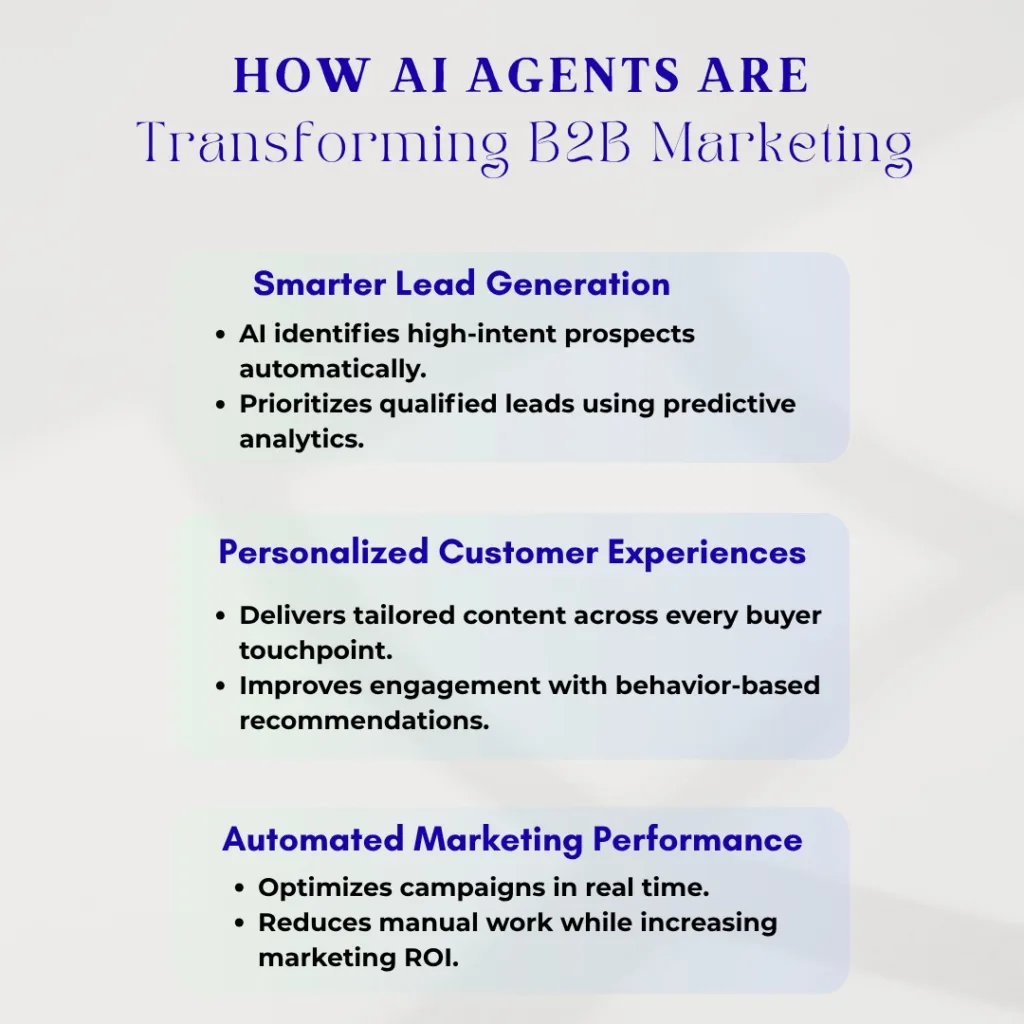
Smarter Lead Qualification
Instead of treating every lead equally, AI agents score prospects based on behavioral signals, engagement history, website activity, demographics, and buying intent.
This allows sales teams to focus only on high-value prospects while improving enterprise lead generation performance.
Personalized Customer Experiences
Modern buyers expect personalized communication.
AI agents automatically customize:
- Emails
- Landing pages
- Product recommendations
- Website messaging
- Follow-up sequences
This increases engagement while improving customer satisfaction.
Better Sales and Marketing Alignment
Marketing teams often struggle to deliver qualified leads.
Using AI sales enablement, AI agents help both departments share customer insights, buying signals, and engagement history, allowing sales representatives to approach prospects with greater context.
Faster Decision Making
AI analyzes thousands of data points instantly, allowing marketers to:
- Identify campaign trends
- Predict conversion opportunities
- Detect underperforming campaigns
- Recommend improvements
Instead of waiting weeks for reports, teams receive actionable insights in real time.
How AI Agents Transform Every Stage of the Marketing Funnel
| Marketing Stage | Traditional Process | AI Agent Enhancement |
| Awareness | Generic campaigns | Personalized targeting |
| Consideration | Manual segmentation | Intelligent audience analysis |
| Decision | Standard nurturing | Predictive engagement |
| Retention | Scheduled emails | Personalized customer journeys |
AI-Powered Account-Based Marketing
Large B2B organizations increasingly rely on account-based marketing AI to identify high-value companies and deliver personalized experiences across multiple stakeholders.
AI agents can:
- Identify target accounts
- Analyze company intent
- Recommend messaging
- Personalize campaigns
- Track engagement
- Predict buying readiness
This significantly improves marketing efficiency for enterprise sales.
AI Improves Marketing Automation
Traditional automation relies on predefined rules.
Modern AI agents continuously learn and optimize every workflow.
Businesses using marketing automation B2B gain:
- Faster campaign execution
- Smarter segmentation
- Better email timing
- Automated optimization
- Improved ROI
Intelligent Lead Nurturing
Most prospects are not ready to purchase immediately.
AI agents monitor engagement and automatically trigger personalized communication based on customer behavior.
This approach supports intelligent lead nurturing by delivering relevant content exactly when buyers need it.
Examples include:
- Educational emails
- Product comparisons
- Case studies
- Webinar invitations
- Personalized follow-ups
AI-Driven Outreach at Scale
Cold outreach often produces inconsistent results.
Using AI-driven outreach, businesses can:
- Personalize email sequences
- Optimize subject lines
- Predict response rates
- Schedule follow-ups
- Recommend messaging
This increases engagement while reducing manual work.
AI in B2B Demand Generation
Generating consistent demand requires multiple channels working together.
AI agents optimize:
- Content marketing
- Paid advertising
- Email campaigns
- SEO
- LinkedIn campaigns
- Webinars
These capabilities strengthen B2B demand generation while reducing wasted marketing spend.
AI Agents Are Improving Paid Advertising
Paid advertising has become increasingly data-driven.
Today, AI Agents Are Improving Paid Advertising by automatically adjusting bids, identifying high-performing audiences, testing creatives, allocating budgets, and optimizing campaigns based on real-time performance data.
Instead of relying solely on manual optimization, marketers can continuously improve return on ad spend through intelligent campaign management.
Autonomous Marketing Workflows
One of the biggest advantages of AI agents is their ability to create autonomous marketing workflows.
These workflows automatically:
- Capture leads
- Segment audiences
- Send emails
- Schedule meetings
- Update CRM records
- Generate reports
- Recommend campaign improvements
This dramatically increases marketing productivity.
Enterprise Growth Systems Powered by AI
Large organizations require scalable infrastructure.
AI agents contribute to modern enterprise growth systems by connecting CRM platforms, analytics, advertising tools, customer databases, and marketing platforms into a unified ecosystem that continuously learns and improves performance.
AI Supports Modern Digital Marketing
AI agents simplify complex Digital Marketing Workflows by automating repetitive tasks while providing marketers with valuable insights.
Examples include:
- Keyword analysis
- Campaign monitoring
- Email optimization
- Social scheduling
- Analytics reporting
- Conversion tracking
Marketing teams can spend more time on strategy instead of manual execution.
AI Agents for SEO
Search visibility remains one of the most important acquisition channels.
Modern AI Agents for SEO help businesses:
- Discover keywords
- Optimize content
- Improve internal linking
- Identify technical SEO issues
- Monitor rankings
- Generate optimization recommendations
This enables continuous SEO improvements without excessive manual analysis.
AI Marketing Agents Are Changing Campaign Management
Modern AI Marketing Agents can manage multiple campaigns simultaneously across email, paid media, websites, CRM systems, and analytics platforms.
Rather than acting as simple automation software, these intelligent assistants continuously learn from campaign performance and recommend strategic improvements.
Automate Content Marketing at Scale
Content remains the foundation of B2B marketing.
Businesses now use AI to Automate Content Marketing at Scale through:
- Blog creation assistance
- Email drafting
- Content personalization
- Social media generation
- Performance optimization
- Content repurposing
This helps marketing teams produce more valuable content while maintaining quality and consistency.
AI Agent Applications Across B2B Marketing
| Business Function | AI Agent Role | Business Outcome |
| Lead Generation | Lead scoring | Higher conversion rates |
| Email Marketing | Personalized campaigns | Better engagement |
| Sales Support | Opportunity insights | Faster sales cycles |
| Analytics | Predictive reporting | Smarter decisions |
| Customer Success | Retention recommendations | Increased customer lifetime value |
Comparing Traditional Marketing vs AI-Driven Marketing
| Traditional Marketing | AI-Driven Marketing |
| Manual segmentation | Intelligent segmentation |
| Generic messaging | Personalized communication |
| Scheduled reports | Real-time insights |
| Manual optimization | Continuous optimization |
| Limited scalability | Enterprise-scale automation |
Best Practices for Implementing AI Agents
| Best Practice | Why It Matters |
| Start with one workflow | Easier adoption and testing |
| Integrate CRM data | Improves personalization |
| Monitor AI performance | Ensures accuracy |
| Keep human oversight | Maintains quality and compliance |
| Optimize continuously | Maximizes long-term ROI |
Future of AI Agents in B2B Marketing
Over the next few years, AI agents will become strategic marketing partners rather than simple automation tools.
Businesses can expect:
- More predictive marketing
- Fully personalized customer journeys
- Autonomous campaign management
- Smarter lead qualification
- Better cross-channel coordination
- Continuous campaign optimization
- Higher marketing efficiency
Organizations that embrace AI early will be better positioned to adapt to changing buyer expectations and maintain a competitive advantage.
Conclusion
AI agents are transforming every aspect of B2B marketing, from lead generation and content creation to campaign optimization and customer engagement. By combining data analysis, automation, and intelligent decision-making, these systems enable businesses to operate more efficiently while delivering highly personalized experiences.
As buyer expectations continue to evolve, organizations that integrate AI agents into their marketing strategies will improve productivity, strengthen customer relationships, and create sustainable growth in an increasingly competitive marketplace.
Frequently Asked Questions
1. What are AI agents in B2B marketing?
AI agents are intelligent software systems that automate marketing tasks, analyze customer data, personalize campaigns, and continuously optimize marketing performance using machine learning and real-time insights.
2. How do AI agents improve lead generation?
AI agents analyze customer behavior, identify purchase intent, score leads automatically, and prioritize high-quality prospects, helping businesses improve conversion rates and sales efficiency.
3. Can AI agents replace marketing teams?
No. AI agents are designed to support marketers by automating repetitive tasks and providing insights, while human professionals continue to lead strategy, creativity, and relationship building.
4. Which marketing activities can AI agents automate?
AI agents can automate email marketing, audience segmentation, campaign optimization, lead scoring, social media scheduling, SEO recommendations, reporting, paid advertising optimization, and customer nurturing.
5. Why should B2B companies adopt AI agents?
AI agents help B2B organizations increase efficiency, reduce manual work, personalize customer experiences, improve campaign performance, enhance decision-making, and scale marketing operations for long-term business growth.
