


Digital advertising has become increasingly complex, with marketers managing multiple platforms, audience segments, budgets, and performance metrics simultaneously. To keep pace with these demands, businesses are turning to AI-powered solutions that can analyze data, make decisions, and optimize campaigns in real time. AI agents are transforming paid advertising by improving efficiency, reducing manual effort, and maximizing returns on ad spend.
Modern marketers are also leveraging AI Agents for SEO alongside paid advertising strategies to create a unified digital marketing approach. These intelligent systems help businesses identify valuable audience insights, optimize keywords, and support advertising decisions with data-driven recommendations. By combining SEO intelligence with paid media efforts, organizations can create stronger customer acquisition strategies and improve overall campaign effectiveness.
Unlike Traditional Automation, which follows predefined rules and workflows, AI agents continuously learn from campaign performance and user behavior. Many brands now use AI-driven solutions to Automate Content Marketing initiatives while simultaneously optimizing paid advertising campaigns. This combination allows businesses to deliver personalized experiences across multiple touchpoints while maintaining consistency in their messaging and advertising strategies.
Understanding AI Agents in Paid Advertising
AI agents are advanced software systems capable of analyzing vast amounts of marketing data, identifying patterns, making recommendations, and even taking autonomous actions. These systems help advertisers automate repetitive tasks while improving campaign outcomes through continuous learning.
Key capabilities of AI agents include:
- Audience analysis and segmentation
- Bid optimization
- Budget allocation
- Creative testing
- Performance forecasting
- Conversion tracking
- Customer Journey Optimization
- Real-time campaign adjustments
As a result, organizations are increasingly adopting AI advertising automation to streamline campaign management and improve efficiency.
The Evolution of Paid Advertising with AI
Traditional paid advertising often required marketers to manually adjust bids, monitor campaigns, and analyze performance reports. Today, AI agents perform these tasks automatically and with greater accuracy.
Traditional Campaign Management vs AI-Powered Campaign Management
| Feature | Traditional Management | AI-Powered Management |
| Bid Adjustments | Manual | Automated and real-time |
| Audience Targeting | Static Segments | Dynamic Segmentation |
| Budget Allocation | Periodic Review | Continuous Optimization |
| Data Analysis | Human-driven | AI-driven Insights |
| Campaign Scaling | Slow | Rapid and Automated |
| Performance Monitoring | Manual Tracking | Continuous Monitoring |
This shift has made campaign automation a critical component of modern digital marketing strategies.
AI Advertising Automation Enhances Campaign Efficiency
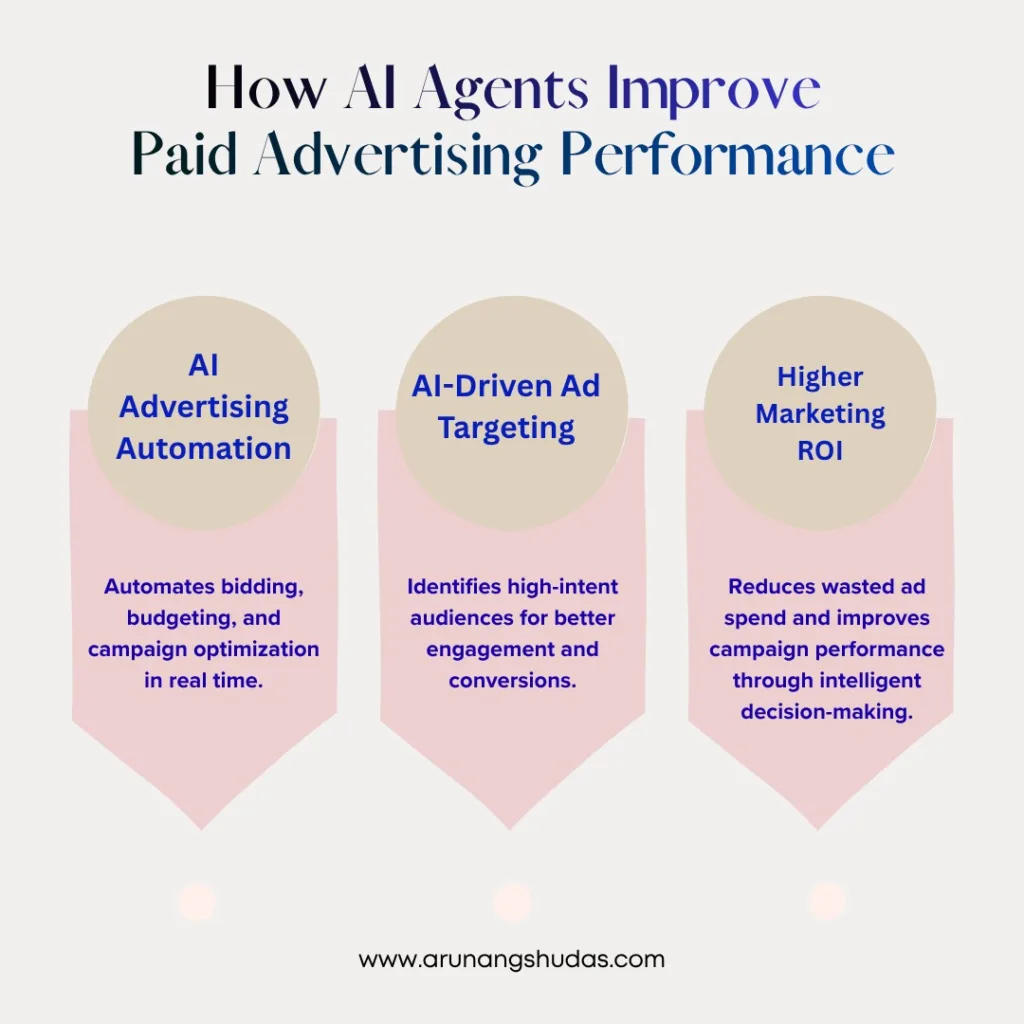
One of the biggest advantages of AI advertising automation is its ability to eliminate repetitive manual tasks. AI agents continuously monitor campaign performance and make adjustments without requiring constant human intervention.
Benefits include:
- Faster campaign optimization
- Reduced operational workload
- Improved budget efficiency
- Better audience targeting
- Higher conversion rates
By automating campaign management, businesses can focus on strategy while AI handles execution.
PPC AI Tools Improve Decision-Making
Modern PPC AI tools analyze large datasets that would be impossible for humans to process efficiently. These tools evaluate user behavior, engagement metrics, conversion data, and market trends to identify optimization opportunities.
Common Functions of PPC AI Tools
| PPC AI Function | Business Impact |
| Keyword Analysis | Improved targeting |
| Audience Insights | Higher engagement |
| Budget Optimization | Reduced waste |
| Predictive Analytics | Better planning |
| Ad Testing | Increased conversions |
| Performance Forecasting | Smarter decisions |
Organizations using advanced PPC AI tools often experience significant improvements in campaign performance and efficiency.
Ad Optimization Systems Deliver Better Results
Modern ad optimization systems continuously evaluate campaign data and automatically make adjustments to improve performance.
These systems can optimize:
- Ad copy
- Headlines
- Visual assets
- Audience segments
- Device targeting
- Geographic targeting
- Ad scheduling
Through machine learning algorithms, ad optimization systems identify the combinations that generate the best results and automatically prioritize them.
Intelligent Bidding AI Maximizes Advertising Spend
Bidding is one of the most critical aspects of paid advertising. AI agents use intelligent bidding AI to determine the optimal bid for every auction in real time.
Factors analyzed include:
- User intent
- Device type
- Location
- Time of day
- Historical performance
- Conversion probability
Benefits of Intelligent Bidding AI
| Benefit | Result |
| Real-Time Adjustments | Better bid efficiency |
| Conversion Prediction | Improved ROI |
| Budget Protection | Reduced overspending |
| Audience Prioritization | Higher quality traffic |
| Continuous Learning | Long-term improvement |
This technology enables advertisers to maximize campaign performance while maintaining budget control.
Google Ads AI Is Transforming Search Advertising
Many businesses rely on Google Ads AI features to automate and improve advertising campaigns. Google’s AI-powered solutions help advertisers optimize bidding, targeting, and creative assets.
Key capabilities include:
- Smart Bidding
- Responsive Search Ads
- Performance Max campaigns
- Automated audience targeting
- Conversion optimization
With Google Ads AI, marketers can scale campaigns more effectively while reducing manual management requirements.
Meta Ads Automation Enhances Social Advertising
Social media advertising has also benefited significantly from Meta Ads automation. AI agents continuously analyze user behavior across platforms and optimize ad delivery accordingly.
Benefits of Meta Ads automation include:
- Dynamic audience targeting
- Automated budget distribution
- Creative optimization
- Real-time campaign adjustments
- Improved conversion performance
These capabilities help businesses reach the right users at the right time with relevant messaging.
AI-Driven Ad Targeting Improves Audience Precision
One of the strongest advantages of AI-powered advertising is AI-driven ad targeting. Rather than relying solely on predefined audience segments, AI agents identify behavioral patterns and predict purchasing intent.
AI-Driven Ad Targeting Benefits
| Targeting Capability | Marketing Advantage |
| Behavioral Analysis | Better audience matching |
| Predictive Modeling | Higher conversion potential |
| Interest Detection | Improved engagement |
| Intent Recognition | More qualified leads |
| Dynamic Segmentation | Better personalization |
This precision allows advertisers to improve campaign relevance and overall effectiveness.
Marketing ROI AI Helps Maximize Returns
Every marketer aims to improve return on investment. Marketing ROI AI helps businesses identify the most profitable campaigns, channels, and audience segments.
AI agents analyze:
- Revenue attribution
- Customer acquisition costs
- Conversion rates
- Lifetime value
- Advertising spend efficiency
Using marketing ROI AI, organizations can make more informed investment decisions and allocate resources more effectively.
Autonomous Ad Management Is Reshaping Marketing Operations
The future of paid advertising lies in autonomous ad management. AI agents are increasingly capable of managing entire campaigns with minimal human intervention.
Responsibilities include:
- Audience selection
- Budget allocation
- Bid management
- Performance optimization
- Creative testing
- Reporting
As autonomous ad management evolves, marketing teams can focus more on strategy and innovation rather than routine operational tasks.
Customer Journey Optimization Through AI
Modern advertising success depends on understanding the complete customer experience. AI agents support Customer Journey Optimization by tracking user interactions across channels and touchpoints.
Benefits include:
- Personalized messaging
- Better attribution tracking
- Improved customer experiences
- Increased conversion rates
- Enhanced retention strategies
This holistic approach ensures that advertising efforts align with customer needs throughout the buying process.
Digital Marketing Workflows Become More Efficient
AI agents also improve Digital Marketing Workflows by connecting advertising platforms, analytics tools, CRM systems, and marketing automation software.
Advantages include:
- Reduced manual effort
- Faster reporting
- Improved collaboration
- Better campaign consistency
- Enhanced decision-making
Organizations that optimize Digital Marketing Workflows often achieve greater operational efficiency and improved campaign outcomes.
Conclusion
AI agents are rapidly transforming paid advertising by enabling smarter decision-making, real-time optimization, and greater operational efficiency. Through technologies such as AI advertising automation, PPC AI tools, ad optimization systems, intelligent bidding AI, Google Ads AI, Meta Ads automation, AI-driven ad targeting, marketing ROI AI, and autonomous ad management, businesses can significantly improve campaign performance and profitability.
As organizations continue investing in AI-powered solutions, the combination of Customer Journey Optimization and streamlined Digital Marketing Workflows will play a crucial role in delivering more personalized, efficient, and successful advertising campaigns.
FAQs
1. What is AI advertising automation?
AI advertising automation uses artificial intelligence to manage, optimize, and improve advertising campaigns through automated decision-making and real-time adjustments.
2. How do PPC AI tools improve campaign performance?
PPC AI tools analyze large datasets, optimize bidding strategies, identify audience opportunities, and provide actionable insights that improve advertising effectiveness.
3. What is intelligent bidding AI?
Intelligent bidding AI automatically adjusts bids during ad auctions based on factors such as user behavior, conversion likelihood, device, and location.
4. How does AI-driven ad targeting work?
AI-driven ad targeting analyzes customer behavior, interests, and intent signals to identify and reach the most relevant audience segments.
5. Why is autonomous ad management important?
Autonomous ad management reduces manual work, improves campaign efficiency, optimizes budgets, and allows marketers to focus on strategic initiatives.
