Close Menu
Arunangshu Das Blog
  • SaaS Tools
    • Business Operations SaaS
    • Marketing & Sales SaaS
    • Collaboration & Productivity SaaS
    • Financial & Accounting SaaS
  • Web Hosting
    • Types of Hosting
    • Domain & DNS Management
    • Server Management Tools
    • Website Security & Backup Services
  • Cybersecurity
    • Network Security
    • Endpoint Security
    • Application Security
    • Cloud Security
  • IoT
    • Smart Home & Consumer IoT
    • Industrial IoT
    • Healthcare IoT
    • Agricultural IoT
  • Software Development
    • Frontend Development
    • Backend Development
    • DevOps
    • Adaptive Software Development
    • Expert Interviews
      • Software Developer Interview Questions
      • Devops Interview Questions
    • Industry Insights
      • Case Studies
      • Trends and News
      • Future Technology
  • AI
    • Machine Learning
    • Deep Learning
    • NLP
    • LLM
    • AI Interview Questions
    • All about AI Agent
  • Startup

Subscribe to Updates

Subscribe to our newsletter for updates, insights, tips, and exclusive content!

What's Hot

10 Hidden Features of Chrome DevTools Every Developer Should Know

December 18, 2024

Bootstrap or Seek Funding? A Financial Modeling Guide for Sustainable Growth

October 9, 2025

The Backend Developer Salary

January 20, 2025
X (Twitter) Instagram LinkedIn
Arunangshu Das Blog Tuesday, April 21
  • Write For Us
  • Blog
  • Stories
  • Gallery
  • Contact Me
  • Newsletter
Facebook X (Twitter) Instagram LinkedIn RSS
Subscribe
  • SaaS Tools
    • Business Operations SaaS
    • Marketing & Sales SaaS
    • Collaboration & Productivity SaaS
    • Financial & Accounting SaaS
  • Web Hosting
    • Types of Hosting
    • Domain & DNS Management
    • Server Management Tools
    • Website Security & Backup Services
  • Cybersecurity
    • Network Security
    • Endpoint Security
    • Application Security
    • Cloud Security
  • IoT
    • Smart Home & Consumer IoT
    • Industrial IoT
    • Healthcare IoT
    • Agricultural IoT
  • Software Development
    • Frontend Development
    • Backend Development
    • DevOps
    • Adaptive Software Development
    • Expert Interviews
      • Software Developer Interview Questions
      • Devops Interview Questions
    • Industry Insights
      • Case Studies
      • Trends and News
      • Future Technology
  • AI
    • Machine Learning
    • Deep Learning
    • NLP
    • LLM
    • AI Interview Questions
    • All about AI Agent
  • Startup
Arunangshu Das Blog
  • Write For Us
  • Blog
  • Stories
  • Gallery
  • Contact Me
  • Newsletter
Home » Software Development » Backend Development » 10 Use Cases for SQL and NoSQL Databases
Backend Development

10 Use Cases for SQL and NoSQL Databases

Arunangshu DasBy Arunangshu DasFebruary 22, 2025Updated:February 26, 2025No Comments6 Mins Read
Facebook Twitter Pinterest Telegram LinkedIn Tumblr Copy Link Email Reddit Threads WhatsApp
Follow Us
Facebook X (Twitter) LinkedIn Instagram
Share
Facebook Twitter LinkedIn Pinterest Email Copy Link Reddit WhatsApp Threads

When it comes to databases, one of the biggest debates in the tech world revolves around SQL vs. NoSQL. Both have their strengths, and the right choice depends on the specific needs of your project.

SQL databases, also known as relational databases, have been around for decades and are great for structured data and complex queries. On the other hand, NoSQL databases (which include document stores, key-value stores, column-family stores, and graph databases) are designed to handle unstructured or semi-structured data with high scalability.

So, when should you use SQL, and when should you use NoSQL?

Use Cases for SQL Databases

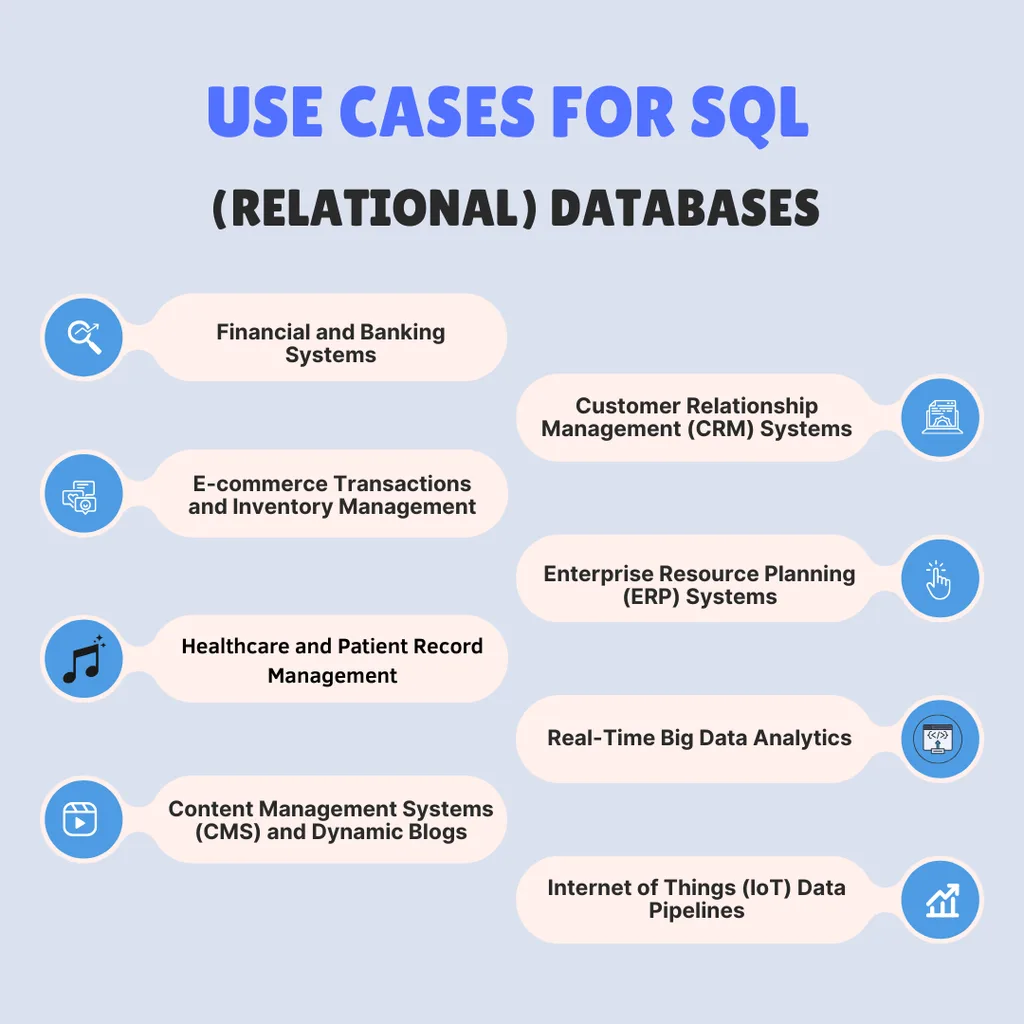
SQL databases are ideal for applications that require structured data, consistency, and complex queries. Here are five scenarios where SQL is the best choice:

1. Financial and Banking Systems

Banks and financial institutions deal with highly structured data that must be accurate, consistent, and secure. Any discrepancy can lead to huge losses, so ACID (Atomicity, Consistency, Isolation, Durability) compliance is crucial.

Example: A banking system needs to ensure that a transaction, such as transferring money from one account to another, happens entirely or not at all. If a transfer fails midway, SQL databases ensure data integrity by rolling back the incomplete transaction.

Best SQL Databases for this use case: PostgreSQL, MySQL, Oracle, SQL Server

2. Customer Relationship Management (CRM) Systems

CRM software (such as Salesforce) stores customer interactions, sales records, and support tickets in structured tables. These records need complex queries and relationships, such as retrieving all interactions of a customer with multiple departments.

Example: A sales manager wants to pull a report of all customers who made a purchase in the last 6 months but haven’t been contacted yet. With SQL’s JOIN and WHERE clauses, such queries are quick and efficient.

Best SQL Databases for this use case: PostgreSQL, MySQL, SQL Server

3. E-commerce Platforms for Transactions and Inventory

E-commerce websites handle order transactions, payments, inventory management, and customer data, all of which require strict consistency.

Example: Imagine a situation where two customers place an order for the last available item at the same time. An SQL database with locking mechanisms ensures that only one order goes through, preventing overselling.

Best SQL Databases for this use case: MySQL, PostgreSQL, Oracle

4. Enterprise Resource Planning (ERP) Systems

ERP systems integrate various departments like HR, finance, procurement, and logistics. These require structured data and complex reporting.

Example: A company’s ERP system needs to generate a monthly payroll report by aggregating attendance data, bonuses, and tax deductions—tasks well-suited for SQL’s aggregation functions.

Best SQL Databases for this use case: Oracle, SQL Server, PostgreSQL

5. Healthcare Management Systems

Healthcare applications require strict data integrity, relationships, and compliance (HIPAA, GDPR, etc.). SQL databases ensure patient records remain consistent and traceable.

Example: A hospital uses an SQL database to store patient medical records, prescriptions, and doctor appointments, ensuring that records don’t get duplicated or lost.

Best SQL Databases for this use case: PostgreSQL, MySQL, SQL Server

Use Cases for NoSQL Databases

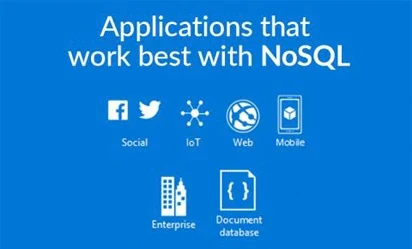
NoSQL databases are designed for applications that require high scalability, flexibility, and handling of unstructured data. Here are five scenarios where NoSQL is the better choice:

6. Real-Time Big Data Analytics

When dealing with massive amounts of real-time data, NoSQL databases (especially column-family and key-value stores) outperform SQL databases due to their high-speed write operations.

Example: Social media platforms like Facebook or Twitter analyze millions of posts, comments, and likes per second. NoSQL databases handle this scale efficiently without performance bottlenecks.

Best NoSQL Databases for this use case: Apache Cassandra, Amazon DynamoDB

7. Content Management Systems (CMS) and Blogs

CMS platforms like WordPress, Drupal, and Ghost need flexible data storage because articles, images, and metadata vary widely in structure. NoSQL allows developers to store unstructured and semi-structured content easily.

Example: A blog post may have different fields like title, author, tags, images, and embedded videos, but not every post contains all these fields. A document-based NoSQL database like MongoDB allows flexible storage without predefined schemas.

Best NoSQL Databases for this use case: MongoDB, CouchDB

8. Internet of Things (IoT) Applications

IoT applications generate huge volumes of sensor data that need to be processed in real-time. NoSQL databases are designed for high write-speed and scalability.

Example: A smart home system collects temperature, humidity, and motion data from thousands of sensors. NoSQL databases allow fast, schema-less writes to store this constantly changing data.

Best NoSQL Databases for this use case: Apache Cassandra, InfluxDB

9. Personalization and Recommendation Engines

Personalization engines need to analyze user behavior and preferences in real time to provide tailored recommendations. Graph databases (a type of NoSQL) are particularly useful here.

Example: Netflix and Spotify use graph databases to store user preferences and relationships between content to make recommendations based on past behavior.

Best NoSQL Databases for this use case: Neo4j, Amazon Neptune

10. Scalable Gaming Applications

Online multiplayer games generate millions of concurrent transactions, including player profiles, leaderboards, in-game purchases, and real-time actions. NoSQL databases provide high-speed performance and scalability.

Example: A battle royale game with millions of players online simultaneously needs a database that can handle high traffic while keeping response times low. NoSQL databases excel at handling real-time game state updates.

Best NoSQL Databases for this use case: Amazon DynamoDB, Redis

Conclusion: SQL or NoSQL? It Depends!

Both SQL and NoSQL databases have their strengths.

FeatureSQLNoSQL
Data StructureStructuredUnstructured / Semi-structured
ScalabilityVerticalHorizontal
Use CaseTransactions, Finance, ERP, HealthcareBig Data, Real-Time Analytics, Personalization, IoT
QueryingComplex Queries (JOINs, Aggregations)Fast Reads/Writes, Flexible Data Models
ACID ComplianceStrongEventual Consistency

Choosing the right database depends on your project’s needs. If you need data integrity, structured queries, and consistency, go with SQL. If you require scalability, flexibility, and fast real-time processing, opt for NoSQL.

You may also like:

1) 5 Common Mistakes in Backend Optimization

2) 7 Tips for Boosting Your API Performance

3) How to Identify Bottlenecks in Your Backend

4) 8 Tools for Developing Scalable Backend Solutions

5) 5 Key Components of a Scalable Backend System

6) 6 Common Mistakes in Backend Architecture Design

7) 7 Essential Tips for Scalable Backend Architecture

8) Token-Based Authentication: Choosing Between JWT and Paseto for Modern Applications

9) API Rate Limiting and Abuse Prevention Strategies in Node.js for High-Traffic APIs

10) Can You Answer This Senior-Level JavaScript Promise Interview Question?

11) 5 Reasons JWT May Not Be the Best Choice

12) 7 Productivity Hacks I Stole From a Principal Software Engineer

13) 7 Common Mistakes in package.json Configuration

Read more blogs from Here

Share your experiences in the comments, and let’s discuss how to tackle them!

Follow me on Linkedin

Follow on Facebook Follow on X (Twitter) Follow on LinkedIn Follow on Instagram
Share. Facebook Twitter Pinterest LinkedIn Telegram Email Copy Link Reddit WhatsApp Threads
Previous Article7 Advantages of Microservices Over Monolithic Architecture
Next Article 5 Key Principles of Database Normalization
Arunangshu Das
  • Website
  • Facebook
  • X (Twitter)

Trust me, I'm a software developer—debugging by day, chilling by night.

Related Posts

How Does $JAVA_HOME Affect an Already Installed /usr/bin/java?

January 24, 2026

Top 10 Software Development Companies in India for US and UK Companies

January 13, 2026

Top 10 Healthcare Credentialing & Privileging Software in the US in 2026

December 30, 2025
Add A Comment
Leave A Reply Cancel Reply

Top Posts

Text Embeddings in NLP

May 16, 2024

6 Common Mistakes in Backend Architecture Design

February 5, 2025

How does containerization work in DevOps?

December 26, 2024

How to Set Up Your First WordPress Website on Cloudways? (Step-by-Step for Beginners)

June 19, 2025
Don't Miss

AI Hardware Boom: GPUs, Chips, and Market Trends in 2025

September 9, 20256 Mins Read

The AI hardware boom is transforming the global technology and semiconductor industries at an unprecedented…

The Rise of Serverless Architecture

October 6, 2024

7 Common CORS Errors and How to Fix Them

February 26, 2025

Emerging IoT Hacking Techniques and How to Stay Protected

November 21, 2025
Stay In Touch
  • Facebook
  • Twitter
  • Pinterest
  • Instagram
  • LinkedIn

Subscribe to Updates

Subscribe to our newsletter for updates, insights, and exclusive content every week!

About Us

I am Arunangshu Das, a Software Developer passionate about creating efficient, scalable applications. With expertise in various programming languages and frameworks, I enjoy solving complex problems, optimizing performance, and contributing to innovative projects that drive technological advancement.

Facebook X (Twitter) Instagram LinkedIn RSS
Don't Miss

10 Best Practices for Securing Your Backend

February 14, 2025

Migration to the Cloud: Real World cases

July 2, 2024

What are the differences between Docker and Kubernetes?

November 3, 2024
Most Popular

BERT

May 14, 2024

Measurement of Dispersion

April 3, 2024

Why Agencies Love Cloudways: 12 Hidden Features You Should Know

June 27, 2025
Arunangshu Das Blog
  • About Us
  • Contact Us
  • Write for Us
  • Advertise With Us
  • Privacy Policy
  • Terms & Conditions
  • Disclaimer
  • Article
  • Blog
  • Newsletter
  • Media House
© 2026 Arunangshu Das. Designed by Arunangshu Das.

Type above and press Enter to search. Press Esc to cancel.

Ad Blocker Enabled!
Ad Blocker Enabled!
Our website is made possible by displaying online advertisements to our visitors. Please support us by disabling your Ad Blocker.