


Operating a startup can be challenging. In addition to day-to-day business operations, customer acquisition, and growth, one of the toughest jobs facing founders is bookkeeping. A lot of companies begin with spreadsheets and soon find out that it is hard, time-consuming, and full of errors to manually track expenses and transactions. This is where startup accounting software provides the answer.
You do not need to struggle to enter your financial transactions, bills and tax information. On the flipside, startup accounting can be structured, streamlined, and stress-free with the assistance of intuitive and automated tools. Effective startups may save both time and money on several procedures that can involve client billing, payroll, expenses, and tax filing
In this post, we will present all that you should know about accounting software. We are going to discuss what it is, why it matters to startups, features to consider, Best Accounting Software for Startups and even how to have a professional like Arunangshu Das help you decide on and implement the best software.

By keeping financial data accurate and organized, accounting software allows founders to focus on innovation and growth rather than getting bogged down by manual spreadsheets or the early expense of a full-time accountant.
What is Accounting Software?
Accounting software is a digital financial management tool designed to record, track, and analyze business finances. For startups, it replaces the chaos of manual bookkeeping with a single, centralized platform to:
- Automate invoicing and billing to ensure faster payments.
- Track and categorize expenses in real time.
- Streamline payroll management for growing teams.
- Simplify tax calculations and compliance.
- Generate real-time analytics and financial reports.
Also Read this Blog – Startup Ideas for Students in India: Practical Paths to Entrepreneurship
Key Features Every Startup Needs
Not all accounting tools are built the same. While enterprise companies need complex legacy systems, startups require agility, automation, and scalability. The best accounting software for startups should eliminate day-to-day operational friction so you can focus entirely on growth.
Here are the non-negotiable, essential features to look for:
1. Automated Invoicing and Billing
Cash flow is the lifeblood of an early-stage company. Late payments can severely threaten your runway, making efficient invoicing critical.
- Custom Professional Branding: Create and send sleek, branded invoices that reflect your startup’s professionalism.
- Recurring Billing & Subscriptions: Essential for SaaS or agency models—automatically bill clients weekly, monthly, or annually.
- Integrated Payment Gateways: Let clients pay instantly via credit card, ACH, or Apple Pay right from the invoice to speed up your collection cycle.
- Automated Reminders: Gently nudge clients with automated emails when an invoice is coming due or past due, saving you awkward follow-up conversations.
2. Real-Time Expense Management
Every dollar counts when you are scaling. Waiting until the end of the month to see what you spent is a recipe for a cash crunch.
- Bank Feeds & Smart Categorization: Connect your business bank accounts and credit cards to automatically pull in transactions and categorize them using AI.
- Receipt Capture on the Go: Snap photos of receipts with a mobile app to instantly match them to transactions, ensuring you never miss a tax deduction.
- Employee Spend Control: Issue virtual or physical corporate cards with built-in spending limits to keep team expenses in check.
3. Comprehensive Payroll and Contractor Support
Startups scale by hiring fast, often relying on a mix of full-time employees and freelance talent across different states or countries.
- W-2 and 1099 Management: Seamlessly pay full-time staff and independent contractors while keeping their tax statuses separated.
- Automated Tax Filing: The software should automatically calculate, withhold, and file local, state, and federal payroll taxes to keep you legally compliant.
- Direct Deposit: Offer fast, reliable electronic payments directly into your team’s bank accounts.
4. Automated Tax Calculation & Compliance
Tax mistakes can result in heavy penalties that younger businesses simply cannot afford. Your software should take the guesswork out of tax season.
- Sales Tax Automation: If you sell digital or physical goods globally or across state lines, the software must calculate the correct sales tax or VAT based on the buyer’s location.
- Tax-Ready Financials: Organize your chart of accounts so that come tax season, you can hand everything over to a CPA or export it directly into tax filing software with one click.
- R&D Tax Credit Tracking: Many startups qualify for Research and Development tax credits; your software should easily track eligible development expenses.
5. Real-Time Analytics and Financial Reporting
If you plan to raise venture capital or secure a bank loan, you need accurate, professional financial statements on demand.
- Essential Financial Statements: Instantly generate Profit & Loss (P&L) statements, Balance Sheets, and Cash Flow statements.
- Burn Rate & Runway Tracking: Visual dashboards that tell you exactly how much cash you are spending each month and how many months of runway you have left.
- Investor-Ready Reporting: Easily export clean, detailed financial health reports to share with stakeholders, board members, or potential investors during a funding round.
6. Cloud Storage and Multi-Device Access
The days of being tied to a single desktop computer are over. Startup founders are always on the move and need their financial data to move with them.
- True Mobility: Access your dashboard, send invoices, or check your cash balance from your phone, tablet, or laptop anywhere in the world.
- Secure Cloud Backups: Your data is continuously backed up with bank-grade encryption, protecting your sensitive information from hardware failures or cyber threats.
- Multi-User Collaboration: Grant tailored access levels to your co-founders, bookkeeper, operations manager, or external CPA without sharing a single password.
Pro Tip for Startups: Look for an API Integration Ecosystem
Beyond these six core features, ensure the software plays nicely with your existing tech stack. Look for robust integrations with your CRM (like Salesforce or HubSpot), your e-commerce platform (like Shopify or Stripe), and your project management tools. Seamless data flow prevents manual data entry errors down the road.
Why Startups Need Accounting Software
Just imagine your concentration on creating your product and your Accounting Software for Startups has the number-crunching on the background.
Key benefits include:
- Saves Time: Automates repetitive tasks.
- Reduces Errors: Minimizes human mistakes.
- Tax Filing: Very easy, and accurate.
- Provides Real-Time Intel: Up-to-the-minute cash flow and profits.
- Boost Investor Confidence: Expert reports add to the investment desirability and persuade investors in its favor.
Factors to Consider Before Choosing Software for Startups
Not every tool is a good fit. When comparing Best Accounting Software to Startups, we recommend that you evaluate the features and prices of the products offered
- Convenience – Designed for novices.
- Cost – Budget friendly, perfect for a startup with no money to spare.
- Scalability – Can the tool scale with your startup?
- Integration – Integrates with your CRM, payment gateway, or project management application.
- Customer Support- Help when you get stalled.
Top Advantages of Accounting Software for Startups
Some major advantages of using Software for Startups include:
- Streamlined invoicing and billing.
- Expense monitoring and tracking.
- Automated payroll and salary management.
- Secure data storage.
- Reports and analytics for decisions.
Best Accounting Software for Startups
Choosing the right accounting platform depends heavily on your startup’s business model, budget, and growth trajectory. While some tools excel at managing inventory for e-commerce, others are built strictly to track billable hours for service agencies.
Here is how the top six contenders stack up against each other:
1. QuickBooks Online
Best Overall for Scalability and Venture-Backed Startups
QuickBooks Online (QBO) is the undisputed industry standard for business accounting. Because the vast majority of external CPAs and investors use and prefer QBO, it is often the safest bet for startups planning to raise institutional funding.
- Pros: Highly scalable tiers; an unmatched ecosystem of third-party integrations; massive network of certified accountants.
- Cons: The interface can feel overly complex for solo founders; subscription costs scale up quickly as you add users.
- Best For: High-growth startups needing investor-ready reporting and deep operational scaling.
2. FreshBooks
Best for Service-Based Startups and Agencies
FreshBooks was originally built as an invoicing tool, and it still leads the market in client-facing features. It completely removes the intimidation factor of traditional double-entry bookkeeping, focusing instead on capturing time and turning it into revenue.
- Pros: Exceptional, intuitive invoicing; built-in project time tracking; easy-to-use client collaboration portals.
- Cons: Limited inventory tracking features; basic plans impose caps on the number of active clients you can bill.
- Best For: Consultants, agencies, design firms, and software freelancers.
3. Xero
Best for Modern Tech Startups and Distributed Teams
Xero is a sleek, cloud-first alternative to QuickBooks that is incredibly popular among tech startups. Unlike other platforms that charge per user, Xero supports unlimited users on all its main tiers, making it highly cost-effective for collaborative teams.
- Pros: Clean, intuitive dashboard interface; unlimited users; powerful open API architecture for custom development stack integration.
- Cons: Entry-level plan places strict limits on the number of invoices and bills you can enter per month.
- Best For: SaaS companies, remote-first startups, and teams utilizing a highly customized tech stack.
4. Zoho Books
Best for Automation-Focused and Product-Based Startups
Part of the massive Zoho product ecosystem, Zoho Books punches way above its price point. It offers enterprise-grade workflow automation and native inventory management features that competitors usually restrict to their most expensive premium tiers.
- Pros: Highly affordable; built-in automation rules; seamless native integration with CRM and inventory apps.
- Cons: Can feel siloed if you don’t use other Zoho apps; smaller network of independent CPAs familiar with the platform.
- Best For: E-commerce, manufacturing startups, and businesses looking to automate rigid backend financial workflows.
5. Wave Accounting
Best for Bootstrapped Startups and Solopreneurs
Wave provides a genuinely free accounting and invoicing software package. It doesn’t lock core bookkeeping functions behind paywalls, choosing instead to make its money via transaction fees on credit card processing and add-on payroll features.
- Pros: $0 base fee; unlimited invoicing and expense tracking; incredibly easy to set up and use on day one.
- Cons: Lacks advanced features like inventory tracking, project profitability, or custom financial auditing logs.
- Best For: Early-stage bootstrapped founders, side-hustles, and micro-startups with simple financial footprints.
6. Sage Business Cloud Accounting
Best for Scaling Startups Needing Heavy Financial Analytics
Sage is built for companies that are looking past the initial startup phase and preparing for mature, mid-market scaling. Its standout features revolve around predictive forecasting, deep financial modeling, and robust multidimensional reporting.
- Best For: Capital-intensive startups, international businesses, and founders focused heavily on data-driven forecasting.
- Pros: Powerful predictive analytics; robust multi-currency capabilities; excellent audit trail logging.
- Cons: Steeper learning curve for non-accountants; UI feels a bit dated compared to cloud-native platforms like Xero.
Popular Startup Software Compared
| Software | Best for | Pricing | Key Features |
| QuickBooks | All-rounder | Paid | Invoicing, tax, payroll |
| FreshBooks | Client-based startups | Paid | Invoicing, time tracking |
| Xero | Remote teams | Paid | Cloud access, integrations |
| Zoho Books | Affordable option | Low Paid | Inventory, automation |
| Wave | Budget-conscious startups | Free | Invoicing, expense tracking |
| Sage | Scaling startups | Paid | Forecasting, analytics |
How Accounting Software Aids in Growing Startups
The transition from a fragile early-stage startup to a scalable, stable enterprise requires more than just a great product—it demands rigorous financial control. The right small business accounting software serves as an operational backbone that fuels growth in three critical ways:
1. Monitoring Financial Metrics in Real Time
When a startup begins to scale, transaction volume can skyrocket overnight. Relying on monthly or quarterly financial cleanups leaves founders flying blind.
- Instant Visibility: Cloud-based dashboards update constantly, offering an immediate look at key metrics like customer acquisition cost (CAC), lifetime value (LTV), and gross margins.
- Agile Decision Making: Real-time data allows you to spot sudden spikes in operational costs or dips in specific revenue streams immediately, giving you the agility to pivot before small issues become structural crises.
2. Creating Reliable, Investor-Ready Forecasts
If you are planning to pitch to angel investors or venture capitalists, static spreadsheets won’t cut it. Investors look for numbers backed by historical data and realistic projections.
- Scenario Modeling: Modern accounting tools allow you to build “what-if” financial models. You can simulate how hiring five new developers or scaling up your ad spend will impact your cash position over the next twelve months.
- Continuous Audit Trails: By maintaining organized, clean historical ledgers, the software removes the friction from investor due diligence, proving that your startup is financially mature and well-managed.
3. Ensuring Smooth and Consistent Cash Flow
A startup can be highly profitable on paper but still go bankrupt if cash is locked up in unpaid invoices when bills come due.
- Runway Protection: Accounting platforms provide clear visual representations of your monthly burn rate and remaining runway, ensuring you know precisely when you need to close your next funding round or hit profitability.
- Automated Capital Optimization: By automating collections and integrating directly with bank feeds, the software minimizes the gap between delivering value and receiving cash, optimizing your working capital naturally.
Common Mistakes Startups Make in Accounting
Even with access to top-tier financial software, technology is only as good as the processes behind it. Avoid these four frequent pitfalls that routinely derail young companies:
1. Ignoring Cash Flow in Favor of Paper Profit
Many founders focus strictly on top-line revenue metrics or bookings. However, revenue is an accounting concept; cash is reality.
- The Trap: Recognizing a massive software contract as revenue before the client has actually paid can give a false sense of security.
- The Fix: Shift your focus to your Cash Flow Statement. Monitor your accounts receivable aging reports weekly to identify slow-paying clients before they choke your daily operations.
2. Failing to Track Small or Fragmented Expenses
In the early days, it is easy to dismiss a minor software subscription, a quick team lunch, or an occasional hardware purchase as negligible.
- The Trap: When multiple team members are buying micro-SaaS tools or minor office equipment on personal cards, those untracked expenses compound. Come tax season, you lose thousands of dollars in legitimate deductions.
- The Fix: Enforce a strict receipt-capture policy from day one. Use mobile app receipt scanning to match expenses to transactions immediately, and transition your team to corporate cards with built-in spending controls.
3. Choosing the Wrong Software for Their Lifecycle
Startups often fall into two extremes: either using a completely free, bare-bones tool that they rapidly outgrow within six months, or overpaying for a complex enterprise system that requires a dedicated administrator to operate.
- The Trap: Migrating financial databases is painful and costly. Choosing a tool without an open API or integration ecosystem forces your team into manual data entry as your tech stack grows.
- The Fix: Select a platform that matches your financial footprint today but offers tiered plans, third-party integrations, and flexible user permissions that scale seamlessly alongside your revenue.
4. Failing to Secure Sensitive Financial Data
Startups are prime targets for cyberattacks and financial fraud because their internal controls are often relaxed or non-existent.
- The Trap: Sharing a single master login among founders, interns, and external contractors creates major vulnerabilities. It leaves no audit trail to show who authorized a payment or modified a past transaction.
- The Fix: Implement role-based access control (RBAC). Ensure every user has separate credentials, enforce Multi-Factor Authentication (MFA), and select accounting platforms that use bank-grade, end-to-end data encryption.
The Future of Startup Accounting Software
The accounting landscape is undergoing a massive shift, moving away from passive record-keeping tools and evolving into proactive financial intelligence engines.
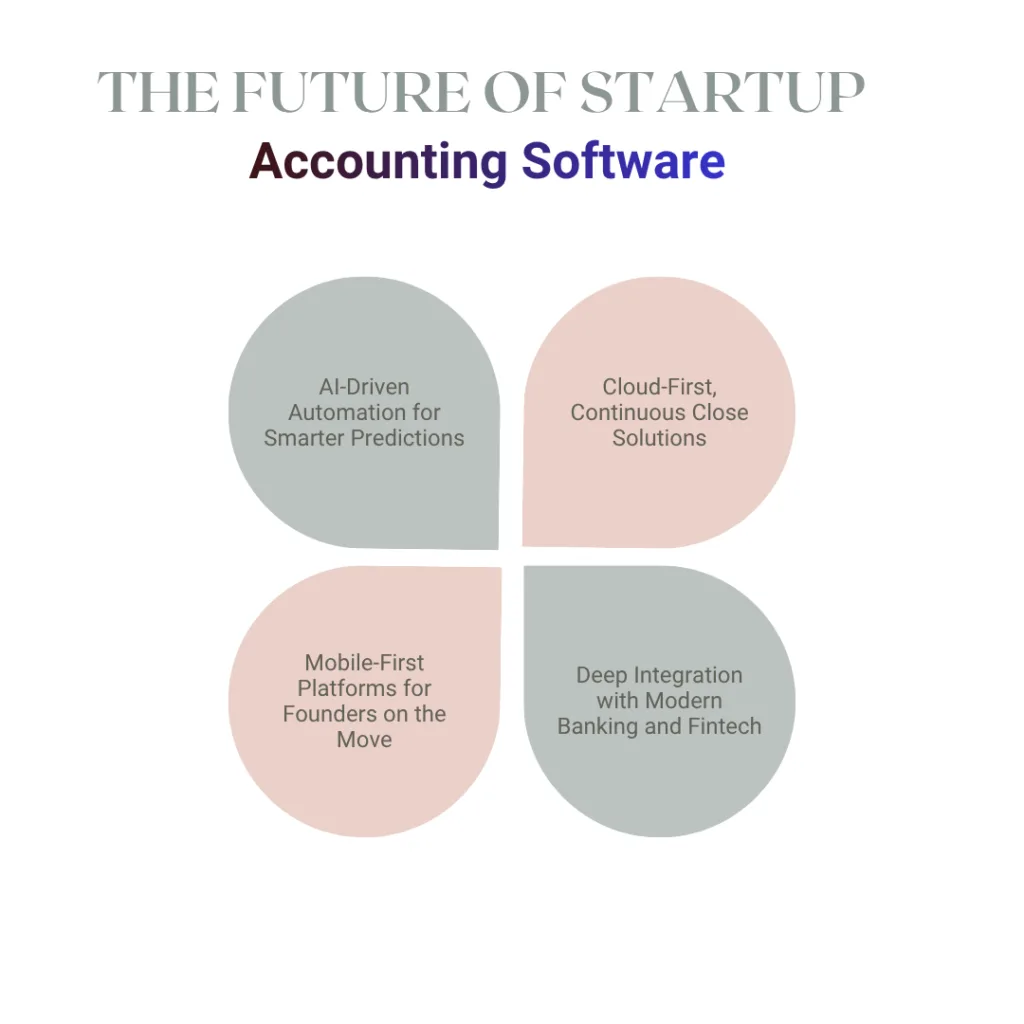
The next generation of tools centers on four defining pillars:
1. AI-Driven Automation for Smarter Predictions
The days of manual data entry, manual ledger coding, and painful month-end reconciliations are drawing to a close.
- Autonomous Workflows: Machine learning algorithms now handle routine bookkeeping by automatically extracting data from incoming invoices, predicting general ledger codes, and auto-matching bank statements.
- Predictive Anomaly Detection: Instead of discovering an error during a quarterly review, AI systems scan for unusual spending patterns or potential double-billings in real time, flagging risks before capital leaves your account.
2. Cloud-First, Continuous Close Solutions
The concept of waiting two weeks after the month ends to “close the books” is becoming obsolete.
- Continuous Accounting: Next-generation cloud software updates your financial state continuously. This means metrics like your balance sheet or income statement reflect your exact financial health at any given hour of any day, entirely unchained from physical office locations.
3. Mobile-First Platforms for Founders on the Move
Modern startup founders rarely run their businesses from a single desktop monitor.
- Executive Dashboards: Future-ready platforms build comprehensive mobile apps that don’t just offer cut-down features, but provide full business visibility—allowing you to approve major vendor payouts, review cash runways, or generate investor-ready charts directly from your smartphone.
4. Deep Integration with Modern Banking and Fintech
The line between your business bank account and your accounting software is blurring into a unified financial ecosystem.
- Embedded & Agentic Commerce: Accounting tools are integrating deeply with open banking frameworks and automated fintech APIs. In the near future, your software won’t just track your bills—it will autonomously negotiate vendor terms, optimize treasury management to maximize yield on your venture capital deposits, and execute payments based on your cash flow health.
How Arunangshu Das is Empowering Startups Through Accounting Software
The task of choosing the best Software for Startups, can be quite challenging. That’s where Arunangshu Das comes in.
He is focused on getting startups set up with the best tools and getting the best performance out of it, as well as support. Through customized training to system integration, he knows how to make startups do the most with what they’re spending—saving time, limiting errors and having financial transparency.
Conclusion
The Difference between Accounting Software for Startups If youre a brand-new business looking for accounting software, the right one can make a world of a difference. For those who are starting a new company, the best idea is to invest early in a Best Accounting Software for Startups minimizing time spent with numbers and spending the effort in innovation and growth.
Begin simply, select carefully and leave it to technology to deal with the money while you grow your business feeling secure.
FAQs
1. What is the cheapest accounting software for startups?
Wave Accounting is the best free option for startups.
2. Can free accounting software be enough for a new business?
Yes. Although free programs like Wave are excellent for startup companies that are at an early stage, paid options are better for companies that are expanding.
3. Which accounting software is best for startups with remote teams?
Xero is highly recommended because of its cloud-first, multi-user approach.
4. How does accounting software help to get investors?
What’s more, it delivers accurate financial reports, forecasts and real-time insights that instill investor trust.
5. Are cloud-based accounting tools secure?
Yes. Most solutions in the cloud protect data with strong encryption, same as the way banks in general work.
