


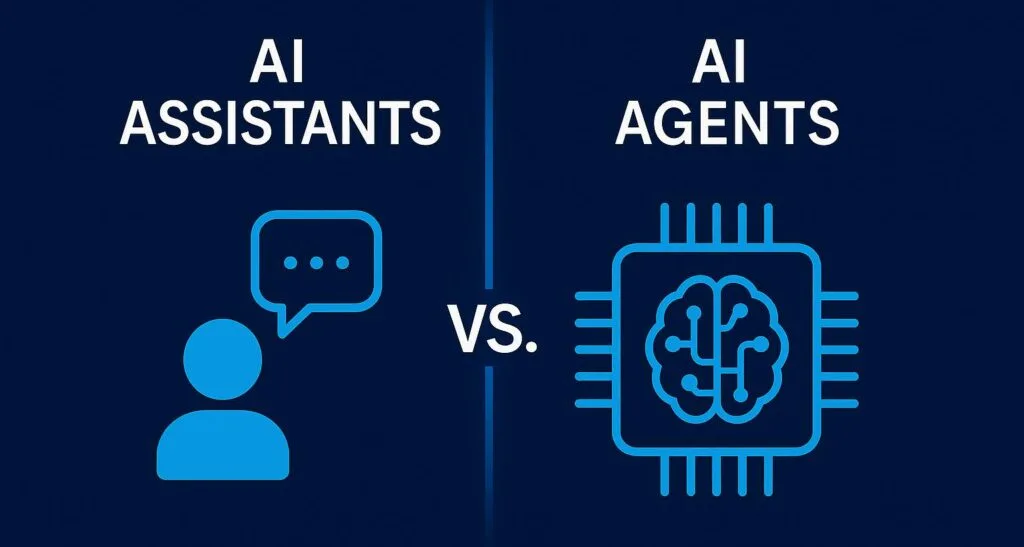
The AI agent vs AI assistant debate is confusing business leaders and tech buyers alike. Are they the same thing? Is an agent just a smarter assistant? The short answer is no. The difference between an AI agent vs AI assistant is fundamental: an assistant suggests; an agent executes. An assistant waits for your command; an agent acts autonomously within defined boundaries. An assistant helps you work; an agent works for you.
Understanding the AI agent vs AI assistant distinction matters because the two technologies require different implementation strategies, security protocols, and ROI calculations. In 2026, companies that confuse assistants for agents will waste budget on tools that do not deliver autonomy.
Companies that deploy agents without proper safeguards will face compliance disasters. This guide breaks down the AI agent vs AI assistant comparison across definitions, use cases, decision-making authority, and real-world examples.
Table of Contents
AI Agent vs AI Assistant: Head-to-Head Comparison
Let’s define the core differences in the AI agent vs AI assistant battle before diving into specific examples. Understanding these distinctions is the first step to choosing the right tool for your workflow.
| Dimension | AI Assistant | AI Agent |
|---|---|---|
| Primary role | Suggest, recommend, summarize | Execute, negotiate, complete tasks |
| Decision authority | None — requires human approval | Limited — acts within parameters |
| Typical interaction | Chat or voice command | Background autonomous operation |
| Example tasks | Draft email, summarize document, schedule meeting | Renegotiate contract, reconcile accounts, reroute shipments |
| Human oversight | Continuous (you approve every action) | By exception (you review only failures or high-stakes actions) |
| Learning | From your feedback | From outcomes and environment |
The AI agent vs AI assistant comparison reveals a spectrum of autonomy. Assistants are tools. Agents are teammates. Assistants reduce friction. Agents reduce headcount. Neither is inherently better—the right choice depends on your risk tolerance, task complexity, and regulatory environment.
What Is an AI Assistant? (And Where It Excels)

In the AI agent vs AI assistant discussion, assistants are the familiar tools most people have used since 2023. ChatGPT, Claude, Microsoft Copilot, and Google Gemini are all AI assistants. They respond to prompts, generate text, answer questions, and perform simple actions like drafting emails or creating calendar invites. However, every action requires human initiation and human approval.
AI assistant capabilities include summarization, translation, code generation, brainstorming, and basic data analysis. You ask a question; the assistant answers. You request a draft; the assistant writes it. You approve the output; you send it. The assistant never acts independently. This is the defining characteristic in the AI agent vs AI assistant comparison: assistants are reactive.
Best use cases for AI assistants:
- Drafting internal memos or client emails
- Summarizing long documents or meeting transcripts
- Brainstorming marketing copy or product names
- Answering customer questions via chat (with human review)
- Generating first-pass code or SQL queries
AI assistant capabilities have improved dramatically in 2026. Modern assistants can maintain context across 100,000 tokens, cite sources, and even suggest edits to your work. However, they still cannot act. You are always the decision-maker. For low-stakes, creative, or exploratory tasks, assistants are perfect. For mission-critical operations, they are insufficient—which brings us to agents.
What Is an AI Agent? (And Why It’s Disruptive)
In the AI agent vs AI assistant debate, agents represent the next frontier. An AI agent is an autonomous system that receives a goal, breaks it into steps, executes those steps, handles exceptions, and reports results—all without continuous human intervention. Autonomous AI agents do not wait for you to click “approve.” They act within boundaries you set in advance.
For example, an AI assistant can draft a contract renewal email for you to review and send. An AI agent can negotiate the renewal directly with the vendor, redline unacceptable clauses, escalate to legal if needed, and execute the signature—all while you sleep. This is the core AI agent vs AI assistant distinction: agents have execution authority.
Best use cases for autonomous AI agents:
- Contract review and negotiation (LexFinity Agent)
- Accounts payable reconciliation (ReconBot)
- Customer retention offers (EmpathAI)
- Cross-departmental workflow orchestration (Operon Agent)
- Supply chain rerouting during disruptions
Autonomous AI agents require more setup than assistants. You must define parameters (e.g., “discount up to 15%,” “no exclusive clauses”), escalation rules (e.g., “if contract value > $100k, get human review”), and fallback behaviors. However, once configured, agents deliver 10x the labor savings of assistants because they replace execution, not just suggestion.
Key Differences: AI Agent vs AI Assistant in Practice

Let’s examine concrete scenarios that highlight the AI agent vs AI assistant difference.
Scenario 1: Customer refund request
- AI Assistant: Reads the request, drafts a refund approval email for a manager to review and send. Total time saved: 3 minutes.
- AI Agent: Verifies the customer’s purchase history, checks refund policy, approves if eligible, processes the refund via Stripe, and sends confirmation. If ineligible, sends explanation and coupon. Total time saved: 15 minutes + manager attention.
Scenario 2: Vendor contract renewal
- AI Assistant: Summarizes the current contract, highlights changes, and drafts an email asking legal to review. Time saved: 20 minutes.
- AI Agent: Compares renewal terms to market benchmarks, redlines unfavorable clauses, negotiates via email with vendor’s AI agent, and presents a signed contract. Time saved: 6 hours + legal review.
Scenario 3: Data entry from PDF to CRM
- AI Assistant: Extracts fields from a PDF and pastes them into a spreadsheet for a human to copy into the CRM. Time saved: 5 minutes.
- AI Agent: Extracts fields, validates against existing records, creates or updates CRM entries, and flags duplicates for human review. Time saved: 45 minutes.
These examples clarify the AI agent vs AI assistant distinction. Assistants are accelerators for human work. Agents are substitutes for human work.
When to Use AI Assistant vs AI Agent
The AI agent vs AI assistant choice depends on four factors.
Use an AI assistant when:
- The task requires creativity or subjective judgment (brand voice, strategic direction)
- You have low volume (less than 10 similar tasks per week)
- The cost of error is high (one wrong email could lose a client)
- You are in early exploration (you do not know the exact workflow yet)
Use an autonomous AI agent when:
- The task follows clear, repeatable rules (even if complex)
- You have high volume (50+ similar tasks per week)
- The cost of delay exceeds the cost of error (speed matters more than perfection)
- You have defined escalation paths for exceptions
Most organizations need both. The AI agent vs AI assistant debate is not “which one wins?” but “which task gets which tool?”
Risks and Implementation: AI Agent vs AI Assistant
The AI agent vs AI assistant risk profiles are dramatically different. AI assistants have low risk because a human approves every output. The worst case is a poorly drafted email that you edit before sending. Autonomous AI agents have higher risk because they act without per-action approval. An agent could approve a fraudulent refund, sign a bad contract, or delete critical data.
Mitigate agent risk with three safeguards:
- Action limits: Set dollar thresholds above which the agent cannot act without human approval.
- Audit trails: Require every agent action to be logged in an immutable ledger.
- Human-in-the-loop mode: Start all agents in “suggest only” mode for 30 days. Review every suggested action. Then grant execution权限 for low-risk actions, then expand.
For AI assistant capabilities, no special safeguards are needed beyond normal data security. Assistants do not act, so they cannot cause operational damage.
The Future of AI Agent vs AI Assistant
By 2028, the line between AI agent vs AI assistant will blur. Assistants will gain limited execution capabilities (e.g., “send this email after I approve”). Agents will gain better natural language understanding (e.g., “handle this exception like you saw me handle it last week”). However, the fundamental distinction—suggestion vs. execution—will remain.
The most sophisticated platforms will offer a slider from “assistant mode” (every action approved) to “agent mode” (autonomous within bounds). You will choose the autonomy level per task, per user, per dollar threshold. Already, vendors like Microsoft and Salesforce are building this hybrid model into their 2027 roadmaps.
Final Verdict
The AI agent vs AI assistant distinction is simple: assistants suggest; agents execute. Assistants need your permission for every action. Agents act autonomously within guardrails. Use assistants for creative, low-volume, or high-stakes tasks where human judgment is irreplaceable. Use autonomous AI agents for repetitive, high-volume, rule-based tasks where speed matters more than perfection. Deploy both. Just do not confuse them—your security and compliance teams will thank you.
Frequently Asked Questions (FAQs)
Q1: Is ChatGPT an AI agent or an AI assistant?
ChatGPT is an AI assistant, not an agent. It can suggest, summarize, draft, and answer questions, but it cannot execute actions autonomously. ChatGPT cannot send an email, update a database, or negotiate a contract without a human copying its output and taking action. Some third-party plugins (e.g., Zapier) give ChatGPT limited execution, but the core model remains an assistant. In the AI agent vs AI assistant spectrum, ChatGPT is firmly on the assistant side.
Q2: Can an AI agent turn into an AI assistant or vice versa?
No, the architecture is different. Autonomous AI agents are built for execution: they have APIs to external systems, permission frameworks, audit logging, and exception handling. AI assistant capabilities are built for conversation and generation. You cannot turn a pure assistant into an agent without adding execution infrastructure. However, platforms like Microsoft Copilot are adding agent-like features (e.g., “execute this workflow”). In those cases, the platform includes both modes, but the underlying distinction remains.
Q3: Which is more expensive: AI agent or AI assistant?
Agents are significantly more expensive, typically 3-5x the cost of an assistant. An enterprise AI assistant license costs $20-$50 per user per month. An autonomous AI agent license costs $300-$1,500 per month per agent (not per user). The higher price reflects the value: agents replace human labor (saving 20-40 hours per week), while assistants augment human labor (saving 5-10 hours per week). The AI agent vs AI assistant ROI calculation favors agents for high-volume, repetitive tasks.
