


Managing investment risk has become increasingly complex as financial markets react instantly to economic events, geopolitical developments, inflation data, and company performance. Traditional portfolio management methods often struggle to process enormous volumes of market information quickly enough for informed decision-making. Modern portfolio risk AI solutions powered by intelligent automation are helping financial institutions identify risks, improve forecasting accuracy, and make faster investment decisions.
Today’s investment professionals are integrating AI-driven systems into Investment Banking Operations to strengthen Financial Decision-Making while enhancing Core Infrastructure across trading and analytics platforms. As organizations also focus on Faster SEC Filing, AI-powered technologies are creating a unified environment where compliance, reporting, and portfolio monitoring work together seamlessly. These innovations are transforming how firms evaluate risk before it impacts investment performance.
What Is Portfolio Risk Management?
Portfolio risk management is the continuous process of identifying, measuring, monitoring, and reducing investment risks while maintaining targeted returns.
It includes evaluating:
- Market risk
- Credit risk
- Liquidity risk
- Concentration risk
- Currency exposure
- Interest rate sensitivity
- Industry-specific risks
- Geopolitical uncertainty
Instead of relying solely on historical reports, organizations now use portfolio optimization AI and advanced analytics to monitor thousands of market variables simultaneously.
Why Traditional Portfolio Risk Management Falls Short
Many financial organizations still depend on manual reporting and spreadsheet-based analysis.
Common challenges include:
- Delayed market insights
- Human calculation errors
- Slow portfolio reviews
- Incomplete risk visibility
- Limited predictive capabilities
- Difficulty monitoring global assets
- Time-consuming investment research
As investment portfolios become larger and more diversified, traditional methods struggle to provide real-time intelligence.
How AI Agents Transform Portfolio Risk Management
Modern Autonomous AI Agents continuously collect, analyze, and interpret financial information without constant human supervision.
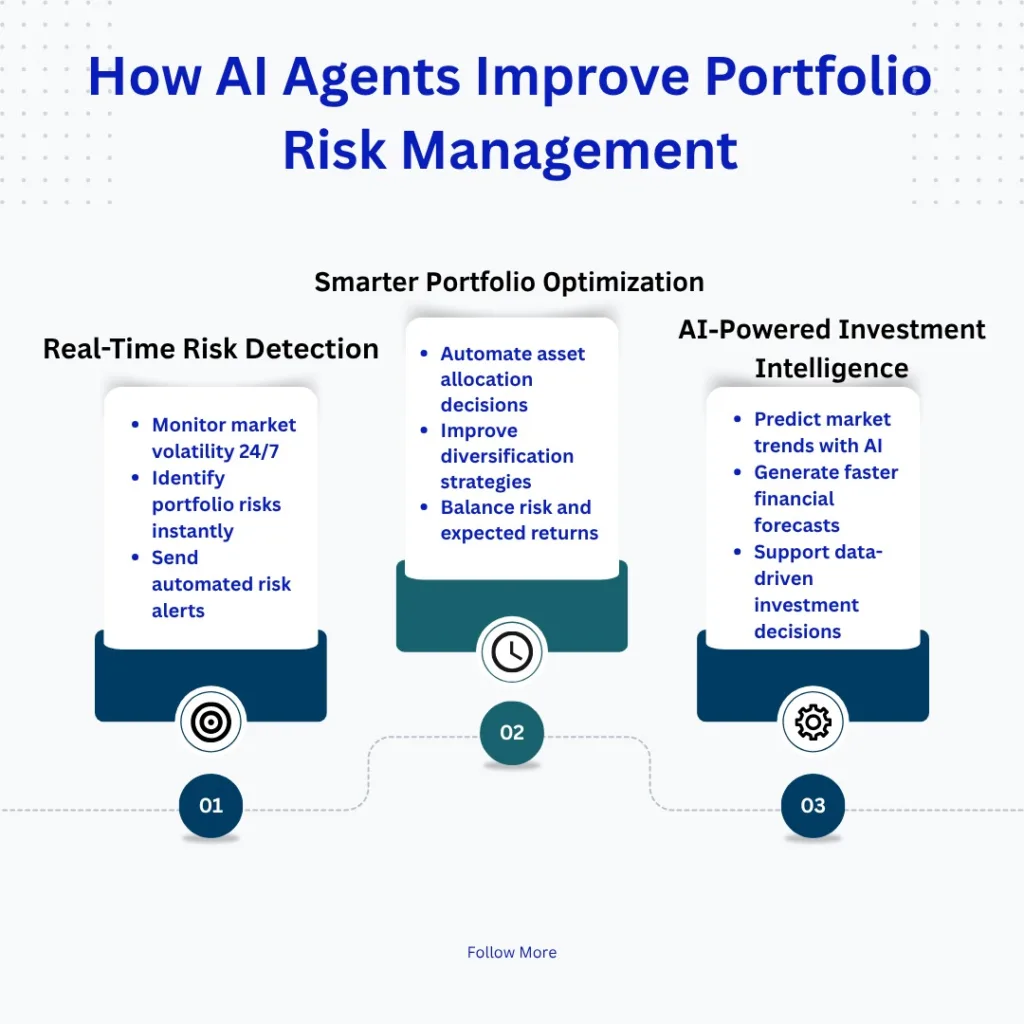
These intelligent systems can:
- Monitor live market conditions
- Analyze earnings releases
- Detect unusual price movements
- Compare historical market behavior
- Recommend portfolio adjustments
- Generate automated risk reports
Unlike traditional software, AI agents continuously learn from new information to improve future recommendations.
AI-Powered Portfolio Monitoring
One of the biggest advantages of investment monitoring systems is continuous surveillance.
AI agents monitor:
- Stock prices
- Bond markets
- Commodity movements
- Currency fluctuations
- Economic indicators
- Corporate news
- Earnings announcements
- Social sentiment
This enables investment teams to respond immediately instead of waiting for scheduled reviews.
Traditional vs AI-Based Portfolio Risk Management
| Feature | Traditional Approach | AI Agent Approach |
| Monitoring Frequency | Periodic | Real-time |
| Risk Detection | Manual | Automated |
| Market Analysis | Historical | Live + Predictive |
| Reporting | Time-consuming | Instant |
| Decision Support | Limited | AI-driven |
| Portfolio Updates | Scheduled | Continuous |
Predictive Risk Analytics Improves Investment Decisions
Historical data alone cannot predict future volatility.
Predictive risk analytics combines:
- Historical trends
- Macroeconomic indicators
- Market volatility
- Company fundamentals
- Alternative data
- Real-time news
AI models estimate future portfolio risks before they significantly impact returns.
This proactive approach improves long-term investment strategies.
Portfolio Optimization AI Maximizes Performance
Maintaining the right balance between return and risk requires continuous portfolio adjustments.
Portfolio optimization AI evaluates:
- Asset correlations
- Diversification levels
- Expected returns
- Risk tolerance
- Market volatility
- Investment objectives
The AI recommends allocation changes that align with investment goals while minimizing unnecessary exposure.
Asset Allocation Automation
One of the most valuable applications of AI is asset allocation automation.
Instead of manually rebalancing portfolios, AI systems automatically evaluate:
- Equity exposure
- Fixed income allocation
- International investments
- Alternative assets
- Sector weightings
Portfolio adjustments happen based on predefined investment strategies and market conditions.
AI Applications Across Portfolio Risk Management
| AI Capability | Business Benefit |
| portfolio risk AI | Continuous risk visibility |
| predictive risk analytics | Early warning detection |
| asset allocation automation | Better diversification |
| investment monitoring systems | Live portfolio tracking |
| portfolio optimization AI | Improved return-risk balance |
| risk intelligence AI | Smarter investment decisions |
Financial Risk Monitoring Becomes Continuous
Organizations increasingly rely on AI for Financial Risk Monitoring because risks evolve every minute.
AI agents continuously evaluate:
- Volatility spikes
- Currency exposure
- Inflation risks
- Interest rate changes
- Credit quality
- Market liquidity
Rather than waiting for monthly reports, firms receive alerts immediately.
Financial Forecasting Systems Improve Accuracy
Forecasting has traditionally relied on historical averages.
Modern financial forecasting systems combine:
- Market data
- Economic indicators
- Industry performance
- Company earnings
- Global events
AI continuously updates projections as new information becomes available.
This helps portfolio managers make faster investment decisions.
Intelligent Wealth Management for Modern Investors
Today’s investors expect personalized investment advice.
Intelligent wealth management platforms use AI to:
- Understand investor goals
- Evaluate risk tolerance
- Recommend diversified portfolios
- Monitor investment performance
- Suggest rebalancing opportunities
This creates a highly personalized investment experience.
Risk Intelligence AI Provides Deeper Insights
Traditional dashboards often highlight only obvious risks.
Risk intelligence AI identifies hidden relationships between:
- Asset classes
- Market sectors
- Economic events
- Interest rates
- Currency markets
- Corporate fundamentals
These deeper insights improve long-term portfolio stability.
AI Benefits for Investment Teams
| Department | AI Benefit |
| Portfolio Managers | Better allocation decisions |
| Risk Teams | Continuous monitoring |
| Compliance | Automated reporting |
| Research Analysts | Faster market analysis |
| Executives | Improved strategic planning |
| Investors | Personalized recommendations |
Autonomous Investment Analysis Reduces Manual Work
Investment research requires reviewing enormous datasets.
Using autonomous investment analysis, AI agents automatically:
- Review financial statements
- Compare company performance
- Analyze earnings reports
- Identify valuation changes
- Detect investment opportunities
Analysts spend less time gathering information and more time making strategic decisions.
Financial Research Workflows Become More Efficient
AI significantly improves Financial Research Workflows by automating repetitive analytical tasks.
Instead of manually collecting market reports, analysts receive:
- Automated research summaries
- Market trend analysis
- Company comparisons
- Risk assessments
- Portfolio recommendations
Research teams can focus on higher-value investment strategies.
Supporting Private Equity Due Diligence
AI also enhances Private Equity Due Diligence by accelerating the evaluation of acquisition opportunities.
AI agents can:
- Analyze financial statements
- Review legal documents
- Identify operational risks
- Compare industry benchmarks
- Detect hidden financial issues
This shortens due diligence timelines while improving decision quality.
Financial Modeling for Analysts
Modern Financial Modeling for Analysts benefits from AI-generated assumptions and automated scenario analysis.
AI can rapidly evaluate:
- Revenue forecasts
- Cash flow projections
- Valuation models
- Sensitivity analysis
- Market scenarios
Analysts produce more accurate financial models in less time.
AI in Wealth Management and Financial Services
Across Wealth Management and broader Financial Services, AI agents improve customer outcomes through automation and intelligent analytics.
Benefits include:
- Personalized portfolio recommendations
- Continuous investment monitoring
- Automated compliance
- Risk reporting
- Market forecasting
- Portfolio optimization
Financial advisors gain deeper insights while serving more clients efficiently.
Hedge Fund Automation with AI
Leading firms are increasingly adopting hedge fund automation to improve investment research and execution.
AI agents help hedge funds by:
- Monitoring global markets
- Identifying arbitrage opportunities
- Tracking alternative data
- Detecting anomalies
- Supporting quantitative strategies
- Managing portfolio exposure
Automation enables faster responses to rapidly changing market conditions.
Business Impact of AI Portfolio Risk Management
| Business Objective | AI Outcome |
| Reduce portfolio risk | Real-time monitoring |
| Improve forecasting | AI-driven predictions |
| Increase efficiency | Automated workflows |
| Better diversification | Smart asset allocation |
| Enhance client experience | Personalized wealth management |
| Faster investment research | Autonomous analysis |
Best Practices for Implementing AI Agents
Successful implementation requires:
- High-quality financial data
- Strong governance policies
- Human oversight
- Regular AI model validation
- Secure cloud infrastructure
- Compliance monitoring
- Continuous performance evaluation
Organizations combining AI with experienced investment professionals achieve the strongest outcomes.
Conclusion
AI agents are fundamentally changing how financial organizations manage investment portfolios. Through portfolio risk AI, predictive risk analytics, asset allocation automation, investment monitoring systems, portfolio optimization AI, financial forecasting systems, risk intelligence AI, and autonomous investment analysis, firms can identify emerging risks earlier, optimize portfolio performance, and improve investment outcomes.
As AI adoption expands across Financial Research Workflows, Private Equity Due Diligence, Financial Modeling for Analysts, Wealth Management, Financial Services, Financial Risk Monitoring, and hedge fund automation, portfolio managers gain powerful tools for making faster, more informed, and data-driven investment decisions in an increasingly complex financial landscape.
Frequently Asked Questions (FAQs)
1. What is portfolio risk AI?
Portfolio risk AI uses artificial intelligence to continuously monitor investments, detect emerging risks, analyze market data, and recommend actions that improve portfolio performance while reducing exposure.
2. How does predictive risk analytics improve investment decisions?
Predictive risk analytics combines historical data, market trends, economic indicators, and AI models to forecast potential risks before they significantly affect investment portfolios.
3. What is asset allocation automation?
Asset allocation automation uses AI to rebalance investment portfolios automatically based on market conditions, investor objectives, diversification requirements, and predefined risk levels.
4. How do Autonomous AI Agents support wealth management?
Autonomous AI Agents monitor portfolios continuously, analyze financial data, generate personalized recommendations, automate reporting, and improve investment decision-making for advisors and clients.
5. Can AI replace human portfolio managers?
No. AI enhances portfolio management by automating research, monitoring, forecasting, and risk analysis, while experienced investment professionals continue to provide strategic judgment, regulatory oversight, and client relationship management.
