



Image processing is one of the most exciting areas in artificial intelligence and computer vision today. Every time a machine identifies a face, detects an object in a photo, or enhances a blurry image, a series of complex operations take place behind the scenes. These operations often involve analyzing images pixel by pixel. In such scenarios, even a small technical concept like padding in image processing can dramatically influence the accuracy of the results.
When developers design algorithms for image recognition or deep learning models, they rely heavily on convolution operations. These operations use filters that move across an image to extract features such as edges, shapes, textures, and patterns. However, without padding, these operations shrink the size of images after each step, which can eventually cause loss of important information.
That is exactly where image padding comes into play. Padding ensures that the edges of an image are handled correctly during processing. It allows filters to operate evenly across all regions of the image, including the borders. In modern padding in deep learning architectures such as Convolutional Neural Networks (CNNs), padding is considered an essential design element that improves model performance and preserves spatial information.
Understanding this concept is not only useful for machine learning engineers but also valuable for designers, photographers, and developers working with visual data. Once you understand how padding works, you gain much more control over how images are transformed and analyzed.
Also read:- Top 5 AI Apps to Turn Your Photos into Animated GIFs
What is Padding in Image Processing
1. Simple Definition of Image Padding
So, what is padding in image processing? In simple terms, padding refers to the process of adding extra pixels around the border of an image before performing operations like convolution. These additional pixels are typically filled with zeros or values derived from nearby pixels.
Imagine placing a picture inside a frame. The frame adds space around the picture without changing the original image. Padding works in a very similar way in digital image processing.
The primary reason for adding padding is to prevent image shrinking during convolution operations. When a filter moves across an image, it requires surrounding pixels to compute results. At the edges of the image, there are fewer surrounding pixels available. Without padding, filters cannot process edge pixels effectively, which leads to smaller output images and loss of edge details.
In many computer vision tasks like object detection, facial recognition, and medical imaging, edge details are extremely important. If the edges are ignored or reduced during processing, the system may fail to detect critical patterns.
Because of this, padding in CNN has become a standard practice in deep learning architectures. Frameworks like TensorFlow and PyTorch automatically implement padding options so developers can control how images are processed.
2. Understanding Padding with a Simple Example
Let’s understand a padding example with a simple scenario.
Suppose you have a 5×5 image and apply a 3×3 filter during convolution. Without padding, the filter cannot fully cover the outermost pixels of the image. As a result, the output becomes 3×3, which means information at the borders gets ignored.
However, if we add one layer of padding around the image, the size becomes 7×7. Now the filter can move across the entire image, including its edges, without losing information.
This small adjustment dramatically improves feature extraction and prevents unnecessary shrinking of feature maps. According to deep learning research, convolution operations reduce image size when filters are smaller than input images, and padding helps maintain spatial dimensions during these operations.
In practical deep learning models, padding allows networks to stack multiple convolution layers while still preserving meaningful spatial information across the image.
Why Padding is Important in Image Processing
1. Preservation of Spatial Information
One of the most important benefits of padding image processing is that it preserves spatial information. In convolution operations, filters analyze patterns across neighboring pixels. If padding is not used, the outermost pixels receive less attention because the filter cannot fully overlap them.
As convolution layers stack in deep learning models, the image size continuously shrinks. After several layers, the image may become so small that it loses important visual context. Padding solves this issue by maintaining consistent dimensions across layers.
When spatial information is preserved, the model can better understand the structure and relationships within the image. For example, when detecting objects such as cars or animals in an image, the edges of the object might be located near the border of the frame. Without padding, these details might be ignored.
Because of this, padding in deep learning is widely used in architectures designed for image classification, segmentation, and object detection.
2. Mitigation of Boundary Effects
Another important role of padding in image processing is reducing boundary effects. Boundary effects occur when pixels near the edges are treated differently than those in the center of the image.
When convolution filters slide across the image, they rely on surrounding pixels to calculate new values. At the center of the image, there are enough surrounding pixels available. But at the edges, fewer pixels exist, which can create distortions or uneven feature extraction.
Padding provides artificial pixels around the borders so the filter can process edge pixels in the same way it processes central pixels. This ensures uniform processing across the entire image.
In CNN-based systems used for autonomous driving or medical imaging, even small distortions at the edges can affect predictions. Proper padding ensures that all parts of the image contribute equally to feature extraction.
3. Control Over Output Size
Padding also gives developers precise control over the output dimensions of feature maps. In deep learning pipelines, maintaining consistent image sizes across layers often simplifies model architecture.
For example, many CNN architectures require input and output dimensions to match so that multiple layers can be stacked effectively. By adjusting padding parameters, developers can ensure that convolution layers maintain the same dimensions as the input.
This concept is particularly useful when designing complex neural networks such as U-Net, ResNet, and VGG. These architectures rely heavily on padding in CNN to maintain structural consistency across layers.
Padding therefore acts as both a functional tool and a design mechanism that allows engineers to build deeper and more efficient neural networks.
Types of Padding in Image Processing
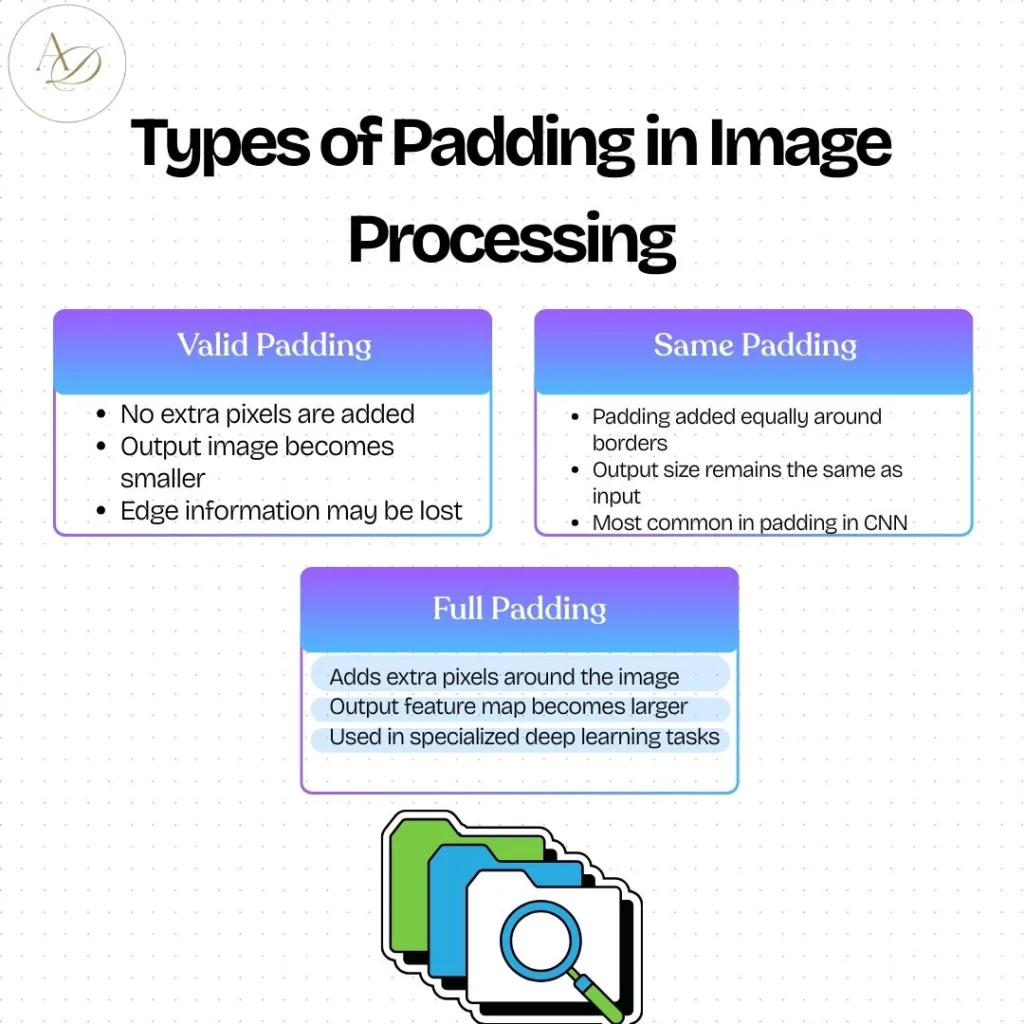
Understanding the types of padding in image processing is essential for designing effective CNN models. Different padding strategies produce different output dimensions and behaviors.
1. Valid Padding
Valid padding means no padding is applied at all. The convolution filter only moves across positions where it fully overlaps with the input image.
Because no extra pixels are added, the output image becomes smaller after convolution. This method is useful when dimensionality reduction is desired.
However, valid padding may cause loss of information near image edges, making it less suitable for tasks requiring precise spatial information.
2. Same Padding
Same padding ensures that the output image has the same dimensions as the input image. This is achieved by adding padding equally around the image borders.
In many deep learning frameworks, the same padding is automatically calculated based on filter size and stride. It is widely used in CNN architectures because it preserves spatial dimensions across convolution layers.
For example, if a 3×3 filter is applied to an image with stride 1, the same padding adds one pixel around the border so the output size remains unchanged.
3. Full Padding
Full padding adds enough pixels so that the output image becomes larger than the original input. This method is less commonly used but can be helpful in specific mathematical operations such as transposed convolution.
In some signal processing tasks, full padding allows filters to analyze image structures more extensively beyond the original boundaries.
Understanding these types of padding in CNN helps practitioners choose the correct strategy depending on their goals.
How Padding Works in CNN and Deep Learning
1. Padding Process in Convolution Operations
The padding process typically occurs before the convolution operation begins. During this step, rows and columns of pixels are added around the edges of the input image.
These pixels may contain:
- Zero values (Zero Padding)
- Reflected border pixels
- Replicated edge pixels
Once padding is added, the convolution filter slides across the padded image and performs calculations on every region. This allows edge pixels to participate fully in feature extraction.
Because of this, padding in CNN ensures that convolution operations treat every pixel equally. It prevents information loss and improves feature detection near the borders.
2. Mathematical Formula Behind Padding
In convolution operations, the output size can be calculated using the following formula:
| Parameter | Meaning |
| Input Size | Width or height of the input image |
| Padding | Number of pixels added to the border |
| Kernel Size | Size of convolution filter |
| Stride | Step size of filter movement |
Output Size Formula:
Output = (Input + 2 × Padding − Kernel) / Stride + 1
This formula allows engineers to calculate exactly how padding will affect feature map dimensions.
Practical Padding Example in Image Processing
Let’s walk through a realistic padding example used in CNN architectures.
Suppose we have an image of size 28×28 and we apply a 5×5 filter.
Without padding:
- Input: 28×28
- Kernel: 5×5
- Output: 24×24
After multiple layers, the image may shrink drastically.
With padding:
- Padding: 2 pixels around border
- Input becomes: 32×32
- Output remains: 28×28
This allows the neural network to maintain spatial information across layers.
Comparison Table of Different Types of Padding
| Padding Type | Description | Output Size | Common Use |
| Valid Padding | No padding applied | Smaller output | Downsampling layers |
| Same Padding | Adds pixels to maintain input size | Same as input | Most CNN architectures |
| Full Padding | Adds extra pixels beyond input size | Larger output | Specialized convolution tasks |
Real-World Applications of Padding in CNN
The concept of padding in deep learning is used across many industries.
Some common applications include:
- Image classification systems
- Object detection algorithms
- Medical imaging analysis
- Autonomous vehicle vision systems
- Facial recognition technology
These systems rely heavily on padding image processing to ensure accurate feature extraction across the entire image.
How Arunangshudas Can Help You Master Image Processing
If you are learning computer vision or working on deep learning projects, guidance from experts can make a huge difference. Platforms and educators like Arunangshudas provide valuable resources that simplify complex concepts like padding in CNN and convolutional neural networks.
Through tutorials, coding demonstrations, and real-world case studies, learners can understand how padding in image processing works in practical scenarios. Instead of just studying theory, these resources help developers implement padding techniques directly in frameworks like TensorFlow and PyTorch.
For students entering the AI field, structured learning paths and mentorship programs can accelerate their progress significantly. Whether you are building an object detection model or experimenting with neural networks, understanding padding is a foundational step toward mastering computer vision.
Also read :- Top 10 AI Websites to Create Stunning Images in 2026
Tools and Platforms – AI Websites to Create Stunning Images & Best Image Optimizer for Speed
Modern image processing workflows often combine deep learning with creative and optimization tools.
1. AI Websites to Create Stunning Images
Some popular platforms include:
- MidJourney
- DALL-E
- Leonardo AI
- Adobe Firefly
- Runway ML
These platforms use advanced neural networks to generate realistic images from text prompts.
2. Best Image Optimizer for Speed
Optimizing images is essential for fast-loading websites and applications. Some of the Best Image Optimizer for Speed tools include:
- TinyPNG
- ImageOptim
- ShortPixel
- Kraken.io
- Squoosh
These tools reduce file size without compromising image quality.

Conclusion
Understanding what is padding in image processing is essential for anyone working in computer vision or deep learning. Padding may seem like a small technical adjustment, but its impact on image processing pipelines is enormous.
By adding extra pixels around image borders, padding ensures that convolution filters operate uniformly across the entire image. This helps preserve spatial information, reduce boundary effects, and maintain control over output dimensions.
The various types of padding in image processing—including valid, same, and full padding—offer flexibility for different use cases. Whether you are designing a deep learning model, building an image recognition system, or optimizing image processing pipelines, padding plays a crucial role in achieving accurate results.In modern AI applications, mastering concepts like padding in cnn and padding in deep learning is essential for building powerful and reliable computer vision systems.
FAQs
1. What is padding in image processing?
Padding in image processing refers to adding extra pixels around the edges of an image before applying convolution operations. It helps maintain image dimensions and prevents information loss at the borders.
2. Why is padding important in CNN?
Padding in CNN preserves spatial information, prevents shrinking of feature maps, and allows filters to analyze edge pixels effectively.
3. What are the types of padding in CNN?
The main types of padding in CNN include:
Valid Padding, Same Padding, and Full Padding
Each method produces different output sizes.
4. What is a simple padding example?
A common padding example involves adding a one-pixel border around a 5×5 image before applying a 3×3 convolution filter so the output size remains unchanged.
5. How does padding affect deep learning models?
Padding in deep learning ensures consistent feature extraction, improves model accuracy, and helps maintain spatial dimensions across convolution layers.
