


Financial services is a major sector that is undergoing digital transformation, as speed, accuracy, compliance, and customer-centric services are increasingly demanded. The introduction of autonomous AI agents that can execute complex tasks with limited human involvement is one of the biggest changes. The smart systems are reshaping Financial Research Workflows, streamlining data collection and analysis, reporting and decision-making processes. This has led to a rapid banking AI transformation and more productivity with lower operating costs.
Understanding Autonomous AI Agents in Finance
Powered by cutting-edge technology, autonomous AI agents can make decisions, perform actions, analyse data, and learn from it, all on their own and with minimal human oversight. These agents have the ability to perform more complex tasks due to their use of machine learning, natural language processing, and predictive analytics, which are not capabilities that can be replicated by traditional automation tools that rely on predefined rules.
A growing number of institutions are adopting these technologies to improve customer service and transform business processes for their institutions’ AI banking efforts.
Key Characteristics of Autonomous AI Agents
- Self-learning capabilities
- Real-time decision-making
- Continuous process optimization
- Advanced data analysis
- Predictive forecasting
- Intelligent workflow management
Autonomous agents are becoming an integral part of the contemporary AI finance infrastructure, thanks to these capabilities.
Why Financial Institutions Are Investing in Autonomous AI Agents
1. Improved Operational Efficiency
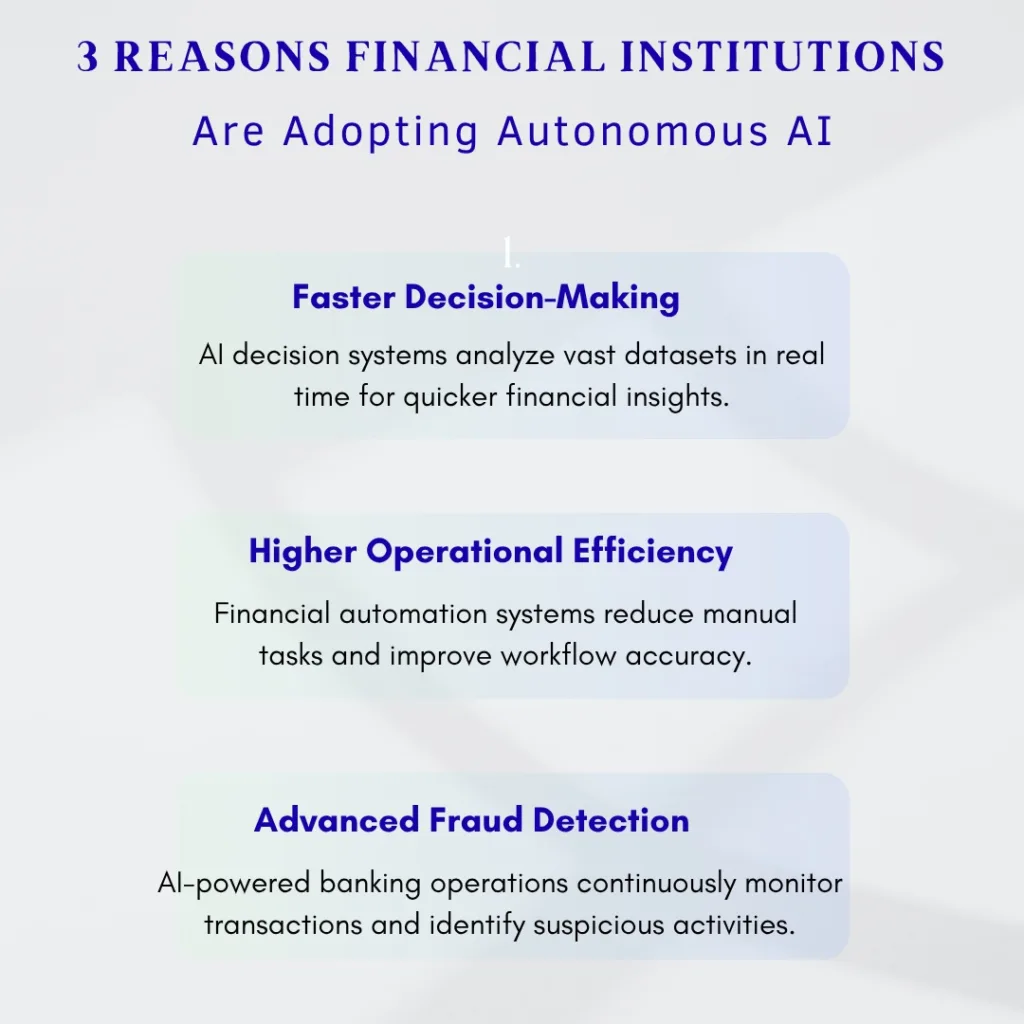
Financial institutions and banks handle several million transactions every day. Autonomous AI agents help eliminate repetitive manual tasks, leading to significant improvements in operational efficiency AI initiatives.
Examples include:
- Loan application processing
- Fraud detection
- Compliance monitoring
- Customer onboarding
- Risk assessments
Instituions can manage greater workloads without having to sacrifice accuracy, as manual intervention will be reduced.
2. Faster Decision-Making
Financial markets are very fast-moving. Real-time insights are a must for organizations to be competitive. The ability to instantly analyze large amounts of data with advanced AI decision systems means executives and analysts can make informed decisions more quickly.
For example:
| Traditional Process | AI-Powered Process |
| Credit Risk Review (2-3 Days) | Minutes of the Automated Risk Analysis. |
| Manual Portfolio Assessment | Real-Time Portfolio Insights |
| Quarterly Forecasting | Continuous Predictive Forecasting |
This has emerged as a significant contributor to enterprise AI uptake in the finance industry.
3. Enhanced Fraud Detection
The methods of financial fraud are ever more sophisticated. AI agents work autonomously and are always on the lookout for suspicious activity that might not be spotted by human teams.
Benefits include:
- Real-time fraud alerts
- Behavioral anomaly detection
- Reduced false positives
- Improved regulatory compliance
Financial automation systems have become a vital part of the security systems of the leading banks.
4. Streamlined Compliance and Risk Management
Financial firms have a highly regulated environment. AI agents can automatically track changes in regulation, review deals and create compliance reports.
Compliance Functions Automated by AI
| Compliance Activity | Traditional Method | AI-Driven Method |
| KYC Verification | Manual Review | Automated Verification |
| AML Monitoring | Sample-Based Checks | Continuous Monitoring |
| Regulatory Reporting | Manual Compilation | Automated Report Generation |
| Risk Assessment | Periodic Reviews | Real-Time Risk Analysis |
This automation can significantly cut compliance expenses and accuracy.
The Role of AI in Private Equity Due Diligence
Private Equity Due Diligence is one of the areas that is undergoing a major change.
In the past, analysts would take weeks to analyze:
- Financial statements
- Market research reports
- Legal documents
- Operational performance data
An AI agent can analyze thousands of documents in hours, pinpointing risks, opportunities and performance indicators.
Benefits include:
- Faster deal evaluation
- Improved accuracy
- Reduced research costs
- Better investment decisions
This functionality is growing in importance for investment companies looking to make big acquisitions and mergers.
How Autonomous AI Supports Intelligent Finance Workflows
The modern financial institutions are creating smarter finance workflows that bring together departments, systems and data sources.
Examples include:
Customer Service
AI agents can:
- Answer customer queries
- Recommend financial products
- Resolve account issues
- Schedule follow-ups
Wealth Management
AI systems can help advisors with the following:
- Analyzing portfolios
- Predicting market trends
- Identifying investment opportunities
- Monitoring risk exposure
Lending Operations
Autonomous agents streamline:
- Credit scoring
- Document verification
- Loan approvals
- Payment monitoring
These features play a crucial role in the functioning of AI in banking.
Autonomous Enterprise Software: The Next Evolution
Financial institutions are evolving from simple automation to autonomous enterprise software that can manage several business processes at once.
For example:
Commercial banks can implement AI assistants that:
- Analyze customer behavior.
- Detecting fraud risks.
- Generate personalized offers.
- Execute compliance checks.
- Create management reports.
All these activities are automatic and take place within a connected ecosystem fueled by AI finance infrastructure.
Lessons from Marketing Automation and Business Automation
The financial industry is following in the footsteps of other industries that have used Marketing Automation and Automation Tools for Business to its full extent.
Financial AI agents can:Like marketing platforms do by nurturing leads and customizing campaigns, financial AI agents can:
- Personalize banking experiences
- Automate investment recommendations
- Optimize customer engagement
- Improve retention rates
In turn, this convergence is stimulating industry-wide innovation with AI in fintech.
Business Impact of Autonomous AI Agents
Financial Benefits
| Business Area | Impact of AI Agents |
| Operations | Lower processing costs |
| Compliance | Reduced regulatory penalties |
| Customer Service | Faster response times |
| Lending | Quicker approvals |
| Investment Analysis | Better decision accuracy |
| Fraud Detection | Reduced financial losses |
That’s the reason financial institutions are still increasing their investments in AI.
Future Outlook for Banking AI Transformation
Banking is not limited to task automation when it comes to AI transformation. Financial institutions should use more advanced AI agents that will be able to:
- Autonomous financial analysis
- Dynamic risk management
- Hyper-personalized customer interactions
- Real-time regulatory adaptation
- End-to-end process optimization
With the growing maturity of technology, enterprise AI will eventually become a necessity.

Conclusion
Autonomous AI agents are transforming the financial sector in various ways, with a primary impact being their ability to streamline processes, cut expenses, bolster security measures, and facilitate better, more intelligent decision-making. Financial institutions can build scalable and future-proof operations with advanced financial automation systems, smart analytics, and integrated AI finance solutions.
These technologies are playing a crucial role in today’s financial landscape, revolutionizing Private Equity Due Diligence and laying the groundwork for sophisticated AI decision systems. The rise of fintech AI innovation is poised to continue, with companies that invest in autonomous AI now being likely to shape the future of financial services.
FAQs
1. What are autonomous AI agents in finance?
Autonomous AI agents are intelligent systems that can analyze data, make decisions, and execute financial tasks with minimal human involvement.
2. How do autonomous AI agents improve banking operations?
They automate repetitive processes, enhance fraud detection, accelerate decision-making, and improve customer service efficiency.
3. Why is enterprise AI adoption growing in financial institutions?
Financial organizations are adopting AI to reduce costs, improve compliance, increase productivity, and gain competitive advantages.
4. How does AI support Private Equity Due Diligence?
AI can analyze large volumes of financial, legal, and operational documents quickly, helping investors identify risks and opportunities faster.
5. What role does AI finance infrastructure play in digital transformation?
AI finance infrastructure provides the technological foundation needed to support intelligent workflows, automated processes, predictive analytics, and scalable AI-powered banking operations.
